The Spirit of Shaolin By Master Shi Yan Jia

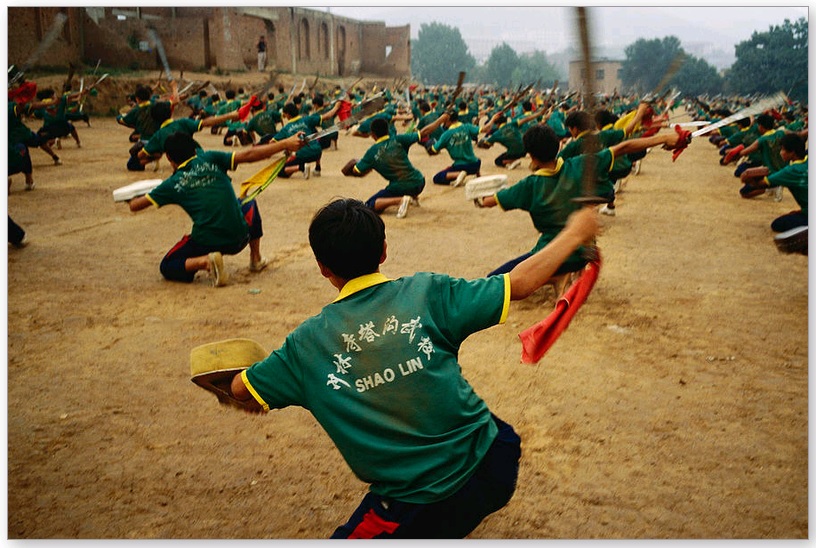
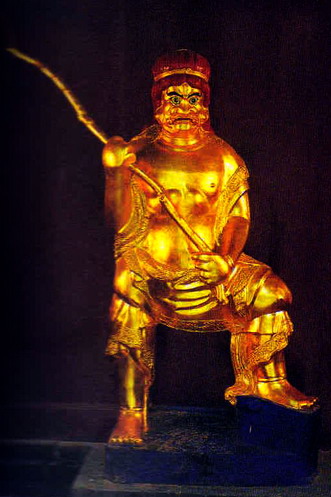
Shaolin Kung Fu is technically speaking the martial arts system of attack and defense movements that uses forms (series of moves combinations:套路 taolu) as a basic method of training. Both the moves and their combinations are based on Traditional Chinese Medicine’s theory about the working of the human body. The cultural and spiritual aspect of Shaolin Kung Fu comes through its essential roots in Chan Buddhism, the first belief shared by practitioners. This is especially the case in regards to wisdom and strength; for wisdom, the Buddha Puti Damo (left) is worshipped to and for strength, the Buddha Jin Na Luo Wang (right) is taken refuge in.

A Typical Day For a Shaolin Monk

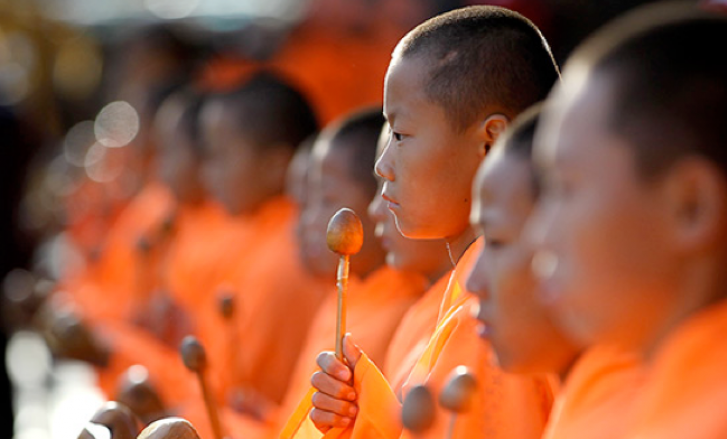
Early at five o’clock every morning, the monks of the Shaolin Temple arise with the striking of the gong. They join together to start the first morning class of the day, lasting for 90 minutes. At 06:40, monks mindfully join a line in the Zhai Tang (place where the monks have food) to have breakfast. Before and after the meal, monastic chanting is carried out. Every monk has his own alms bowl with food in it and is not allowed to leave anything uneaten. During this meal time, everyone is to keep silent. Between 08:00-09:00 the monks study Buddhism where dharma learning is taught to cultivate knowledge and wisdom. Between 09:10-11:30, there is study time to practice Kung Fu at the back of a nearby mountain., Lunch is then taken afterwards at 11:40 in a similar manner to breakfast, some grand masters and scholastic monks however do not eat lunch in order to enter fully into their monastic life and study. Afternoon training time then takes place between 14:00-17:30. After a short rest, members of the temple go to the monastery for evening chanting which lasts an hour. The final part of a day is a 45 minute meditation period followed by a period for self-study that lasts until the sound of the bell again at 21:30 which signals the end of the day.

Shaolin Kung Fu’s Nine Steps of learning:

1. 结缘 Knowledge: In various ways, begin to know about Shaolin Kung Fu and the Song Shan Shaolin Temple 2. 仰慕 Admiration: Feel moved by the sprit and character of Shaolin Kung Fu and so be naturally energised towards it. 3. 抱负 Ambition: Start to plan your life again after the feeling of your heart and making the decision to learn Shaolin Kung Fu. After setting a specific goal, set your mind to realize that ambition in your lifetime. 4. 痴迷 Enthusiasm: Make a self-affirmation of the goals chosen and pursue with a one-pointed determination of love and dedication. 5. 行动 Action: Adapt your goal to specific courses of action and start to practice Shaolin Kung Fu. This will be a hard learning process. 6. 认识 Understand: Come to rational knowing and the cultural connotations of Shaolin Kung Fu. 7. 信仰 Faith: Start to transform rational understanding into a deeper understanding about Buddhism. Shaolin Kung Fu is considered one way of learning Chan Buddhism (and so named “Wushu Chan”). 8. 感悟 Awareness: Practice Shaolin Kung Fu from a deeper self belief enabling practice to become not just a goal but an effective path to becoming aware and realising the essence of Buddhism. 9. 见性 Nature: From learning Shaolin Kung Fu, develop a full understanding about wisdom and strength, see the truth of life and the universe.

Master Shi Yan Jia

Master Shi Yan Jia (Wei Shifu) is a 34th generation Shaolin Disciple of the current Shaolin Temple Abbot the Venerable Shi Yong Xin, came to the Shaolin Temple to learn Shaolin Kungfu from the age of 8 years old and stayed there for a further ten years. He is currently ranked at level 7*. He has 8 years of experience in teaching Kung Fu to international students from all over the world and giving performances to many people. In the 1st national Shaolin Kung Fu competition Master Shi Yan Jia was awarded first place in traditional Shaolin Fist form and Shaolin Spear form. At the 9th Sports Meeting in Henan province, he also won first place for his Shaolin Staff routine, and in the championships of Zhengzhou, he came first in the Traditional Sword form category. Master Shi Yan Jia is the headmaster of Qufu shaolin kung flu school. The school has only recently relocated to Shimen mountain near the historic city of Qufu (eastern Shandong Province), hometown of the great Chinese philosopher, Confucius. If you would like to find out more about his school visit www.studymartialarts.org or Skype: studymartialarts.org for a free consultation on your martial arts trip to China.
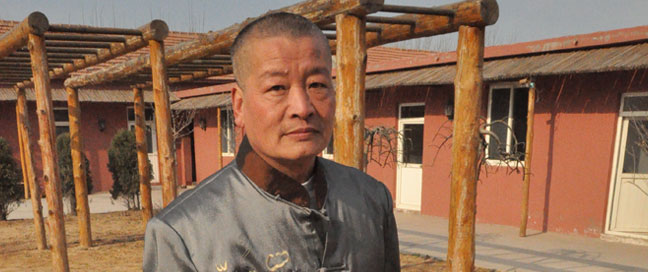
Yue Jia Quan training in Yantai Shandong


Yue Jia Quan
 is the Yue family fist directly attributed to General Fei of the Southern Song Dynasty (1127-1279).

Yue Jia Quan is a short boxing combat system based primarily upon the principles of combining inner and outer bodies in theory and application. Emphasis is on low stances centreline and body strikes that over power opponents and the efficient use of kicks. This combat style comes from the principal philosophy of the positive and negative and combines the five elements of the heart, liver,lung, spleen and kidney in the human body.

Yue Jia Fist training consisting of:

Forms practice, combat strength and conditioning drills, free sparing, breathing exercises, hard body conditioning as well as active and standing qigong.

If you would like to study Yue Jia Quan with a traditional master with years of actual combat experience as opposed to forms competition experience follow the link. http://www.studymartialarts.org/master/master-sui-peng-fei/49.html

Master Sui Peng Fei is based in Yantai, Shandong. It is a very pretty and relatively small costal city on the east coast of China. At present we are offering serious students the chance to enrole in a 1 year Chinese course, (1 year visa included), plus 1 year training with Master Sui and accommodation in a new 2 bed apartment for 1 year – Short term options with or without a Chinese language course are available on request. Accommodation would either be at the University and a 3-6 month language course would have to be applied for or alternatively with an invitation letter organised through SMA we have the opportunity to set those interested in this up with a Home-stay Family. All this can be done through only through http://www.StudyMartialArts.Org

Master Sui Peng Fei

5 Top Tips for Studying Kung Fu in China

Shaolin Students

The begining…

“The interesting parts are between the facts… “

In the summer of 2007 while on a break from my urban planning job back in Belfast I made the decision to travel to China and study traditional kung fu. I craved adventure and a change from the daily grind. Most of my friends had gone travelling between school and university or between university and work. I’d created a window of opportunity and felt this was the right time to use the money I’d saved. My martial arts experience at that time was limited to my regularly Jeet Kune Do classes. Despite my lack of sashes or belts I wasn’t worried. What I lacked in experience I knew I had in determination to work hard and learn as much as I could. Like most of you reading this article I’ve an interest and passion for martial arts as well as a growing interest in learning more about the spiritual and healing arts of China. As a teen I used to day dream about what it would be like to visit a land where a monkey could become a king.

China here I come…

Immediately I set to the task of researching kung fu schools in China. I craved being taught in a traditional way without distractions. I wanted to learn how to deal with confrontation effortlessly and improve every aspect of my life.

So I took action and found a school, got my visa and boarded a plane. 13 hours later I arrived in Beijing totally unprepared. I stayed the night in a hotel near the airport and the next day I boarded my internal flight to my end destination with high hopes. I was as green as the grass I’d left back in Ireland. From that moment until now it’s been one hell of an adventure.

Over the last few years I’ve visited a lot of kung fu schools and met a number of students studying at these schools. Some have come for martial arts, some adventure, some for health and fitness and some simply to create space for changing past bad habits. Your reasons for seeking this experience are your own. But what they should have in common is a desire to improve. Focus on your training and the experiences and other benefits will follow. So here are my 5 top tips for getting the most out of your training at a kung fu school.

Shaolin martial arts students

My top 5 tips

  1. There are more schools than ever popping up all over China specifically to cater for the growing demand from westerners who want to study traditional kung fu. Make your decision carefully, not just in terms of your school choice and style but also in terms of what you want to achieve and get out of the experience. Schools now offer students more than just martial arts. They offer often offer additional classes in Chinese language, Buddhism and TCM for example. These are good and offer you the chance of dipping your toes in the water from which further learning can be sought.
  2. The importance of your fellow students at a kung fu school should not be under estimated. These students will be people you will learn from and have to live with.
  3. Be realistic. There have been occasions when I’ve received enquiries from students that are just damn right ridiculous or expect to be able to open their own schools after as little as 6 months to a year of studying.
  4. Be prepared for a culture shock and a different way of thinking or in some cases a total lack of thought. Remember that can also be part of the enjoyment too. You’re not in Kansas anymore so don’t expect it to be the same or constantly winge about it. We all go through this and at times have a love hate relationship with the place(s) we visit. When you catch yourself doing this stop! If it continues just go home. Don’t bring those around you down with a bad attitude or negitivity or disturb your fellow students training or enjoyment. Be patient, present and self aware.
  5. And remember just because someone is wearing kung fu shoes, a kung fu suit, or has some prayer beads it doesn’t mean that they are a good master or martial artist.

If you’d like to find out more or have any questions about studying martial arts in China this site is the pick of the bunch. www.StudyMartialArts.Org