I arrived in Mengcun with two suitcases, a year of inconsistent martial arts experience, and no idea what to expect from training at the Baji Quan International Training Center in China. I left with something I had not planned on: a genuine feel for one of China’s most respected fighting arts, and an unexpected education in a culture I barely knew existed.
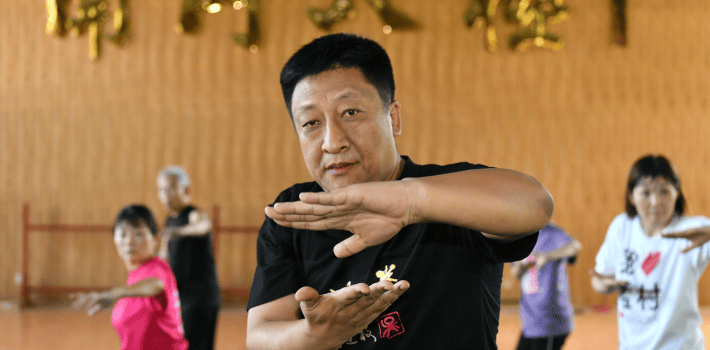
Mengcun is not where most foreigners learn kung fu. The famous schools cluster around Shaolin, Wudang, and the big cities. The Baji Quan International Training Center in Mengcun sits in Hebei Province’s farmland, and what it offers instead of fame is a focus on one style liked with a provincial pride. This is the birthplace of Baji Quan, a style developed here over three hundred years ago, and the school at its center is run by the family that has carried the art for eight generations. Grandmaster Wu Lianzhi is the officially recognized National Intangible Cultural Heritage inheritor of the style, and he and Master Wu Dawei still oversee training personally. Within my first week, a coach adjusted my stance with his hands in a way that fixed in one minute what months of videos had not. That is the difference between learning an art and learning about it.
The training itself is honest work. Mornings belong to fundamentals — low stances, the style’s famous single techniques, and internal post work that looks gentle and burns like nothing else. Afternoons rotate through forms, traditional weapons, combat application, and, for those ready, the body-striking post conditioning that Baji is known for. I will not pretend the post work was enjoyable. It was, however, effective, and the masters monitor it closely enough that you push hard without breaking anything.
The cultural dimension was the surprise I had not booked. Mengcun is a Hui Autonomous County, meaning a large share of the local population are Chinese Muslims, descendants of traders and settlers who arrived centuries ago. I came to know this first through the food, which was some of the best I ate in China — hand-pulled noodles, beef dishes built on the county’s famous braised beef craft, all halal by default. Then through the soundscape: the county’s many mosques, including Ming-era buildings in the old town, add a call to prayer to the rhythm of village life, and attending a Friday prayer as a respectful observer (with permission, and after explaining myself) was one of the most memorable hours of my stay. The school’s own heritage carries this thread too — Baji Quan’s founder, Wu Zhong, was a Hui Muslim, and the masters speak of the art’s principles as drawing on Islamic thought alongside China’s other traditions. As a non-Muslim, I never felt like an outsider in that story. I felt like a guest being shown something worth knowing.
A fair review needs the other side. Mengcun is small, quiet, and far from tourist infrastructure. English is rare outside the school, winter is cold, and evenings are what you make of them. If you need nightlife, variety of styles, or Western comforts, a bigger school will suit you better. Come here if you want depth instead: one art, taught properly, in the place it was born, surrounded by a living culture most travelers to China never encounter.
I came for kung fu and got that — real, structured, demanding kung fu. But when I think back, the training and the county are tangled together in my memory: the morning stances, the noodle shops, the old mosque, the masters’ corrections. That combination is what I would recommend to anyone, of any background, willing to trade comfort for authenticity.
October 10–24, 2026 | Gulun Chan Academy, Mount Songshan, China
An Invitation to the Extraordinary
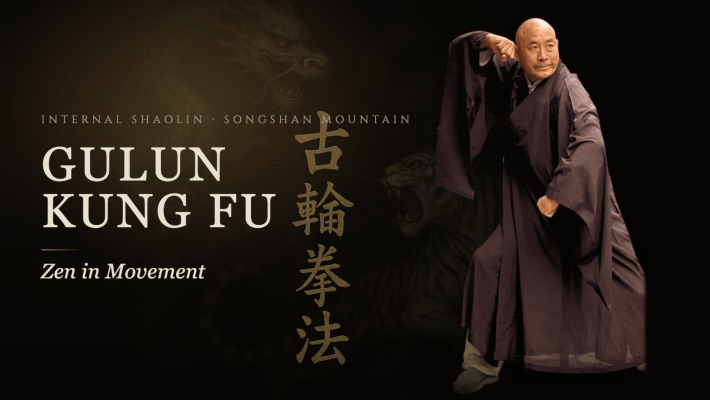
For the first time in its history, the Gulun Chan Academy opens its doors for a dedicated retreat. This is not a casual workshop or a tourist experience. It is a rare, intimate immersion into the living heart of an unbroken Shaolin lineage—a two-week journey into the stillness where Chan (Zen) and Kung Fu become one.
From 10–24 October 2026, you are invited to train directly under Shifu Wu Nanfang, the 6th generation lineage holder of the Gulun tradition. Shifu will teach Gong Fu and give talks every day—something that has never happened before. He does not transmit lightly.
This retreat is for those who are ready to sit with themselves. To find stillness. To encounter a tradition that has survived centuries of upheaval and emerged with its essence intact.
The Teacher: A Living Master in a Modern World
Shifu Wu Nanfang began his training around 1972, at the age of ten, under his grand-uncle Wu Youde. Days were for school. Evenings were for the family’s practice—practice that took place under the shadow of the Cultural Revolution (1966–1976), when the Chinese state systematically dismantled Buddhist and martial traditions. The Wu family practised anyway—at night, in the mountains behind Shaolin Temple, after the village had gone to sleep.
“Especially when I was young, during the ten years of the Cultural Revolution, the policy was to eliminate Buddhism. No Buddhist cultural things were permitted to exist. So in that turbulent era, my family was behind Shaolin Temple, deep in the mountains. In that environment, my grandfather and the others, they all used the nighttime. After everyone had gone to sleep, they would still be there constantly practising.”
As a boy, Wu Nanfang slept beside his great-grandfather, absorbing presence as much as stories. The elders took him to Shaolin Temple’s Baiyi Hall, where murals depicted the ancestor Wu Gulun—the monk entrusted by the Shaolin Temple Master to preserve the tradition’s secrets in the mountains. Standing before these images, something awakened—not ambition, but recognition.
He studied under grandfather Wu Youde, uncle Wu Musheng, cousin Qiao Heibao, and for over twenty years with Master Xingxing in both martial and Zen practices. At seventeen, against his family’s wishes, he committed to lifelong practice. In 1995, he took Buddhist refuge at Shaolin Temple under Abbot Shi Suxi, who gave him the Buddhist name Defang.
He then spent the better part of a decade travelling across Songshan Mountain, tracing the students his great-grandfather and grandfather had taught, collecting the scattered fragments of Gulun Kung Fu that had drifted across the region in the upheavals of the twentieth century.
“I used ten years to collect many of these things. The purpose was to be more complete. To properly preserve, promote and continue these Shaolin-transmitted cultural martial arts manuals.”
He frames the inheritance as something carried, not owned.
“This is the wisdom cultivated by how many generations of Shaolin senior monks. Formed generation by generation, not by one person. So it comes not easily.”
Today, Shifu Wu Nanfang stands as one of the few living holders of this complete tradition—a man who risked his safety as a boy to preserve what the state tried to erase, and who now offers it to sincere students from around the world.
The Training: Internal Kung Fu, Chan Stillness
The theme of this retreat is Chan and Kung Fu—not as separate pursuits, but as a single, integrated path.
Most Gulun Kung Fu training is internal—slow, spiralling, and deeply meditative. Every movement originates from the dantian (the body’s energetic centre) and flows outward through the limbs with intention and awareness. This is not about speed, flash, or athletic display. It is about presence, alignment, and breath.
The curriculum is rooted in the foundational pillars of the Gulun system, yet flexible enough to accommodate advanced practitioners:
Standing Meditation (Zhan Zhuang / Xu Zhuan): The root of everything. Stand still, align your structure, sink your energy. This looks simple but contains infinite depth.
Zhuan Gong: Five stances that form the basis of virtually every movement in Kung Fu. Here you learn structure and how to ground yourself completely.
Ba Duan Jin: Eight Pieces of Brocade—ancient Qigong exercises that open the body’s energy channels and prepare you for deeper practice.
Pan Gen: The first basic form, focused on moving from your roots and centre. This is your first taste of the beautiful, flowing, spiralling movements that characterise Gulun Kung Fu.
Each evening, Shifu and Ben will give a talk—a series on the heart of the tradition: where Chan and Kung Fu meet.
The Location: The Mountain as Your Temple
The academy is nestled at the foot of Mount Songshan—one of China’s Five Great Mountains and a UNESCO World Heritage site. This is not a chaotic city; it is a peaceful, rural, temple-dotted landscape where the rhythm of life follows the sun.
Just 1 kilometre from the academy stands Huishan Temple—a Buddhist temple over 1,500 years old, predating even the famous Shaolin Monastery. Many students rise before dawn to practise Zhan Zhuang in the temple courtyard as the sun rises over the mountains. The combination of ancient stone, morning light, and absolute quiet is unforgettable.
Surrounding the academy, the forests and mountain trails offer quiet, solitary spots for personal practice. Training among the pines, with birdsong replacing walls and the sky as your ceiling, deepens the connection to the art in ways that indoor practice cannot replicate.
Who Is This For?
This retreat is not for everyone—and that is precisely the point.
It is not for those seeking a fighting bootcamp or a tourist experience. It is for those who:
Resonate with Zen simplicity
Long for authenticity
Value patient practice over quick results
Have been searching for a deep internal movement practice
Are ready to sit with themselves and find stillness
Whether you are a complete beginner or a seasoned practitioner, the Gulun system meets you where you are. The foundations are designed for everyone. What matters more than experience is willingness to practise slowly and consistently.
Logistics: Simple, Safe, Supportive
Getting There: Fly into Zhengzhou Airport (CGO). The academy is a 90-minute taxi ride away. Book your taxi via Didi or Amap using this address: 会善寺西800米路北800米古轮禅院.
Facilities: Rooms are equipped with air conditioning and hot water. Wifi is available.
Visa: For the 14-day retreat, your primary option is the Tourist Visa (L Visa), which allows stays of up to 30 days. Depending on your nationality, you may also qualify for visa-free entry. The academy can provide an official invitation letter—simply email Li Juan at wugulunacademy@hotmail.com to start the process.
Safety: China is substantially safer than most of Europe—very low crime, little drunkenness, no aggressive street culture. Dengfeng and Songshan are quiet, rural, and friendly. Foreigners are generally welcomed warmly rather than taken advantage of; people are more likely to refuse payment than overcharge.
Why This Moment Matters
This is the first time Shifu Wu Nanfang has opened his doors for a dedicated retreat. It is the first time he will teach daily, in person, to a group of sincere students. Given his age and the rarity of his transmission, this may be a once-in-a-lifetime opportunity.
The Gulun tradition has survived for over 150 years—through revolution, suppression, and obscurity. It has been carried by a lineage of masters who refused to let it die. Now, for two weeks in October, you have the chance to step into that stream.
Not to observe. Not to take photos. But to practise. To sit. To learn from a man who embodies the very thing he teaches.
Secure Your Place
This is a small-group, intimate retreat. Spaces are strictly limited to preserve the quality of instruction and the depth of the experience.
Event Details:
Dates: October 10–24, 2026
Location: Gulun Chan Academy, Mount Songshan, China
Tick, tick, tick—time’s ticking down and the match is about to start. Don’t let the nerves take over; take control of your mind! It’s time to focus, breathe, and remember: the hardest punch you’ll throw today might just be at your own thoughts.
But are you here to fight your opponent or wrestle with your inner chatter?
It’s the final round of a tournament, and your opponent is strong—stronger than you expected. You’re exhausted, sweat dripping, lungs burning. The crowd cheers, but it’s all a distant hum. For a moment, you hesitate. Doubt creeps in. Can I do this? Am I good enough?
Then you remember your training—not just the drills, but the mental preparation.
In that moment, you tap into the psychological techniques that have been ingrained in your routine, the strategies that help you stay calm, focused, and resilient. This is where the true power of martial arts comes from: mastering the mind.
5 Psychological Techniques to Master Your Mindset and Achieve Peak Performance
Your mind is your most powerful weapon in martial arts. When your mind is sharp, even the toughest opponent can’t break your focus.or your confidence. These techniques help sharpen focus, build resilience, and prepare you for any challenge.
1. Visualization for Mental Rehearsal
What it is: Visualization makes you practice the action, movements, and results you want to acquire in the martial art.
Why it works: Neuroscience proves that thinking through an action develops the same neural structures as if one would perform the said action physically. It boosts confidence, promotes the development of muscle memory, and prepares the body for unpredictable challenges.
How to do it:
Find a quiet space where you won’t be distracted.
Close your eyes and vividly picture yourself doing the technique perfectly, whether it’s executing a pinpoint kick, dodging an attack, or landing a clean strike.
Focus on all senses. Listen to the crowd, feel your uniform, and even imagine how your muscles are tight.
Practice for 5–15 minutes daily, especially before competitions.
Visualize overcoming obstacles, like recovering from a mistake mid-fight, to build mental toughness and be resilient.
2. Mindfulness and Present-Moment Awareness
What it is: Mindfulness is the state of being completely present in the now, without being distracted by the past or future. It makes a martial artist live free from influences of thoughts and emotions under pressure.
Why it works: By being mindful, there is the improvement of reaction time, overthinking reduction, and entering a state of “flow,” where movements become automatic and seamless.
How to do it:
Start with 10 minutes of mindful breathing. Settle in a comfortable position and breathe deeply, focusing solely on the sensation of air entering and leaving your body.
In training, use the body scan technique. Bring your attention to how your feet feel on the mat, the tension of your hands, or the rhythm of your breathing
While sparring or in matches, practice “micro-mindfulness” by bringing attention back to your breath between exchanges to remain grounded.
Regular mindfulness practice off the mat builds your ability to remain calm and adaptable during extremely stressful periods.
3. Positive Self-Talk and Affirmations
What it is: This requires one to notice self-defeating thoughts and replace them with empowering positive language.
Why it works: Negative thoughts drain your energy and focus. Positive self-talk keeps your mindset strong, boosts motivation, and helps you recover quickly from setbacks.
How to do it:
Make a list of affirmations having to do with martial arts, such as: “I am ready and able.” “Every strike strengthens me.””I learn with every challenge that comes my way.”
Write them down so you see them each day in the mirror or in your training journal.
When you find yourself having negative thoughts during training, interrupt that thought with a positive phrase. For example, Negative, “I’m bad at grappling.” I just come here every session and learn and improve my grappling techniques.”
Make self-talk a habit, so it becomes your default mode during matches and tough training sessions.
4. Goal Setting with a Growth Mindset
What it is: Goal setting is about creating structured, measurable objectives that focus on progress rather than perfection.
Why it works: Clear goals provide direction, motivate consistent effort, and foster resilience when faced with adversity. A growth mindset ensures that you use mistakes as opportunities to improve.
How to do it:
Use the SMART framework. Define exactly what you want to achieve (e.g., “Improve my spinning backkick accuracy”).
Attach a metric to track progress (e.g., “Land it successfully 8 out of 10 times in practice”).
Set goals that stretch but don’t overwhelm you.
Tie goals to your martial arts journey (e.g., mastering moves for an upcoming tournament).
Set a deadline to track improvement (e.g., “In 4 weeks”)
Break down larger goals into smaller ones to avoid feeling overwhelmed and to celebrate accomplishments. Example:
Week 1: Focus on positioning
Week 2: Perfect the timing
Week 3: Train in sparring conditions.
5. Controlled Breathing to Manage Stress
What it is: Breathing techniques help regulate your nervous system, lowering anxiety and maintaining focus. They are important in managing adrenaline spikes during competitions.
Why it works: Slow, controlled breathing activates the parasympathetic nervous system, counteracting the fight-or-flight response. This ensures clarity of mind and better endurance.
How to do it:
Practice the 4-7-8 technique: Inhale through your nose for 4 seconds.Hold your breath for 7 seconds.Exhale slowly through your mouth for 8 seconds.
Implement this technique prior to matches, in between rounds, or after an intense round to collect oneself.
Box breathing is another strategy. Breathe in for 4 counts, hold for 4, exhale for 4 counts, and pause for 4 before repeating
Combine breathing with visualization to enhance its calming effects.Envision whatever’s causing stress leaving your body with every exhalation.
These techniques work wonders for mastering your mindset, but wait, have you tried this specific yoga?
“Warrior’s Focus Yoga” A super-short yoga flow to enhance mental clarity and calm for martial arts.
StepsMountain Pose (Tadasana)How: Stand tall, feet together, arms relaxed by your sides.“Stand like a mountain, steady and strong, Your focus is sharp, where you belong.”Warrior II (Virabhadrasana II)How: Step one foot back, front knee bent, arms stretched wide. Gaze over your front hand.“Stretch like a warrior, balance in sight, Grounded in calm, ready to fight.”Reverse WarriorHow: Tilt your back hand to your thigh, lift the front arm high. Open your chest as you inhale deeply.“Rise like a champion, heart open wide, Breathe in your strength, with the world on your side.”Child’s Pose (Balasana)How: Kneel, stretch your arms forward, forehead to the mat. Breathe deeply.“Rest like a river, peaceful and still, Let go of the chaos; embrace your will.”Time: Just 3 minutes! Repeat the flow twice for added focus and peace. Perfect for prepping your mindset before training or competition. 🥋
Conclusion
Successfully mastering the psychology of martial arts doesn’t merely depend on physical strength or perfect technique; instead, it requires mentally training oneself to remain calm, focused, and resilient in intensifying situations. Through all these mental strategies—visualization, mindfulness, positive self-talk, goal setting, controlled breathing, and even a quick session of Warrior’s Focus Yoga-you will be placed in an optimum position to handle all the pieces of the challenge of combat sports in and out of the ring.
If you are seasoned or just getting started in martial arts training, it is the right mindset that sets you on the path to overcoming the many obstacles coming your way. But remember, tools also matter. Being a partner with wholesale MMA gear manufacturersensures you get the finest gear to accompany all your preparation, whether it is mental or physical. The psychological impact this has can also help you master your mind for peak performance.
With the U.S election upon us this entry seems somewhat appropriate given the respective track records of the two main candidates.
Ultimately the beauty of teaching and preparing lessons brings with it the opportunity for the teacher to evolve and deepen his or her own learning. Reading an article in High Existence I noticed the opportunity to adapt Nietzsche’s lesson on the tragedy of conformity into a positive affirmation I can use during my own meditation class.
This lesson and the affirmation compliments the visualisations I am using with my middle and high school students in order to make them feel more secure grounded and confident, therefore less reactive and more in control throughout the day.
__________________
A traveller asked the wise man. “What attributes are found in every man?” The wise man replied ‘The propensity for laziness and fearfulness.’ They hide themselves behind customs and opinions.’
In your heart you know that you will be in this world only once, there is no second chance. Will you let laziness and fear control your being?
Will you spend your life in fear of your neighbor, in fear of someone who demands conformity and cloaks himself with it?
I am fearless, I am neither lazy nor timid, I do not fear inconveniences and my dealings with my friends display unconditional honesty and unburdened kindness.
Through my actions I reveal my true self. My strength my confidence. I am a unique miracle. I dare to show myself as I am. I will show my uniqueness with every last movement of my muscles, consistent in my uniqueness I am beautiful, and worth regard.
When the great thinker despises mankind, he despises its laziness: for it is laziness that makes men seem like factory products, things of no consequence and unworthy to be associated with or taught.
A man or woman who does not wish to belong to the masses needs only to cease taking him or herself easily; I will follow my conscience, which flows with strength and shines with confidence.
Adapted from Friedrich Nietzsche Lesson on the tragedy of confirmity
The oldest evidence for walking on two legs comes from one of the earliest humans known, Sahelanthropus. Walking upright may have helped this species survive in the diverse habitats near where it lived—including forests and grasslands. Today the habitat of the modern humans are urban areas and walking no-longer is matter of life and death but quality of life.
As a low impact exercise over 10,000 steps are recommend each day so its not an exercise that will help you loose pounds like running will. However, the benefits of walking can not simply be measured in weight loss or even fitness gains. Walking is much more than that. Walking is about the maintenance of overall physical and mental health. A evolutionary leap that is one of the most natural parts of our lives.
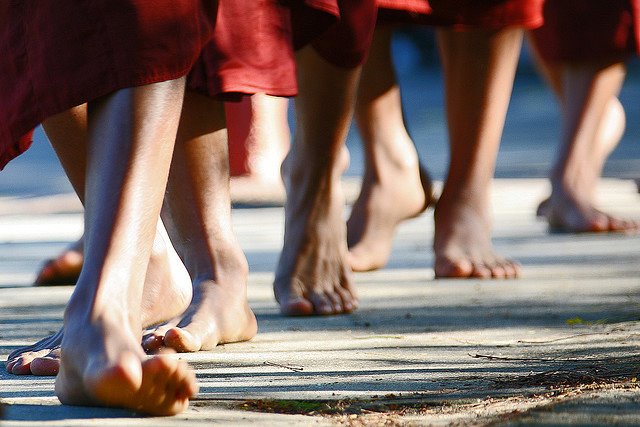
As a child our first steps are greeted with joy and as an adult our last with sadness. Walking is central to our being whether as a means of movement, a health exercise, a de-stresser, a way to clear your mind, think or connect to your own body or nature. As a result it’s a natural choice for an active meditative exercise that everyone can do.
Here’s a simple set of instructions for one form of walking meditation that focuses on connecting you to your own body and your surroundings.
1. Be aware of your posture, reduce your speed, relax and regulate your breathing with long slow deep breaths .
2. Using your five senses, listen to your surroundings and take a moment to become aware of them. Turn your attention to smells and touch, smile and explore your surroundings with wonder.
3. Become aware of your body, its movements its sway and connect to the sensation of walking. Observe how your body feels during the process of walking and enjoy these sensations for short periods of relaxed mindfulness.
So if you’re in Beijing here are my top three parks in Beijing for mindful walking:
Check out this app that is designed to help you integrate mindfulness into your daily routines. https://itunes.apple.com/hk/app/gps-for-the-soul/id586099254?mt=8 or alternatively. Leave your phone behind and get rid of all technological attachments for a mindful walk.
Check out www.StudyMartialArts.Org for martial arts adventure travel and training options in Beijing and World Wide.
When we inhale, the air comes into the inner world. When we exhale, the air goes out to the outer world. The inner world is limitless, and the outer world is also limitless. We say “inner world” or “outer world,” but actually there is just one whole world. In this limitless world, our throat is like a swinging door. The air comes in and goes out like a swinging door. The air comes in and goes out like someone passing through a swinging door. If you think, “I breathe,” the “I” is extra. There is no you to say “I.” What we call “I” is just a swinging door which moves when we inhale and when we exhale. It just moves; that is all. When your mind is pure and calm enough to follow this movement, there is nothing: no “I,” no world, no mind nor body; just a swinging door….
Tozan, a famous Zen master, said,
“The blue mountain is the father of the white cloud. The white cloud is the son of the blue mountain. All day long they depend on each other, without being dependent on each other. The white cloud is always the white cloud. The blue mountain is always the blue mountain.”
This is a pure, clear interpretation of life. There may be many things like the white cloud and blue mountain: man and woman, teacher and disciple. They depend on each other. But the white cloud should not be bothered by the blue mountain. The blue mountain should not be bothered by the white cloud. They are quite independent, but yet dependent. This is how we live….
When we become truly ourselves, we just become a swinging door, and we are purely independent of, and at the same time, dependent upon everything. Without air, we cannot breathe. Each of us is in the midst of myriads of worlds. We are in the center of the world always, moment after moment. So we are completely dependent and independent. If you have this kind of experience, this kind of existence, you have absolute independence; you will not be bothered by anything.