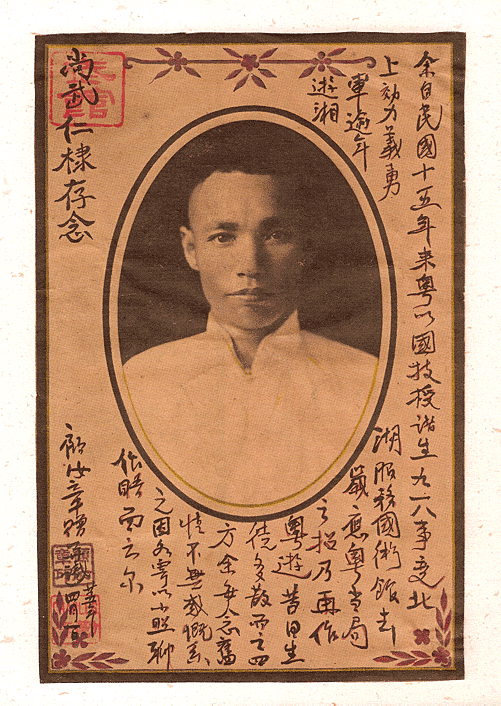
Lives of Chinese Martial Artists (8): Gu Ruzhang-Northern Shaolin Master and Southward Bound Tiger. — Kung Fu Tea

Introduction Gu Ruzhang is one of the best known martial artists of the Republic of China era. He is remembered today as a pioneer who helped to bring Northern Shaolin to Southern China. Most accounts of his illustrious career start with his appearance at the first National Guoshu Exam held in 1928. At the conclusion […]

via Lives of Chinese Martial Artists (8): Gu Ruzhang-Northern Shaolin Master and Southward Bound Tiger. — Kung Fu Tea

China’s Confucius Institute

confucius_institute_logoWhat is the Confucius Institute?

The Confucius Institute is a non-profit public educational organization affiliated with the Ministry of Education of the People’s Republic of China. Since its founding in 2004 it has been the main educational organization tasked with the job of promoting Chinese language and culture to the world outside the Middle Kingdom. It seeks to do this through Chinese language courses, and cultural exchanges. These cultural exchanges normally focus on language music, calligraphy, and martial arts.

Due to its status as a non-profit the course and cultural exchanges offered through the institute are not only affordable but often include the chance for student participants to gain free scholarships.

These scholarships allow high school level Chinese language students, college level Chinese students, self-taught Chinese language students and Chinese language teachers and researchers to go to China for a specific period of time and have the chance to choose from more than thirty different destinations from the most well-known and “obvious”, like Beijing and Shanghai, to Harbin, Chengdu, Chongqing, Dalian, and Qingdao, which are less known to the general public. There aren’t yet any scholarships from the Confucius Institute that go to Taiwan and Hong Kong.

Confucius Institute Locations throughout the world

Confucius Institutes’ can now be found all over the world, and through its educational programmes links and relationships are fostered through the promotion of Chinese language and culture. The aim being to promote China, its culture history and language to the world.

Scholarships

Scholarships are awarded for exceptional knowledge of Chinese culture by the Office of Chinese Language Council International (HANBAN) through Chinese Bridge. These scholarships are checked on this site and generally fall into four types.

1 – Brief program of 4 weeks

Financial contribution from Hanban with complete coverage for lodging and the price of the course. Minimum requirements: having completed a HSK exam and not have previously studied in China (that last requirement is decided by the individual Confucius Institutes).

2 – Six month program

A half year in China completely covered by Hanban. Minimum requirements: having reached the HSK at level 3 or greater and the HSKK of any level.

3 – Year Program

Completely covered for a year. Minimum requirements: having reached HSK level 4 and the HSKK intermediate level.

4 – Graduate course for Chinese language education

Complete coverage for two years. Minimum requirements: having reached HSK level 5 and HSKK intermediate.

A few partner universities with the Confucius Institute also make Masters available in conjunction with universities in China mainly centred on production, to put it briefly, two degrees for the price of one. Quite appealing!

conficius-institute-scholarships-2015

Standardised testing

The Confucius Institute organizes Chinese language exams recognized throughout the world. The most important when applying for a scholarship, are HSK and HSKK.

HSK is an acronym for Hanyu Shuiping Kaoshi (汉语水平考试, Chinese language level exam). The HSK is subdivided into 6 levels. To pass this exam, the Chinese language student must have a strong knowledge of Chinese grammar but above all, Chinese characters. In fact each level requires the knowledge of a certain number of words:

  • HSK 1 – 150 words
  • HSK 2 – 300 words
  • HSK 3 – 600 words
  • HSK 4 – 1200 words
  • HSK 5 – 2500 and more words
  • HSK 6 – more than 5000 words

The HSK exam consists of various tests that require just the spoken and written language.

The HSKK, which stands for Hanyu Shuiping Kouyu Kaoshi (汉语水平口语考试, Spoken Chinese language level exam), is an exam that mostly tests the ability to read out loud and speak the Chinese language.

The HSK and HSKK are the minimum requirements to be able to apply for a scholarship in China. The exams are open to all, just go on the site
www.chinesetest.cn (or directly on the site of the closest Confucius Institute), enrol in the exam with the Confucius Institute you prefer and show up on the day of the test with the document and admission ticket you can print on the www.chinesetest.cn site.

The prices for these exams are:

HSK 1 = 20 USD, HSK 2 = 30 USD, HSK 3 = 40 USD, HSK 4 = 50 USD, HSK 5 = 60 USD, HSK 6 = 70 USD.

HSKK basic = 20 USD; HSKK intermediate = 30 USD; HSKK advanced = 40 USD.
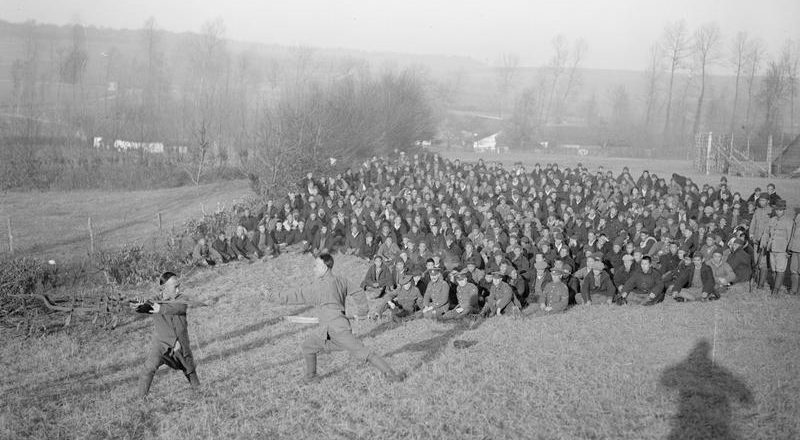
A 1918 Account of Traditional Martial Arts in the Chinese Labor Corps

benjudkins's avatarKung Fu Tea

THE CHINESE LABOUR CORPS ON THE WESTERN FRONT, 1914-1916 (Q 8514) A sword display in a Chinese labour camp in Crecy Forest, 27 January 1918. Copyright: © IWM. Original Source: http://www.iwm.org.uk/collections/item/object/205244368

Introduction

Co-authorship of today’s post is shared with Joseph Svinth, the editor of the EJMAS and multiple other important works on martial arts studies.   He brought the following account and historic photographs to my attention, and we both agreed that they were worth sharing here.

It seemed as though the events of WWI had largely receded from the public consciousness over the last few decades.  Yet the Great War has been making a comeback in popular culture.  It served as the setting for the hit 2017 film “Wonder Woman,” as well as several other projects appearing on the small screen.  It is often forgotten that China was officially a combatant in WWI (having declared war on…

View original post 2,160 more words

The Sword Shops of Beijing’s Bow and Arrow Street

Looking over my posts from the last few months I realized that it has been too long since we discussed new (to us) images of the Chinese martial arts. In this post our friend Sidney Gamble will help to rectify that oversight. Regular readers may recall that Gamble was an American sociologist who documented […]

via Through a Lens Darkly (47): The Sword Shops of Beijing’s Bow and Arrow Street — Kung Fu Tea

5 Bits of Wisdom from The Matrix Movies

5.) Wisdom: Choice is not as it seems. Quote: No, you’ve already made the choice. Now you have to understand it. Said by the Oracle to Neo in “The Matrix Reloaded” as they discuss a dream in which he sees Trinity falling. Interpretation: Studies in neuroscience have repeatedly validated the notion that by the time […]

via 5 Bits of Wisdom from The Matrix Movies — Stories & Movement

Chinese Martial Arts in the News: September 11th, 2017: The Back to School Edition!

benjudkins's avatarKung Fu Tea

Guess who is coming to Philadelphia this September?

Introduction

Welcome to “Chinese Martial Arts in the News!”  This is a semi-regular feature here at Kung Fu Tea in which we review media stories that mention or affect the traditional fighting arts.  In addition to discussing important events, this column also considers how the Asian hand combat systems are portrayed in the mainstream media.

While we try to summarize the major stories over the last month, there is always a chance that we may have missed something.  If you are aware of an important news event relating to the TCMA, drop a link in the comments section below.  If you know of a developing story that should be covered in the future feel free to send me an email.

Its been way too long since our last update so there is a lot to be covered in today’s post.  Let’s get to…

View original post 1,541 more words

Ma Liang’s “New Wushu:” Modernizing and Militarizing the Traditional Chinese Martial Arts

Asking “What if?” Few things are more difficult to research than historical events that did not happen. This is especially true for social scientists who approach the question of theory creation and hypothesis testing from a more empirical or positivist angle. Yet difficult is not the same as “impossible.” Nor am I sure […]

via Ma Liang’s “New Wushu:” Modernizing and Militarizing the Traditional Chinese Martial Arts — Kung Fu Tea

Research Notes: The Big Knife and Ma Liang’s Attempted Comeback

benjudkins's avatarKung Fu Tea

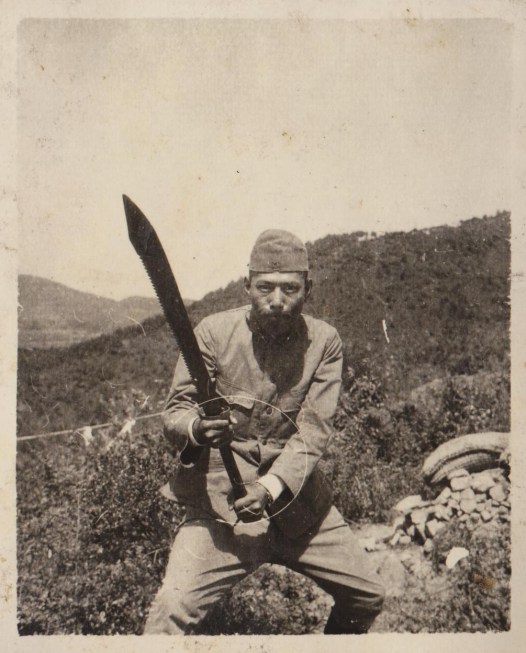
A captured Chinese dadao being held by a Japanese soldier. Note the unique saw back blade. Source: Author’s Personal Collection.

Given that it is a holiday weekend, I will be keeping this research note brief.  Still, the subject matter is quite interesting.  China’s Republic era dadao, or big knives, generate a good deal of interest among both historians and practical martial artists.  They also played a role in the development of General Ma Liang’s career as a martial arts reformer.

In some ways that is a bit surprising.  The general’s troops were often Muslim and hailed from impoverished areas of Northern China.  Of course these were exactly the sorts of individuals that would win fame as they faced down the Japanese army along the Great Wall in 1933, or slightly later in famous Marco Polo Bridge incident.  Stories of such exploits went a long way towards explaining the general enthusiasm…

View original post 1,149 more words

“The rotation of the waist/pelvic region is like the turning of a wheel on an axle”