1991 1st World Wushu Championship In an attempt to foster a uniquely Chinese international sport, the Beijing based International Wushu Federation (IWUF) offers the first world wushu championship in Beijing. San Shou is offered for the first time as an open competition with no military ties. Jason Yee of the United States wins a Bronze […]
Two Views on the Indian Martial Arts
Introduction
Greetings from Germany, where I am now enjoying a much anticipated conference dedicated to the study of fightbooks hosted by the German Blade Museum. I will be posting both the text of my keynote and a full report on the conference once I get back to the United States. In the mean time I would like to share two additional papers that were given at this summer’s 2017 Martial Arts Studies Conference. The first video was produced by P. S. Gowtham and focuses on both the techniques and narratives seen in two Indian martial arts. This presentation is short, but its a great project by a promising young scholar. Be sure to check it out.
After watching Gowtham’s introduction we can move on to the main event. That is Prof. Gitanjali Kolanad’s keynote titled “Striking a Balance – the relationship between dancing and fighting.” We were very…
View original post 44 more words
Making Martial Arts Studies Matter
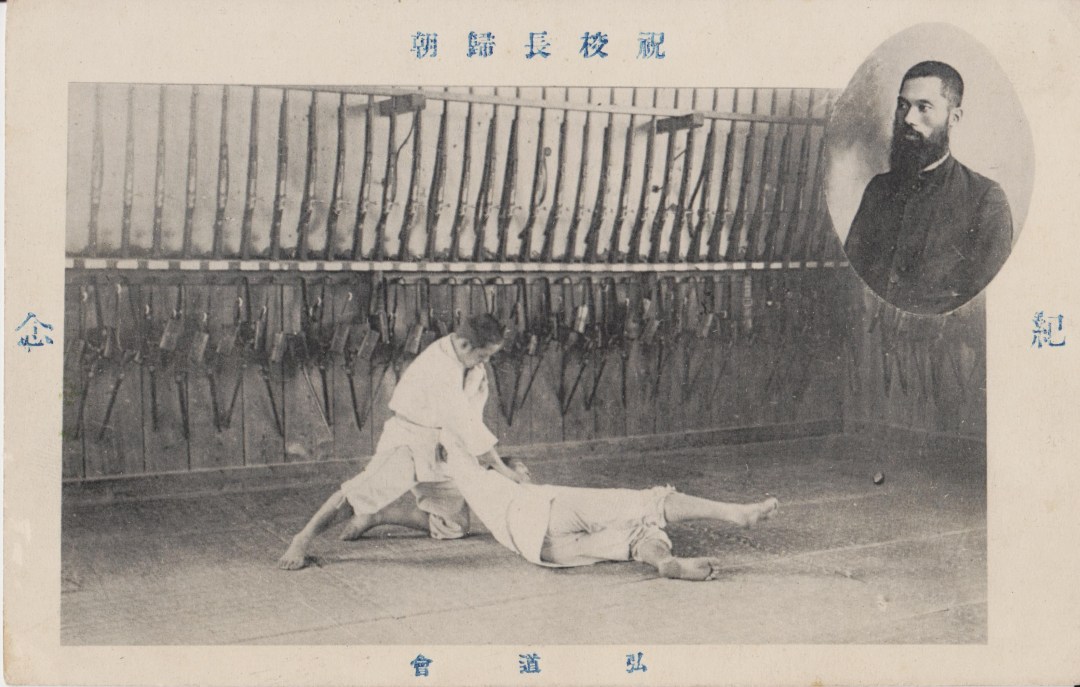
Rifles and bayonets for a school military drill class behind two Judo students. Vintage Japanese postcard, late 1930s. Source: Author’s personal collection.
Introduction
Greetings! If all has gone according to plan, I am now on a plane returning to the United States from Korea. I will be posting both my paper and a full report on the conference later. But first I need to head to Germany for the much anticipated Fightbook Conference which is being hosted at the German Blade Museum in Solingen. As such, I will be sharing a few more of the keynotes from the 2017 Martial Arts Studies in conference in Cardiff. And to tell you the truth….I think I recognize that guy….
All joking aside, I am pretty happy with the way that this paper turned out, and the conference organizers did a great job of integrating my slides into the video of my…
View original post 29 more words
Communicating Embodied Knowledge in Martial Arts Studies, Part II
Introduction
One of my few disappointments about the 2017 Martial Arts Studies conference was that a change in travel plans forced me to miss the final afternoon of the event. As such, I was not able to take part in the closing workshop which addressed a number of topics that are important to the emerging field of Martial Arts Studies. Of these the most basic would have to be, “How do we talk about our personal experience with these fighting systems in our academic studies of them?” Luckily this debate was just posted on YouTube, and I plan on watching Parts I and II on my flight to Korea.
Click here to start with Part I (if you have not already seen it).
Click here to go directly to Part II.
Here is what the conference program had to say about the workshop:
At this year’s Martial Arts Studies Conference
View original post 491 more words
Enrich the body and soul by learning kung fu in China

by Nathan Williams
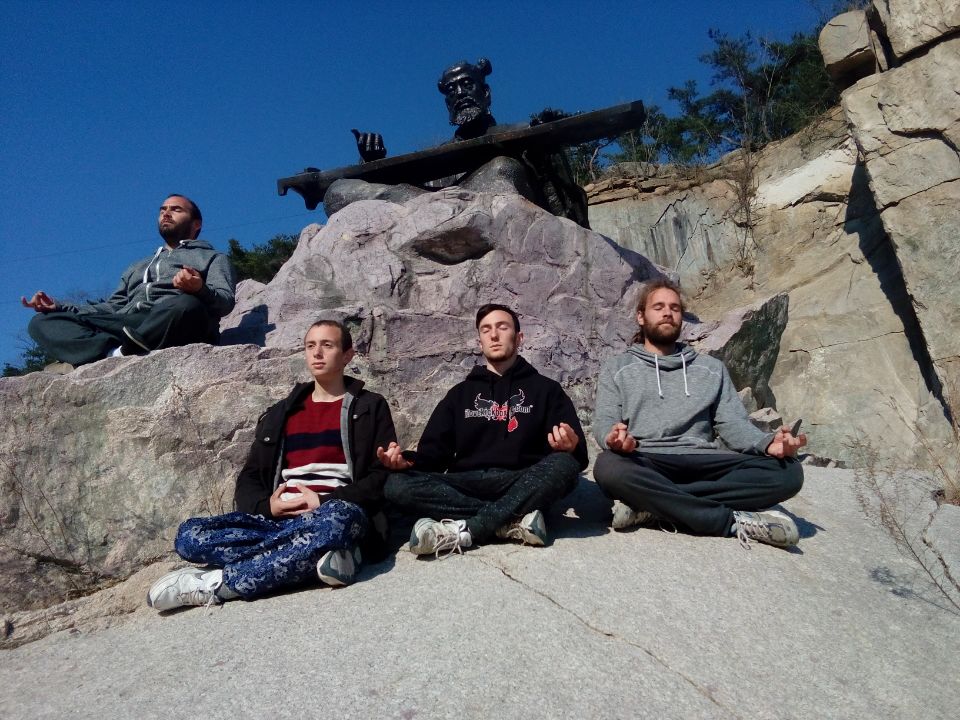
An experience to enrich the body and soul. The Academy is a great place to live and to learn; the masters are very supportive and the students are like family to me – it feels like a community of like minded people all pulling in the same direction. The location: the Shengjing Shan mountain is breathtakingly beautiful – the many temples and trails and walkways are very serene and tranquil. The surrounding towns can be difficult to navigate around so best to learn from fellow students but you’ll soon find your way around.
Learning a moderate amount of Chinese would be preferably before coming to China because hardly anyone speaks English. There aren’t any Chinese classes at the Academy but it shouldn’t stop you from learning – you’re in China! With language books and language apps you will be able to learn, it just takes time and discipline (luckily you’ll find both here at the academy). Don’t expect to learn in a classroom environment.
I found the accommodation satisfactory and as expected in rural china – you’re staying in a kung fu school, not a hostel. The food is good and again, you’re staying in a kung fu school, not dining out at a restaurant each night. Although there are some authentic Chinese restaurants nearby for special occasions.
Tips: bring cash with you and make sure you can draw money out of your debit/credit card as it can be tricky in China. If you have a problem, it will be difficult to go to a bank and find someone who speaks English. Download a VPN for your phone/laptop so you can access western sites and social media apps, if not, you may find speaking with family and friends back home to be quite difficult. It’s also good to have a hobby outside of training, some learn Chinese, some are working on their own books, some cook, some learn instruments, some just chill and watch movies, some do all of the above. It’s had a profoundly positive affect on me mentally and physically and I am mentally much stronger and more resilient.
“Nathan visited Shengjing Shan Kung Fu Academy for his experience. Others may go else where. Wherever you go whatever you choose to learn. For the majority that decide to learn kung fu in China it is life changing and a positive experience they never forget. For my part I feel blessed not only in helping people find the right school but get the most out of the experience. For the schools it is always my pleasure to send them quality students.” – David Kelly – StudyMartialArts.Org
Communicating Embodied Knowledge in Martial Arts Studies, Part 1
Introduction
One of my few disappointments about the 2017 Martial Arts Studies conference was that a change in travel plans forced me to miss the final afternoon of the event. As such, I was not able to take part in the closing workshop which addressed a number of topics that are important to the emerging field of Martial Arts Studies. Of these the most basic would have to be, “How do we talk about our personal experience with these fighting systems in our academic studies of them?” Luckily this debate was just posted on YouTube, and I plan on watching Parts I and II on my flight to Korea.
Click here to go directly to Part I.
Here is what the conference program had to say about the workshop:
At this year’s Martial Arts Studies Conference, we will set aside time for workshops and a round table panel discussion…
View original post 466 more words
Disenchanting Jianghu (Rivers and Lakes): Historical Experience and the Kung Fu Refusenik
Introduction I am happy to report that all of the conference papers and book chapters I have been working on for the last month are now finished. Unfortunately, my blogging sabbatical must continue a little while longer. I am now preparing to hop on a plane for a few weeks of transoceanic travel and […]
Xande and Why His Guard Has Not Been Passed for 11 Years
An article from Xande about why his guard has not been passed in the past 11 years.
Taekwondo – A Killing Art
Introduction Greetings from my short writing sabbatical! There are two subjects that have been on my mind. The first is Korea as I spent much of the day editing a 15 page conference presentation down to a svelte 7 pages for an event that will be held at Cheongju University in the first week […]