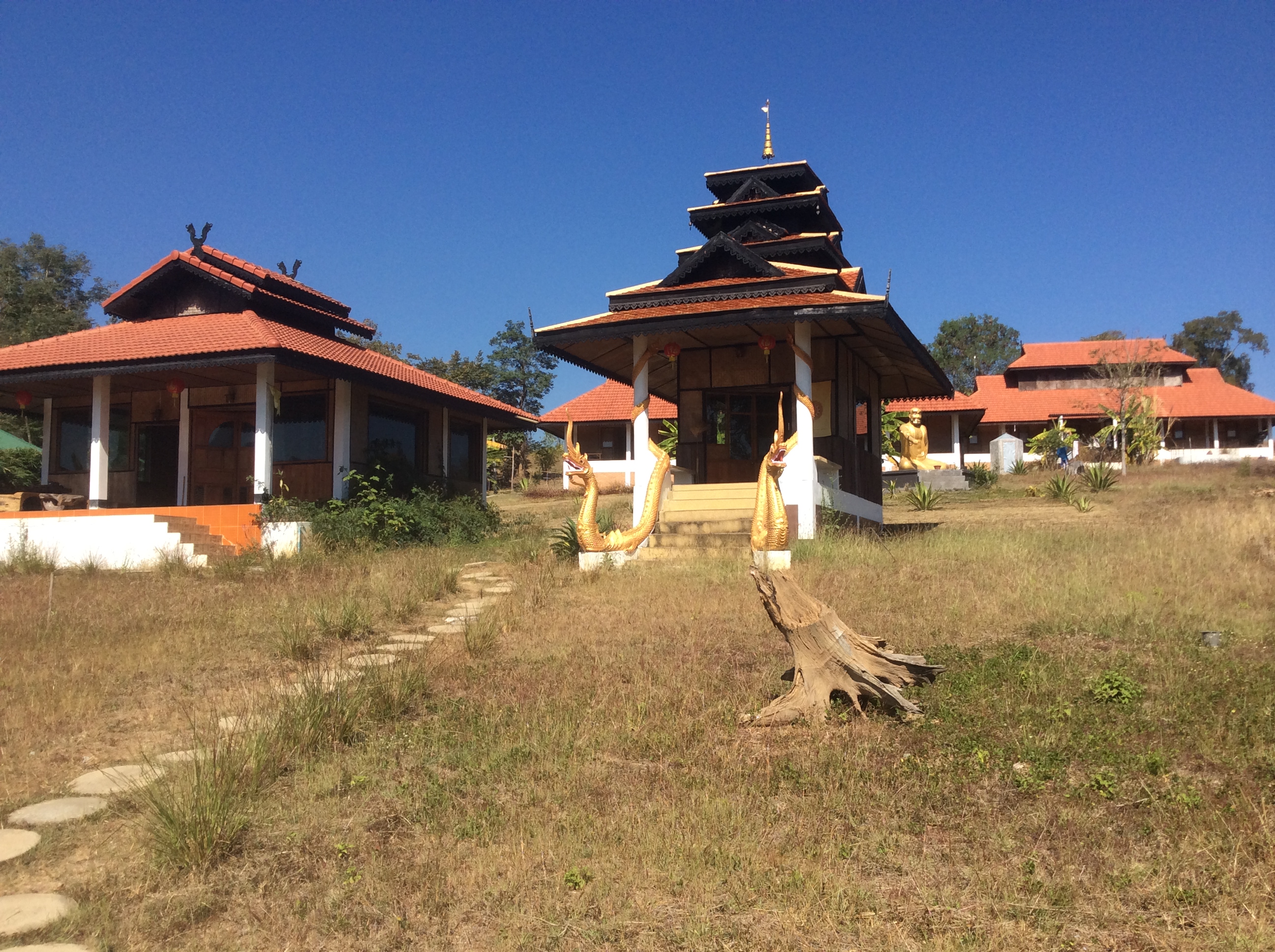
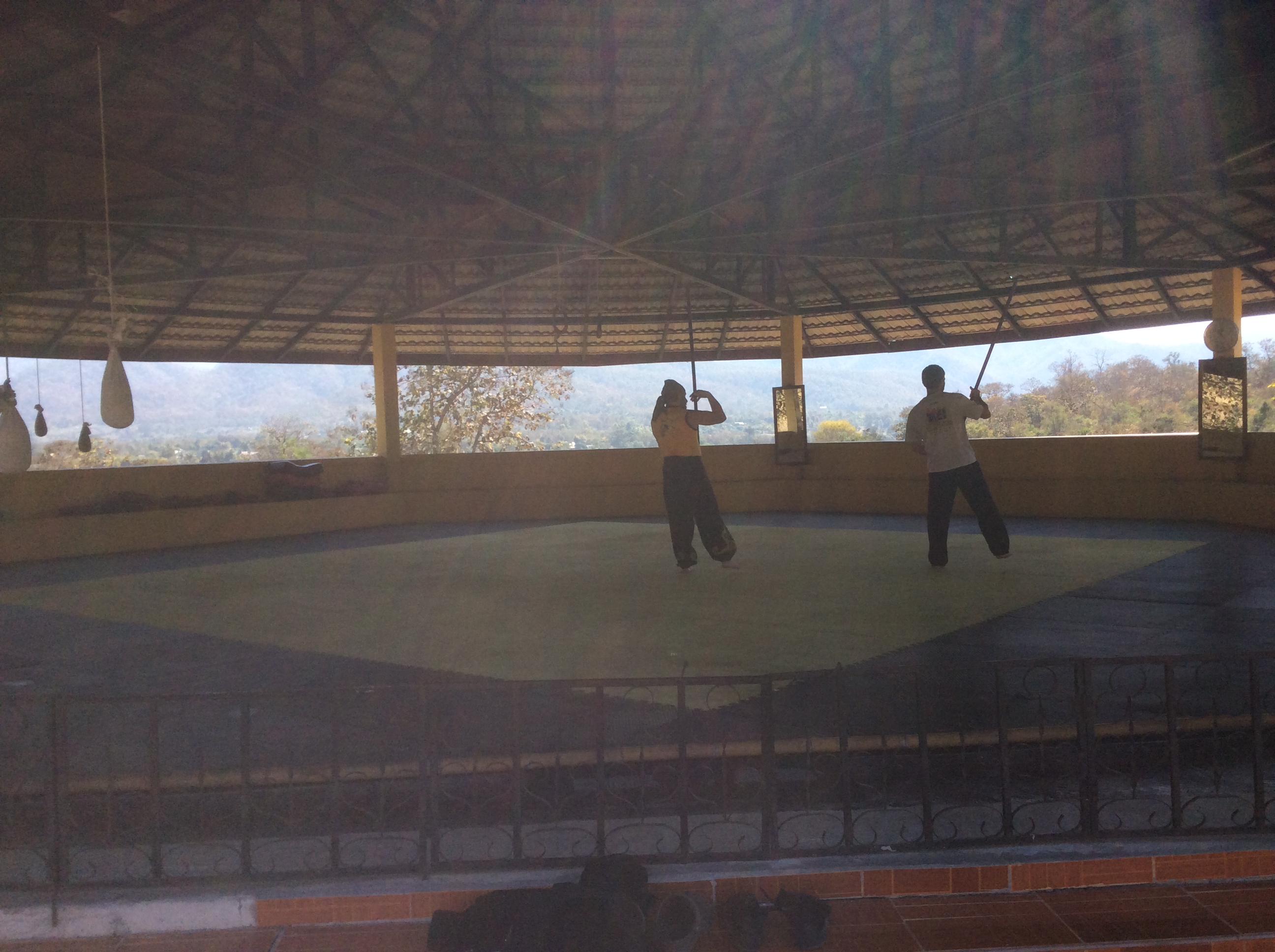
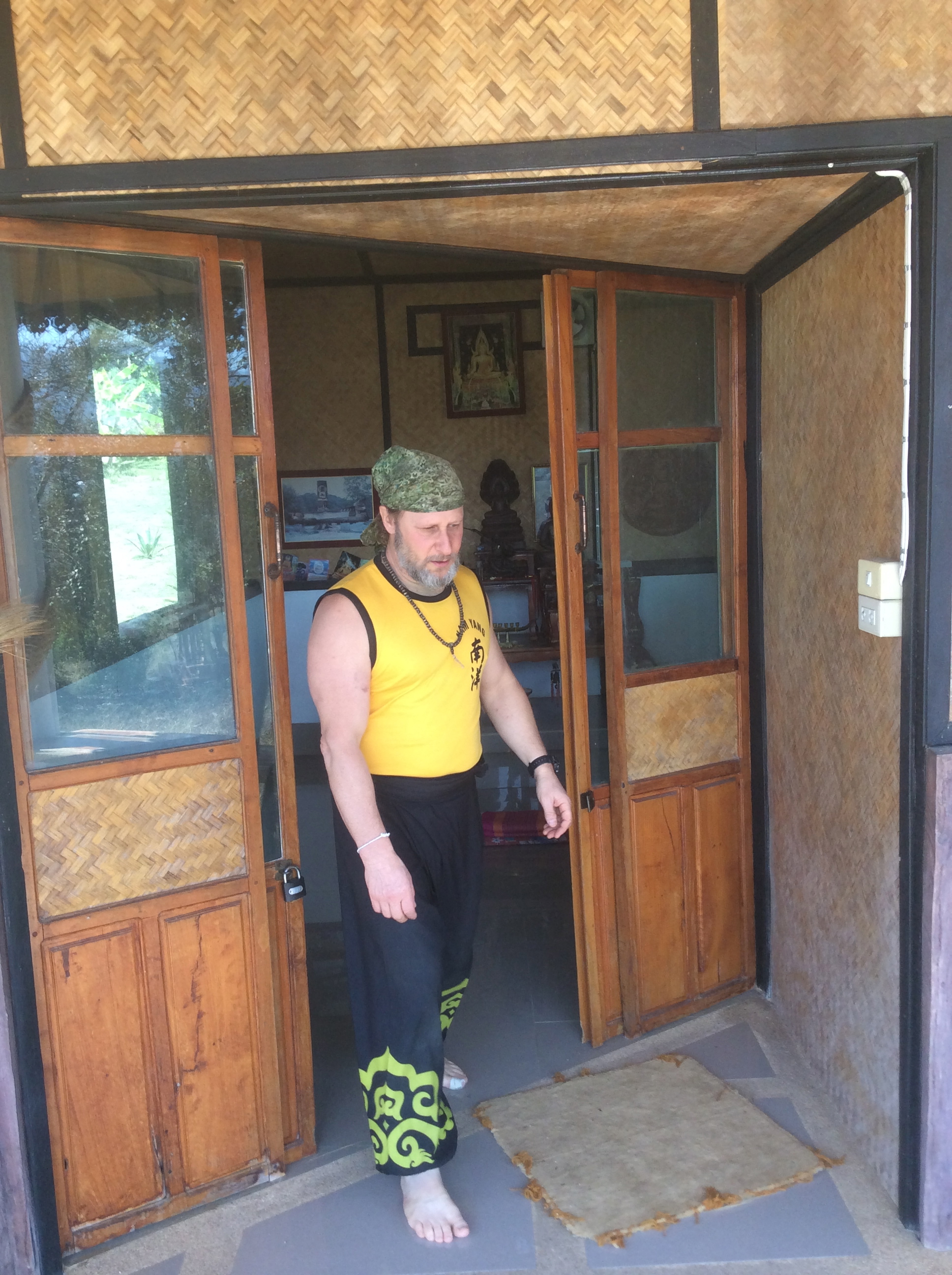
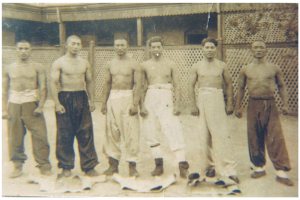
Training At Kunyu Mountain Shaolin Kung Fu School

‘The following is a short diary from a student who studied at Kunyu Mountain Shaolin Kung Fu Academy during the October holidays. In this short blog he breaks down each days training. ‘

At Kunyu Shan you have a choice of doing one of the Shaolin martial arts styles, Wing Chun or Bagua. I chose Shaolin with Shifu Gao.

Kunyu Mountain
Monday:

Tai Chi starting at 6.00am, this is optional but highly recommended. Afterwards you do Qi Gong for 20 minutes followed by breakfast.

Breakfast consists of rice / sweet rice porridge, rice bread, bread, and eggs. You can take your pick of everything. I recommend bringing (or buying once you’ve arrived) some honey / jam / peanut butter to put on the bread. As this bread is served with every meal so you can always eat this.

After breakfast you have about hour to relax, then “Line up”. You meet with your master, then go on the morning run with your group, around 1km at a pretty decent pace. You loop back to the compound and begin training immediately.

You’ll warm up, then start learning shaolin basics for 1.5 hours (kicks, punches, stances, flying elbows, the lot). This is reasonably intense.

30 minutes break.

After the break you’ll go straight into learning “forms” for 1.5 hours. This is reasonably relaxed.

Lunch – this consists of a buffet of 2 vegetable based dishes, and one meat based dish. You can take the amount you want of each. The food isn’t too great, but it’s not too bad either. Some days are better than other, for example one day you get steamed meat dumplings, and another chicken on a stick and potato wedges.

I normally took a nap after lunch until 14.00. Second line up is at 14.30.

Finally, run the same 1km, then straight into Sanda training for 1.5 hours. This generally involves reasonably high intensity drills, basics, and pad work. There is very little practise sparring, so if you’re into competitive fighting, I recommend Muay Thai or somewhere else.

Finally you’ll have dinner, which is extremely similar to the lunch. Again, I recommend bringing something to put on bread for afterwards.

After this you can do what you like, some extra training, table tennis, watch a movie, take a shower, etc. (There is no time to shower in the morning, and hot water is only turned on in the evening for 3-4 hours.)

The structure of the rest of the week is the same, the only difference being what you studying during the three lesson periods of the day.

Tuesday:

Tai Chi

Conditioning – Partner up and get punched in the stomach, pectorals, shoulders, lats, floating ribs, kicks to the inside and outside of the thighs. Then high intensity punch bag work without gloves, which absolutely shredded my knuckles and they’re only just starting to heal now 1.5 weeks later.

Power training – Reasonably standard anaerobic training, sprints, bear crawls, bunny hops, hopping, planking, v-sits, etc.

Wednesday:

Tai Chi

Acrobatics – Jumping kicks, forward rolls, backward rolls, forward break-falls, backward break-falls, side break-falls, etc. Some of the backward break-falls are very difficult at first, and if you mess them up you will end up hitting your head / winding yourself. But once you get them, they’re relatively painless. This whole lesson is conducted on top of large reasonably firm padded matts. (The same matts used in the Sanda ring).

Forms.

Sanda.

Thursday:10599536_1557778751112613_2335631134442809634_n

Tai Chi

Shaolin Basics.

Rest

Power Stretching – some risk of getting injured during this, but it seems that the Shifu’s are starting to understand this now, and they were reasonably nice about it. Apparently they used to push people way too far during power stretching, but I found this to be okay. But I’m also reasonably flexible to start with from years of Tae Kwon Do training. The worst part was holding a specific shoulder stretch for 3 minutes, for two sets, with threats if anyone failed of whole group punishment.

Friday:

Tai Chi

Shaolin Basics

Ring Sparring – During this period everyone gets together to watch people sparring in the Sanda ring. If your Shifu has given you permission you may seek someone to spar against and get into the ring. Generally, with the exception of a couple individuals who have cleared sparred before, the level of sparring was quite poor. I believe this is because as I previously stated, there is a lack of any practise sparring. You learn all the techniques, but this is not enough in my opinion.

Mountain Stair Climb – This involves a leisurely walk up one of the mountains to a temple. You then have to run up and down it as many times as you can in 1.5 hours. Make sure you don’t overdo it on this, running down 300 odd stairs will literally destroy your knees – so at the very least take it very slow on the way down, then power on the way up.

Conclusion

The training was very physically intensive, from what I’ve written it may not sound it, but even lessons like “Shaolin basic’s” is relentless – constant jumping, shouting, powerful techniques, etc. My main advice is that the fitter you are before you come to Kunyu the more you’ll be able to enjoy it!

P.s. The Shifu’s dish out punishment with large 5-6 foot staffs. I didn’t see it happen whilst I was there, but if you break the rules you will get staffed. And they don’t hold back.

by Steve Hoult

Steve Hoult was a StudyMartialArts.Org student who went to Kunyu Shan for a week during October. For a full and more independent reviews of the school visit the StudyMartialArts.Org website. When you book your training do it through the StudyMartialArts.Org for discounts, extra service and a welcome pack full of language learning materials and martial arts information.
Kung Fu in Thailand Days 6-7: Breakdown

Greetings,

Well if my last entry was about breakthrough, this was one would have to be about breakdown, but I’ll come to that later. Yesterday was Saturday, a rest day. I had Thai Massage in the morning, not excruciating for the most part this time, but she did discover an area in my shoulder which was pretty crazy to have worked on. I felt great afterwards and went down to the training area for some solo work, practiced staff form then sword, the Tan Dao, Chinese Sabre or Broadsword. After using the stick I got permission to practice with a real sword. I wound up selecting the real, real sword. Let me explain. They have practice swords which are real swords, but with a blunt steel blade and considerably lighter. The real, real sword has an edge which could cut: it isn’t particularly sharp not having been honed for a while but is a serviceable blade. The main thing is the weight; it’s much heavier than the practice sword I’d previously used. Using the real sword is almost as much difference from the practice sword as is the practice sword from the stick; using it very much ground-truthed the whole experience. This applies not just to the matter of strength conditioning but in being able to perform properly the form.

IMG_0858

On our day-off we go into the town of Pai for supper (amazing Thai food!!) and eat ourselves silly. Before going down I had a chat with Eddie about teaching and learning dynamics. He shared that he gets concerned when a master doesn’t correct him. “A master won’t correct you for two reasons”, he commented. One is because he doesn’t think it’s worthwhile and the other is because you’ve got it so perfect you don’t need it, “and I know that’s not the case”. So when the Master corrects it’s because he cares, and even more importantly, he thinks you care. This means that you’ve taken the corrections and applied them, so it’s worth correcting again and again, going deeper into whatever you’re learning. There is also the matter of attitude. Some people don’t take well to corrections, or shall I say, the act of being corrected. The process of being corrected is something I’ve experienced many times with Native elders. When they are correcting you, they are doing it because they care and it is a sign that they see you as trainable. Another thing Eddie mentioned was quite interesting to me. He said that, from his perspective, when one comes to Nam Yang you don’t pay for the teaching and the training; you pay for the accommodations, the food and services. The training is always there, it’s part of a way life and it is up to the student to enter in and make the most of it for themselves. The the more you try and the harder you train the more will be given to you and the more you will gain. The onus is on you.

Today was a great day; it was the best day yet! In fact, things just keep getting better here every day. I’ve still got 8 days left and already I’m feeling somewhat apprehensive about leaving. We worked in the group and I worked alone on sword and staff adding to the sequence of moves in my forms. We worked some very cool activities for strengthening and technique development in partners I can’t wait to bring home for Julian and Sarah. We got into practicing the most intense combat moves yet, so much fun!! I love this stuff and always feel especially honoured when Master Iain picks me to demonstrate the move: block me, lock me, throw me to the floor. I was especially honoured today when he cracked me on the nose. It wasn’t really that hard but it was a good square shot which elicited an audible pop. He felt so badly about. We were demonstrating a move which required me to come in with a grapple; Sifu seemed to want me to come in with some energy so I did. Either I came in too hard or he misjudged the distance or perhaps a bit of both but I think he felt worse than I did. I told him it was easy to misjudge the distance of such a target given my nose is probably a little closer than most others, I mean hey, that’s what makes me handsome in Thailand! Sifu asked several times throughout the session if I was ok. I glowed a little like Rudolph for a while but it doesn’t hurt at all anymore. Whenever we sit down for mid-session tea, Sifu pours the tea and asks, “Now, are there any questions about Kung Fu”. It’s really a special time of day. Today our youngest in the group asked about Nam Yang’s code of conduct, or Ethos. It’s a fantastic document and communicates very effectively the principles of loyalty, respect, equality, responsibility, brother/sisterhood, family, diligence and selflessness which distinguish Nam Yang, its Masters and Instructors. Here’s an excerpt, “Joining Nam Yang Pugilistic Association means becoming part of an ancient tradition dating back to Tat Moh (Bodhidharma), the Shaolin Founder, about 1500 years ago.” This brings me to the breakdown I had mentioned at the outset.

Processed with Rookie

I got up extra early this morning and went to meditate in the Buddha House. It was locked so I set up under the stars between the two Nagas (Dragons) out front (see picture attached). Afterwards I went down to where we begin our day’s activities in the open training area under the stars. We went through all the various Chi Kung exercises and moved into the stepping meditation. Afterwards we entered the Shuan Yang Sun Frost White Crane soft martial art form. I started sinking in to the movements, but of course was making mistakes, and Sifu came to correct me. Each move, of which I believe there are 66 though they all flow together, has a name. To help me understand the move he was correcting Sifu shared its name, “Goddess Pan Gu Opens Heaven: the Beginning of Heaven and Earth”. As I moved into the form it hit me how deep and vast is this tradition; there’s so much here and I’ll never even come close to learning it: 1,500 years of perfecting practice handed down from master to student, layer upon layer upon layer of art and science, technique and form. One must start young to really learn this and practice all your life; here I am almost 53 years old and just beginning with a two week intensive surrounded by these young fellows signed up for weeks and months at a time. What have I been doing with myself all these years? Goddess Pan Gu opened Heaven and I cracked open: I felt like I was falling, being swallowed into an abyss knowledge, wisdom, diligence and subtlety. Under northern Thailand’s pre-dawn light tears streaming down my face, pulling my elbows together, rolling back the shoulders, stretching out my hands until the wrists stabbed with pain, sinking down in the stance, rooting into the earth, drawing up Chi I cracked open, grieved for all the things I’d never know or learn, all the lost opportunity, and opened deeper to the form.

Time for sleep and I wish you all the best,

by David Lertzman

David Lertzman Ph.D. is the Assistant Professor of Environmental Management and Sustainable Development PI: Energy Indigenous Environment Interface Research Program, Haskayne School of Business, University of Calgary.

This blog entry is part of a series of blogs David Lertzman wrote for StudyMartialArts.Org detailing his experiences training at Nam Yang Shaolin Kung Fu Retreat. If you’re interested in visiting this school book your place here and get an exclusive discount  Nam Yang Shaolin Kung Fu Retreat.


Kung Fu in Thailand Days 4-5: Breakthrough

Greetings,

Sore all over, did I mention sore all over? Between the fall I took in Chiang Mai, the Kung Fu exercises, incessant stretching and traditonal Thai massage, I’m sore all over…sore in places I can’t even reach, and others I shall not mention. That was how I felt last night, yet in the few short days I’ve been here at Nam Yang I’m already feeling myself so much more flexible and strong, especially from the waist down.

IMG_0866

Today was a day of break throughs: meditation stepping, punching, weapons and stretching. On a student’s first morning, each is given a very simple pattern of three steps, first on one side then the other, as a meditative walking sequence which forms a basis for part of the Shuan Yang Sun Frost White Crane. I should put “simple” in quotes! It’s just three steps to one side and back, then three to the other and back. Sounds pretty easy right? It took me three mornings just to be able to do the stepping sequence, but it felt so good when I got it as then one can start sinking into the meditation focusing on all the little details: turning and placement of the foot, gripping the ground and rooting down, angle of the knee, direction of the hips, repeat, repeat, repeat, repeat. Moving through and starting to naturalize these details takes one into the meditation. The meditative walking and Shuan Yang are part of Southern Shaolin Kung Fu’s gentler or soft martial arts, yet the awareness built in these practices really helped me with the punching. I finally started to understand, meaning to get in my body, the pattern of step, grip the ground with your foot, sink down and punch. The result was immediate and obvious: way more focussed power yet far less effort and force required to throw the punch. Recall we are throwing these punches repeatedly into a hanging sand-filled cloth bag. Sifu had said it’s not about swinging the bag but in making a dent. For me there’s also a certain sound which accompanies a proper punch, it’s a kind of pop thud as you hit squarely the sack sending your Chi into its centre. When you grip the ground with your foot you draw Chi from the earth up through your body and send it out your arm into the target: step, grip, sink, punch; step, grip, sink, punch; step, grip, sink, punch, repeat…in getting this I worked exclusively on my left, my weaker side.

In weapon’s today I had a breakthrough with the staff. The break through was that I started being able to do it! By doing it, I mean that I started being able to move comfortably with the staff in the provided sequence and pick up the new combinations of steps and strikes which build cumulatively in the form. The form is the sequence of all the moves put together. The staff form has a very cool salutation at the beginning where you bow and then salute the staff, raising your Chi and sending it into the stick. The actual sequence then begins with kicking the bottom of the staff up and into your other hand moving into a series of strikes, steps, blocks, lunges and thrusts. The staff is a 6 foot, hard wood stick, rather heavy and quite longer then I’m used to. It is the original weapon for which the Shaolin are famous having defeated armies of both infantry and cavalry with just the staff as their weapon. Staff translates directly into spear and other really cool long bladed weapons like the Horse Cutting Knife, which is like a staff with a long, wide, curved sword on the end. The fluid, swirling sequence with Horse Cutting Knife is quite beautiful. I was also back on the stick for my sword practice having to learn new steps and patterns which would translate back in the next session, if I get them correct, to the real sword. I drilled with series of swirling figure 8 slashes upwards then downwards walking forward and back in very small steps. We doubled the number of moves I have, which can now translate to when I have a real sword back in my hand.

IMG_0865

Along with the weapons the big highlight today was working with Eddie. Eddie is the young man who is Sifu Iain’s top student and instructor at Nam Yang in the Thailand retreat centre. Eddie has a powerful life story. As with too many young people today, he had wound up on the streets using heavy drugs and really down and out. Through a series of events Eddie wound up at the Shaolin Temple in London where the head Master took him in letting him sleep on the floor. It’s now been ten years of intensive Kung Fu training for Eddie, travelling to different countries training with some of the top Sifus in the world. At Nam Yang Eddie has found his place and will be taking over for Sifu Iain when he leaves, a huge nod of confidence and respect. Eddie is a specialist in Chin Na at which he is quite expert having spent 2-3 years of study with a world renowned Chin Na master in California. Chin Na is the art of joint locking. It literally means Chin – to seize or catch, and Na – to hold or control. The old Shaolin Masters spent many, many years developing the art of Chin Na which contains hundreds of moves all based on achieving the perfect angle, pressure and leverage to seize an opponent and control them with joint locks. The session was amazing and a great deal of fun getting seized and put to the ground ground with exquisite and graceful agony! Eddie’s workout was also quite a bit more aggressive on the strength training than that to which we had become accustomed with Master Iain. I’m the oldest student here and I was proud to be able to keep up in good form with all the exercises and repetitions except one where I had to drop out a couple reps before the end. I think my back and wanting to prevent the old disc injury slowed me on that one but it was probably wise counsel. Oh, the other break through: flexibility. Before I injured my back I had done a good bit of Yoga and one of the postures on which I had worked quite a bit was the forward bend. Years ago I used to be able to stand and bend over putting my hands flat on the ground; however, since blowing out my discs I have done very little forward flexion, of which there is a lot going on here. As I learned in Yoga, you can’t just bend over but must keep your legs straight and, most importantly, your back flat to avoid any undue pressure on the lower spine. Yesterday in Eddie’s class I managed to achieve this, and it was glorious. It took me a long time to get there but I believe my Yogini teacher and dear friend Sheri would have approved the form.

IMG_0871Before closing I’d like to share one more breakthrough which I had not counted, yet is likely the most important: a personal development breakthrough somewhat humbling, yet empowering. When I first inquired about training at Nam Yang I was looking to leave closer to the end of January and train for a week to ten days. I was so thrilled when Master Iain replied that he would be here at that time but would have to depart Thailand at the end of the first week of February leaving the school with his capable head student and instructor, Eddie. When the better priced ticket came up I changed my timing to leave earlier and maximize my time with the Sifu. That gave me a few extra days on the other side which I decided to put into Muay Thai, or Thai Boxing for which the country is famous. I located what seemed to be the perfect place just north of Chiang May, another residential martial arts academy called Muay Sangha that blends ancient and modern Muay Thai with some other forms. I got really excited about training there for four days before my respite of several days doing nothing in Chiang Mai – a required component under Sarah’s direct orders – before coming back home to Canada. I was really disappointed when Kru Pedro, the Master of Muay Sangha, told me this was not enough time but graciously invited me for tea and exhibition to his studio. I re-worked and re-worked my schedule to create the minimum one-week required for acceptance at Muay Sangha. Now, after having spent time here at Nam Yang and getting to work with Eddie, who is also my weapons instructor, I have made the decision to stay here the few extra days to deepen and anchor my learning in this mindful, monastic environment. I will be honoured to train with Eddie when Sifu leaves and take up Kru Pedro’s kind offer for tea following up on his suggestion to come for training the next time I am in Thailand…yes, there will be a next time, hopefully with my family, Sarah and Glen.

Peace and Chok Dee (Good Luck in Thai).
by David Lertzman

David Lertzman Ph.D. is the Assistant Professor of Environmental Management and Sustainable Development PI: Energy Indigenous Environment Interface Research Program, Haskayne School of Business, University of Calgary.

This blog entry is part of a series of blogs David Lertzman wrote for StudyMartialArts.Org detailing his experiences training at Nam Yang Shaolin Kung Fu Retreat. If you’re interested in visiting this school book your place here and get an exclusive discount  Nam Yang Shaolin Kung Fu Retreat.

The Origins and Lineage of Shaolin Wugulun Kung fu

Shaolin ChanWuYi and Wugulun Heritage

The origins of Shaolin ChanWuYi and Wugulun Kung Fu date back to the sixth century. When Bodhidharma, who is credited with bringing Buddhism from India to China, settled in Shaolin there was already a Buddhist temple there.

While sitting for nine years in a cave behind the temple, Bodhidharma developed Zen Buddhism which he introduced to China and which later spread to Japan and the rest of the world. Needing some form of exercise to maintain the health of his own and his disciples’ bodies, he developed a series of movements or exercises designed to promote health and fitness – based often on the movements of birds and animals they observed around them — and at the same time to deepen the practice of meditation. Herbs from the mountainside were collected and used for healing.

Master Wu Gulun

Due to China’s turbulent history, the Shaolin Temple, with its highly skilled fighting monks, was sometimes in favour with ruling dynasties, sometimes not. It was destroyed and rebuilt a number of times. Around 1870 it was again in disfavour with the rulers of the Qing dynasty and the temple was in imminent danger of being destroyed yet again. The Temple Master instructed one of his foremost monks, Wu Gulun, to leave the temple and carry the traditions of the Shaolin culture with him to preserve them. He had, however, first to fulfill a rule of the Temple: that anyone leaving the temple should fight and vanquish all the monks to prove his strength and suitability to cope with the secular world he was entering. As the top Kung fu student, Wu Gulun easily achieved this feat and disappeared into the mountains to live in an isolated village, Bai Yu Gou, where he continued to practice and preserve the secrets of the Shaolin heritage.

c8df10f3-cf64-4f99-9a69-367091de563e-orgMaster Wu Shanlin

As he needed to be able to pass on this knowledge he married and had a son, Wu Shanlin, to whom he taught all the ancient secrets. Master Wu Shanlin became the second Grandmaster of the Wugulun lineage. Continuing to live in the small village, Wu Shanlin married and had two sons, Wu You De and Wu Tian You. To them and also his nephew, Qiao Hei Bao, and a young orphaned student, Zhang Qing He, he passed on the traditions.

Wu Tian You had a son who sadly died when he was quite young. This son was Master Wu Nanfang’s father. From an early age Wu Nanfang studied with his great grandfather, Wu Shanlin, then with Qiao Hei Bao and Wu You De and later Zhang Qing He. He is thus the direct descendent and inheritor of the Shaolin ChanWuYi and Wugulun tradition.

The 1920’s in China was a period of huge unrest and turmoil. In 1928 a general, Shi You Shan, was looking at the Shaolin temple as a possible source of resistance and danger so he sent one of his underlings there to try to gauge just what kind of a threat the fighting monks posed. The underling asked who the best fighter was as he wanted to fight him and see how strong he was. He was told that actually the best fighter, Wu Shanlin, was not in the Temple but in an isolated village in the mountains. The underling found Wu Shanlin and challenged him to fight with his sword. So powerful was Wu Shanlin’s qi that he paralyzed the man’s sword arm with just a look and a shout, causing the sword to fall uselessly to the ground.

Within two days of Shi You Shan hearing about this incident, he decided the Temple was indeed a threat and destroyed it almost totally.

As Master Wu Gulun’s greatest desire was that the Shaolin tradition should be returned to the Shaolin Temple when the time was right, Wu Shanlin returned to the devastated Temple with his son, Wu Tian You, with the intention of helping to rebuild it and restore the traditions and heritage which he had been preserving. He found to his dismay, however, that the monks were demoralized by the defeat, and most decided to either return to a secular life or join the army. The remaining few were men of poor character and Wu Shanlin felt he could not pass on his knowledge to them as it might be used wrongly, maybe to hurt people rather than to rebuild the Temple. He stayed for three years, teaching a few basic Wugulun kung fu moves, but then returned to his village to wait for a more auspicious time. Many current kung fu teachers claim that they know the original kung fu forms from their teachers who had practiced under Wu Shanlin. In reality they know only a few very basic forms.

Master Zhang Qing He

Zhang Qing He, the third Grandmaster, was an orphan who was rescued and looked after by the monk, Chun Quan, in a small temple on the Luoyang side of Song Mountain. Chun Quan sent him to study with Master Wu Shanlin when he was about twenty years old. Zhang Qing He also qualified as a doctor and was in fact better known for his medical skills than for his kung fu.

In about 1988 Master Zhang Qinghe came to live at the Shaolin Temple to treat his beloved Buddhist Master who was very ill. There he came into contact with a young monk, Dejian, who was studying and teaching at the Temple. Dejian started training in the Wugulun Kung fu style with him. In 1990,Master Zhang Qing He requested Wu Nanfang, who was teaching Wugulun Kung fu nearby to come and introduce Dejian to Wu Nanfang. They are brothers, because they are fellow apprentices of one and the same master.

img_51241Master Wu Nanfang and Master Dejian

This was an historic meeting as it is these two masters, Wu Nanfang and Dejian who, after the death of Master Zhang Qing He in 2004, are currently concerned with the preserving and passing on of the Shaolin Wugulun Kung Fu tradition — Master Dejian from the San Huang Zhai Monastery and Master Wu Nanfang from the Shaolin Wugulun Kung fu Academy.

Information courtesy of the Shaolin Wugulun Kung fu Academy.

_______________________________________________

“If you would like to study at the Shaolin Wugulun Kung Fu Academy or would like to find out more information about the kind of training you can expect at the school click the link above. It is my opinion that this school is one of the very few authentic Shaolin Schools left in China and is definitely worth considering if you wish to study authentic Shaolin martial arts. Lately, I’ve been somewhat disillusioned with some of the training and also the managerial practices I’ve witnessed at some of the other more popular Shaolin International Kung Fu Schools in China. Maybe its time for a change a return to the roots of Shaolin with more focus on self discipline and quiet meditation rather than the flash and high flying kicks of the modern perversion we see so often. A perversion that turns poor young ambitions Shaolin masters into business men who scramble over westerners for money with little thought to the detriment they are doing to the name of Shaolin and China as a destination for martial arts.” – David Kelly

Kung Fu in Thailand Day 3: A Day of Rest

Greetings everyone,

Yesterday, Wednesday, was a rest day, as is Saturday. We bundled up in Sifu’s truck and drove north to Mae Hong Son close to Burma. We visited some hill tribe markets and two principal Temples, one in front of a small lake and another on a hill overlooking the town. The hill tribes women’s hand weaving is exceptional and they sell the most delicious wild honey by the side of road. One of the highlights of the day was when we picked up four Buddhist monks walking up the winding mountain road who piled in the truck with us. Not only is Sifu Iain extremely knowledgeable in Kung Fu and martial arts in general, he has also a deep knowledge and experience of the local area and its peoples. Thus, our journey was one through the historical, cultural and philosophical landscapes of the region. Being so close to Burma there is a very strong influence from the Shan people. Indeed, the whole area has been flooded with various ethnic groups, in particular hill tribes fleeing conflict in Burma. I finally had the current political situation in Thailand explained effectively over lunch by Sifu Iain and the day ended at the Temple on the Hill in Mae Hong Son, Wat Phra That Mae Yen. It is hard to describe how extraordinary are these temples. The view from the mountain top on which the temple sits was spectacular as the jungle stretched out below with its forested hills and mountains, limestone spires and the blazing sun setting behind.
IMG_0868

Today we followed the same training schedule from 6 am to a little after 9 a.m., and 3:30 p.m. to about 6:15 p.m. Along with my extra 2 hours in the middle I also received a real Thai Massage. It was as much ordeal as it was massage but the lady hired for the massage was very good natured. She is a strong and gifted traditional massage therapist. She laughed at the noises I made with her elbows in my back and foot in my leg and told me to say, “Sooo, sooo!”. She tweaked my nose and invited me to the discotheque tonight in Pai but I told her I couldn’t go. I learned later from Sifu that men with big noses are considered extremely handsome in this part of Thailand; I’ve finally found somewhere that values my natural good looks and charm! We did a lot of Chi Kung, stretching and meditation today. We also continued with the Tigre-Crane Sum Chien and another sequence I have not yet described called Shuan Yang, which in English is called Sun Frost White Crane. Shuan Yang is a kind soft or gentle martial art that looks a lot like Tai Chi, but more martial. Indeed, some believe it to be the origins of Tai Chi. We did some great punching drills with the suspended sand filled cloth sacks and had a marvellously vigorous kicking session. Today on weapons I got to take up the actual bladed sabre, the Tan Dao or Chinese Broadsword. Wow, that was a gas training with sword in the open outdoor training ground my traditional black and gold Kung Fu pants billowing wet chest bared to northern Thailand’s blazing afternoon sun.

IMG_0856At tea Sifu spoke of the history of Nam Yang’s Tigre-Crane lineage. His Master’s Master, Master Ang, was the one I mentioned earlier who brought the art out of China and passed it eventually to Master Tan Soh Tin who then passed it to Iain Armstrong, the man I call Sifu. What an amazing history. Master Ang started Kung Fu as a boy and had three different masters. His first master was known as “the secretive old man” who introduced him to Tigre-Crane at 8 years old. His second master was an herbal medicine peddler who specialized in the Shaolin weapons system and Tiger form. The third was a Shaolin monk. I was amazed to learn that Master Ang eventually fought in Sun Yat-Sen’s army with the Koumintang, which was subsequently taken up by Chian Kai-Shek. As the Communists became victorious and began executing the Shaolin Kung Fu martial artists Master Ang emigrated to Singapore and later started Nam Yang in 1957. He ran the club until his death in the mid 1980s and the leadership passed to Master Tan who trained Sifu Iain. Iain now has schools here in Thailand, in the UK, in Russia and another about to open in Italy. It is very special to be a part of this lineage and I hope to bring home some foundational skills I can practice on my own. I’ve taken to playing flute under the stars while the others arrive to the outdoor training area for the morning session. Thus, I must sign off as 5 a.m. comes early!

by David Lertzman

David Lertzman Ph.D. is the Assistant Professor of Environmental Management and Sustainable Development PI: Energy Indigenous Environment Interface Research Program, Haskayne School of Business, University of Calgary.

This blog entry is part of a series of blogs David Lertzman wrote for StudyMartialArts.Org detailing his experiences training at Nam Yang Shaolin Kung Fu Retreat. If you’re interested in visiting this school book your place here and get an exclusive discount  Nam Yang Shaolin Kung Fu Retreat.

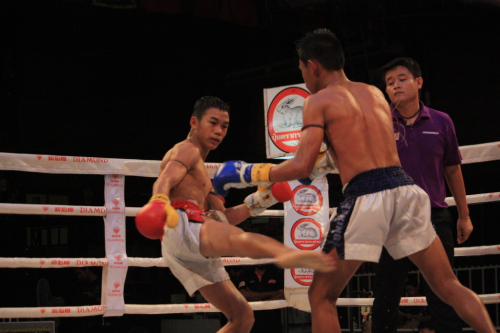
DAILY PHOTO: Thai Boxing


Thai boxing at the Rangsit International Boxing Stadium

B Gourley's avatarTiger Riding for Beginners

Taken in August of 2014 in Rangsit, Thailand. Taken in August of 2014 in Rangsit, Thailand.

This photo was taken at the Rangsit International Boxing Stadium, which is located in a Bangkok suburb to the north, during the August 31, 2014 fights.

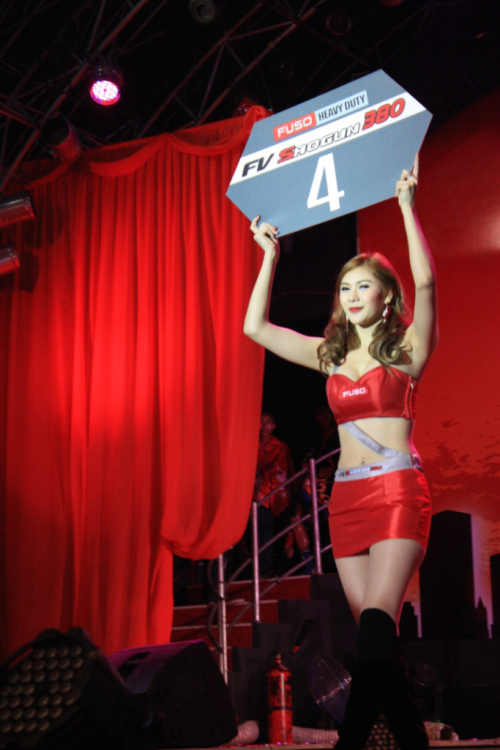
BONUS DAILY PHOTO:

Taken at the August 31, 2014 fights. Taken at the August 31, 2014 fights.

View original post

Chinese martial arts history PART FOUR


The Boxer Rebellion

nybestkickboxing's avatarSifu David Ross

The Boxer Rebellion

One of the most famous branch sects was the Yihequan (Fists of Righteousness and Harmony), popularly known as the Boxers. The Boxer Rebellion began in North China in 1898 as a popular peasant protest movement. Unlike the Taiping, the Boxer Uprising was opposed to Christian activity within China, particularly missionary evangelism in the countryside.

Shuaijiao_masters_tianjin_1930

Joseph W. Esherick has argued, rather successfully, that the “boxers” were not in fact martial artists, but rather followers of a variety of protection rituals; they took part in certain rituals, believing spirits would possess them making them impervious to foreigners’ bullets. These rituals were easily learned by the young, uneducated peasants of the Yellow River floodplain, and transmitted from village to village.

“The two elements, martial arts and heterodox beliefs, are clearly alternatives, not linked elements of a single tradition.”
– Joseph W. Esherick, The Origins of the Boxer Uprising

Members of…

View original post 381 more words

Kung Fu in Thailand Day Two: The Training Begins!

Today was an awesome day! I was up about 5:30 a.m. and we started a little before sunrise with Chi Kung and Sam Chien, crescent moon shining with mist hanging off the jungle. We trained with the group this morning from 6-9 am and in the afternoon session from 3:30 until a little after 6 p.m. I did 2 hours of solo instruction focussing on Chi Kung and Sum Chien. Sum Chien is a series of moves that forms a basis for the Southern Shaolin Tigre-Crane form we are learning. I also got to begin weapons training with staff and starting on Chinese Sabre using a stick. I thought staff would come more easily to me than sword but I probably did better with the sword technique. I worked on weapons with the head student who is also an instructor. The hardest part is probably the footwork. All in all I would say we spent about 2.5 hours today in stretching and conditioning, lots of stretching.

IMG_0864

In the evening we focused on special breathing techniques that apply to Chi Kung and Sum Chien, which Sifu said were actually quite advanced. I did well with my prior yoga and Chi Kung training. Then we worked on punching drills into heavy cloth sacks filled with sand hung from the rafters. It makes your knuckles pretty red but is very instructive on technique and really fun!! The idea is not to swing the sack but to be able to dent it by sending your chi into the target. One of my favourite times of day is the break in training when Sifu call us up to the veranda where we sit on teak stools and he pours special tea in all our cups on a table shaped like a dragon. He then delivers teachings about technique principles, tells stories and dispenses wisdom. Like I said, you can tell a lot about Sifu by how his chief students treat him: with utmost respect and admiration, hanging off every word with the rest of us. Sifu spoke about Kung Fu as a way of life; the martial aspect is part of a bigger picture and no one part is more or less than the other. Kung Fu prepares us for meditation and the pathway to enlightenment.

At afternoon tea Sifu spoke about the tendons. I had mentioned that I felt where an injury in my shoulder was really being stretched when being corrected in some technique for practicing one of the slow punch forms early in the morning. At first it hurt but I stayed with it and then it started to open. Sifu said that such body awareness is the first step to Kung Fu. He said one’s tendons have a grain like wood. When you get injured it forms a pattern in the tendon, like a knot. As you develop your awareness you can use the Kung Fu forms to go into the tendon and open it up taking out some of the scar tissue and re-patterning the tendon. He said something else that was very profound which reminded me of Sequoyah. Speaking about training and repetition, for example of a simple movement like a step or the most basic punch over and over again, Sifu said that you could never get board of anything that is done with deep intention and full awareness.

Life here has a rather monastic feeling. We train before sunrise and retire a little after sunset. Two meals a day are wholesome yet simple, rice with vegetables and a clear, tangy vegetable soup, prepared by our cook who is mostly blind and comes from one the tribes originally on the Burmese side. Accommodations are comfortable yet spartan, the bed being a heavy, handcut bamboo cot. It is surprisingly quite chilly in the morning and I really missed my fleece pants for the first couple hours but had to put on a good showing as a Canadian while everyone else was quite bundled up.

There are several people training, all male from young to old: two other Canadians, a Dutch fellow, a Belgian and a Brit. The Belgian and Brit are senior students. One is already a teacher and the other well on his way, very dedicated, lovely young men. Tomorrow we have a rest day and are going to see some remote hill tribes with whom Sifu is connected. I’m pretty sore in many places with a nice, large bruise on my arm from yesterday’s push-hands activity, and very happy.

Love and Blessings
David

David Lertzman Ph.D. is the Assistant Professor of Environmental Management and Sustainable Development PI: Energy Indigenous Environment Interface Research Program, Haskayne School of Business, University of Calgary.

This blog entry is part of a series of blogs David Lertzman wrote for StudyMartialArts.Org detailing his experiences training at Nam Yang Shaolin Kung Fu Retreat. If you’re interested in visiting this school book your place here and get an exclusive discount  Nam Yang Shaolin Kung Fu Retreat.

A Brief History of Some Walls: The Great Wall of China


Learning about the great wall, a brief history.

Marren's avatarYelhispressing

The Great Wall of China Source: en.wikipedia.org

Many describe The Great Wall as the longest structure built on earth. According to legend it is so magnificent that one can see it from space. It travels for 4, 500 miles in the North, touches the East Coast and the North Central of China, meandering through mountains, lower lands and the Gobi Desert. It is interesting to note that the translation for the wall was not always ‘Great’ but ‘Long Wall.’ As Julia Lovell puts it, the Great Wall is a collection of walls. The Chinese are known for their love of walls based on their early construction [from the 1st millennium BC], around the fields of farms, temples, houses and palaces. Furthermore, in the spiritual realm the Chinese paid homage to their God of Wall and Moat. According to Louise Chipley Slavicek, the Chinese believed that the God of Wall and Moat informed a person of their death…

View original post 850 more words

THE TRUTH ABOUT QIGONG EXERCISES

by Phillip Starr

In the wee hours of most mornings, millions of Chinese people flock to the local parks to practice various and sundry forms of qigong, which are exercises intended to gather, store, and/or manipulate what is known as “qi” (life force, internal energy). Dozens of books on the subject are readily available in many bookstores and on the internet and for those who prefer a more “hands-on” approach, there are many qigong instructors who will provide direct, detailed instruction. To say that there’s some considerable interest in this subject would be a serious understatement. However, the fact is that most of the available instruction in the subject is…flawed. I realize that this statement isn’t going to make me a slew of new friends but it’s true, so listen up.

To begin with, the are three main types of qigong. In a nutshell they are:

*Qigong for Health

Many millions of people around the world practice qigong as a form of health maintenance, which is intended to strengthen the body’s immune system and prevent illness. They also look to it as a way of slowing down the aging process and staying fit.

Additionally, many people also practice it as a form of medical therapy. Suffering from various injuries and/or illnesses, they look to qigong as a healing technique.

*Spiritual Qigong

Qigong has long been popular with many Buddhist and Taoist sects that believe that regular practice will promote spiritual awakening.

*Qigong for Martial Arts

Practitioners of numerous martial arts, especially the Chinese “internal” schools of taijiquan, xingyiquan, and baguazhang practice assorted qigong routines, believing that it will enhance their martial arts skills. They assert that regular qigong practice will augment their striking power while also protecting their bodies against an opponent’s powerful attacks.

Martial arts enthusiasts often get confused as to which exercises are best employed to complement their martial skills. For instance, practicing qigong exercises that are intended to maintain good health will not necessarily have any impact on one’s combative skills. Qigong can be divided into four types:

Breathing Exercises

There are four main breathing exercises, which are usually practiced in a seated position. The first three (Long Breath, Microcosmic Orbit, and Macrocosmic Orbit) are used by martial arts devotees. The first two (Long Breath and Microcosmic Orbit) are used for health and healing, and all four (the last one is known as Imminent Breathing) are used by Taoists who seek spiritual development.

Solo Postures

In this form of qigong, certain breathing and visualization techniques are combined

with a static position that is held for a given period of time. This is done to circulate the

life force through the body. How long the posture is maintained varies from one teacher to

another.

Solo Exercise

In this type of qigong, breathing and visualization techniques are combined with

various movements to circulate the life-energy. Some of these exercises are really very

simple; just one or two movements are repeated several times. Others are considerably

more complicated.

Two-Person Qigong

This form of qigong requires the assistance of a partner. It is an excellent training

method as it acts as a barometer for students and proves to them that there is indeed more

to them that what their eyes perceive. Moreover, it bridges the gap between qigong

exercises and the actual application of internal power through one’s martial arts

techniques. Oddly enough, this form of qigong practice is not found in Chinese qigong

training, which likely accounts for their frequent inability to effectively emit qi (known as

“fajing”).

In most of the Solo Exercise and Solo Movement routines, the method of breathing AND INTERNAL “MOVEMENT” is crucial. By “internal movement”, I mean the contraction, “twisting”, and relaxation of various internal tissues, which include small muscles, fascia, and tendons. These unseen actions must be properly coordinated with the breath and physical movements (in the case of Solo Movement exercises) to assist in gathering and manipulating qi and to “massage” certain internal organs/tissues. Simply standing in a particular posture or making a certain movement is not enough and results will be minimal.

Body alignment must also be considered. If the body’s structure isn’t correctly aligned, you’ll experience considerable discomfort after a short time. Many qigong teachers simply tell the student that the pain they experience is due to misalignment and they should learn to relax. This kind of instruction really isn’t very helpful; the student needs to be shown how to stand and move correctly.

Moreover, your intention (known as “yi” in Chinese) must be brought into play. One of the fundamentals principles of all qigong is this:

“Where your yi goes, your qi also goes.”

Without the special ingredient of yi, your qigong is worthless and you’d be better off taking up knitting.

So, there you have it. The principles of utilization of yi, body alignment, and internal movement/breathing are largely identical to those that are outlined in detail in my upcoming book, “Developing Jin” (released in April of 2014). I will provide additional articles in the future on the basic principles of qigong.