Keep your eye out for this documentary charting the lives of three young girls at Tagou.
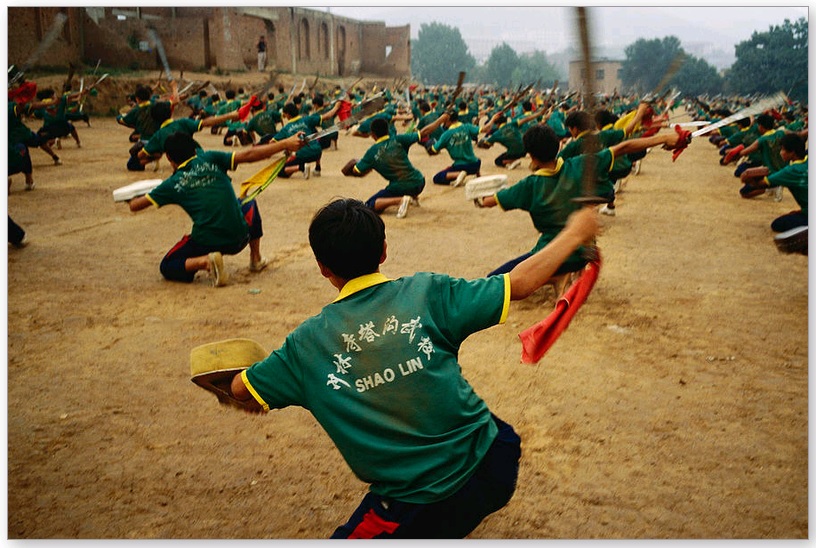
DRAGON GIRLS is the story of three girls and their life at the martial arts school Shaolin Tagou, China’s biggest Kung Fu School housing 26.000 students. Far from their families, Xin Chenxi (age 9) and Chen Xi (age 15) are fighting an every day battle of discipline, rules and hard physical training. However, despite this Kung Fu is their chance. The girls do everything they can to become the country’s best fighters, to be able to provide for their parents in future and lead a better life than them. Huang Luolan (age 17) couldn’t cope with the training regime of the school. She fled for Shanghai. The girls lead an extremely hard life concentrating on their achievements. But deep inside they have the same dreams as children all over the world have. And no one can take that from them.
Exceptionally small tables and chairs at the Qing Tang Fu Restaurant
Last night I went to a Shaanxi Food Restaurant with my fantastic girlfriend that happened to have the smallest table and chairs I’ve seen outside a nursery. Check them out!!
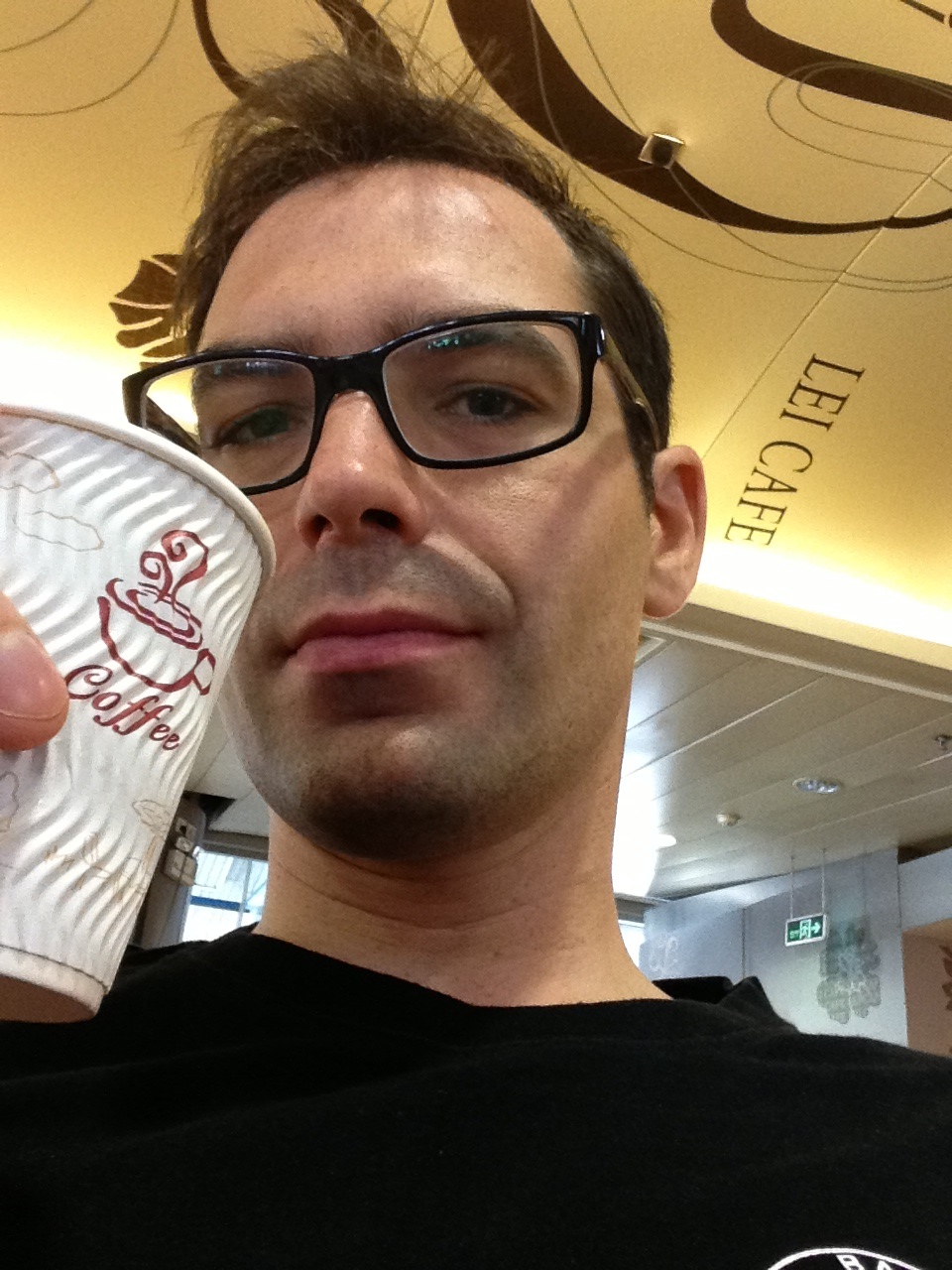
The perfect cup of joe at Beijing Airport pre flight
With a 5am start at the back of my mind and fully satisfied from the delicious food we headed home so I could prepare for my trip. Now I’m chilling out and blogging to pass my time at the airport while waiting for my flight to Shanghai.
So I’m off on another one of my frequent martial arts school visits. I usually concentrate these annual trips to the summer holiday due to other commitments. This time I’m off to meet up with Scott from Rising Dragon Martial Arts School for a tour of their new school location. The school will move to Jiangsu province in September and will be a short train ride outside of Shanghai.
With great transport links to and from both Shanghai and the capital Beijing it will be in easy reach for our SMA international martial arts students as well as those already in China. Situated within a revitalised Taoist site costing in-excess of 10 million US dollars the school will offer a very different experience from the existing site which is currently in one of the most beautiful rural areas I have visited here in China. A number of questions spring to mind for my meeting with Scott. Why the move from the current location having spent half the last decade creating such an amazing school there? How did the opportunity for the new school location come about? What will you miss about the last school? And of course what plans do you have for the new school?
Having talked a number of times to Scott over the last few weeks prior to my trip I can tell he is excited to tell me about his future plans for the school.
A picture of Rising Dragon Martial Arts School. In the picture you can see the students from the schools BJJ class. This is one of the only international full-time martial arts schools that combine Chinese arts stand up game with BJJ’s ground game. Check out that stunning location in the background.
If you want to study martial arts in China make http://www.StudyMartialArts.Org your first contact for information on schools, training discounts and travel and training resources all at no additional cost.
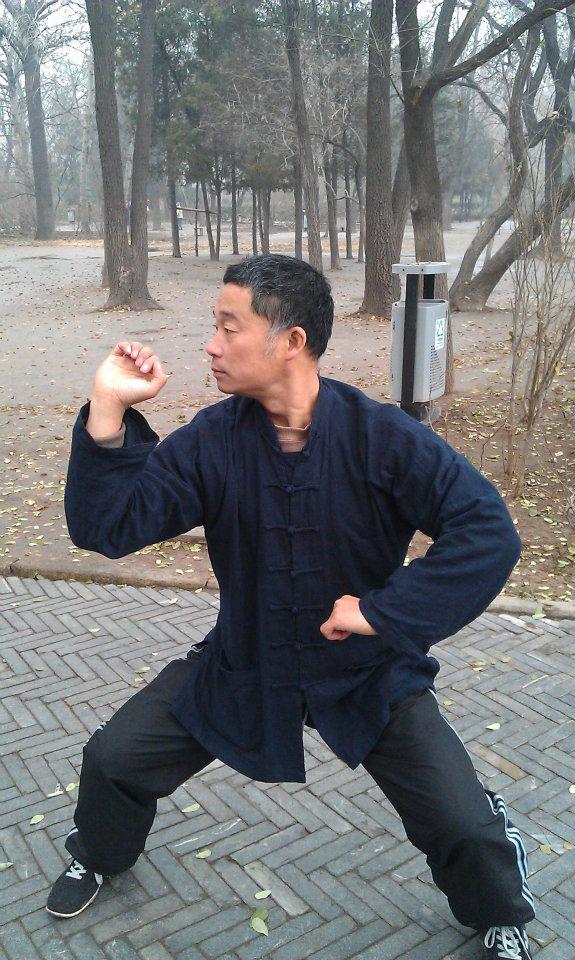
Over the last few years, master Zhou Jingxuan has become a known figure among some online martial arts communities, due to the many videos of his published on youtube, featuring action from a wide variety of traditional Chinese martial arts. Relatively few people, though, are really familiar with the man behind the videos – the unique personality that he is in the real world. In this article, I wish to therefore allow a glimpse into the life and times of this fascinating individual.
It is a peculiar and somewhat surreal thing that, a Westerner belonging to a nation of people who are less than 15 million in number worldwide, who dwells in the Middle-East, would come to be a student of another man, half a world away – one of nation counting over 1.5 billion people. Some would call it Karma, Fate, or Divine Intervention. I, for one, attribute this to the power of Human Wills. For where two people search the same thing, its shape, nature or distance matter less than its essence. What one looks for, with unquestionable desire and an utmost thirst, will bring one to find the answers, in the existence of other human beings. So it came to be, that I have become a student of master Zhou Jingxuan; a man quite unlike myself, who nonetheless shares with me something transcendental and special. A connection to an ancient mindset, now long gone from the soul of the majority of humanity. This keen interest in the Martial Arts – a glue that brings persons together and bridges across cultures like no other; a gift that Zhou is handing over to those eager to accept, passing it on as it had been passed to him.
Seeking truthful and serious traditional instruction, I came to study, many years ago, under master Zhou’s student, Nitzan Oren – a fellow Israeli, and nowadays also a dear friend. Later, on two occasions, I have had the chance to study directly under Zhou shifu. With both teachers I have studied Xing Yi Quan and Pigua Zhang. My latest training period with Zhou had been for 40 days of daily training, during summer 2012. Prior to that, I have also trained daily with Zhou shifu for a month in summer 2010, when he had come to Israel to instruct his Israeli students and their students.
Master Zhou, now about 48 years old, was born and had lived all of his life in Tianjin city, China. Today, Tianjin is a booming metropolis of 13 million people, with infrastructure and facilities no less impressive that those of famous European cities (albeit its pollution being quite terrible). But at its core, Tianjin is an ancient city, and up until 30 years ago, it was still quite primitive in its construction and accommodations, not to mention the living standards, which were quite fitting to a third-world country. And, while culture in some respects has always flourished, either above or below the surface, the mentality and mindset of most of this city’s inhabitants was always that of the poor and struggling. Even today, it can be said that large portions of the city are one big ‘rough neighborhood’. This is the environment Zhou had grown up and still lives in – a place which builds character, psychological endurance, and sharp survivalist instincts.
Tianjin 1930Tianjin 2012
In 1931, the Empire of Japan had invaded Manchuria, with the goal of conquering all of China, marking the (true) beginning of World War II. The China that had been invaded had been at its weakest point in many centuries, following 200~ years of economic conquest by Western powers, and a succession of terrible civil wars. The Chinese barely survived the war, in which the Japanese Imperial Army was not only close to occupying all of China, but performed some of the worst atrocities and war crimes in modern times, including mass murders and rapes of thousands and tens of thousands of people at a time. Tianjin suffered greatly from this occupation, and so had Zhou’s family. His grandfather in turn, set out to fight the Japanese. The Chinese army was so scarce in resources, that it was frequent that the soldiers would run out of ammunition, or lack firearms altogether.
A Chinese soldier, carrying a Da Dao sword on is back, waiting at the Tianjin railroad
The 29th army, which Zhou’s grandfather joined, had therefore experimentally equipped their soldiers with additional weapons – Dao and Da Dao swords, to fight the Japanese at close quarters, or when the ammunition would run out. It is almost unthought of that in the age of automatic and semi-automatic guns, that people would be fighting against such weapons with swords, but the 29th army did so quite successfully. Zhou’s grandfather survived the war, at the cost of seeing all his friends being killed by the Japanese. It seems to me that this traumatic experience of the most brutal kid of fighting had undoubtedly affected young Zhou shifu, who took to heart the lessons of war and violence.
Another soldier of the 29th army, carrying Dao swords on his back.
For Zhou, it was obvious from a young age that he was going to practice martial arts. The district he was lives in, Hong Qiao, is one of two districts in the city of Tiajin famous for their martial artists (the other being Nankai). He lived (and still lives) near Xigupark – an impressive island of greenery in the middle of gray Tianjin, which had over the years become an attraction point for many martial artists. The teaching atmosphere was very different from other places, especially compared to schools in modern times. People simply came to the park and practiced. You could have a choice from many teachers, and if you had the right connections, also be recommended by your own teachers to become a student of others. Because of these unique circumstances, Zhou had the opportunity to get to know hundreds of highly-skilled martial arts teachers in his lifetime, and study under quite a few of them.
Beginning at age 9, Zhou started his studies with the arts of Chuo Jiao, Fanzi Quan and Tan Tui. Later, he also learned Pigua Zhang (under two teachers), Xing Yi Quan (under four teachers), and Baji Quan and Jingang Bashi (under two teachers who are gongfu brothers) and Li style Taiji Quan. Additionally, all of Zhou’s teachers taught him several weapon forms, each. Some of these weapons are related to the arts he had studied, while others (such as the Six Harmonies Spear form) are interdependent from style. Overall, Zhou shifu ended up having 11 long-term teachers, out of which he became an official disciple (indoor student) of 7 of them.
Master Zhou’s Lineage
Zhou also had encounters and knowledge exchanges with several other martial arts teachers. Since he had over the years become such an enormous fountain of martial knowledge, there were always people who were interested in learning his skills – especially material from his rare art of Shaolin Jingang Bashi. It is not the custom in Chinese society, however, that two people of the same class (say two veteran teachers) would become each-others student. Because of this, Zhou exchanged knowledge with these teachers on a friendly basis, and gained insight into the use and theory of many other martial arts and weapons in that manner.
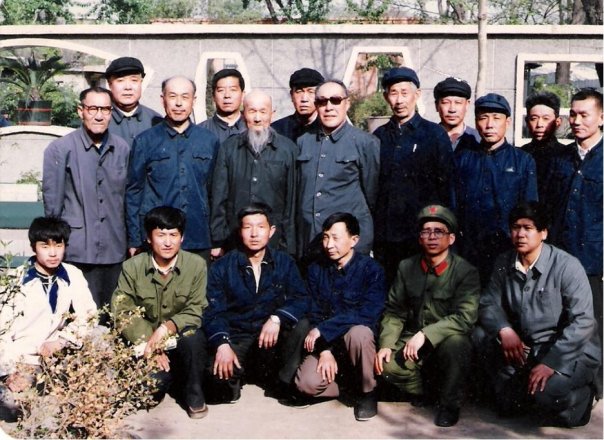
Members of Zhou’s gongfu family – practitioners of Baji Quan and Jingang Bashi, together with members of the Communist Party. Circa 1980s. Zhou is sitting in the front row, on the far left, wearing a white shirt. Behind Zhou stands his grand-teacher, Tian Jinzhong, wearing glasses. To Tian’s left stands another grand-teacher of Zhou’s – Zhao Fujiang (bald man with dark-blue shirt), who was master Tian’s younger gongfu brother in their Baji lineage.
As a child, Zhou was mischievous and adventurous. This had probably been his way of coping with the harsh living conditions in Tianjin, past the Cultural Revolution (a time of great poverty and death throughout China). The country was difficult to survive in, and life was chaotic at times. People had to learn how to endure and manage, and teach these skills to their families as well. Thus, beginning when Zhou began his martial arts learning at the age of 9, and through his teenage years and early 20s, he was involved in a lot of fights that were forced upon him by others. Times have since changed, China and Tianjin have become relatively safer places, and Zhou have since turned more peaceful in nature. Also in accordance with the times, Zhou has since been accepting students with all types of goals in training – not just martial; enjoying teaching people who may seek learning the arts for self-preservation and development as well. He himself has too begun to practice more health-oriented methods over the years, to balance his previous martial experience. Zhou’s previous martial experiences are still evident though, when demonstrating the proper execution of movements and martial techniques – with a fierceness of a true fighting scenario.
When Zhou was a young teenager, he recalls, there was a certain Taiji Quan teacher in the park. To Zhou and his friends, he was a target for ridicule, as he looked funny, and they did not think much of the slow movements he had been practicing. The old man, on his part, did not mind at all the children’s behaviour, and completely ignored them. They used to come at him in the park when he was not training, and try to push him over. Zhou vividly remembers how, despite their best attempts, they could not do anything to him. Whenever they pushed on him, his body would collapse and absorb their energy with no apparent effort. Those who used too much force on him would be bounced back on into the ground by their own strength and momentum. Today, Zhou is stricken by this silliness and his disrespect towards the old man, when he was younger. He says: “I wish I was wiser, and would have gone to study under this man, as he had obviously possessed a great skill in the martial arts”.
Baji Quan
Such experiences, as well as Zhou’s tutelage by many teachers over the yearshave made him garner much respect towards other arts and martial artists. It is difficult, and often impossible, to make Zhou shifu speak badly of other people and their arts. He could go in-length for many minutes on end, on the wonderful skills of practitioners which he thinks highly of. But ask him of someone who is not skilled or is not a good person, and Zhou would rather say he does not know enough about this person or his martial art, than speak badly of them. He also regrets not having the chance or the time to practice under or with martial artists of styles he has not learned. While Zhou is very satisfied and enthusiastic about the styles he practices and teaches, this yearning for more knowledge is derived from his great appreciation of other practitioners and their arts.
Having trained in Xigu park since childhood (and later started teaching there), Zhou is a very familiar figure in the park. It seems that most people who gothereknow him somehow – if not by name, at least by recognizing his face and composure. Since his youth, he has also been famous around his neighborhood for his excellent skills in Pigua Zhang.
In Chinese society, where one’s name, Ego and ‘Face’ often play a huge role, it is rare that people publicly ask others, who are not their own teachers, to instruct them. Such an act would, in this traditional society, indicate that the person asking instruction is ‘lesser’ or even ‘inferior’ to the other. Nonetheless, I have myself seen many people in the park approach Zhou shifu, asking him to teach them little something here and there, or to correct their practice. I have also been witness to several parents who came to Zhou, and asked him to formally accept their children as his students. These parents were interested in the physical well-being of their children – their health and ability to protect themselves, and also in exposing their children to traditional Chinese culture, in an age in which most Chinese children are more interested in imitating American culture.
China at large has suffered from two centuries of Economic and Military occupation by Western powers. The very center of this ugly takeover was the city of Tianjin, which still features several neighbourhoods with lots of Western-style architecture, reminiscent of 19th century Europe. These times were then followed by several decades of strict Communist rule, which was also anti-Western in ideology, and actively fought the West in the Korean War and during the Cold War. That said, it was to be expected that the older Chinese generations would not think highly of Westerns. Neither did Zhou think too positively of Westerners, when he was younger. Having never learned a foreign language or known a Westerner as a friend, like most of the Chinese of his generation, his opinion of Westerners was shaped by the bloody, turbulent history of China over her last few centuries. While one could hardly suggest that this social mindset was stained by harsh things like Racism, one could say that suspicion, prejudice and bias are definitely common in this society towards foreigners.Which is perfectly understandable, by the way, considering their historical circumstances, and China’s isolation from the Western world throughout most of the last 100 years.
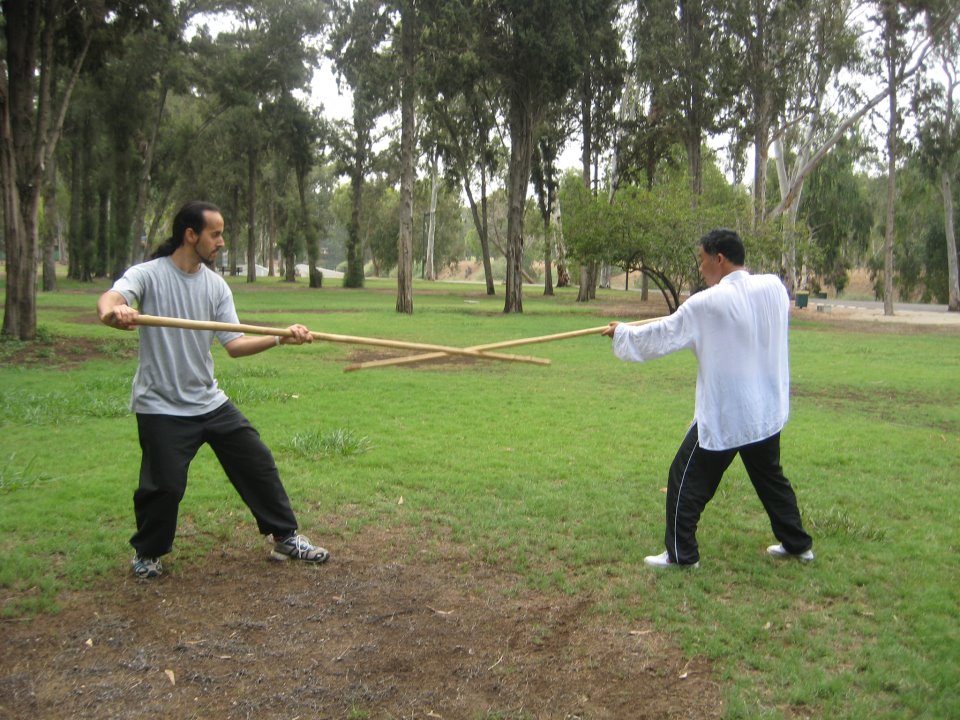
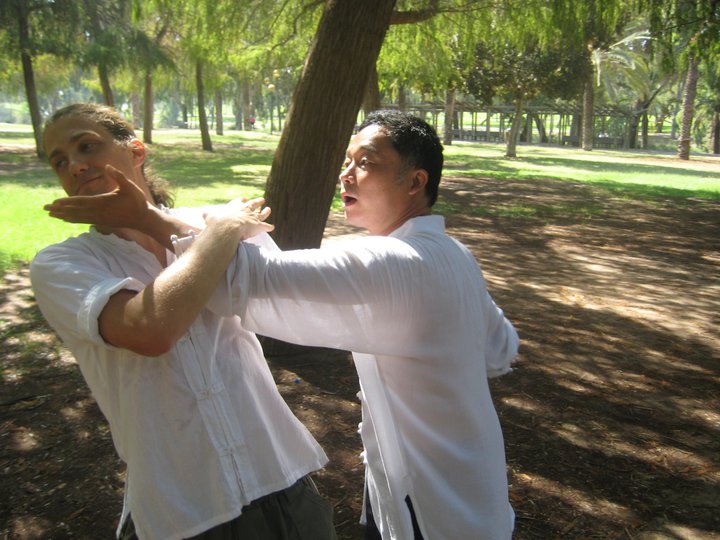
Zhou shifu, with one of his top students, Nitzan Oren from Israel. HaYarkon Park, Tel-Aviv, Israel, August 2010.
I believe that Zhou’s ideas about foreigners must have taken their first shift once he began to teach Westerners in the 1990s. Slowly but surely, he came to understand that they were not at all as bad as they were always portrayed to be when he was younger. A major change of heart was in the years following Zhou’s acquaintance with my teacher, Nitzan Oren. At the time, and also nowadays, Zhou have had trouble with students leaving his side before they could learn a reasonable amount of martial material and skills.Most of the young Chinese tend to neglect serious martial arts practice, possibly because Zhou is more readily available to them (don’t appreciate him enough because of that), and also because the pursuit of careers and finance is of a greater interest to them than training. Few of Zhou’s Chinese students have stuck around for over 2-3 years, and those who did, usually never trained as hard as Zhou had probably hoped for. One Chinese female student of Zhou had stayed with him for 11 years, and had reached a very good level. Unfortunately, she quit training altogether once she got married (as commonly happens in Chinese society, which is still very chauvinistic compared to the West).
Zhou shifu, with one of his top students, Ben Bario from Israel.HaYarkon Park, Tel-Aviv, Israel, August 2010.
Nitzan was the exception, remaining by Zhou’s side for 7 years straight, and studying with him daily. It was the first time that Zhou had had such a serious-minded student. In the beginning, Zhou still carried some cultural biases and prejudices towards Westerners. Over time though, Nitzan’s persistence and perseverance have made him change his mind about Westerners. Following Nitzan, more and more Westerners came to study with Zhou. He then noticed that, not only were these people willing to come all the way from another continent to train with him, some of them also invested more effort in their training than many of his Chinese students. He also figured that these Westerners were genuinely interested in traditional Chinese culture, which ironically, many of the younger Chinese were now throwing away, in favour of chasing fantasies related to the Consumerism and Hedonism of the globalized “American” culture. In an age in which the Chinese are quickly losing their own cultural roots, Zhou has found comfort in knowing that there are foreigners willing to put in the time and effort, to preserve what is dear to him, besides his few dedicated Chinese students. That is why, as a mature adult, he had a drastic change in some of the ideologies he had been indoctrinated into since early childhood, and have come to accept Westerners as equals, and decent people. To the extent that at such an age (when he was over 35), a person is willing to consciously have this big a change of heart, is in my opinion a wonderful testimony to Zhou’s pragmatic, humble and down-to-earth character. In our time, many Chinese (in mainland China) treat foreigners nicely, but think and speak badly of them behind their backs, as a result of the education they had been receiving from youth (though the situation is improving, and there are also many Chinese who are most welcoming and kind towards foreigners). Zhou has transcended that nationalistic mentality, and have come to accept Westerners without prejudice or bias. That sort of attitude may ‘go without saying’ for a person educated in the safe confines of a Liberal Democracy, but for a person who has been brainwashed all his life as a citizen of a Totalitarian state, this is not at all obvious. Today, Zhou has many foreign students worldwide, and takes great pride in all of them.
Zhou shifu teaching Ilan – a 3rd Dan Aikidoka from Israel.HaYarkon Park, Tel-Aviv, Israel, August 2010.
In general, it can be said that Zhou is very dedicated to his students. He treats everyone with equal care and attention, whether Indoor or Outdoor students, young or old, Chinese or Western, long-term or short-term. He garners respect for any student with sincere interest in martial arts, and would out of his way to teach more if the student works hard. Sometimes, one even has to ask Zhou to slow down, as he is so eager to teach more as soon as he thinks the student is capable.
As mentioned earlier, in China, many still have mixed or negative feelings towards non-Chinese. Therefore, in the park, rude people would sometimes pass by and mock or laugh at foreign practitioners. These acts are disgracing, since usually a Chinese would not dare to behave in that manner towards another Chinese in public (that said, we should consider that sadly, this phenomenon also exists in the West). Zhou can become very upset with such people, and would immediately shout at them and scold them for talking of or behaving badly towards his students; making sure they would leave the place at once. It is important that I stress in any case, that such people are an exception to the rule, and that most Chinese think positively of people who are sincere in their efforts to learn aspect of their culture. More commonly, I would encounter Chinese people who were very happy to see a Westerner practicing Chinese martial arts.
It is important to understand that martial arts are everything to Zhou – his hobby, his job, and his way of life. While educated to an extent in Calligraphy, Chinese literature and Classics and even in Traditional Chinese Medicine, martial arts were always his focal point. In his lifetime, he has had many jobs in commerce and trade, from book-salesmanship to gem-trade, but teaching martial arts have remained his only steady occupation. Like many other great teachers in the past, this kind of lifestyle is what had helped him reach a superb level of skill in his pursuit of choice.
There are some teachers who have had more influence over Zhou than others. One such teacher, which he holds in high esteem, is master Li Guoliang (of Tianjin; there is another known teacher by the same name from Taigu, whose name is written with different characters in Chinese). From master Li, Zhou had received much of his knowledge of Xing Yi Quan – a lot of which is rarely seen elsewhere nowadays, and have also gained the deep foundations in Zhan Zhuang (standing post) training. These teachings have deeply affected the way Zhou shifu practices and teaches martial arts. Zhan Zhuang, and other skills taught by master Li, are now ‘obligatory material’ for any student who comes to study under Zhou (with proper, specific adaptations being made for the particular martial art the student is practicing). Zhou considers the Zhan Zhuang training to be the most important, and have told his students that: “Even if one cannot practice at all on a certain day, it’s still vital that one would somehow make time for practicing Zhan Zhuang for at least 20 minutes”. Another skillset that Zhou would teach, to advanced students, are his Dan Tian development methods, which he had learned from several teachers, but in particular and most of all from Zhao Fujiang (one of his grand-teachers). To train these, one first needs a solid foundation in Zhan Zhuang, which requires prolonged daily practice. The Dan Tian methods can then be introduced, and later be implemented and embedded into any of the arts Zhou teaches, in most fighting movement.
Master Zhou is also a big exponent of the notion of Quality being more important than Quantity. Although he himself have studied many arts, he had dedicates several years, and many hours a day, for the practice of each of these arts. Therefore, it is important to him that student spend the time required to hone their ability with each method, drill or technique, before they move on to learn more material. That said, Zhou is pragmatic in his approach, and does not force the students to abide by his wishes. Nor does he even force anyone to study a particular art or skill, and the final choice is up to the student. His words are a hearty recommendation – one’s that’s often better adopted, but is not strictly dictated or enforced. A student’s free will and self-actualization is, eventually, what’s most important to Zhou when he teachers.
Master Zhou, demonstrating application with his Israeli student, Etai. During this particular moment, Zhou was showing how proper alignment and structure, as developed through Zhan Zhuang training, can make it easy for a small person to resist a much larger individual. Zhou is roughly 5’6 in height, and Etai is 6’4. HaYarkon Park, Tel-Aviv, Israel, August 2010.
Because many of the higher-level skills Zhou has learned had originated from his Xing Yi Quan practice methods, and possibly because of his teacher’s requests, Zhou refrains from allowing video of his Xing Yi to be taken. It is a shame, as his Xing Yi truly exceptional. I remember vividly how I watched Zhou demonstrate things with his Xing Yi that others only speak of.
For example – many people have written of the difference between ‘Ming Jin’ (obvious power) and ‘An Jin’ (hidden power) in the art. Few teachers, though, can show the difference well. Zhou once demonstrated this difference to us students, using the same movement – Pi Quan – Xing Yi’s most basic movement. The first variation, of ‘obvious’ power, had cut through the air like a baseball bat making a home-run. It was blunt, solid, sharp and defined. Then he delivered the ‘hidden power’ variation, which is of the higher level. It shot away like lightning tearing a gap in the air, lashing out with a true killing intent, which was at once both subtle and frightening. Myself, I could demonstrate this too, but certainly not as brilliantly as master Zhou does. In his demonstration, even though he had not touched anyone, you could feel the differentiation of spirit and intent behind the movements in a very distinct fashion.
Another time, I’ve had the ‘privilege’ of Zhou asking me to try and use short-power striking (Cun Jin) on him. This meant I needed to shock him with a strike from zero distance – my hand already on his chest. I was not skilled enough at the time, and Zhou was not satisfied with my power. I could not at all affect him. He then asked me to be his dummy. I was to stand in a strong stance, and flex my chest muscles as he was about to release his force on the side of them. As he did, I felt nothing on the surface of my skin, and he barely seemed to move at all. It was as if he had touched me with cotton. From roughly the middle of his striking palm, it felt as if a very thin needle had dug deep into my chest, and within it had carried an explosive charge, which was then detonated as it had reached the middle of my torso through the route set by the ‘needle’. For a split of a second, I felt Death. Psychologically, the closest sensation I could think of is when one vomits badly when one is very ill, and momentarily feels like he is about to die. That is somewhat how I felt – for a moment, as if my game was over; there wasn’t even enough time to fear what was going on – it was only the knowledge of impending doom that was quick enough to enter my consciousness. Luckily, master Zhou knows what he’s doing, and did not shock me with his full capacity. Neither was there any damage or pain following the moment of the strike. Still, this was a humbling experience, which had made me realize some of the true potential of what Zhou is teaching.
Zhou shifu, demonstrating an application on Tom, one of his Israeli students. HaYarkon Park, Tel-Aviv, Israel, August 2010.
This all reflect Zhou’s liking for the hands-on teaching approach. He rightfully believes that in order to truly understand martial arts, the student must feel them. This means, beyond the obvious, that the student should have free access to touching Zhou’s body when he performs movements, to get a sense of how the body is supposed to move; also, that the student be able to execute the techniques on Zhou himself. These things are absolutely essential for learning Zhou’s martial arts. They also expose the intimacy of the relationship between Zhou and his committed students – with both sides expected to openly ask any question, and not shy away from physical contact. This is the traditional manner in which many Chinese martial arts were taught, but this approach is becoming exceedingly rare in the teaching of traditional martial arts; especially in the West and in Japan, where because of cultural politeness and social norms, many prefer a more ‘sterile’ learning environment and a teacher that keeps his distance and plays the role of an ‘authority figure’. Zhou would have none of that, and would never claim to be an authority on anything, or expect a better treatment by anyone because he is a teacher.
Now closing in on his 50s, measuring by his skill and power, one could never guess. He would still casually perform splits, move faster than any of his students, exert a greater amount of force than them in his strikes, and easily toss people weighing twice his weight. Other things Zhou can do are, too, out of the ordinary. By the power of his mental intent alone, for example, he could make the hairs on his hand stand erect or fall (these are moved by tiny muscles under the skin, which in medical literature are said not be under one’s conscious control). I have also seen Zhou using mere one or two fingers to strike people in demonstrations, making them collapse sideways or to the ground at a great velocity because of the shock.
It is not that Zhou is a Superman of sorts. He is nothing but an ordinary person who has taken his skills to a very high level, in a process lasting several decades. He is the first to admit, for instance, that he is not a strong man, and cannot carry or lift exceedingly heavy weights. His skill with the martial arts, involving an attuned technical ability and a body built around this skillset, is what enables him to handle other human beings, in fighting, much better than people who are physically bigger and stronger than him. Some of the arts his teaches, such as Baji Quan, lend themselves well to people of a greater mass and height. Still, Zhou has proven that with dedication and perseverance, one can reach a level in which is the skill itself matters much more than other attributes.
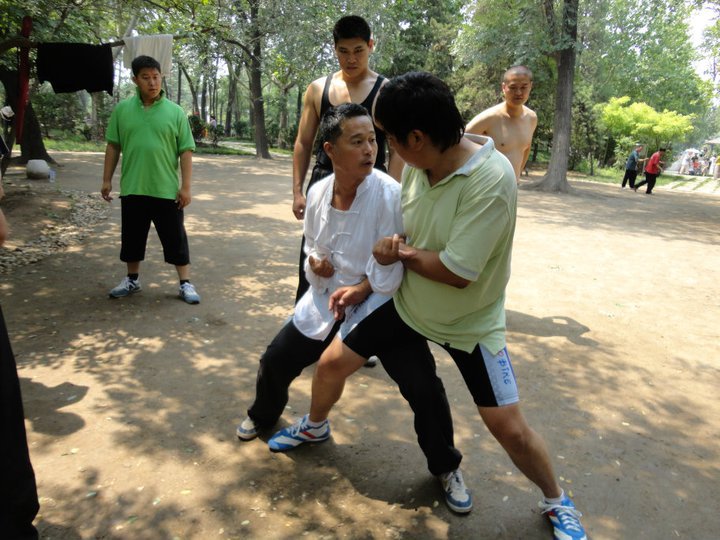
Zhou shifu, teaching Baji Quan to a group of Chinese students. All of them are bigger and heavier than him. The Chinese guy standing directly behind Zhou is Xiao Hei – a national Western-Boxing champion, who is 6’3 and weighs twice Zhou’s weight.
To have had the opportunity to learn with Zhou and his student Nitzan is something I shall always cherish. I feel that such a privilege, of finding a true traditional teachers of the Chinese fighting arts, who is both capable and a good person, is rare, even in the age of globalization and access to Internet resources. One of the biggest regrets I have in life is, that my own personal circumstances have not allowed me to spend more time with Zhou shifu, and take from him what he so willingly aspires to give to those interested. It is my hope that, in the future, many others would have the opportunity to get to know Zhou, as a teacher and a human being. From the times I have spent with man, I have undoubtedly benefited more than I could have ever described in an article.
A Brief Introduction to Fujian White Crane Kung Fu
Fujian White Crane Kung Fu, once known as Tiger Crane Combination Kung Fu comes from Fujian Province in China. Fujian Province is famous throughout China for its flamboyant, fierce and efficient White Crane Kung Fu styles. For the sake of simplicity, it is known as Fujian White Crane Kung Fu in the West. It is the complete system of White Crane (the tiger stance providing a strong base for the more flamboyant hand techniques of the crane).
Created by a female martial artist called Fang Qi Niang it incorporates fighting principles to suit every body type and personality, and has a defense to counter various attacks. The characteristics of this style are deep rooted stances, intricate hand techniques and fighting mostly at close range.
Because of its complexity, the system is often known as a “scholar’s style”, suitable for students who wish to take their skill to the highest possible level. The efficiency and practicality of the Crane system is such that a number of other styles have borrowed elements of this style to make those styles more effective.
The Crane is a Chinese symbol of happiness and longevity and Crane style exercises are renowned in China for improving the general wellbeing of the practitioner. As well as the muscle groups, Fujian White Crane Kung Fu exercises increase flexibility, improve lung capacity, strengthen the joints and increase bone density.
If you’re interested in studying Fujian White Crane Kung Fu full-time in China visit the http://www.StudyMartialArts.Org website there you will find a host of masters and martial arts schools where you can learn traditional Chinese Martial Arts.
Phew – for some time there, it looked like my epic Kung Fu pilgrimage was looking like turning in to the most extravagant wild goose chase in human history. Ok, apart from the search for the Holy Grail. And Noah’s Ark. Oh, and there was the Ark of the Covenent for a while there, and something about a golden fleece for the Greeks? Oh no they got that in the end, didn’t they.
OK fine it’s not the most extravagant wild goose chase in history, but grant me a little dramatic invention with a splash of poetic license and things will go much easier for the both of us in the long run, I promise.
Anyway, where was I? Ah yes. After a week of searching, I was beginning to worry having not seen an ounce of Kung Fu, anywhere – and this was only confirmed by a student in one of my first classes who took no small pleasure in telling me that the nearest place that specialised in Wing Chun was halfway across China, and nobody really did Kung Fu in Sichuan Province. Having travelled several thousand miles specifically for this sole purpose, this came as something of a disappointment. It turns out that I have managed to pick the only province in China where nobody really gives a monkeys’ about Kung Fu – not even Kung Fu with monkeys in it (yes, for those uninitiated in Kung Fu lore, there is such a thing) or Kung Fu done by magical ghost monkeys (I can back this one up too – put ‘Monkey King’ in to You Tube for the most random five minutes of your life). There is, in fact, a distinct lack of Kung Fu, or monkeys, or any combination thereof, in this province. I hope I am clear.
Indeed it was all beginning to look rather bleak, until the wife of a fellow English teacher at the university mentioned a group of older women that do Tai Chi every morning, right outside my flat. Now I have to admit that two weeks ago this news would not have filled me with joy, but by this stage I was beginning to panic that my best laid plans were rapidly laying to waste, so I decided to check it out.
Which is why, at 6:45am on a Sunday morning I was roaming the streets of the campus in a pair of tracksuit trousers and a t-shirt in rain that, were it any heavier, would have required a pair of armbands instead of an umbrella. After about twenty minutes of soggy wandering the nearby streets I began to wonder if they came out in the rain after all, and was set to turn home when I espied an open door to a hall, with music drifting out of it and in the gloom, an elderly gentleman inside, wearing duck-egg blue silks and moving slowly, ethereally, slipping through the air as if he were floating on top of it. I had found my Tai Chi.
Cautiously I sidled up to the door, lingering awkwardly in the foyer like only a Brit can. Taking pity on me, the old man smiled and motioned toward a chair, indicating it was OK to watch. I tried to explain that no, I wanted to learn, and we soon discovered common ground in that I spoke not a word of his language, and he not a word of mine. This led to an awkward five minutes of miming and pointing from me and much awkward, albeit patient, grinning from him until realisation dawned and my brand new Sifu invited me to follow him. Two things immediately sprang to mind. One, that in China Tai Chi is not so soft and slow as it is in the west (the martial form is punctuated with snaps of speed and power that I was not expecting) and two, that although it is slow (or because it is slow) Tai Chi is actually one heck of a workout. After the first hour I was sweating; movements that I would have used kinetic energy to achieve in the past (kicks, stretches etc) now had to be achieved through strength and suppleness alone.
I am put in mind of a swan floating on a lake; the beauty visible above the surface of the water belies the churning effort of the legs to create all that graceful floating. And disguises an incredible power – the swan also, as the saying goes, has the power to break a man’s arm. I ended my first two hour class exhausted and excited. Tai Chi Quan is not the Kung Fu I came here seeking, but it may well be what I find.
Inherent in BaJi Zhandao philosophy, is the Daoist concept that is woven throughout Daoist philosophy; namely the vital and integral theory of Yin and Yang.
That, at the same time something can be large and limitless in its size and entirety, like the infinite expanse of the universe itself; simultaneously there can exist side by side, its opposite of such infinitesimal size, like the tiniest of atoms.
Baji Zhandao (Baji Fighting Dao) is the combination of Qi (breath or energy), martial arts, health, medical/therapeutic healing arts, aesthetics, and fighting skills, all of which can be applied to a skillful fighter or to produce an accomplished martial artist. Judging from its name, “Fighting Dao” is the instrument through which the proponent can gain victory.
I have been practicing Ba Ji Quan, Pi Gua Tong Bei, Ba Gua, Tai Chi, Xing Yi and many other kinds of traditional Chinese martial arts since I was very young. The great Ba Ji master, Wu Zhong, went to Shao Lin temple to compete in three matches, all of which he subsequently won. Some emperors in the Qing Dynasty learned Ba Ji from Huo Dian Ge, who was then an armed escort in the retinue of Wu Zhong. Many Ba Ji practitioners also served as bodyguards for among others: Sun Yat-Sen, Chiang Kai Shek, Chen Shui Bian, Mao Ze Dong, and Zhou En Lai. Ba Ji’s success in this area is testament to its practicality and martial techniques, which are not flowery or useless moves, but instead a series of deadly weapons.
I have won many gold medals in both national and international martial arts contests and in April 1995 was listed in A Compendium of Chinese Martial Artists. My students and apprentices come from 15 different countries around the world.
In 2007, I founded Ba Ji Zhandao, which, with the basics of Ba Ji Quan, also incorporates aspects of Tai Chi, Xing Yi, Ba Gua, Tong Bei, Praying Mantis Boxing, Chuo Jiao and Wing Chun and has developed into a new school of martial arts. The internal training aspect, or Qi Gong, was exclusively passed on to me from my teacher, as I was an indoor student. Following years of practice and my own research, I have developed Ba Ji Zhandao, so that the practitioner can attain even more powerful internal strength and more efficient internal breathing, to time in perfect accompaniment with the martial art moves. Other external strength exercises practiced include Tie Sha Zhang (Iron Palm), Huang Long Zhang (Yellow Dragon Palm), and so on.
八极战道的理念
Ba Ji Zhandao theories
无为不漏法:The method of energy retention and circulation and the creation of a “steel jacket”.
The body has 4 main acupuncture points, namely the Bubbling Well in the feet and the Lao Gong in the palms. To initiate the retention and circulation of energy throughout the body; first, using the mind the practitioner must “close off” the 2 Bubbling Well points (Yong Quan) and the 2 Lao Gong points; following which the practitioner can begin to close off the remaining acupuncture points throughout the rest of the body.
Although one is closing off these points, this is to close off the points to outside interference or incoming energy/power; one must use the heart and mind to focus the concentration on keeping the inner body’s energy gates open to allow the energy to flow through; doing thus will allow the muscles, tendons, sinews, vessels, organs and energy channels to become stronger and more invigorated, until finally your body will feel like it is made from some kind of indestructible material like a diamond or “steel jacket”, that cannot be penetrated by an opponent’s force, yet will enhance the practitioner’s health and longevity.
People practice Ba Ji Zhandao to promote Chinese Kung Fu and to enhance communication among Kung Fu fans around the world and to continue to develop the art and their own practice. It can build your body, health and strength, dispel disease, plus bring you a long life. We are committed to bringing out the true martial, health and curative functions of martial arts and clearing the misunderstanding caused by “flowery but useless Kung Fu”. Ba Ji can also cultivate your willpower, intelligence and health, as well as develop a firm and indomitable spirit.
八极战道如何训练
Ba Ji Zhandao training regimen
一:形体外功训练(柔身法)通过柔身而达灵活敏捷之目的。
Body conditioning and training to make your body flexible and agile.
二:刚阳法(黄龙掌•铁砂掌)。训练效果可使双掌具有很大的杀伤力
Gang Yang training (yellow dragon palm, iron palm) is to make your palms deadly weapons.
Post training (“engraving the wooden post”), striking the board, kicking the ball can make different parts of your body strong enough to resist blows and defeat your opponent, enhance your blood circulation and make your body more sensitive i.e. Increasing the sensory perception and awareness, in Chinese this is referred to as “Ting Jing”, that is making the body, even the skin, the limbs, the senses and the visual awareness and all perceptory organs/features more and more sensitive, so the practitioner becomes even more aware of what others are doing or even intend to do.
四:空劈掌,每天劈1000掌,目的可使周身灵活强劲似弹簧,双掌练出穿透劲儿(穿甲劲儿)。
Palm chop or hack. Every day you should practice palm chops 1000 times to make your body have the qualities of aliveness, agility and elasticity, plus the coiling, explosive power of a spring, additionally, after training your palm will be able to slice through objects.
Practicing Ba Ji Zhandao’s internal breathing, energy and strength (Qi Gong) training for 2 hours everyday, can soon change the overall functions of your body and integrate it into the martial arts so that every part of the body can be as hard as a diamond and every movement can be deadly.
Ba Ji’s Zhandao includes 6 forms, a dagger form, a sparring form, a 2-person sparring exercise, (wrestling and qin na or joint-locking, striking acupoints (Dim Mak) and dislocating the joints) small Ba Ji, large Ba Ji, six big opening, eight big moves, six elbows, broadsword, spear, rapier, cudgel, Tai Chi, Xing Yi, Ba Gua, Pi Gua, Tong Bei, Mantis forms and so on. After some period of diligent practice, successful students will become accomplished martial artists who can deal with a variety of potentially dangerous situations, plus have great skills to fight with and defeat opponents.
The essence of Ba Ji’s Zhandao: Ba Ji Zhandao has its roots firmly embedded in traditional Daoism, which is the very essence of Han Studies. China is a sound milieu conducive to the development of martial arts. Here, every style and school of martial arts is in full bloom, each with its own respective uniqueness. Ba Ji Zhandao incorporates Ba Ji, Tai Chi, Xing Yi, Ba Gua, Pi Gua, Chuo Jiao, Tong Bei and Wing Chun. Internal breathing, energy and strength are the essence of martial arts, so the better these qualities and components are, the better the martial artist you will be. Inherent within the core of martial arts are also philosophy, military strategy, psychology, scientific theories, the theory of meridian science, Daoism, Confucianism, and Buddhism. All the aforementioned are essential to Ba Ji Zhandao. I have been practicing martial arts for more than 50 years and with overseas students coming from 15 different countries, I am proficient at teaching martial arts in a scientific and efficient way, to allow students to comprehend the material and movements taught.
He was a shooting star – brilliant, breathtaking, rare, and gone too soon. But in his 32 years, Bruce Lee practiced what he preached, reaching a near-perfect physical and mental state few can even fathom. Obviously this took him his entire life to reach; there are ways that we can learn from Bruce’s lessons and mishaps so that we can reach our own self-perfection.
Bruce Lee’s life reads like mythology. There are magnificent stories within his overall story that made him into the legend he has become. The same can be said about fitness; there are lessons within the overall model (we call these lessons “attributes”). But one must start with the overall story – the overall attribute – before one can break things down and focus on the small stories. I am going to call the overall attribute “the Jeet Kune Do fitness ideal”; that is, what makes a JKD practitioner fighting fit overall.
I think to set this in context, we need a story from Bruce Lee’s life and I can think of no better one than the catalyst for Bruce Lee’s split with traditional Wing Chun Gung Fu and the beginnings of Jeet Kune Do. The year is 1964 and the place is Oakland. Bruce Lee is in trouble for teaching non-Chinese gung fu, so he is challenged to a fight with Wong Jak Man, supposedly one of San Francisco’s gung fu champions of the time. The fight begins, Bruce hits Wong, and Wong begins to run around the room with Bruce in hot pursuit. Eventually Bruce catches him, jumps on him and hits him a few times, and forces him to conceded defeat. What was the problem here? There were two main ones, actually. First, Bruce could not apply his techniques adequately to end the fight in any acceptable amount of time, thus the beginnings of his search for better ways (JKD). Second, and most important for this entry, Bruce was exhausted from chasing Wong around the room. It suddenly became very obvious that he needed to improve his fitness level, and fast.
From that point onward, Bruce upped his conditioning routines and the results can be readily seen in any of his movies (notice, too, that his physique improves from one movie to the next, until you see his ultimate physical perfection in Enter the Dragon). Bruce was meticulous in recording his routines, so we are lucky to have many of them still. One will notice while looking through them, though, that his routines evolved over time. The being said, he always had a few exercises he stuck with until his death in 1973, the main one being running (usually with his dog, Bobo). Bruce ran not just for conditioning, but for mental clarity, which was needed more and more as he approached the end of his life. The point here is three-fold: 1. Jeet Kune Do has a focus on conditioning, 2. conditioning is important for both mental clarity and fighting ability, and 3. the forms of conditioning evolved over time.
Fast forward to today and my personal routines, in and out of class, for my overall attribute-building. I always begin class with conditioning routines, usually involving rounds of running with interval exercises mixed in (I will cover this more in a later entry). Personally, I have turned to plyometrics (jump training) for my fitness needs and the results have been astounding. I combine these exercises into intervals, so I may do a set of 3-5 plyometric exercises for 4-5 minutes, take a 30-45 second break, and repeat. I have found this has not only drastically improved my conditioning attributes, but it has also improved my overall physique. That is not to say I don’t run. I still run 3-5 miles (more than that is excessive, in my opinion) once or twice a week if I can. I combine this with bag work and calisthenics and I am currently in the best shape of my life. I can train longer and harder, spar more effectively, and perform techniques with more ease than ever before. Bruce Lee was onto something, but there is no surprise there.
To sum up, overall conditioning is very important in Jeet Kune Do. It should be key in every martial art and to martial artist. Too often martial artists rely on nothing but their training to carry them through, but Bruce Lee found out the hard way that sometimes pure training isn’t enough. We have to supplement and constantly improve and evolve. That is one of the core essences of Jeet Kune Do. Stay fit and fight longer.
Shaolin Kung Fu is technically speaking the martial arts system of attack and defense movements that uses forms (series of moves combinations:套路 taolu) as a basic method of training. Both the moves and their combinations are based on Traditional Chinese Medicine’s theory about the working of the human body. The cultural and spiritual aspect of Shaolin Kung Fu comes through its essential roots in Chan Buddhism, the first belief shared by practitioners. This is especially the case in regards to wisdom and strength; for wisdom, the Buddha Puti Damo (left) is worshipped to and for strength, the Buddha Jin Na Luo Wang (right) is taken refuge in.
A Typical Day For a Shaolin Monk
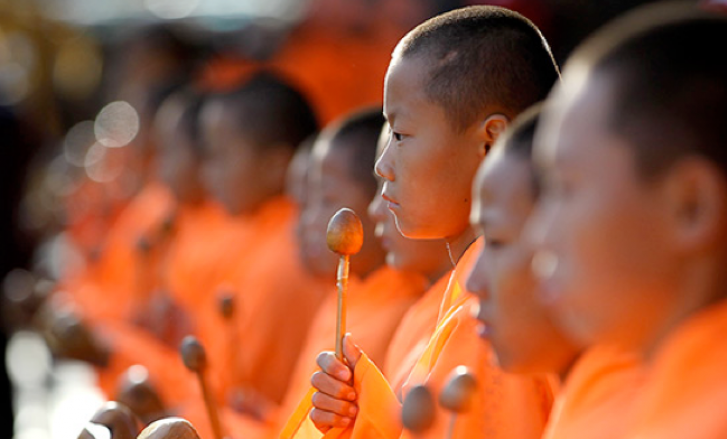
Early at five o’clock every morning, the monks of the Shaolin Temple arise with the striking of the gong. They join together to start the first morning class of the day, lasting for 90 minutes. At 06:40, monks mindfully join a line in the Zhai Tang (place where the monks have food) to have breakfast. Before and after the meal, monastic chanting is carried out. Every monk has his own alms bowl with food in it and is not allowed to leave anything uneaten. During this meal time, everyone is to keep silent. Between 08:00-09:00 the monks study Buddhism where dharma learning is taught to cultivate knowledge and wisdom. Between 09:10-11:30, there is study time to practice Kung Fu at the back of a nearby mountain., Lunch is then taken afterwards at 11:40 in a similar manner to breakfast, some grand masters and scholastic monks however do not eat lunch in order to enter fully into their monastic life and study. Afternoon training time then takes place between 14:00-17:30. After a short rest, members of the temple go to the monastery for evening chanting which lasts an hour. The final part of a day is a 45 minute meditation period followed by a period for self-study that lasts until the sound of the bell again at 21:30 which signals the end of the day.
Shaolin Kung Fu’s Nine Steps of learning:
1. 结缘 Knowledge: In various ways, begin to know about Shaolin Kung Fu and the Song Shan Shaolin Temple 2. 仰慕 Admiration: Feel moved by the sprit and character of Shaolin Kung Fu and so be naturally energised towards it. 3. 抱负 Ambition: Start to plan your life again after the feeling of your heart and making the decision to learn Shaolin Kung Fu. After setting a specific goal, set your mind to realize that ambition in your lifetime. 4. 痴迷 Enthusiasm: Make a self-affirmation of the goals chosen and pursue with a one-pointed determination of love and dedication. 5. 行动 Action: Adapt your goal to specific courses of action and start to practice Shaolin Kung Fu. This will be a hard learning process. 6. 认识 Understand: Come to rational knowing and the cultural connotations of Shaolin Kung Fu. 7. 信仰 Faith: Start to transform rational understanding into a deeper understanding about Buddhism. Shaolin Kung Fu is considered one way of learning Chan Buddhism (and so named “Wushu Chan”). 8. 感悟 Awareness: Practice Shaolin Kung Fu from a deeper self belief enabling practice to become not just a goal but an effective path to becoming aware and realising the essence of Buddhism. 9. 见性 Nature: From learning Shaolin Kung Fu, develop a full understanding about wisdom and strength, see the truth of life and the universe.
Master Shi Yan Jia
Master Shi Yan Jia (Wei Shifu) is a 34th generation Shaolin Disciple of the current Shaolin Temple Abbot the Venerable Shi Yong Xin, came to the Shaolin Temple to learn Shaolin Kungfu from the age of 8 years old and stayed there for a further ten years. He is currently ranked at level 7*. He has 8 years of experience in teaching Kung Fu to international students from all over the world and giving performances to many people. In the 1st national Shaolin Kung Fu competition Master Shi Yan Jia was awarded first place in traditional Shaolin Fist form and Shaolin Spear form. At the 9th Sports Meeting in Henan province, he also won first place for his Shaolin Staff routine, and in the championships of Zhengzhou, he came first in the Traditional Sword form category. Master Shi Yan Jia is the headmaster of Qufu shaolin kung flu school. The school has only recently relocated to Shimen mountain near the historic city of Qufu (eastern Shandong Province), hometown of the great Chinese philosopher, Confucius. If you would like to find out more about his school visit www.studymartialarts.org or Skype: studymartialarts.org for a free consultation on your martial arts trip to China.
In the summer of 2007 while on a break from my urban planning job back in Belfast I made the decision to travel to China and study traditional kung fu. I craved adventure and a change from the daily grind. Most of my friends had gone travelling between school and university or between university and work. I’d created a window of opportunity and felt this was the right time to use the money I’d saved. My martial arts experience at that time was limited to my regularly Jeet Kune Do classes. Despite my lack of sashes or belts I wasn’t worried. What I lacked in experience I knew I had in determination to work hard and learn as much as I could. Like most of you reading this article I’ve an interest and passion for martial arts as well as a growing interest in learning more about the spiritual and healing arts of China. As a teen I used to day dream about what it would be like to visit a land where a monkey could become a king.
China here I come…
Immediately I set to the task of researching kung fu schools in China. I craved being taught in a traditional way without distractions. I wanted to learn how to deal with confrontation effortlessly and improve every aspect of my life.
So I took action and found a school, got my visa and boarded a plane. 13 hours later I arrived in Beijing totally unprepared. I stayed the night in a hotel near the airport and the next day I boarded my internal flight to my end destination with high hopes. I was as green as the grass I’d left back in Ireland. From that moment until now it’s been one hell of an adventure.
Over the last few years I’ve visited a lot of kung fu schools and met a number of students studying at these schools. Some have come for martial arts, some adventure, some for health and fitness and some simply to create space for changing past bad habits. Your reasons for seeking this experience are your own. But what they should have in common is a desire to improve. Focus on your training and the experiences and other benefits will follow. So here are my 5 top tips for getting the most out of your training at a kung fu school.
Shaolin martial arts students
My top 5 tips
There are more schools than ever popping up all over China specifically to cater for the growing demand from westerners who want to study traditional kung fu. Make your decision carefully, not just in terms of your school choice and style but also in terms of what you want to achieve and get out of the experience. Schools now offer students more than just martial arts. They offer often offer additional classes in Chinese language, Buddhism and TCM for example. These are good and offer you the chance of dipping your toes in the water from which further learning can be sought.
The importance of your fellow students at a kung fu school should not be under estimated. These students will be people you will learn from and have to live with.
Be realistic. There have been occasions when I’ve received enquiries from students that are just damn right ridiculous or expect to be able to open their own schools after as little as 6 months to a year of studying.
Be prepared for a culture shock and a different way of thinking or in some cases a total lack of thought. Remember that can also be part of the enjoyment too. You’re not in Kansas anymore so don’t expect it to be the same or constantly winge about it. We all go through this and at times have a love hate relationship with the place(s) we visit. When you catch yourself doing this stop! If it continues just go home. Don’t bring those around you down with a bad attitude or negitivity or disturb your fellow students training or enjoyment. Be patient, present and self aware.
And remember just because someone is wearing kung fu shoes, a kung fu suit, or has some prayer beads it doesn’t mean that they are a good master or martial artist.
If you’d like to find out more or have any questions about studying martial arts in China this site is the pick of the bunch. www.StudyMartialArts.Org







 He was a shooting star – brilliant, breathtaking, rare, and gone too soon. But in his 32 years, Bruce Lee practiced what he preached, reaching a near-perfect physical and mental state few can even fathom. Obviously this took him his entire life to reach; there are ways that we can learn from Bruce’s lessons and mishaps so that we can reach our own self-perfection.
 From that point onward, Bruce upped his conditioning routines and the results can be readily seen in any of his movies (notice, too, that his physique improves from one movie to the next, until you see his ultimate physical perfection in Enter the Dragon). Bruce was meticulous in recording his routines, so we are lucky to have many of them still. One will notice while looking through them, though, that his routines evolved over time. The being said, he always had a few exercises he stuck with until his death in 1973, the main one being running (usually with his dog, Bobo). Bruce ran not just for conditioning, but for mental clarity, which was needed more and more as he approached the end of his life. The point here is three-fold: 1. Jeet Kune Do has a focus on conditioning, 2. conditioning is important for both mental clarity and fighting ability, and 3. the forms of conditioning evolved over time.

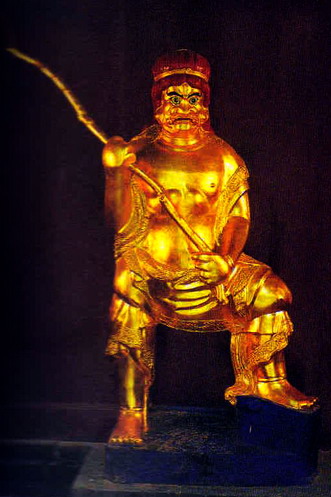 Shaolin Kung Fu is technically speaking the martial arts system of attack and defense movements that uses forms (series of moves combinations:套路 taolu) as a basic method of training. Both the moves and their combinations are based on Traditional Chinese Medicine’s theory about the working of the human body. The cultural and spiritual aspect of Shaolin Kung Fu comes through its essential roots in Chan Buddhism, the first belief shared by practitioners. This is especially the case in regards to wisdom and strength; for wisdom, the Buddha Puti Damo (left) is worshipped to and for strength, the Buddha Jin Na Luo Wang (right) is taken refuge in.
 SMA bloggers