Discipline is one of the most difficult words that I know. No, it isn’t a spelling thing! The difficulty comes from all the aspects that it encompasses. All of the little things that are required to truly have discipline.
The importance of goals will not be included here beyond the point that you NEED goals for your life in order to accomplish anything. How big your goals are will dictate how much discipline you need to develop.
U.S. Navy Adm. William H. McCraven in his speech to the University of Texas 2014 graduating class listed 10 Life Lessons from Basic SEAL Training
1. If you want to change the world, start off by making your bed.
“If you can’t do the little things right, you will never do the big things right.”
It is amazing how something so small and trivial can start you out the right way. It isn’t about being rewarded by your parents for doing your chores. It is about taking responsibility to get things done. As Aristotle said…
There are dozens of everyday things that help develop discipline. These range from following a bedtime and a wake-up time to regular oil changes in your car. Discipline allows you to build on successful and failed activities. It helps in remembering the lessons from everything that you do.
 A common example comes from learning any subject. Once you set a goal (earn the next martial arts rank), you must spend the time and effort to learn and perform properly. It is common that students “think” they know their material but fail horribly when tested on it. This is usually from the lack of applying discipline to their training. I use pretests to show students that they aren’t as ready as they think. Once they’ve completed the pretest., I ask them if it was their best performance. Usually, they admit not. My next question becomes “why wasn’t it?” It may take several ranks of repeating this cycle before it sinks in but most eventually recognize that it is discipline that keeps “good enough” from ruining “excellent.”
It is important to utilize discipline in everything you do daily. The benefits of a little discipline changes your whole day just because you know where your car keys are. People also greatly enjoy when you apply discipline to getting things done that you said you would. This is also part of your career. Not completing tasks can lead to unemployment. In your private life, it builds trust and shows respect.
How can you tell if your discipline is lacking? I’ve asked students (in front of their parents) the question “How many times should you be told to do something??” The answer from students is “Once!” How many times did you need to be told to get the last project/chore done?

 Being “undecided” is the same as choosing to not do something. At some point the decision MUST be made to take action. This is a highly promoted concept in personal protection. Choosing to do something to protect yourself has a much greater chance of survival than choosing to do nothing.
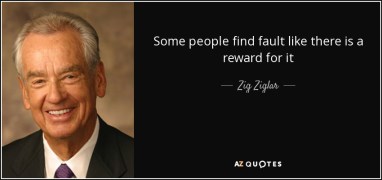 The previous reflected physical and tangible things to make have to make decisions about. The problem is when we can’t take our decision making skills and apply them to non-physical and intangible things. How to chase your dreams is a great illustration here. How long have you hesitated in making a decision about what to do? How many opportunities have passed that would have let you achieve everything you wanted? “And like a fistful of sand, it can slip right through your hands.” This can be anything from finding that perfect job posting and not applying for it because “it’s not the right time” or allowing “I don’t know how” to interfere with moving forward.
 For many years, Tony Robbins has helped motivate people to work for and reach their goals. The idea struck me hard after reading his quote. I recognized the bunch of little things that I’ve been afraid to work on because I couldn’t believe the outcome would be more valuable than what could potentially go wrong. It has left me with more confusion about how to get these things done but that will change as the plan is decided and the work begun. I know that my students have seen some of this occurring but it can’t be helped because I’m not far enough along to have everything smoothed out. It should be seen by them, though, as the journey never ends and the work continues.
 I think that I’ve got a company that has motivated people who have found inspiration in the challenges of my curriculum – official and unofficial. In fact, they can’t get hired into my company without a very long audition that demonstrates their motivation. Their inspiration feeds their motivation to make a wonderful cycle of personal growth. Another quote is to “Hire character. Train skill.” (Peter Schutz) as skill can be taught but character can’t be. I only want people of character to join me in working on these skills.
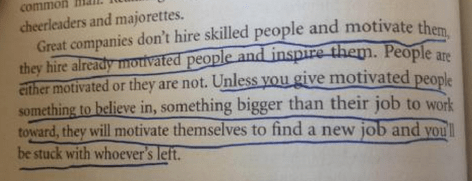 The daily life applications help show these motivated people that there are things bigger than their job to believe in. The students as a group find ways to serve each other and the school, which then leads them to seeing how they can serve within their community (including other special groups that they belong to). I truly believe this as very few people decide to just “quit” our classes. They have life issues that get in the way. Many find their way back but it isn’t as important as them taking these applications with them.
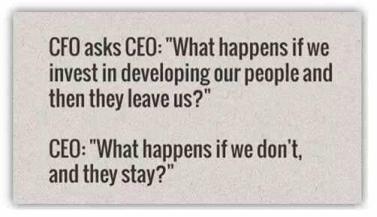 I have students from a wide range of skills and careers. They all come back and continue training because they see how much it helps their world beyond the physical fitness. I greatly enjoy investing in students. They don’t always see it but their effort and development is also their investment in me.
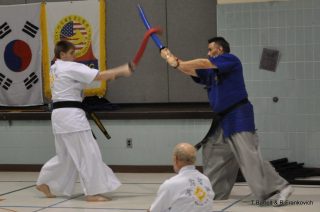 The real fun comes when we add a partner to play the opponent (i.e. Bad guy). The designed response for the partner can throw off the movement of the combination. Movement angles change, techniques don’t seem to be on target any longer. Students can have a hard time “seeing” what they’re trying to accomplish. That’s when I get the “what are you talking about?” look or the “there’s no way this will make sense” look.
 All too often, it is forgotten that there is a progression toward learning new techniques and applications. Some are obvious but many are hidden within the drill. If you get too focused on doing only the original drill, then the insights from the different version will be a struggle to find. This is the same for any subject matter. The physical techniques of personal protection and martial arts are easily recognized but there are others. An everyday example is driving. How many people only know two applications for the car – gas or brake? It takes time to see another option – coast. It takes time because it involves more knowledge and developed skill at reading traffic flow and timing for distances.
 The idea of gaining rank, position or titles is a big draw. People like rewards and recognition. The problem is that true leadership has nothing to do with any of those.
 You should always work to become replaceable. If it can’t survive without you, then too little of the knowledge was passed on. This would be because you really don’t know enough or your were selfish and hadn’t really led anything.
 One example is Dr. Mark Crapo Sensei. He is a high ranking leader within Seidokan Aikido but you probably haven’t heard about him unless you’re part of Seidokan. His leadership has been invaluable to Seidokan but he has lead a far larger entity,

 This came across a newsfeed recently. I think it is awesome! They may be a little blunt but they easily fit the rules for life. Taken from a combat setting, they can be applied to the every day World without much adjustment.
 SMA bloggers