‘Passionate about martial arts, my focus is supporting the martial arts community world wide by running, and managing the development StudyMartialArts.Org, who’s mission is to help sustain traditional martial arts and help martial arts students study, and travel abroad.’
When traveling to Buddhist temples why not prepare yourself and learn about Buddhist temple etiquette?
While traveling its important to be respectful of other cultures and traditions. Being, humble and modest were travel is part of the journey to greater levels of awareness. We hope this information will be helpful to any www.StudyMartialArts.Org students wishing to pay their respects at the Shaolin Temple or any other Buddhist Temple they may visit on there journey.
Below are some top tips.
Buddhist temples
Take off your shoes and hats before entering. There will almost always be a sign outside of the temple pointing visitors to the designated area for shoes and hats. The many pairs of visitors’ shoes clumped together will tip you off.
Cover your shoulders. Since it gets very hot in Asian countries during the summer, many tourists forget to cover their shoulders and legs before entering places…
Instructors are instructors…they’re professional, they teach, they’ll give you attention and hope for the best. Jiu jitsu instructors are no different…they teach, they’ll give attention and like any other teacher, they’ll get frustrated at times. We are after all, human. While I’m absolutely in love with jiu jitsu (shoo-shizzu if you prefer) and love being around my students, sometimes I’m just not in the mood to roll, teach or learn. That being said, I asked 10 different BJJ instructors from different clubs and different skill levels to tell me things that they normally wouldn’t tell their students (or teachers). While no disrespect intended on my beloved art, and on the promise of anonymity, here are the top-10 things your jiu jitsu instructor won’t tell you:
DISCLAIMER: These are quotes from various instructors from various gyms with minor adjustments (such as “we” instead of “I”) made for the flow of the article that has been…
Bruce Lee’s Jeet Kune Do: A Philosophy of Physical Self-Perfection
by David Quigley
It is a safe assumption that almost everyone has heard of Bruce Lee. He was and remains arguably the most famous Asian-American star in the history of film (sorry, Jackie Chan). And anyone who has seen any of his films cannot help but notice his amazing physique, speed, agility, and flexibility. However, what a lot of people do not realize – especially those outside the martial arts world – is that Bruce Lee was a philosopher obsessed with fitness, or what he called, the art of expressing the human body. Indeed, Bruce Lee was a philosopher in every aspect of his life, and focused a lot of his writings on honest self-expression and self-perfection. Even the martial art he developed, Jeet Kune Do (or, the Way of the Intercepting Fist), is in itself a philosophy.
Most of us love our smart phones. I use mine all the time to keep in touch with my family in China. But the constant multi-tasking of texting, emailing, social media and apps is over stimulating our brain and increasing the production of the stress hormone cortisol according to Neuroscientist, Daniel J Levitin, who has written a new book about his findings. So does this mean we have to throw away our smart phones? At The Shaolin Temple we tread the middle way, using Zen techniques to keep us tranquil and focused while still being a part of the modern world. Here I share with you seven Shaolin tips to help you stay calm in a crazy world
Take Small Regular Vacations Turn your mobile phone to aeroplane mode or switch it off completely two hours before you go to sleep. The same goes for when you workout…
Here’s a performance of the Tibetan White Crane (白鶴派) art, Needle in Cotton.
The set is performed by Luk Chi Fu at one of the demonstrations that Chee Kim Thong adjudicated in Singapore in the 1960s. As such, it offers an insight into the richness of Singapore’s martial-arts heritage at that time. At a guess, Luk was probably not actually a contestant: the masters present were also asked to demonstrate for the audience.
Tibetan White Crane is a very different art from the Fujian White Crane styles such as Wuzuquan. In fact, it’s difficult to identify any significant commonalities, suggesting either a relationship in the distant past, or a completely separate art with its own adoption of certain crane characteristics.
At least two groups still practise this art in Singapore. Tibetan White Crane (Baihepai) is an art one hears mentioned frequently in gongfu circles. It’s worth…
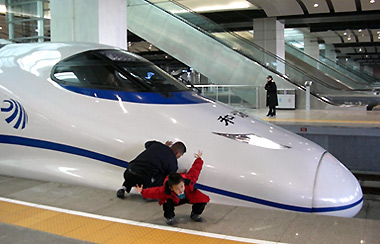
This article puts together all you need to know about buying and using bus and train tickets in China.
1. Buying Tickets
Whenever you want to buy a train or bus ticket in China write down what you want in Chinese (or take a photo), then show it at the ticket booth, hopefully you won’t get asked any questions.
I’ve had locals try to help me and mess it up. They start talking to the person assume they know best and things get messed up along the way. If you’ve written down what you want, details don’t get messed up.
Buying tickets in advance is another way to ensure things don’t go wrong. This is especially important for long and/or infrequent journeys (infrequent being less than 3 a day). There’s lots of people in China, and a lot of them travel, its best to book ahead!
If you’re a techno geek smart phones are a big help for getting around in China and much more, they make getting around, communication and buying tickets that much easier. China has a number of excellent and cheap smart phones that might be worth buying here due to their cheap price, high specs and overall solid build quality. Xiaomi’s are the best of these that have a limited distribution in Europe and North America and are in many ways outperforming established brands like the Samsung Galaxy and even the iphone in terms of specs and value for money.
All these smart phones will have a number of great apps that you can download that can help with travel, translations, shopping, weather, taking pictures and even dating.
I’ll put together an article specifically covering this topic in the near future.
These train ticket office are dotted throughout cities and are easy to use. The advantage of these are that those are often less packed (although it’s not rare to see a small queue during busier hours, especially around peak travel seasons around Chinese New Year). The main disadvantage is that, unless you book early, you risk not getting a ticket, as the railway ticket allocation system gives only so many tickets to a particular booking point. Alas, you are also not able to get some high-end seats: it is known that Deluxe Class seats on the Beijing-Tianjin Intercity trains (C trains) are not available through these channels at all. You will always be charged CNY 5 for a ticket — all ticketing here comes with an obligatory surcharge.
TRAIN TICKETS
Here are a few ways you can buy train tickets:
train ticket offices (queues vary depending on time of year) – these are convenient to use, you can pay cash and there are lots dotted throughout the towns and cities.
automatic ticket machines (at all high speed rail stations; PRC 2nd-generation ID card required)
authorized train ticket offices
by telephone (voice-guided ticketing system)
online (at 12306.cn)
on your iPhone, iPod touch or iPad (special software needed)
The classic way of getting your ticket — and the way most migrant workers do it — is to wait in line (or maybe not, as it might seem!) at a train ticket counter at the departure station. You, of course, being the martial arts student will, want to get it done quickly, so make sure you have all info (see below) ready in Chinese and English.
At the largest departing stations and transport hubs there will be foreign ticket offices. Don’t expect a lot from these but you are likely to get a person with enough English to get you what you want. The following ticket counters have services in English and/or specially for non-Chinese riders:
Beijing Railway Station: Ticket Counter 16
Shanghai Railway Station: At ticket office near South Square
Shanghai Hongqiao Railway Station: Look for “English spoken” ticketing window
Hangzhou Railway Station: High speed railway tickets sold at Ticket Counter 3 (outside the ticket hall full of ticket machines)
A few more useful words:
Chinese words you’ll need to buy a train ticket:
Train ticket :火车票 huoche piao
Train number: 车次 che ci
Soft sleeper:软卧 ruan wo
Hard sleeper: 硬卧 ying wo
Soft seat: 软座 ruan zuo
Hard seat: 硬座 ying zuo
First-class seat:一等座 yideng zuo
Second-class seat:二等座 erdeng zuo
Business-class seat:商务座 shangwu zuo
Window seat:靠窗的座位 kaochuang de zuowei
Pathway seat: 靠过道的座位 kao guodao de zuowei
For intermediate language learners who already have a bit of Chinese this video is fairly helpful.
BUS TICKETS
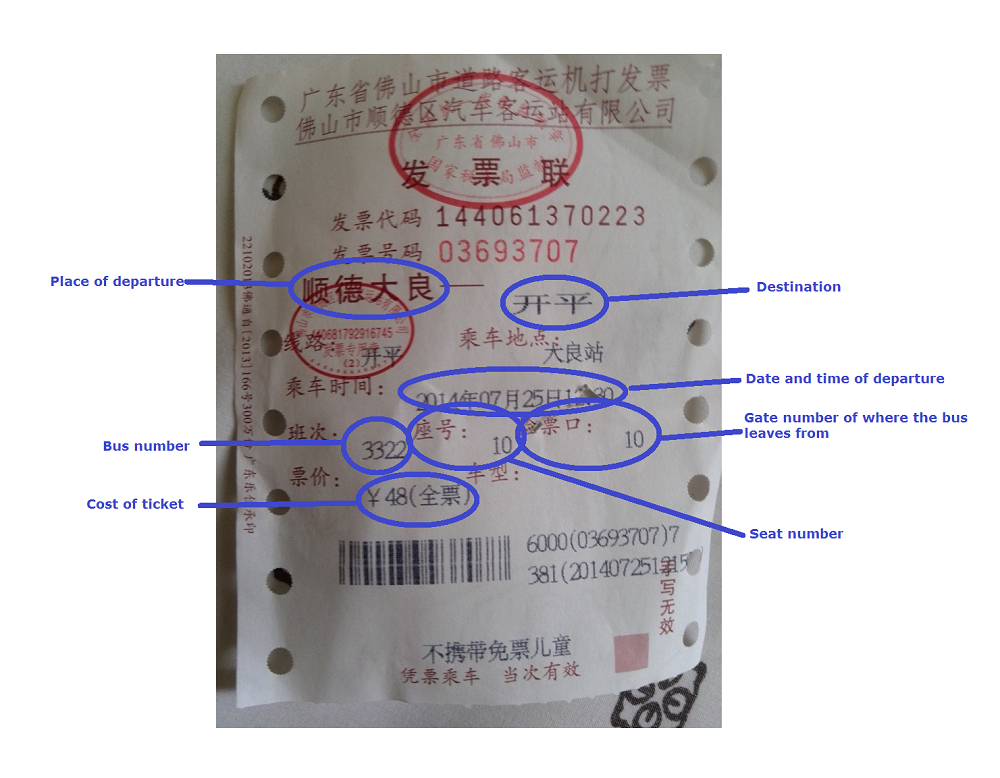
When Buying Bus Tickets there are less options. If you want to buy a bus ticket you should buy them at the relevant bus station. China’s bus stations are organized very simply.
1. Local Bus Stations 本地公交车站 – All local bus services
2. Long Distance Bus Stations 长途公交车站 – All long distance intercity bus services
FOR ALL TRIPS & TO MAKE A PURCHASE, MAKE SURE YOU HAVE THE FOLLOWING FOR BOTH BUS & TRAIN TICKETS :
Date and time of departure/return (日期, 时间) (for some journeys single ticket journeys are only allowed to be purchased)
Train/Bus number (车次)
Departure and arrival (exit) stations (发站, 到站)
Class of travel – Soft sleeper, Hard sleeper, Class of seat (席别)
Optionally: your seat number (席位)
Your passport (动车组实名制 – 护照)
2. Using Tickets
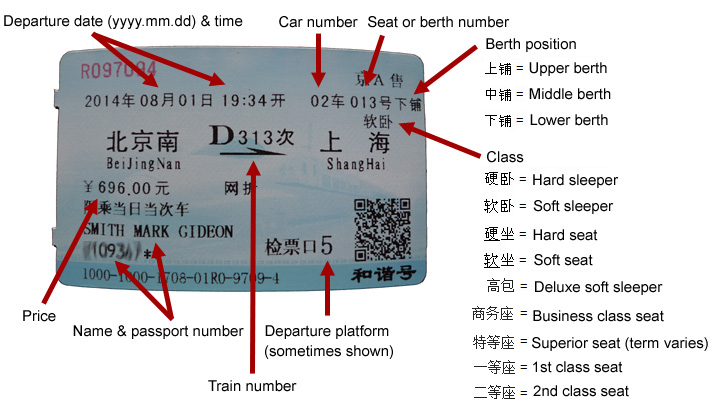
Reading High Speed Trains
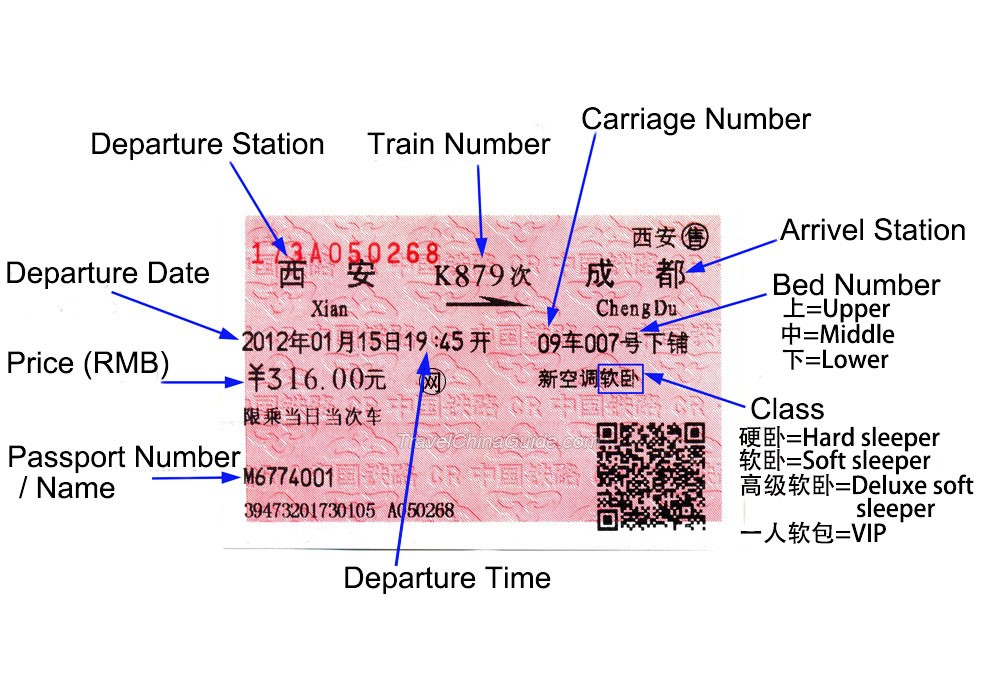
Reading Normal Train Tickets
A lot of people only have standing tickets for the slow normal speed trains, so if there is a spare seat they will just sit in it. Don’t panic people respect the ticket system. So if there is someone sitting in your seat, simply show them your ticket and politely ask them to move.
A little footage taken from the Chang Ping Annual International Martial Arts Competition held every Summer from the 25th to the 28th of July.
‘All are welcome to compete in various forms and combat sports.’
Chang Ping is 45 minutes from the Center of Beijing and is easily reached by public transport. A direct bus will leave every thirty minutes from Jishuitan Subway station, Line 2. Bus 883 leaves from outside the subway station and will take you to the Chang Ping Gymnasium where the competition is held.
It’s Saturday, my last rest day at Nam Yang this trip as I depart for Chiang Mai on Wednesday for a few days R & R before returning to Canada. Life is good here. I’ve made gains in strength, flexibility and sleeping patterns, learning so many new martial arts principles and practices of Shaolin Kung Fu while generally centring myself. I’d like to devote this entry mainly to the theme of centring, which relates directly to my back injury and overall goal for coming here.
I had concluded my previous entry with a discussion of how the intensive training, about 8 hours a day, had re-stimulated my back injury. A disc herniation on the right hand side of my lower lumbar spine was exasperated by the large number of flexion activities performed many times a day, often held for periods of a time. I was trying to be positive about it but feeling pretty down. I got up the next day at about 5:30 am and went down for our morning Chi Kung session at 6. I’d not woken up with that much back pain in years. By the time we got into the Chi Kung practice I was in a downward spiral and going through a lot emotions. As we moved into the stepping meditation I began to calm my mind and bring focus to the practice. Master Iain passed by and reminded me to drop my tailbone; this helps root one’s stance and sink the Chi, accompanied by engaging muscles around the lower Dantien. Doing this automatically brings me back to centre, of which a major benefit seemed to be an immediate relieving of pressure on my back.
I practiced this process of dropping the tailbone, grounding the stance and coming back to my centre many times. I did this not just in our Kung Fu practice but continuously throughout the day. Not only was it improving my Kung Fu stance and helping relieve back pain, it brought a general awareness to my posture and state of mind. This process of coming back to my centre has become a mindfulness practice for me and is something I shall carry forward into my life. I used to do a lot of this at one time. In my twenties I became certified as a fitness instructor integrating Yoga and meditation with some Chi Kung into what I called the “Whole Fitness Workout”, which I taught into my thirties. I often used to tuck under my tailbone and pull in my lower Dantien. It developed a keen awareness of my physical movement centre building good muscle tone in my lower abdomen. I pretty much let that go after injuring my back; it was all I could do just to keep standing and walking for a couple years. Going through this back injury re-stimulation and healing process at Nam Yang I’ve become aware of some unhealthy postural habits on which I will have to work. I think I unconsciously started getting more of a curve back in my lumbar spine to protect my back against flexion, which seems to have been accompanied by a loosening of the musculature and loss of tone in my lower abdomen. I had started noticing this recently at the gym (too much mirror gazing?) when checking form and was wondering about it; with my centring mindfulness practice the awareness has come together. It took years to create this situation but hopefully not so long to correct and maintain it. Even sitting here now I must be reminding myself self to lower the tailbone and maintain my centre.
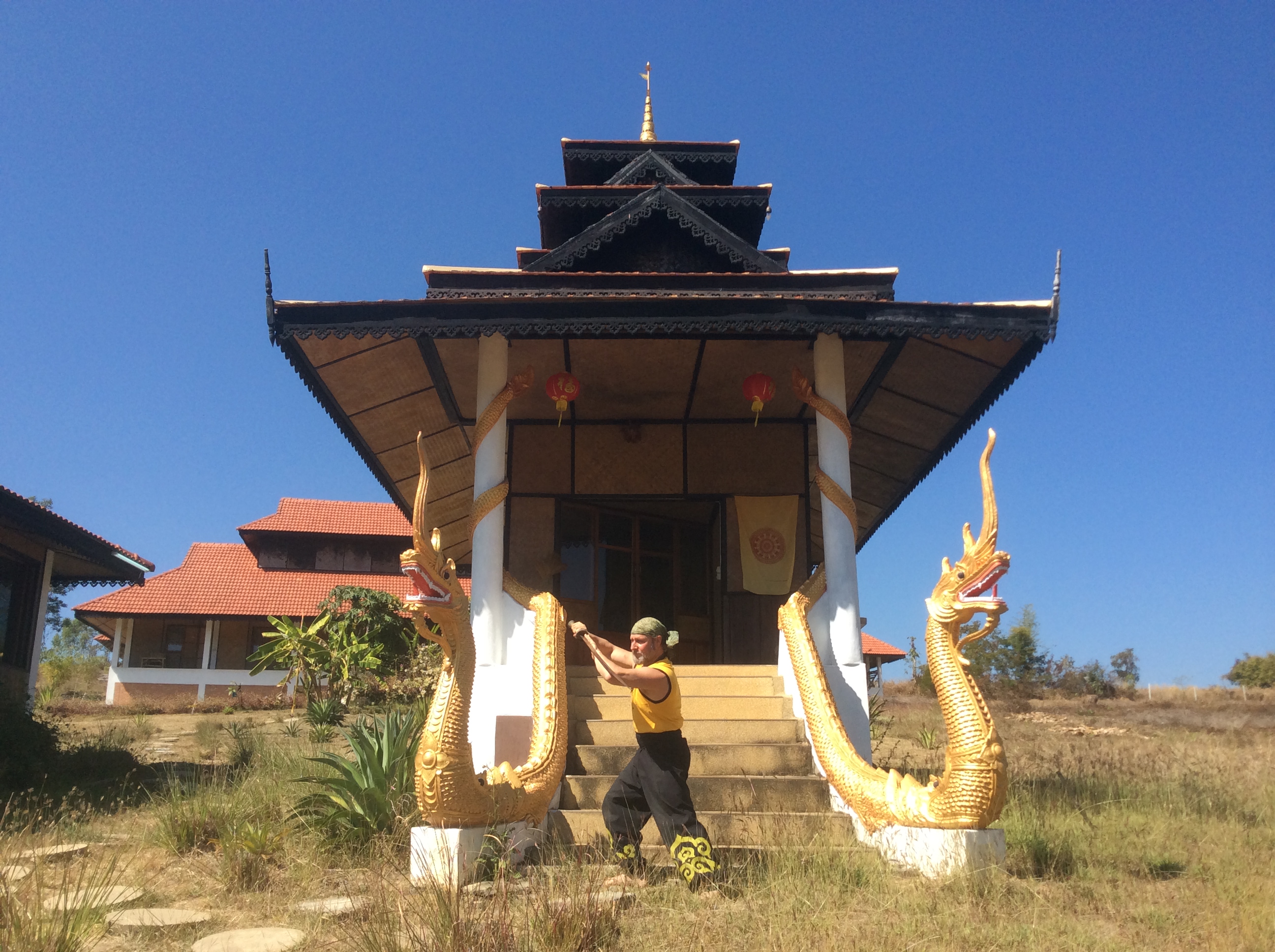
Me doing a slash and block with my favorite Tan Tao (broadsword) flanked by the two great Nagas (Dragons) in front of Nam Yang’s Buddha House.
Maintaining one’s centre, like many of the principle lessons in our Kung Fu practice has numerous applications for life. Indeed, coming into and maintaining my centre was an overarching goal I had shared with Sifu Iain in my initial contact email inquiring about the possibility of training at Nam Yang. “As a goal at Nam Yang I would love to leave with a set of basic fundamentals to carry forward in my personal practice…(and) am especially interested in cultivating a state of mind conducive to maintaining my centre and living graciously amidst the challenges of this beautiful, troubled world.” It’s amazing how things can come together and somewhat blows my mind just reading this. I think the trick for me will be to keep up with this mindfulness practice even when I’m not in pain. I recall Master Iain’s teaching that with this work you can change your life, “You can change who you are.” The word “Kung Fu” is made up of two characters. I understand that the first character for “Kung” means something like “hard work” or “skillful training”; the second character for “Fu” refers to “time spent”. So “Kung Fu” might be translated as “time spent in hard work or skillful training”. Master Iain often quotes his Sifu, Master Tan. One of his most repeated aphorisms is that the secret to learning Kung Fu involves two things: first start, then don’t stop.
Master Iain mentioned at tea that while many other martial arts teach mechanics and techniques, Shaolin Kung Fu teaches principles. The lesson of maintaining my centre fits very well with this philosophy. Like with any other Kung Fu skill, I know mastering the lesson of maintaining my centre will take time and effort to change my life, but it will be time well spent. I’m already feeling the benefits, both in terms of my Kung Fu and my back. Of course along with maintaining my centre I have been modifying activities that involve flexion; yet I have been able to perform most of the others with vigour. It’s been two days since the flare up of my herniated disc and I’m feeling so much better; in the past that much pain would have taken a lot longer to settle down. Another factor to which I attribute this quick turn around is the strength and flexibility I have built up from the waist down since starting the training. These are also principles and practices that I will take with me.
Doing the broadsword salute with Moon behind.
I had checked the weather for Canmore back home and was -30; meanwhile I’ve training here in +35. A 65 degree difference, wow! I got a ride into town on one of the scooters which is the standard means of transport and finally got to amble down “Walking Street” on my own in Pai. Walking Street is a Thai phenomenon and a must see for tourists. Starting around 6 p.m. the street is lit up and packed with a cacophony of street vendors and performers, bars and taverns, discos, restaurants, tea shops and a myriad of nightlife in a carnivalesque atmosphere, replete with red light district in some of the larger cities. This happens pretty much every night, but one of the most famous is the Sunday Night Market in Chiang Mai. I was there but couldn’t get up the juice to go when I first arrived. The one in Pai is no where near as big, but wonderful, even magical. There are so many brilliant artists and artisans selling their wares it can be a little overwhelming: a genius every block. Moreover, the Thai people are so wonderful, beautiful and patient, it really is very touching, and oh boy can they cook! I must have had fresh banana or banana-coconut shake at every vendor. Another special aspect in Pai is its proximity to the local hill tribes. You see a lot of tribal culture and crafts for different peoples like the Karen, Lahu, Lisu and Hmong, each with a distinct language and culture, many of whom are fleeing violence and persecution in the surrounding region. They are agriculturalists and hunters; I was hunting for gifts to bring home and scored big time! I won’t go into the details and spoil a surprise but I did pick up a gorgeous Hmong shoulder bag for 250 Baht, which is about 8 and a half dollars Canadian. It was made from the recycled clothes of a high ranking family, the likes of which are not being made so much anymore.
Anyhow, we train early in the morning and I shall have to try and sleep through the throbbing music echoing off the hills. I have three days of training left and really want to make the most of it! More to say, but for now it’s good night.
Much Love and warmth from Thailand!
by David Lertzman
David Lertzman Ph.D. is the Assistant Professor of Environmental Management and Sustainable Development PI: Energy Indigenous Environment Interface Research Program, Haskayne School of Business, University of Calgary.
This blog entry is part of a series of blogs David Lertzman wrote for StudyMartialArts.Org detailing his experiences training at Nam Yang Shaolin Kung Fu Retreat. If you’re interested in visiting this school book your place here and get an exclusive discount Nam Yang Shaolin Kung Fu Retreat.
Once you arrive in China and meet a few locals it won’t be long before this clip from TMD Shanghai make all too much sense. It’s a light hearted look at some of things I guarantee you who find yourself hearing when you visit the Middle Kingdom. During my 6 years in China I’ve heard and witnessed a lot. Here are some of my favorite questions I’ve been asked during that time. Where are you from?Ài’ěrlán. Ah, Yīngguó! Do you know how to use chopsticks? What’s your favorite color? Do you like Chinese food? How much do they pay you?
“When in China the Chinese inquisition will get you and won’t give up.”
Do you play tai chi? Do you like KTV? Why you not married? Do you like Chinese girl? Whatever you do embrace the inquisitiveness and have fun.