Through a Lens Darkly (40): Butterfly Swords and Tong Wars in North America — Kung Fu Tea

The Yin and the Yang of the Hudiedao Earlier this year I had the opportunity to participate in a day-long seminar on the Wing Chun swords taught by Sifu John Crescione. This was a great experience that provided many students with an introduction to this iconic weapon. Such events, by necessity, tend to […]

via Through a Lens Darkly (40): Butterfly Swords and Tong Wars in North America — Kung Fu Tea

Explore Hong-Kong | 5 places to experience (that do not involve shopping) —

As one of one of the ten most popular cities to visit in Asia, Hong-Kong (香港) is an attractive travel destination known for the Big Buddha and Po Lin monastery of Lantau Island, the incredible views of the Victoria peak, the Wong Tai Sin and Man Mo temples, Stanley, the nightlife in Lan Kwai Fong […]

via Explore Hong-Kong | 5 places to experience (that do not involve shopping) —

James Yimm Lee and T. Y. Wong: A Rivalry that Shaped the Chinese Martial Art in America — Kung Fu Tea

By Charles Russo, author of Striking Distance: Bruce Lee and the Dawn of Martial Arts in America (University of Nebraska Press, 2016). So it Begins At some point in late 1961, James Lee stormed out of the Kin Mon Physical Culture Studio in San Francisco’s Chinatown, effectively breaking off his tutelage under […]

via James Yimm Lee and T. Y. Wong: A Rivalry that Shaped the Chinese Martial Art in America — Kung Fu Tea

Doing Research (8): Taking Seriously the Mundane, or How I Learned that a Choke is Never Just a Choke — Kung Fu Tea

Introduction Welcome to the eighth entry in our series of guest posts titled “Doing Research.” If you missed the first essay by D. S. Farrer (which provides a global overview of the subject), the second by Daniel Mroz (how to select a school or teacher for research purposes), the third by Jared Miracle […]

via Doing Research (8): Taking Seriously the Mundane, or How I Learned that a Choke is Never Just a Choke — Kung Fu Tea

Is Practicing Forms Important for Real Fighting?

by An Jian Qiu

In all martial arts, many students will one day ask themselves:

“Is practicing forms important for real fighting? Should I just be performing drills, or sparring?”

The answer to this is not a simple yes or no because it depends on how you practice your forms:

  • Do you let your mind wander, or are you incredibly focused?
  • Do you ‘take it easy’ and treat it as a warm-up, or are you challenging yourself each time with deep stances and powerful movements?
  • Are you just ‘following the motions’, or do you have a specific goal in mind?

At An Wushu, we believe form training done correctly is incredibly important for developing your kung fu:

  • Forms develop what we call your ‘kung fu body’. Strength and endurance are a very important part of kung fu, but can be developed by many activities; the specific attributes you need for perfecting your kung fu, however – such as flexibility, timing & chi skills – can be best developed through forms
  • Forms teach movements in a logical sequence (e.g., “Strike… if they block, then you do this”) and create useful muscle memory*
  • If you practice your forms the way you fight – with spirit, power, and accuracy – then you’ll fight the way you practice your forms

*Many students are also curious about the applicability of ‘grander’ movements, such as flips, spins, kicks and so on. There are a few schools of thought on this:

  1. In years past, it was not uncommon for future masters to be taught incredibly slowly, often learning a single form over five years! If you have practiced a movement 100,000 times or more, you will definitely be able to use it in combat – even if it is perhaps not as efficient as it could be
  2. Many movements are taken to their extreme to better develop the body: e.g., if you train with your horse stance at parallel, spending minutes then hours in this position each day for many years, your legs will become incredibly strong. If you only stand at ‘fighting height’ for these years of training, you will miss out on this strength.
  3. In some styles, there are moves that are simply not meant to be used in combat, e.g., backflips, and are simply there to develop the body of the practitioner. Similar to Point 2, if you spend years training backflips, you will have much more explosive muscles and better co-ordination than if you didn’t. (Note: There are no movements like this in An Wushu, however, as part of a complete training system this is a great way to train.)
  4. Much of the power generated in kung fu is difficult to do in a small way until you can do it in a big way: e.g., even a beginner can sharply twist their body, push off their heel and throw a strong ‘cross’ punch (albeit at the probable cost of their balance). But if they limit their twist to only 1-inch, can they generate power? The answer is no. By starting with an over-exaggerated movement, a beginner is able to gain the internal feeling needed for any movement and gradually refine the movement to its usable form.

So, is practicing forms important for real fighting? As with anything in kung fu and in life, you only get out what you put in.

To learn more about An Wushu or how to study with Master An full-time in China visit www.StudyMartialArts.Org we work exclusively to help dedicated students connect to quality martial arts schools. This includes visa assistance and independent information all at no additional cost to you. Check us out with no obligation.

Through a Lens Darkly (39): The Strength of Chinese Boxers — Kung Fu Tea

Introduction Some of the most popular posts at Kung Fu Tea have examined vintage images of traditional martial artists. These are also among my favorites to research. Yet it seems that I have neglected this subject with all of the other projects that have come up this summer. Hopefully this post will go some […]

via Through a Lens Darkly (39): The Strength of Chinese Boxers — Kung Fu Tea

The Strangeness of Wing Chun – Kenneth Chung — Wing Chun United

Kenneth Chung talks about the strange way Wing Chun trains the knees and elbows to develop unit strength.

via The Strangeness of Wing Chun – Kenneth Chung — Wing Chun United

3 Reasons to Track Your Fitness

Today there are so many fitness trackers available for you to choose from various bands, watches and apps. All these gadgets are equipped with accelerometers and sensors to track you all day (and night) long. But do they really work or are they just a gimmick? Here are 3 reasons why if used correctly they can help you become fitter and healthier.

1. You can see your fitness goals: It’s one thing to have a sense of how healthy you are, but it’s another thing to see the numbers. Many fitness trackers can record your steps, calories burned, and sleep, so if you’re not meeting your goals in one or more of those categories, you’ll be able to see it in no time. Fitness trackers force you to be aware of your fitness shortcomings so you can modify habits as necessary.

2. You can track your progress: Investing in a fitness tracker forces you to think about what you’d like to get out of your workout routine. Many trackers allow you to add goals — like steps per day or calories burned — so you can keep tabs on whether or not you are progressing. It’s nice to have numbers backing up just how much more fit and active you’ve been feeling and to use as a basis for future goals.

3. You can push yourself safely: Listening to your body is the best way to know your limits, but having extra help doesn’t hurt. Many fitness trackers compile the data they collect from your daily habits to show you trends over time. That means that if you find that you’re being too sedentary on your non-workout days or that you aren’t burning as many calories as you thought in yoga class, you’ll be armed with the information you need to modify your workout routine or your daily activity habits.
Source: Instagram User supertall007

Here’s few of the best on the market

Fitbit Surge ($153+)455645-fitbit-surge

The Fitbit Surge is a sophisticated touch-screen wristwatch. It not only tracks your steps and sleep, but also alerts you to incoming phone calls and text messages, keeps tabs on your heart rate with a built-in optical heart rate monitor, uses GPS to track outdoor activity, and has much more functionality especially for runners.

PROS

Continuous heart rate monitoring. Built-in GPS. Comfortable, secure fit. Tracks new activities like hiking, yoga, and weight-lifting workouts. Excellent app and easy syncing. Supports incoming texts and call notifications. Accurate.

CONS

Limited push notifications. Moderately large. Not waterproof for swimming. Below average battery life with GPS enabled. Charger not interchangeable with other Fitbits.

BOTTOM LINE

With continuous heart rate monitoring, GPS, and broad appeal, the Fitbit Surge is the best all-day fitness tracker to date.


Garmin Forerunner 735XT ($307+)505861-garmin-forerunner-735xt

The Garmin Forerunner series blends the best fitness trackers with all the features you expect from running watches. Additionally it offers a 24/7 activity and sleep tracker with continuous heart rate monitoring, GPS, push notifications, and special features for triathletes. It’s not cheap but it manages to be both lightweight and excellent battery life. If you’re a hardcore martial artist who love to compete in triathlons this is the one for you.

PROS

Excellent for triathletes. GPS. Optical heart rate monitor. Tracks steps, sleep, heart rate, and an array of activities. Supports push notifications. Waterproof. Lightweight. Top-notch battery life.

CONS

Expensive. Not comfortable to wear while sleeping. More sporty than elegant.

BOTTOM LINE

The Garmin Forerunner 735XT fitness tracker gives pertinent information to triathletes about their sports, including advice you don’t often see, like recovery time. It’s comprehensive and easy to use but will set you back a pretty penny.


xiaomi-mi-band-1411724768-y3l7-column-width-inline-1421248072-Zgnt-column-width-inlineXiaomi Mi Band Pulse ($19+)

Best for those on a budget and now available outside of China, the Mi Band Pulse is cheap and cheerful, yet somehow manages to pack heart rate monitoring onto the wrist for an astonishing price. Xiaomi has shifted over a million of its bands in China alone, possibly making this the ultimate fitness tracker. On a down side the main body of the tracker does of a tendency to fall out if you are too rough with it. So don’t keep it on when doing pad work. Another down side is that it will does have a tendency to over estimate your steps in most cases.

Feature check: HR tracking, steps, sleep, smart alarms, incoming call alerts.

PROS
Ridiculously cheap, Easy to wear, easy to use, HRM works for resting rates, Works with Google Fit/Apple Health

CONS

Can overestimate steps, Heart rate goes haywire during exercise, Basic app, Sleep tracking is hit and miss


Moov Now ($45+)moov-now-1438020833-ll2s-column-width-inline-1438619840-t0qI-column-width-inline

Is one of the best for getting fit. Geared towards helping you be better at the sports you love, rather than reporting how you did. It’s an easy and compelling sell, and for our money, is what wearable tech should be about. Some of the misgivings remain: the need to carry your smartphone being the biggest downside to the device.

Feature check: Steps, sleep, advanced sports coaching, run/bike tracking.

PROS

Coaches and track, Displays progress, Great for all abilities, 6 months battery life

CONS

Need to take your phone running, Coach’s voice is robotic and annoying, Daily activity         tracking is basic, Strap comes undone now and then.


Charity Miles ($4.99+)467513-charitymiles

Earn money for charities every time you run, walk, or bicycle by using the free Charity Miles app. Corporate sponsors (whose information you’ll see as a backdrop image in the app) agree to donate a few cents for every mile you complete. Browse the app’s list of charities, find the one that you support, and then hit the road. When a lot of people use Charity Miles, those little bits of money add up.

Using this app you can rack up some serious miles. With this app you can get fit while donating to some excellent charities. The new UI is very clean and visually appealing. Both the GPS and indoor tracking are for the most part reliable. On the downside view the history can be annoying. The activity log looks nice and is easy to navigate but needs to also have the ability to see the length of time each run was.


FitStarr ($7.99 per month or $39.99 per year)467529-358828-fitstar

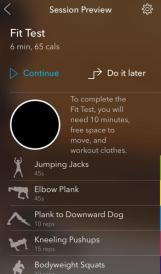
FitStar creates custom workouts for you based on your fitness level. You start by doing a few workouts with the app and you give it feedback as you go about which exercises were too tough, too easy, or just right. The app uses that information to create a routine that challenges you in all the right ways. FitStar was purchased by Fitbit in 2015 and now works with some Fitbit devices. The in-app coach is former NFL player Tony Gonzalez, a beefy workout buddy who is nothing but a bundle of positive, cheery feedback, and absolutely no excuses.

It is customize to you and after each workout you should feel like you’ve accomplished something. The great thing is it sync with your Fitbit (Fitbit actually recommend this app). You get free sessions but for premium its a steal instead of going to the gym and probably having to pay twice as much. With this app and eating right you will lose weight in no time.

If you make a purchase use our links and help support the www.StudyMartialArts.Org project.


Lives of Chinese Martial Artists (18): Xiang Kairan – Imagining the Traditional Chinese Martial Arts — Kung Fu Tea

“When the Nanjing Martial Arts Institute was opened, I was in Hankou [in eastern Hubei], where I noticed in a newspaper that they were dividing their curriculum into two schools – Wudang and Shaolin – and appointing specialists for each of them. For “Wudang” to be isolated like this in the promotion of our […]

via Lives of Chinese Martial Artists (18): Xiang Kairan – Imagining the Traditional Chinese Martial Arts — Kung Fu Tea

Men of violence, martial arts in Imperial China — nysanda

The statements made here regarding the increasing militarization of the society, the endemic use of violence and the role martial artists played in these developments are confirmed by the historical record for both the Ming and Qing Dynasties. In all likelihood they also applied to earlier periods, there is just a lack of documentation to […]

via Men of violence, martial arts in Imperial China — nysanda