An Ode to the Bully

imageBeware the bully, his shoulders held high,

See how his chest puffs, his gaze holds your eye

Note now the lopsided lope of his stride,

Observe affectations that betray his pride.

He paces his habitat, the Friday night pub,

As he searches for victims amongst the hubbub

The shy the fearful, the innocent or weak

The wealthy the happy, the loner the freak

His gaze flits to and his gaze flits fro,

Scanning the crowds for that tell-tale show

He watches for clues, for evidence to stack

Until he finds the pup that strays from the pack

Predators, you see, never like their prey

To be tricky to taste, or to have to pay

With their own blood for their evening meal

Preferring instead to trick, trap or to steal

“For what good is a feast,” they seem to say,

“If it’s so hard earned as to spoil my day.

Or end my days or cause on me

The pain and suffering I intended to thee.”

And so they wait, and pick and choose,

Until they find a victim whose

Attention is spent on a phone or a book,

Too busy with text to take time to look

Above and beyond their own personal space,

Into the crowd for an unfriendly face

Or who’s defences are downed by a whisky too many,

As they stumbles alone off to ‘spend a penny’.

Or those who through their signals alone,

Declare their fear of the dark, the wide unknown

Or perhaps those whose bodily cues seem to say

That they don’t present a risky buffet.

The fidget, the hunch, the averted eye,

The mumbled words, the timid reply.

For the lost and the lonely, they serve such a rich

Juicy and succulent victim sandwich

image

But all this grand strategy, this plan of attack

Do little more than to point to the crack

In his armour, the chink, the fatal flaw,

The Achilles heel, the open back door.

The bully you see doesn’t like it when

The fox’s tail gets pecked by the hen

So more often than not the medicine, the cure,

Is little more than a good punch in the jaw.

The Art of Expressing the Human Body

Dave Kelly's avatarSMA bloggers

Bruce Lee’s Jeet Kune Do: A Philosophy of Physical Self-Perfection

by David Quigley

It is a safe assumption that almost everyone has heard of Bruce Lee.  He was and remains arguably the most famous Asian-American star in the history of film (sorry, Jackie Chan).  And anyone who has seen any of his films cannot help but notice his amazing physique, speed, agility, and flexibility.  However, what a lot of people do not realize – especially those outside the martial arts world – is that Bruce Lee was a philosopher obsessed with fitness, or what he called, the art of expressing the human body.  Indeed, Bruce Lee was a philosopher in every aspect of his life, and focused a lot of his writings on honest self-expression and self-perfection.  Even the martial art he developed, Jeet Kune Do (or, the Way of the Intercepting Fist), is in itself a philosophy.

Bruce lee Hd Wallpapers_8

JKD is not…

View original post 530 more words

Ouch.

image

Is it just me, or does anybody else out there associate colours with different days of the week?  Here’s how it goes for me: Monday is blue, Tuesday is kind of light grey, Wednesday is a decent orange – but not as bright as an actual orange, Thursday is dark brown, Friday is black, Saturday is white, and Sunday is kind of a ruddy red.

I don’t know why, but it’s been that way since school. Probably it was imprinted on me when I learnt them on colour-coded flash-cards, and everyone else in my class has the same associations whilst those down the corridor, with a different teacher, have different colours, or stripes, or cartoon animals.

So much of our world isn’t actually what’s really there, but a dangerous cocktail of our expectations and interpretation of reality.  We take input from our sensory organs, send it to the brain, and the brain decides what the most sensible interpretation should be.  We all carry our own little versions of the Matrix in our heads, telling us what’s happening and what’s probably going to happen next.

Take pain, for example.  I mean all it is, really, is your brain telling you something’s happening.  It takes an electrical signal, makes a decision that that thing is unadvisable or unwanted, and provides you with a cheery little warning.   Really, it’s the same signal that tells you you’re being stroked, or tickled, or gives you that random itch on the one occasion when you can’t reach your nose – just a little louder.

In fact if you want to find out which bits of you hurt and which bits of you don’t without going through the trauma of stabbing yourself all over with a compass*, tickling can be a useful (and if you bring a friend perhaps fun) alternative.  If it tickles, there’s a cluster of nerve endings.  If there’s a cluster of nerve endings, it’ll hurt more than a bit that doesn’t tickle.

There is, of course, a reason for this – nerve endings are clustered around areas of the body that need to be protected, to give the best possible early warning that they’re threatened.  Which is why you must escape a tickle.  And why palms, feet, belly neck and armpits are classic areas of child torture and cruelty for fathers everywhere.

But it’s not real, you know.  It’s the matrix.  And like Keano, you can break it if you know how.  You can manipulate that mix of expectation and interpretation and turn it into your best weapon.  I’m not talking about how to hit the bits that hurt, though.  That rarely works, particularly in the middle of an adrenaline fuelled, alcohol filled fight.  After all most fights include one of those things, probably both, and both are pretty effective pain-killers.

No, I’m talking about manipulating the pain response, the interpretation of pain signals, and using it as a disruption to turn things in your favour.  Playing your opponent on a string like a puppet master, if you will.  And so, without further ado, I bring you How Not to Get Hit’s patented three rules of pain.
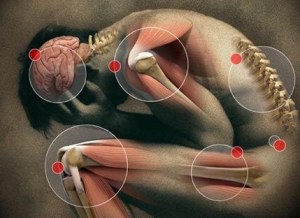
imageOne – the brain can only process (give or take) seven things at any one time.  If you provide more than seven signals, or stimuli, when defending yourself (a series of relatively hard & committed strikes, slaps, or pushes will do) to as many targets as you can get to, it will become increasingly hard for your opponent to respond.  Anyone out there who grew up on eighties Manga, think the seven finger exploding heart technique from Fist of the North Star.  But manage your expectations – no hearts will explode in the execution of this technique.  What will happen though, if each strike is hard enough to send a disruption signal to the brain or is aimed at an area where this disruption signal is hard-wired (like the eyes, groin or throat), is that the attacker will find all the distractions a confusing fog of movement and will likely become less responsive to a) one big mother sucker punch to get them the hell off you and / or b) a hardy shove on the chest, away and slightly downward to break posture, create distance, and get out of there.

Two – the anticipation of pain is worse than the pain itself.  If you can get your attacker to fear pain, then it is likely their will to fight will be reduced in proportion with their belief in their ability to win without injury.  Your ability to fight will, in turn, increase with your belief in your ability to win.  To continue my eighties film analogy, this is the bit where they found the glowing green blood on a leaf in Predator: “If it bleeds, we can kill it”.

Now this can be tricky, since as we mentioned earlier the first thing to go when the adrenaline (or vodka) kicks in is pain sensation.  So instead of going for pain, go for the areas of the body which pain was designed to protect, the vital areas.  Attack the eyes, the throat, the plexus, kneecaps, groin, feet and hands.  Areas of high sensitivity, and areas that the body is hard-wired to protect.  Get a good shot in one of these areas and watch the pain cut through, as the bring tries to protect something it actually needs to survive this fight in the first place.

Also, threaten pain.  Now if he’s attacking you, waving your fist ain’t gonna cut it – we’ve already established that in his assessment of you he’s seen nothing he finds particularly scary.  However if you introduce something that will trigger that response, then the stakes are changed.  Normally I wouldn’t be the one to encourage a weapon since pulling a knife is actually a pretty good predictor that you, yourself, are going to get stabbed.  However if your life is in danger, then picking up something that your attacker fears will do them damage, and waving it about, can be a pretty effective means of halting an attack as self-preservation kicks in.  What’s around you – any ash-trays, chairs or bits of wood?  Get creative; I once saw a kid pick up a bicycle and wave it at his attacker – who stopped, perhaps out of confusion more than anything else.

Three – pain is worse than the anticipation of pain, if it’s unpredictable.  Fear of the unknown is our most powerful, and debilitating fear.  Apart from giant hairy spiders and, for some reason, the witch from the Moomins.  Or is that just me (last obscure 80’s TV reference, I promise).

Now, for the record, we’re getting more into control & restraint territory here than self-defence so if you’re just reading for personal safety purposes, you can skip this bit as it really isn’t relevant.  Still with me?  OK.

Now, what bugs me a lot in martial arts, is when somebody gets a good lock then uses it as an opportunity to test out their newest pressure points.  It’s normally junior grades who do this, as soon enough one finds out the hard way that the quickest way to get a badger to furiously break out of a cage is to poke it with a stick.

However in the process of manipulation, control and restraint giving someone a reason to expect a certain pain from a certain direction is very effective at reducing their resistance to pain from another.  Think of it as an attack on a castle.  You move all your forces to repel an attack on the East wing, which leaves you wide open when the sneaky force advancing behind uprooted trees to breach the West wing (Shakespeare reference that one – pat yourself on the back if you got it).  Get half a lock on, make a big show of a kick or a punch being brewed up in eyeshot, then get a sneaky one in out of their line of site from the other side in a wizardly example of misdirection.  You’ll find it a very effective way of breaking resistance, creating confusion and controlling direction.

So there you have it.  How Not to Get Hit’s introduction to pain.  I’ve barely touched the surface here really, you could fill a whole book with this stuff but at least here, with a bit of though, play and practice, you’ll find something that comes in handy one day.  Whatever colour, or pattern, or cartoon animal, you personally feel that day to be.

*You know, like you did at school to your friends in maths class.  A friend of mine, John, once was asked by another friend, Andre, if he could stab him in the hand with a compass.  Expecting a playful poke, he unwisely agreed.  What he was not expecting was for Andre to suddenly grab his write, pin his hand to the table, raise his compass high above his head like a talisman, and bring it down with all his might**.  It got noisy.  To the best of my knowledge he still can’t wiggle his little finger.

**He should have – this is a guy who once threw a wheely-bin through a classroom window, and took a box of Rice Crispies onto the school bus only to, in turn, throw them at people and shove them up his nose screaming “set the crispy bits free!” at the top of his voice.  Unpredictable, is what I’m saying.
Why The Modern World Is Bad For Your Brain And What Shaolin Monks Do About It

Shifu Yan Lei Team's avatarshifuyanlei

yellow mt3-00085 Most of us love our smart phones. I use mine all the time to keep in touch with my family in China. But the constant multi-tasking of texting, emailing, social media and apps is over stimulating our brain and increasing the production of the stress hormone cortisol according to Neuroscientist, Daniel J Levitin, who has written a new book about his findings. So does this mean we have to throw away our smart phones? At The Shaolin Temple we tread the middle way, using Zen techniques to keep us tranquil and focused while still being a part of the modern world. Here I share with you seven Shaolin tips to help you stay calm in a crazy world IMG_0815

  1. Take Small Regular Vacations  Turn your mobile phone to aeroplane mode or switch it off completely two hours before you go to sleep. The same goes for when you workout…

View original post 423 more words

Tibetan White Crane: Needle in Cotton

cmrmurray's avatarThe Wandering Fist

Here’s a performance of the Tibetan White Crane (白鶴派) art, Needle in Cotton.

The set is performed by Luk Chi Fu at one of the demonstrations that Chee Kim Thong adjudicated in Singapore in the 1960s. As such, it offers an insight into the richness of Singapore’s martial-arts heritage at that time. At a guess, Luk was probably not actually a contestant: the masters present were also asked to demonstrate for the audience.

Tibetan White Crane is a very different art from the Fujian White Crane styles such as Wuzuquan. In fact, it’s difficult to identify any significant commonalities, suggesting either a relationship in the distant past, or a completely separate art with its own adoption of certain crane characteristics.

At least two groups still practise this art in Singapore. Tibetan White Crane (Baihepai) is an art one hears mentioned frequently in gongfu circles. It’s worth…

View original post 4 more words

Chang Ping Martial Arts Festival.

A little footage taken from the Chang Ping Annual International Martial Arts Competition held every Summer from the 25th to the 28th of July.

‘All are welcome to compete in various forms and combat sports.’

Chang Ping is 45 minutes from the Center of Beijing and is easily reached by public transport. A direct bus will leave every thirty minutes from Jishuitan Subway station, Line 2. Bus 883 leaves from outside the subway station and will take you to the Chang Ping Gymnasium where the competition is held.

Below you can see Master An Jian Qiu’s Bajiquan performance at the competition.

Sifu Wang Zhi Peng Wooden Dummy Explanations

2014 in review

The WordPress.com stats helper monkeys prepared a 2014 annual report for this blog.

Here’s an excerpt:

A New York City subway train holds 1,200 people. This blog was viewed about 3,900 times in 2014. If it were a NYC subway train, it would take about 3 trips to carry that many people.

Click here to see the complete report.

Kung Fu in Thailand Days 8, 9, 10: Bits of Gold

It’s Wednesday, our rest day, and lots has happened: Sum Chien, Shuan Yang and sword. Every day I feel like I making gains, training harder with greater awareness. I’m starting to self-correct on a lot of little but important details. I love the lifestyle here and find myself thriving, waking up early and training all day constantly trying to better oneself. Yesterday I trained for 9 hours! I’m learning so much and it’s just grand! The more I learn the more I realize how little I know and it feels good.
IMG_0906

We had a great sword workshop with Sifu. Watching Master Iain move with the sword is an honour and beautiful to behold. Listening to him speak is enlightening: picking up the bits of gold dropping from his mouth. I’ll share a couple examples related to sword, one which is more about technique and the other more about life. For example, teaching a slash with the Tan Dao broadsword using a stick, Sifu demonstrated the technique for getting power using the whole body. People launched into it using their sticks to practice the technique. After a couple of minutes he stopped us. “Right, ok people love the Nunchakus, why?”. Everybody agreed but did not provide the answer he was looking for. “It’s because you can get lots of power”, he explained, “but it’s hard to control.” He then told the story from years ago of a friend who had practiced with the Nunchakus. Nunchaku is a weapon with two pieces of wood attached by a chain popularized by Bruce Lee in his famous movie, “Fists of Fury”. So his friend had brought his Nunchakus to a party to show off. After having a few he went at the demonstration which involves spinning the Nunchakus rapidly through the air then wrapping them around the body and catching the end of the stick under one’s arm. When people who have not achieved mastery do this they invariably wind up hitting themselves in the back of the head, which is exactly what is friend did almost nocking himself out. “Very hard to control”. Master Iain explained that you can do the same thing using your body; even with a stick one can generate great power but it’s much easier to control. He then demonstrated drawing the stick across his torso using his whole body to slash with the stick in a mighty whiplike fashion. “So imagine that the stick is like the end of the Nunchaku and your joint is the chain, but you can still control it.” Furthermore, you have more than one joint to swing off: wrist, elbow, shoulder. Each joint that you can bring into play generates more power. Sifu then demonstrated further how one can bring into play the lower body for the slash as well, drawing up Chi from the ground through one’s whole body and out the stick, or sword.

We had further sword instruction the next morning. It’s amazing to watch Master Iain move; it’s beautiful and terrifying when he holds the sword and always inspiring. He gave us a combination to practice rolling the sword around the back and drawing it over the shoulder in a whole body slashing motion followed by a step with the right foot coming up on the cat stance with most of the weight on our back foot drawing the sword and front leg close in tight to the body then springing outwards in an explosive lunge. I was doing it over and over losing myself in this awesome series of moves and the full body feeling elicited when he stopped us again. “Right”, he said, “everyone come round.” The he spoke about putting one’s character in the moves. Perhaps he had not quite seen what he wanted to in observing us practice, perhaps he was just taking it to the next level; however, this theme had come up in other sessions and not just from Master Iain. Eddie has often commented that people really needing to their whole being into the move, the punch, the hand position, the step, whatever Kung Fu move one is doing, really put your full force, your Chi into it, DO IT! There is an obvious life lesson here that can be applied to anything in life. Of course, there is a place when learning something like a position for the foot in a certain step or stance, a sequence of moves or transition, a certain placement or position of the hands. When it comes to doing actually doing the move, you really have to put your spirit into it. Master Iain continued with the teaching saying that when you do it this way you can change your life, change who you are. He then demonstrated a half hearted, somewhat awkward version of the short sword sequence we had been given to practice. “This is the movement of a clumsy person”, he stated. You may think of yourself as a clumsy person and behave as a clumsy person. When you really apply yourself to the moves, to learning and practicing them properly putting your character into it with the full force of your spirit, you will no longer be a clumsy person. You can change who you are.

In reflecting on the above teaching it comes to me that one must do this authentically. If you one doesn’t really know the move, then how can you fully infuse the movements with your character? Clearly one has to have something into which to put one’s spirit. Yet, it also seems to me that my ego could come into play. I may want to see myself as a great swordsman, a Kung Fu master. Well, at my age and with all my commitments this is unlikely to happen. So somewhere between authentically aspiring to become something I’m not and my self-deluded ego, there must be some kind of truth. To me, this is where having a master comes into play, having a proper role model. So my next question would be, what do I do? I will have been here for two weeks and have only begun to scratch the surface, yet even still what I know is precious to me. So now I must practice what I have learned, and I must develop and listen to the Inner Master. I raised this new found wisdom with Master Iain who provided supportive affirmation and added, “Right, well of course there the internet.” He has a website and many YouTube videos which run through various sequences. Plus, there is a memory stick made available for free copy to students training at Nam Yang which contains numerous instructional videos and various articles by Masters Iain and Tan along with other supplemental materials. I intend to use these to continue my training back home in Canada.

IMG_0887
Another powerful experience with some deep teachings occurred when Eddie was helping another student who had sustained serious abdominal injuries. Without going into any detail on the circumstances, I will try to convey what I learned. We were discussing bringing awareness to one’s centre. The term often used in Kung Fu is Dantien. There are three major Dantiens: the lower Dantien, about three finger widths below the navel; next is the middle Dantien associated with the thymus gland at the level of the heart; and the upper Dantien located at the brow, the “third eye” associated with the pineal gland. Dantien is “a like sea of energy” and often called an “energy centre”. When people refer to, “the Dantien”, “your Dantien”, or “your centre”, they’re usually referring to the lower Dantien. This is one’s physical centre from where one finds balance and movements occur. We are constantly reminded to be aware of this place, holding our centre, moving from it and bringing down our Chi grounding into it. Eddie shared that one’s “true centre” is actually inside at the very centre of your being. “Your centre is where your first cell originated inside your mother; that point from which you come, this is your centre. It doesn’t matter whether you can feel it or not, or where you move your mind; your centre is your centre.” He added that for a woman who has had a baby it’s easier to go back to that place. This was a profound idea for me and ties into what may be the biggest lesson I will take away from this retreat. This will be the subject for an upcoming post but starts with what I share below.

For the first time in a couple years I have been experiencing sciatic pain down my right leg. I know this well having struggled with disc injuries for years. The first episode was a ruptured disc in my early forties. The radiology report was dramatic, “disc material extruded and mobile” accompanied by some minor stenosis and a bulging disc. With physio, active release chiropractic and lots of core strength it cleared up in about a year. After some years I let go of the core strength, got macho and wound up with a major disc herniation. This episode lasted 3-4 years and never fully went away. The first year and a half was brutal; constant pain, I couldn’t stand up longer than a minute past noon. It started to settle down but I was physically and emotionally vulnerable. Far less active I became depressed and gained about 25 pounds. It seemed never ending. I got back into Chi Kung having practiced it throughout my late 20s and 30’s and combined with meditative walking began a slow crawl of the hole. I showed up to the Kung Fu Retreat with my back in the best shape it’s been in years. Sometimes I get a little bit of sciatic pain if I’ve been up for a long time, like when travelling long distances or teaching my Wilderness Retreat for long hours but it usually goes away when I wake up.

I experienced the sciatic back pain as a major set-back. I told Eddie that I had been doing so well. I was feeling so much stronger and more flexible, I was really getting into the training and starting to make real gains. He stopped me. “No”, he said, “you are stronger and more flexible, and you are making gains. Now you have to figure out how to adapt to this changing situation”. That’s the kind of thing I tell my students. It was masterfully done and had a big impact. Eddie suggested I inform Master Iain who directed me to adjust any of the moves I was doing or simply not do anything I felt would aggravate the symptoms. I thanked him and explained that when I introduce new exercises or physical activities I try to do so one at a time and systematically gage the impact. Here I have introduced so many new activities from stretching to strength training to kicking that it’s hard to say whether it would be due to a specific move or just all of it together. I told him I intended to keep training but that I would monitor it closely and make any major or minor adjustment I felt necessary. I believe the cumulative effect of everything together is impacting my back; however, more specifically I felt it must be related to flexion, of which we do quite a bit, particularly in the stretching and some of the Chi Kung activities. Thus I need to modify all such movements and generally take everything down a notch. One thing I did notice was that applying some of the Kung Fu training directions I had been given from Master Iain, particularly sinking my tailbone and holding my centre, seemed to ease some of the pulling from back down my leg. I practiced this and it seemed to help.

That night we had a special activity. The full moon is considered the height of the moon’s yin phase so at midnight on the full moon the practitioners at Nam Yang go out to the training ground to do the Chi Kung sequence usually done every morning at 6 am followed by the Shuang Yang. It’s not yet ful moon but Master Iain is leaving on Friday for some months so we did the activity together. I only did a mild version of the Chi Kung without flexion. The high point was after most people went to bed. I was privileged to see for the first time Master Iain perform all 66 movements of the Shuang Yang. Recall the Shuang Yang is the Shaolin soft martial art which some believe to be the origin of Tai Chi. It took him abut 15-20 minutes. It was so beautiful; in the sleepy late evening light beneath the stays with the half moon glowing above the Shuang Yang sequence had a remarkably dreamy quality to it. I went to bed with a sore back and bruised ego trying very hard to stay positive and see what I would be able to accomplish the next day. I have more to share on this and how the healing process unfolds, but this will have to be in my next entry.

For now I bid everyone a very wonderful goodnight, or good morning for those on the other side of Mother Earth.

Love and Blessings,

by David Lertzman

David Lertzman Ph.D. is the Assistant Professor of Environmental Management and Sustainable Development PI: Energy Indigenous Environment Interface Research Program, Haskayne School of Business, University of Calgary.

This blog entry is part of a series of blogs David Lertzman wrote for StudyMartialArts.Org detailing his experiences training at Nam Yang Shaolin Kung Fu Retreat. If you’re interested in visiting this school book your place here and get an exclusive discount  Nam Yang Shaolin Kung Fu Retreat.