The Psychology of Martial Arts | Mastering Mindset for Peak Performance

Tick, tick, tick—time’s ticking down and the match is about to start. Don’t let the nerves take over; take control of your mind! It’s time to focus, breathe, and remember: the hardest punch you’ll throw today might just be at your own thoughts.

But are you here to fight your opponent or wrestle with your inner chatter?

It’s the final round of a tournament, and your opponent is strong—stronger than you expected. You’re exhausted, sweat dripping, lungs burning. The crowd cheers, but it’s all a distant hum. For a moment, you hesitate. Doubt creeps in. Can I do this? Am I good enough?

Then you remember your training—not just the drills, but the mental preparation.

In that moment, you tap into the psychological techniques that have been ingrained in your routine, the strategies that help you stay calm, focused, and resilient. This is where the true power of martial arts comes from: mastering the mind.

5 Psychological Techniques to Master Your Mindset and Achieve Peak Performance

Your mind is your most powerful weapon in martial arts. When your mind is sharp, even the toughest opponent can’t break your focus.or your confidence. These techniques help sharpen focus, build resilience, and prepare you for any challenge.

1. Visualization for Mental Rehearsal

What it is: Visualization makes you practice the action, movements, and results you want to acquire in the martial art.

Why it works: Neuroscience proves that thinking through an action develops the same neural structures as if one would perform the said action physically. It boosts confidence, promotes the development of muscle memory, and prepares the body for unpredictable challenges.

How to do it:

  • Find a quiet space where you won’t be distracted.
  • Close your eyes and vividly picture yourself doing the technique perfectly, whether it’s executing a pinpoint kick, dodging an attack, or landing a clean strike.
  • Focus on all senses. Listen to the crowd, feel your uniform, and even imagine how your muscles are tight.
  • Practice for 5–15 minutes daily, especially before competitions.
  • Visualize overcoming obstacles, like recovering from a mistake mid-fight, to build mental toughness and be resilient.

2. Mindfulness and Present-Moment Awareness

What it is: Mindfulness is the state of being completely present in the now, without being distracted by the past or future. It makes a martial artist live free from influences of thoughts and emotions under pressure.

Why it works: By being mindful, there is the improvement of reaction time, overthinking reduction, and entering a state of “flow,” where movements become automatic and seamless.

How to do it:

  • Start with 10 minutes of mindful breathing. Settle in a comfortable position and breathe deeply, focusing solely on the sensation of air entering and leaving your body.
  • In training, use the body scan technique. Bring your attention to how your feet feel on the mat, the tension of your hands, or the rhythm of your breathing
  • While sparring or in matches, practice “micro-mindfulness” by bringing attention back to your breath between exchanges to remain grounded.
  • Regular mindfulness practice off the mat builds your ability to remain calm and adaptable during extremely stressful periods.

3. Positive Self-Talk and Affirmations

What it is: This requires one to notice self-defeating thoughts and replace them with empowering positive language.

Why it works: Negative thoughts drain your energy and focus. Positive self-talk keeps your mindset strong, boosts motivation, and helps you recover quickly from setbacks.

How to do it:

  • Make a list of affirmations having to do with martial arts, such as: “I am ready and able.” “Every strike strengthens me.””I learn with every challenge that comes my way.”
  • Write them down so you see them each day in the mirror or in your training journal.
  • When you find yourself having negative thoughts during training, interrupt that thought with a positive phrase. For example, Negative, “I’m bad at grappling.” I just come here every session and learn and improve my grappling techniques.”
  • Make self-talk a habit, so it becomes your default mode during matches and tough training sessions.

4. Goal Setting with a Growth Mindset

What it is: Goal setting is about creating structured, measurable objectives that focus on progress rather than perfection.

Why it works: Clear goals provide direction, motivate consistent effort, and foster resilience when faced with adversity. A growth mindset ensures that you use mistakes as opportunities to improve.

How to do it:

  • Use the SMART framework. Define exactly what you want to achieve (e.g., “Improve my spinning backkick accuracy”).
  • Attach a metric to track progress (e.g., “Land it successfully 8 out of 10 times in practice”).
  • Set goals that stretch but don’t overwhelm you.
  • Tie goals to your martial arts journey (e.g., mastering moves for an upcoming tournament).
  • Set a deadline to track improvement (e.g., “In 4 weeks”)
  • Break down larger goals into smaller ones to avoid feeling overwhelmed and to celebrate accomplishments. Example:

Week 1: Focus on positioning

Week 2: Perfect the timing

Week 3: Train in sparring conditions.

5. Controlled Breathing to Manage Stress

What it is: Breathing techniques help regulate your nervous system, lowering anxiety and maintaining focus. They are important in managing adrenaline spikes during competitions.

Why it works: Slow, controlled breathing activates the parasympathetic nervous system, counteracting the fight-or-flight response. This ensures clarity of mind and better endurance.

How to do it:

  • Practice the 4-7-8 technique: Inhale through your nose for 4 seconds.Hold your breath for 7 seconds.Exhale slowly through your mouth for 8 seconds.
  • Implement this technique prior to matches, in between rounds, or after an intense round to collect oneself.
  • Box breathing is another strategy. Breathe in for 4 counts, hold for 4, exhale for 4 counts, and pause for 4 before repeating
  • Combine breathing with visualization to enhance its calming effects.Envision whatever’s causing stress leaving your body with every exhalation.

These techniques work wonders for mastering your mindset, but wait, have you tried this specific yoga?

“Warrior’s Focus Yoga” A super-short yoga flow to enhance mental clarity and calm for martial arts.
Steps Mountain Pose (Tadasana)How: Stand tall, feet together, arms relaxed by your sides.“Stand like a mountain, steady and strong,
Your focus is sharp, where you belong.”
Warrior II (Virabhadrasana II)How: Step one foot back, front knee bent, arms stretched wide. Gaze over your front hand.“Stretch like a warrior, balance in sight,
Grounded in calm, ready to fight.”
Reverse WarriorHow: Tilt your back hand to your thigh, lift the front arm high. Open your chest as you inhale deeply.“Rise like a champion, heart open wide,
Breathe in your strength, with the world on your side.”
Child’s Pose (Balasana)How: Kneel, stretch your arms forward, forehead to the mat. Breathe deeply.“Rest like a river, peaceful and still,
Let go of the chaos; embrace your will.”
Time: Just 3 minutes! Repeat the flow twice for added focus and peace. Perfect for prepping your mindset before training or competition. 🥋

Conclusion

Successfully mastering the psychology of martial arts doesn’t merely depend on physical strength or perfect technique; instead, it requires mentally training oneself to remain calm, focused, and resilient in intensifying situations. Through all these mental strategies—visualization, mindfulness, positive self-talk, goal setting, controlled breathing, and even a quick session of Warrior’s Focus Yoga-you will be placed in an optimum position to handle all the pieces of the challenge of combat sports in and out of the ring.

If you are seasoned or just getting started in martial arts training, it is the right mindset that sets you on the path to overcoming the many obstacles coming your way. But remember, tools also matter. Being a partner with wholesale MMA gear manufacturers ensures you get the finest gear to accompany all your preparation, whether it is mental or physical. The psychological impact this has can also help you master your mind for peak performance.

Meditation on the Tragedy of Confirmity

jqpoyye

With the U.S election upon us this entry seems somewhat appropriate given the respective track records of the two main candidates.

Ultimately the beauty of teaching and preparing lessons brings with it the opportunity for the teacher to evolve and deepen his or her own learning. Reading an article in High Existence I noticed the opportunity to adapt Nietzsche’s lesson on the tragedy of conformity into a positive affirmation I can use during my own meditation class.

This lesson and the affirmation compliments the visualisations I am using with my middle and high school students in order to make them feel more secure grounded and confident, therefore less reactive and more in control throughout the day.

__________________

A traveller asked the wise man. “What attributes are found in every man?” The wise man replied ‘The propensity for laziness and fearfulness.’ They hide themselves behind customs and opinions.’

In your heart you know that you will be in this world only once, there is no second chance. Will you let laziness and fear control your being?

Will you spend your life in fear of your neighbor, in fear of someone who demands conformity and cloaks himself with it?

I am fearless, I am neither lazy nor timid, I do not fear inconveniences and my dealings with my friends display unconditional honesty and unburdened kindness.

Through my actions I reveal my true self. My strength my confidence. I am a unique miracle. I dare to show myself as I am. I will show my uniqueness with every last movement of my muscles, consistent in my uniqueness I am beautiful, and worth regard.

When the great thinker despises mankind, he despises its laziness: for it is laziness that makes men seem like factory products, things of no consequence and unworthy to be associated with or taught.

A man or woman who does not wish to belong to the masses needs only to cease taking him or herself easily; I will follow my conscience, which flows with strength and shines with confidence.

Adapted from Friedrich Nietzsche Lesson on the tragedy of confirmity

The Path of Mindfulness

Image

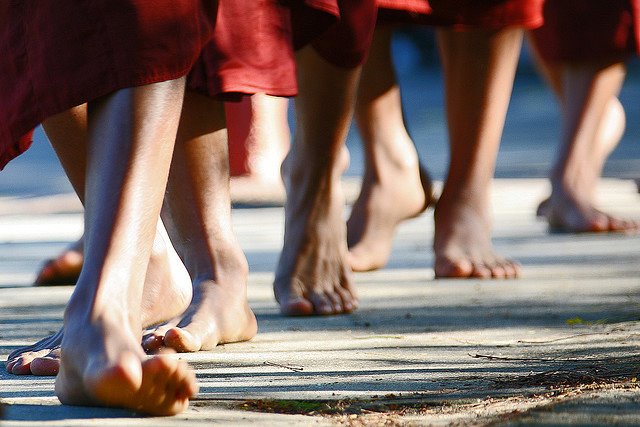
The oldest evidence for walking on two legs comes from one of the earliest humans known, Sahelanthropus. Walking upright may have helped this species survive in the diverse habitats near where it lived—including forests and grasslands. Today the habitat of the modern humans are urban areas and walking no-longer is matter of life and death but quality of life.

As a low impact exercise over 10,000 steps are recommend each day so its not an exercise that will help you loose pounds like running will. However, the benefits of walking can not simply be measured in weight loss or even fitness gains. Walking is much more than that. Walking is about the maintenance of overall physical and mental health. A evolutionary leap that is one of the most natural parts of our lives.

As a child our first steps are greeted with joy and as an adult our last with sadness. Walking is central to our being whether as a means of movement, a health exercise, a de-stresser, a way to clear your mind, think or connect to your own body or nature. As a result it’s a natural choice for an active meditative exercise that everyone can do.

Here’s a simple set of instructions for one form of walking meditation that focuses on connecting you to your own body and your surroundings.

1. Be aware of your posture, reduce your speed, relax and regulate your breathing with long slow deep breaths .

2. Using your five senses, listen to your surroundings and take a moment to become aware of them. Turn your attention to smells and touch, smile and explore your surroundings with wonder.

3. Become aware of your body, its movements its sway and connect to the sensation of walking. Observe how your body feels during the process of walking and enjoy these sensations for short periods of relaxed mindfulness.

So if you’re in Beijing here are my top three parks in Beijing for mindful walking:

1. The Temple of Heaven

2. Beihai Park

3. The Temple of Earth

Check out this app that is designed to help you integrate mindfulness into your daily routines. https://itunes.apple.com/hk/app/gps-for-the-soul/id586099254?mt=8 or alternatively. Leave your phone behind and get rid of all technological attachments for a mindful walk.

Check out www.StudyMartialArts.Org for martial arts adventure travel and training options in Beijing and World Wide.

A Lesson on Breathing

From Zen Mind, Beginner’s Mind

by Shunryu Suzuki

A path between a bamboo forrest.

When we inhale, the air comes into the inner world.  When we exhale, the air goes out to the outer world.  The inner world is limitless, and the outer world is also limitless.  We say “inner world” or “outer world,” but actually there is just one whole world.  In this limitless world, our throat is like a swinging door.  The air comes in and goes out like a swinging door.  The air comes in and goes out like someone passing through a swinging door.  If you think, “I breathe,” the “I” is extra.  There is no you to say “I.”  What we call “I” is just a swinging door which moves when we inhale and when we exhale.  It just moves; that is all.  When your mind is pure and calm enough to follow this movement, there is nothing:  no “I,” no world, no mind nor body; just a swinging door….

Tozan, a famous Zen master, said,

“The blue mountain is the father of the white cloud.  The white cloud is the son of the blue mountain.  All day long they depend on each other, without being dependent on each other.  The white cloud is always the white cloud.  The blue mountain is always the blue mountain.”

This is a pure, clear interpretation of life.  There may be many things like the white cloud and blue mountain:  man and woman, teacher and disciple.  They depend on each other.  But the white cloud should not be bothered by the blue mountain.  The blue mountain should not be bothered by the white cloud.  They are quite independent, but yet dependent.  This is how we live….

When we become truly ourselves, we just become a swinging door, and we are purely independent of, and at the same time, dependent upon everything.  Without air, we cannot breathe.  Each of us is in the midst of myriads of worlds.  We are in the center of the world always, moment after moment.  So we are completely dependent and independent.  If you have this kind of experience, this kind of existence, you have absolute independence; you will not be bothered by anything.

BOOK LINK – http://www.amazon.com/Zen-Mind-Beginners-Informal-Meditation/dp/0834800799

www.StudyMartialArts.Org