Kung Fu in Thailand Day Two: The Training Begins!

Today was an awesome day! I was up about 5:30 a.m. and we started a little before sunrise with Chi Kung and Sam Chien, crescent moon shining with mist hanging off the jungle. We trained with the group this morning from 6-9 am and in the afternoon session from 3:30 until a little after 6 p.m. I did 2 hours of solo instruction focussing on Chi Kung and Sum Chien. Sum Chien is a series of moves that forms a basis for the Southern Shaolin Tigre-Crane form we are learning. I also got to begin weapons training with staff and starting on Chinese Sabre using a stick. I thought staff would come more easily to me than sword but I probably did better with the sword technique. I worked on weapons with the head student who is also an instructor. The hardest part is probably the footwork. All in all I would say we spent about 2.5 hours today in stretching and conditioning, lots of stretching.

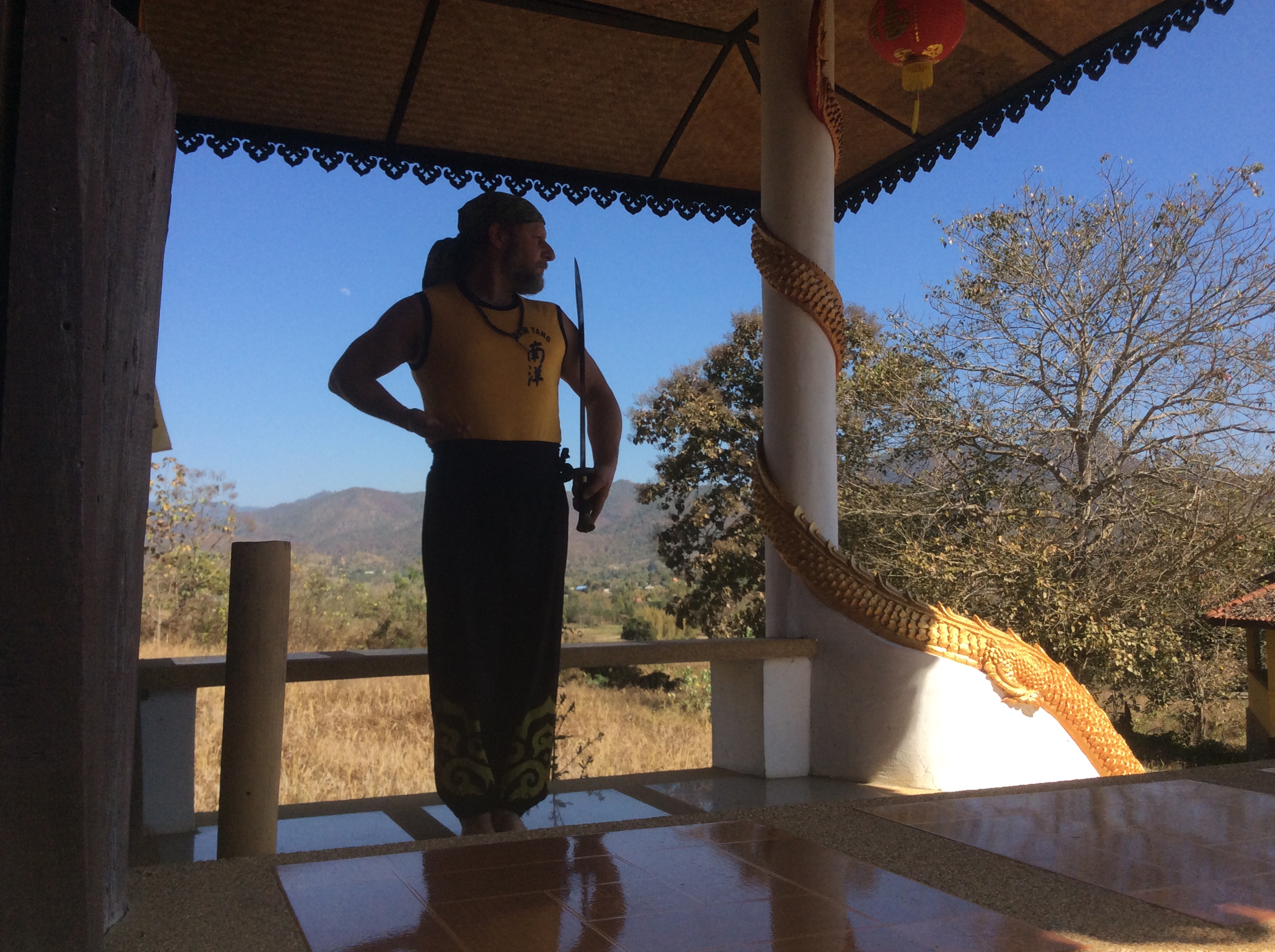
IMG_0864

In the evening we focused on special breathing techniques that apply to Chi Kung and Sum Chien, which Sifu said were actually quite advanced. I did well with my prior yoga and Chi Kung training. Then we worked on punching drills into heavy cloth sacks filled with sand hung from the rafters. It makes your knuckles pretty red but is very instructive on technique and really fun!! The idea is not to swing the sack but to be able to dent it by sending your chi into the target. One of my favourite times of day is the break in training when Sifu call us up to the veranda where we sit on teak stools and he pours special tea in all our cups on a table shaped like a dragon. He then delivers teachings about technique principles, tells stories and dispenses wisdom. Like I said, you can tell a lot about Sifu by how his chief students treat him: with utmost respect and admiration, hanging off every word with the rest of us. Sifu spoke about Kung Fu as a way of life; the martial aspect is part of a bigger picture and no one part is more or less than the other. Kung Fu prepares us for meditation and the pathway to enlightenment.

At afternoon tea Sifu spoke about the tendons. I had mentioned that I felt where an injury in my shoulder was really being stretched when being corrected in some technique for practicing one of the slow punch forms early in the morning. At first it hurt but I stayed with it and then it started to open. Sifu said that such body awareness is the first step to Kung Fu. He said one’s tendons have a grain like wood. When you get injured it forms a pattern in the tendon, like a knot. As you develop your awareness you can use the Kung Fu forms to go into the tendon and open it up taking out some of the scar tissue and re-patterning the tendon. He said something else that was very profound which reminded me of Sequoyah. Speaking about training and repetition, for example of a simple movement like a step or the most basic punch over and over again, Sifu said that you could never get board of anything that is done with deep intention and full awareness.

Life here has a rather monastic feeling. We train before sunrise and retire a little after sunset. Two meals a day are wholesome yet simple, rice with vegetables and a clear, tangy vegetable soup, prepared by our cook who is mostly blind and comes from one the tribes originally on the Burmese side. Accommodations are comfortable yet spartan, the bed being a heavy, handcut bamboo cot. It is surprisingly quite chilly in the morning and I really missed my fleece pants for the first couple hours but had to put on a good showing as a Canadian while everyone else was quite bundled up.

There are several people training, all male from young to old: two other Canadians, a Dutch fellow, a Belgian and a Brit. The Belgian and Brit are senior students. One is already a teacher and the other well on his way, very dedicated, lovely young men. Tomorrow we have a rest day and are going to see some remote hill tribes with whom Sifu is connected. I’m pretty sore in many places with a nice, large bruise on my arm from yesterday’s push-hands activity, and very happy.

Love and Blessings
David

David Lertzman Ph.D. is the Assistant Professor of Environmental Management and Sustainable Development PI: Energy Indigenous Environment Interface Research Program, Haskayne School of Business, University of Calgary.

This blog entry is part of a series of blogs David Lertzman wrote for StudyMartialArts.Org detailing his experiences training at Nam Yang Shaolin Kung Fu Retreat. If you’re interested in visiting this school book your place here and get an exclusive discount  Nam Yang Shaolin Kung Fu Retreat.

A Brief History of Some Walls: The Great Wall of China


Learning about the great wall, a brief history.

Noirfifre1's avatarYelhispressing

The Great Wall of China Source: en.wikipedia.org

Many describe The Great Wall as the longest structure built on earth. According to legend it is so magnificent that one can see it from space. It travels for 4, 500 miles in the North, touches the East Coast and the North Central of China, meandering through mountains, lower lands and the Gobi Desert. It is interesting to note that the translation for the wall was not always ‘Great’ but ‘Long Wall.’ As Julia Lovell puts it, the Great Wall is a collection of walls. The Chinese are known for their love of walls based on their early construction [from the 1st millennium BC], around the fields of farms, temples, houses and palaces. Furthermore, in the spiritual realm the Chinese paid homage to their God of Wall and Moat. According to Louise Chipley Slavicek, the Chinese believed that the God of Wall and Moat informed a person of their death…

View original post 850 more words

New Excerpt from “Zhan Zhuang Breathing – The Breath of Life”


An excellent book that has got a bucket load of information for all those standing tall.

Inside Zhan Zhuang's avatarInside Zhan Zhuang

IZZ-Facebook Page Art

Aloha from Maui, here’s a new excerpt in which I discuss allowing the breath to become round and then spherical…

THE DEPTH ASPECT – FULL MOON/SPHERICAL BREATHING

The Full Moon breathing method adds three additional points on the back to the five Half-Moon points already mentioned. These are Mingmen, GV-4 and two points roughly equidistant between Mingmen and the two Jingmen points. These are located in the vicinity of Zhishi point BL-52, on either side. In combination, these eight points create a complete circle, and when the inhale is generated from the body’s centerpoint, they form the basis of Spherical Breathing. That is, an equal expansion in all eight directions from the tiny sphere of our centerpoint to an energetic sphere that eventually encompasses the entire torso and later the whole body, including the extremities. As this technique becomes comfortable, the practitioner finds that the vertical elements also come into…

View original post 253 more words

Kung Fu in Thailand Day One: Arrival

Steve-Website-Photo1I have arrived in Pai, Mae Hong Son Province for two weeks of traditional Shaolin Kung Fu training in northern Thailand. After a flight delayed by fog we flew a short but spectacular journey over forested mountains and I’m now at Nam Yang Mountain Retreat, International Martial Arts Kung Fu and Meditation Training Centre. Although my work contract allows for 6 weeks of holiday, this is the first real vacation I’ve had since our honeymoon 8 years ago. I really need it.

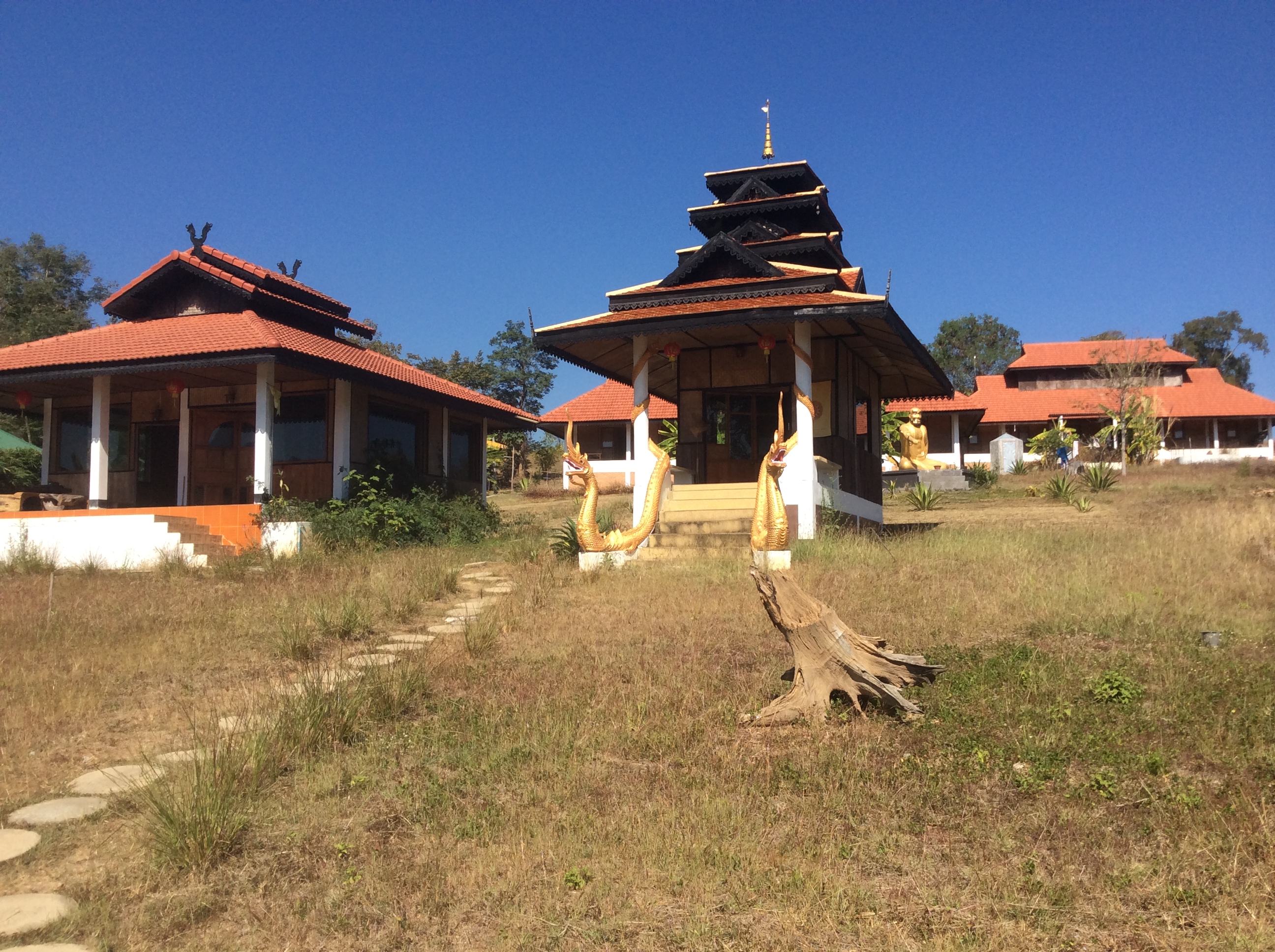
It is very special here. Nam Yang was created by Sifu Iain Armstrong and his wonderful Thai wife under the guidance of Grandmaster Tan Soh Tin with whom he has studied 30 years. Grandmaster Tan’s master brought southern Shaolin (Tigre-Crane) Kung Fu out of China after Mao’s ascendancy when the Shaolin martial artists were being executed. Nam Yang is near the town of Pai in northern Thailand about 30 km from the Burmese border. They grow most of their own food, including the rice, pineapples and bananas. The architecture is beautiful in the local traditional style giving the whole place a Shaolin Temple like quality. It is an extraordinary achievement! They have a large kitchen and open eating area, an office, Buddha House for meditation with two great Nagas (Dragons) descending the stairs, two training octagons, one which is covered and one open-area, plus the living quarters. Accommodations are simple, almost spartan, but we have what we need to get by and it is lovely!

I had a great sit with Sifu Iain over a special tea to review my training goals surrounded by the beautiful landscape and sprawling grounds of Nam Yang Retreat Centre. Afterwards I joined in the evening’s training. We did about 1.5 hours stretching and prep before doing push-hands and some basic drills. Sifu Iain is so authentic. You can tell a lot about Sifu by how his chief students treat him; that says it all. There are several people training, all male from young to old. Two other Canadians, a Dutch fellow, a Belgian and a Brit. The Belgian and Brit are senior students. One is already a teacher and the other well on his way, lovely dedicated young men. We went to Pai for supper tonight as one is leaving tomorrow after having been here some months. The other pretty much lives here training every day all day and sometimes teaching. Tomorrow we start at 6:00 am with Chi Kung for the sunrise. Wednesday is a rest day and we will go to town of Mae Hong Son on the Burmese border visiting remote hill tribes with whom Sifu is connected.

Kap Kuhn Kap (Thank you in Thai),
David

David Lertzman Ph.D. is the Assistant Professor of Environmental Management and Sustainable Development PI: Energy Indigenous Environment Interface Research Program, Haskayne School of Business, University of Calgary.

This blog entry is part of a series of blogs David Lertzman wrote for StudyMartialArts.Org detailing his experiences training at Nam Yang Shaolin Kung Fu Retreat. If you’re interested in visiting this school book your place here and get an exclusive discount  Nam Yang Shaolin Kung Fu Retreat.

Training with Master Zhou

SMA – Baji Zhandao UK training camp visit to Tianjin to train with Master Zhou.

Master Zhou Jingxuan teaches in Xi Gu park in Hong Qiao District. Historically this park continues to attract many of Tianjin’s famous martial arts masters and students. The park is a hive of activity throughout the day.

Master Zhou teaches the rare inner courtyard Shaolin martial art of Jin Gang Ba Shi. In addition to that he also teaches Piguazhang, Xingyi quan, Baji quan, Li style Taichi and Chou Jiao. As our trip to visit with Master Zhou was relatively short we focused our learning on the basics of two specific styles Piguazhang and Bajiquan.

After a warm welcome in Tainjin and some photos we enjoyed two hours of great training in Xi Gu park with Master Zhou. After the training we were invited for dinner with Master Zhou his senior students and a number of representatives from the Tianjin Martial Arts Association.

The following is an assortment of clips from the two day seminar as well as a short clip from a discussion on the evolvement of Bajiquan in Tainjin.

All the training you see in the video took place in Xigu Park where Master Zhou regularly teaches.

For further information on studying with Master Zhou, the Shang Wu Zhai Academy as well as a host of other masters in China and Thailand check out the http://www.StudyMartialArts.Org website.

Research of Martial Arts by Jonathan Bluestein

10553841_10203654851144377_7178757407568710551_oA Friend of mine has just written and put together his very first martial arts book. The title of the book is Research of Martial Arts. It is a monumental treatise of epic proportions on martial arts theory, practice and culture. 418 pages, 220,000 words. Most of it is dedicated to Chinese martial arts, but a lot is said and written of countless others, and I believe you too will find an interest in it.

More information, as well as 72 whole pages of FREE sample chapters and other interesting articles, are available if you follow this link http://www.researchofmartialarts.com/

You can also check out the book here on Amazon http://www.amazon.com/Research-Martial-Jonathan-Bluestein-Shifu/dp/1499122519

Over all the book is very much worth a look if you’re an avid reader martial artist literature. The aim of this book is to present the reader a coherent, clear-cut, and in-depth view of some of the most perplexing and controversial subjects in the world of martial arts, as well as providing a healthy dose of philosophical outlook on these subjects (from various individuals). At its core is the author’s aspiration to build a stronger theoretical foundation for the discussion of martial arts, while addressing matters in innovative ways, which I have come to believe, would help people to better grasp the nature of these arts.

Bajiquan International Training Center

maxresdefaultEarlier this week we announced the addition of a new full-time martial arts school to the StudyMartialArts.Org site.

The Bajiquan International Training Center is one of the best places in China to learn the martial art of Bajiquan. All the masters at this school are dedicated and trainined primarily in this art. The Masters skills, the Wu family lineage and knowledge plus the teaching focus on the practical use of the art, the standardized comprehensive curriculum and the Mengcun facility itself are all huge draws.  9461051

The Bajiquan International Training Center simply put is one of the biggest and most famous Bajiquan schools in the world. How students will learn Bajiquan at this school as opposed to some other Shaolin or Wudang based schools which teach to a smorgasboard of styles is very different.

The location of the school in Mengcun on the outskirts of Cangzhou City firmly puts the focus on training. Site seeing opportunities in Mengcun and Cangzhou City are limited. With so few distractions for students it makes the 6 day training regime easy to stick to. This is one reason why the facilities at the school are so good.

Additionally, another benefit of the school is that it can easily cater to both western and muslim cultures, this makes the Bajiquan International Training Center an attractive multicultural choice.

To see our full review plus prices click the link below. http://www.studymartialarts.org/school/bajiquan-international-training-center/71.html Remember though you must book through us to access our special discounts and additional resources for your training adventure at the school.

Message us privately for our full free school and travel consultation. StudyMartialArts@gmail.com

The Life of Pai

IMG_0905

Stepping of the plane in Chiangmai, I instantly liked the place. The warmth of the air was somewhat different to the dry February cold of Beijing.

Rather unwisely though I failed to print of the directions and contact number for where I would spend the next 3 weeks training. “Mai Pen Rai” with a single step I’d quickly adopted the Thai go with the flow attitude like a natural, after all I was in Thailand and what better why to honor my hosts.

I’d only just touched down in Thailand and the journey was already exceeding my expectations and I felt completely relaxed about the weeks ahead. What I love about traveling is meeting people. My experiences to date have shown me that people vibrate on different frequencies depending on their state of mind. When people are on similar frequencies it’s natural for them to attract and connect. With my mind on exploration, discovery and anticipation for the journey ahead it would be this energetic principle that had drawn me to meet a fellow martial arts traveler.

Energetic principle or fait I met Dr David Lertzman at the boarding gate at Hong Kong international airport heading for Chiangmai. Both of us where surveying the room for a suitable plug socket to charge our respective apple products.

David a professor from Calgary University in Canada was a man who’d spent the last 7 years working with indigenous tribes in the Amazon rainforest. He was traveling to a place called Pai for 3 weeks of Shaolin training in order to follow a passion for martial arts that remained with him from his youth.

We rearranged our seats on the plane and from Hong Kong to Chiangmai the professor and I swapped stories and enjoyed the back and forth of good conversation.

IMG_0856
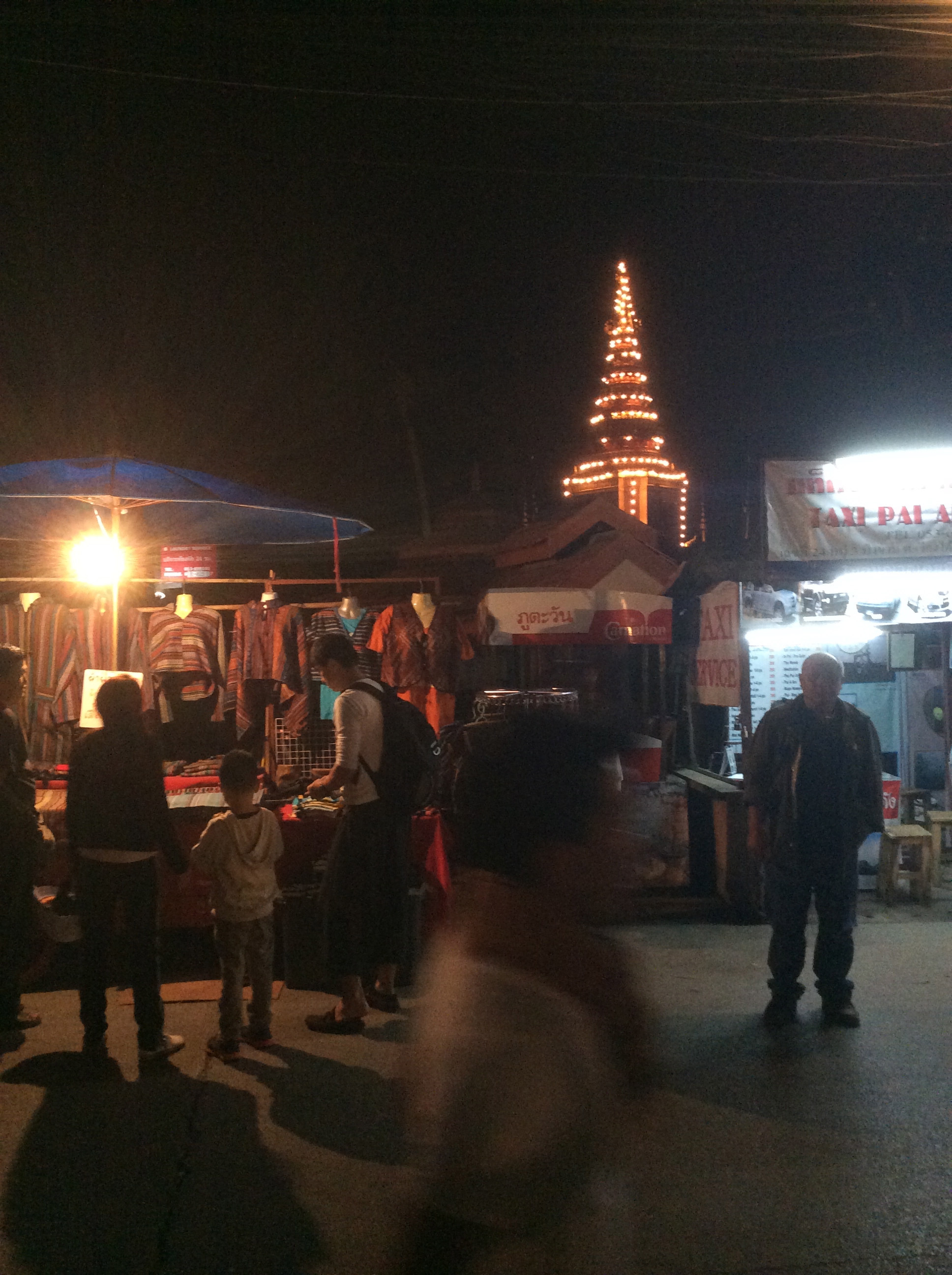
Walking Street

An instantly likeable and approachable man he had a way of making people around him feel comfortable. I pondered the thought of how this character trait would be one that would serve him well in the rain forests of the Amazon where he would have to communicate with numerous indigenous peoples. I pictured him bounding through the rain forests like Sean Connery from the medicine man.

We parted company in Chiang Mai with the intension of staying in touch to share our separate training experiences. He set off for the Nam Yang Shaolin Kung Fu Retreat in Pi and I to meet and train with Sifu Mark Rasmus.

Arriving late at Susan Pailomn it was dark but with a warm welcome and smile I was greeted by Sifu Rasmus. I could feel I was in a good place geographically, mentally and spiritually. Mark showed me to my chalet and we headed out to grab some food.

We talked about our respective martial arts journeys, about the training ahead, about life in Chiangmai, places to eat and places to visit. I new I was in the right place studying with the right master. When we finished it was late.

My first night in Chiangmai my plan ahead of arrival had been to make it to base camp familurize myself with the area and get a good nights rest. Mission accomplished.

Nestled among bamboo groves and trees I woke up from my first nights sleep to the morning chants of Buddhist monks and bell chimes, refreshed and ready to begin my training.The days ahead in Chiang Mai would be filled with excellent tuition under the supervision of Sifu Rasmus.

In addition to this there would be amazing temple visits and location based training, delicious local food and one or two healing Thai massages.Each evening as part of my training regime I would journal my progress. Likewise Professor David Lertzman had also been chronicling his training experience in Pai and was emailing the details of what would become a great blog for those thinking about training at Nam Yang Shaolin Kung Fu School. This is a blog I will post at a later date on the SMA bloggers wordpress site.


IMG_0866
The School

Before we parted company in Chiangmai I’d told David about the Study Martial Arts project, about our mission statement and company ethos. I also explained how I was always on the lookout for quality schools and masters to work with, so any insight he had about the school would be much appreciated.

With David’s regular up dates and emails filling my inbox with detailed accounts of his experience I knew that if an opportunity presented itself I would head to Pai, visit the school and catch up with my fellow martial arts adventurer.

On the second week of training a Thai national holiday fell on the Friday. Intuitively, Sifu Rasmus a keen motorcyclist proposed the idea of a road trip to Pai. With his help I rented a scotter and followed Sifu Rasmus along the beautiful, and somewhat infamous winding road from Chiangmai to Pai. We arrived in Pai dropped off our bags then headed out to explore Walking Street.

Walking Street Market in Pai is located on Rungsiyanon Road. It is a shopper’s paradise offering a wide range of souvenirs big and small, unique handicrafts, lacquerware and hand-made clothes some of which come direct from highland villages or local artists. Along with these gift stalls and shops I delighted in the sights smells and tastes of the authentic street food. Thai, Chinese, Western in such variety all fresh and delicious. The Thai street food experience was living up to the hype. The following day a Saturday would be a day off from training for the students at Nam Yang, so I explored Pai a little soaking in the Friday night before returning to my hotel. After breakfast I headed out to the school to meet David and also one of the instructors Eddie.

The school a ten minute bike ride away from my hotel is on the outskirts of Pai close to its small airport. David met me and showed me around the school and introduced me to some of his fellow students.

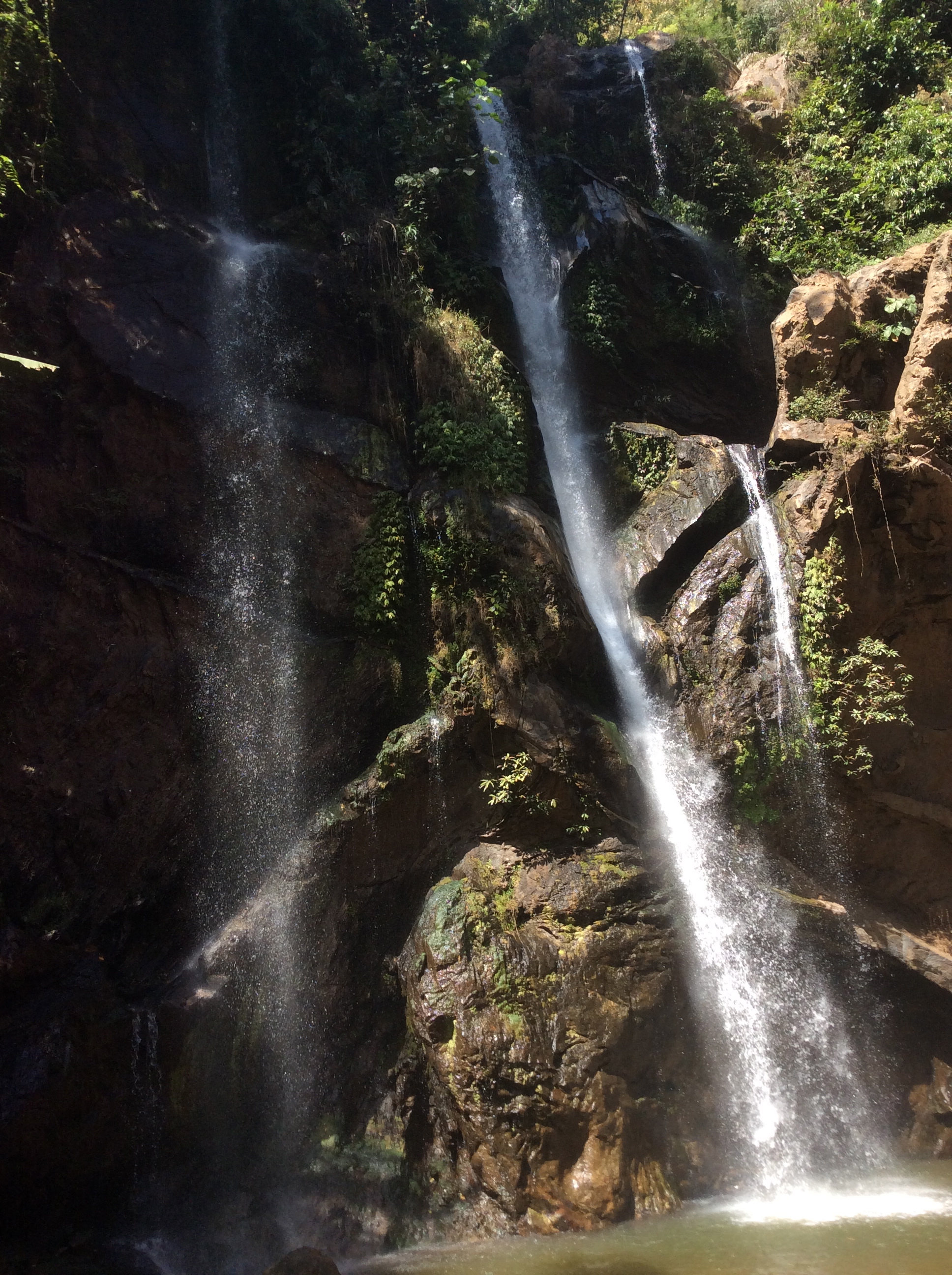
Mork Fa Waterfall
Mork Fa Waterfall

Some of these students were beginners studying martial arts for the first time, others had been students who had studied in China and were somewhat jaded of the experience and some were seasoned and experienced martial artists. After David showed me around he demonstrated one of the forms he’d been working on, then we sat and took tea with Eddie who at the time was one of the schools instructors.”Out door training areas”Normally the journey from Chiangmai to Pai takes 3-5 hours depending on your pace. I’d recommend taking it slow and taking in the scenery. The road itself is super fun but beware, those that get carried away and go to fast might end up as one of the roads numerous casualties. Both experienced and inexperienced drivers have cut short their holiday on this road which snakes it’s way up and over the mountains to Pai.

We stopped midway for lunch on the journey up and on the return I cooled down with a swim at this amazing waterfall at Mork Fa. For more information on martial arts training at this school or training experiences throughout China and Thailand visit the http://www.StudyMartialArts.Org website.

The StudyMartialArts.Org website has discounts on martial arts training and travel experiences as well as exclusive offers only available to those who book through SMA.

MARTIAL ARTS DISCUSSIONS by HUANG YUANXIU

Another amazing translation by Paul Brennan

Paul Brennan's avatarBrennan Translation

–

楊家太極拳各藝要義 武術偶談
THE SKILLS & ESSENTIALS OF YANG STYLE TAIJI BOXING
and
MARTIAL ARTS DISCUSSIONS
黃文叔先生著
by Huang Wenshu [Yuanxiu]
[published by 國術統一月刊社 Martial Arts United Monthly Magazine Society, June 15, 1936]

[translation by Paul Brennan, June, 2014]

–

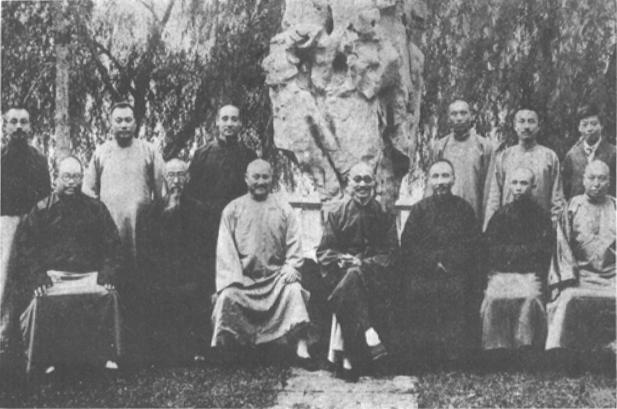
武術偶談 (1936) - photo 1

國術界泰斗合影
Group photo of leading figures in Chinese martial arts:
景中人自右而左前列田紹先鄭佐平杜心五李芳辰劉百川孫祿堂楊澄甫後列沈爾喬黃文叔褚桂亭高振東錢西樵蘇景由
The people in this photo are (from right to left):
Front row:
Tian Shaoxian [Zhaolin], Zheng Zuoping, Du Xinwu, Li Fangchen [Jinglin], Liu Baichuan, Sun Lutang, Yang Chengfu
Back row:
Shen Erqiao, Huang Wenshu [Yuanxiu], Chu Guiting, Gao Zhendong, Qian Xiqiao, Su Jingyou

–

武術偶談 (1936) - photo 2

燕趙國術名人合影
Group photo of famous martial artists from Hebei [from right to left]:
黃文叔 褚桂亭 蘇景由 王向齋 趙道新 張兆東 李星階 高振東 孫汝江 李子揚
Huang Yuanxiu, Chu Guiting, Su Jingyou, Wang Xiangzhai, Zhao Daoxin, Zhang Zhaodong, Li Xingjie, Gao Zhendong, Sun Rujiang, Li Ziyang

–

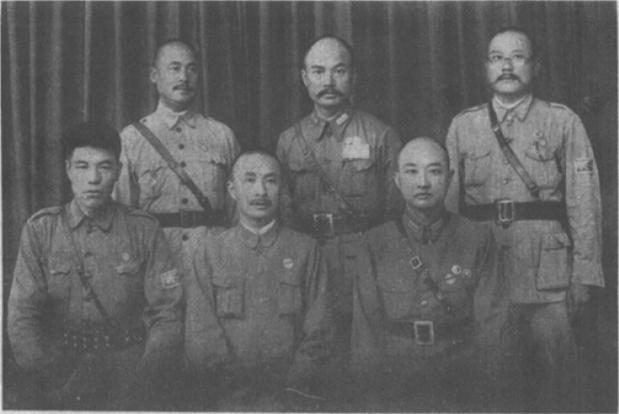
武術偶談 (1936) - photo 3

河北國術名人合影
Group photo of famous martial artists from Hebei:
[back row, right to left:]
騎兵團國術敎習 方瑞臣
Fang Ruichen, cavalry corps martial arts…

View original post 39,519 more words

798 Art District – Exploring Beijing’s Art Scene

798 Art District in the north-east of the city is Beijing’s “SoHo” and is home to a large arts community. Paintings, ceramics, and street art are scattered throughout the area and it’s ex-industrial factories provide artists with flexible open space for arts installations both big and small. The most important of these art galleries include the expansive 798 Space Gallery, Long March Space and UCCA (China’s largest privately funded art museum).
The charm of the area is preserved in its post-industrial feel and the Maoist inspired art slogans and original features scattered throughout the converted factories and shop floors.
As an arts community 798 has both endured and suffered because of its success. Initially development pressures almost saw the district completely redeveloped however, successful campaigning and the growth in tourism resulted in the reclassification of the area as a legitimate art district supported by the government.Nevertheless rising land prices and development pressures remain. As a result many of the original artists of the neighbourhood who set up studios in these former military factories, including Factory 798 which originally produced electronics have been priced out due to increasing rents. Only a handful of the most successful of these artists continue to live and work in the district.

“Creating a unique backdrop to display the art”

“Galleries both big and small sell and display art works”
798 continues to thrive despite the rising prices. Today the district is filled with not only art galleries but also gift shops, book shops, restaurants, cafés, artsy clothing stores and of course street vendors. 798 Art District is one of Beijing’s most popular tourist destinations and certainly China’s largest and most famous arts district.
One of the highlights of the district is its change ability. The installations move, change and evolve. The details, textures and colours of the works of art, the setting and the people offer the viewer new interesting sensory stimuli around every corner.
Taking photos is a must. The street art unique, weird and unusual is accessible and allows you to participate and interact with this very Chinese art experience.
“Reform and Opening Up” (改革开放 – gǎi gé kāi fàng)
798 Art District can be found at Jiuxianquao Road and Jiuxianqiao North Road, Beijing. Entrance is free and it is open each day from 10:00am-6:00pm.

View this article on storehouse – https://www.storehouse.co/stories/g2xa-798-art-district

My Site – http://www.StudyMartialArts.Org