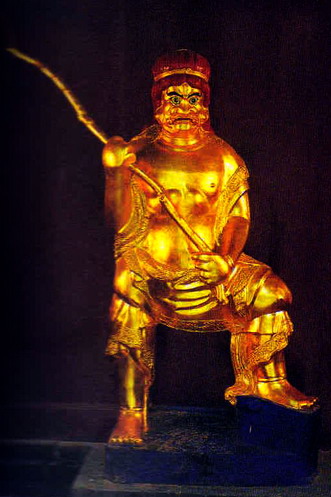
Snapshot Thursday: People praying in the City God Temple – Shanghai

SMA Travel and Culture. Discover the temples and traditions of China.

gaelleguesdon's avatarOverseas discoveris

View original post

The Art of Expressing the Human Body

Bruce Lee’s Jeet Kune Do: A Philosophy of Physical Self-Perfection

by David Quigley

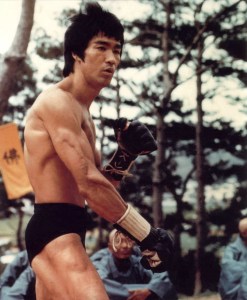
It is a safe assumption that almost everyone has heard of Bruce Lee.  He was and remains arguably the most famous Asian-American star in the history of film (sorry, Jackie Chan).  And anyone who has seen any of his films cannot help but notice his amazing physique, speed, agility, and flexibility.  However, what a lot of people do not realize – especially those outside the martial arts world – is that Bruce Lee was a philosopher obsessed with fitness, or what he called, the art of expressing the human body.  Indeed, Bruce Lee was a philosopher in every aspect of his life, and focused a lot of his writings on honest self-expression and self-perfection.  Even the martial art he developed, Jeet Kune Do (or, the Way of the Intercepting Fist), is in itself a philosophy.
Bruce lee Hd Wallpapers_8

JKD is not ‘Martial Art’; It is a Philosophy

First thing is first, though, and I need to make a clarification, so please bear with me.  Jeet Kune Do is not a martial art, per se.  It is, as I stated above, a philosophy.  Jeet Kune Do evolved over time – from the days of the original Jun Fan Gung Fu Institute in Seattle to his final Los Angeles/Chinatown school – into a fighting system centered on personal expression, simplicity, and personal liberation.  The techniques Bruce taught his students changed constantly as he researched different ideas.  Therefore the “Jeet Kune Do” of 1968 looked different than the “Jeet Kune Do” of 1970.  Jeet Kune Do, therefore, is not a style, but an evolving philosophy, which is important to keep in mind.

Jun Fan Gung Fu (Bruce Lee’s Cantonese name is Lee Jun Fan) is a system developed by Lee, taking aspects from myriad martial arts, but focusing on Wing Chun Gung Fu, western boxing, fencing, Savate, and kickboxing.  I am not trying to split hairs here, but I want to make it clear that JKD has techniques in Jun Fan Gung Fu.  In fact, Bruce Lee developed an amazing curriculum he handed down to Dan Inosanto at the L.A. school, which shows the depth to which Bruce had developed his fighting philosophy.

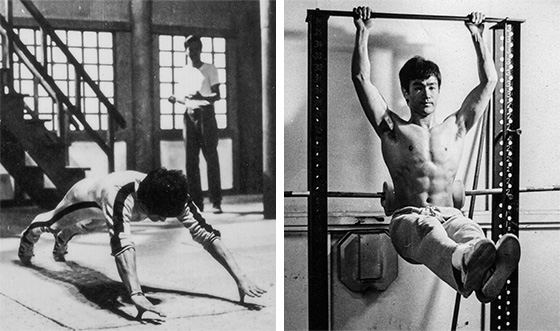
That being said and on top of all of his martial creativity, Bruce Lee was obsessed with self-perfection in all aspects, including the physical.  Fitness was (obviously) very important to Bruce.  What records we have of his regiments show his amazing fitness level, understanding of the human body, and his desire to be physically capable in every aspect.  He even had very specific equipment pieces built to develop power and speed for specific techniques.  One needs only to talk to a few of his students to hear stories of his almost super-human strength and speed to know that his constant training and development paid off.  This is a lesson every martial artist should heed.

the-art-of-expressing-the-human-body

Nevertheless, I frequently see massively overweight martial artists who are unable to execute their techniques correctly.  Too often these martial artists rely solely on their training (whatever that may be) for their physical fitness, and the results are often dismal.  For this reason, fitness is an important aspect of JKD training.  The art itself requires a certain level of physical fitness to be able to perform many of the techniques.  In other words, training the art is not enough; one must develop the physical attributes necessary to be able to pull off the techniques in real-time, with speed, strength, and accuracy.  In testing my students, I require a physical fitness portion, which consists mostly of pushups, pull-ups, bag work, and plyometrics in addition to the rigors of the test itself.  I have noticed that this addition to my tests has not only improved my students’ fitness level, it has also increased their ability to perform the techniques more fluidly, with more power and speed.  In effect, it has increased their ability to honestly express themselves.

In this article I’ve focused on the most basic of introductions to Bruce Lee’s amazing martial art and its relation to fitness.
enter-the-six-pack-7


Following in the footsteps of Miyamoto Musashi

Following in the footsteps of Miyamoto Musashi

musashi

In honor of Miyamoto Musashi and his inspirational Go Rin No Sho (The Book of 5 Rings) the following information is for those wishing to visit Japan and various significant Miyamoto Musashi sites of interest. The following is his post with a little added extra information by me.

20090729_reigandou1
Reigando Cave


One of the best general resources is the Japan National Tourist Organization website at http://www.jnto.go.jp/ That being said, some of the places which martial artists may want to visit are very much off the beaten track and require a lot of searching online, questioning friends and strangers (a visit to any local dojo for help is highly recommended) and help from a local tourist office or bus station. Japan has very low crime, and its people are usually very helpful, so you will eventually get to where you need to be. Please be very respectful to everyone you deal with. For specific directions to the Reigando Cave I suggest getting to the Kumamoto City bus terminal / station and asking (you can write in English if you don’t speak Japanese and can’t find an English-speaking person). This site is also helpful: http://www.manyou-kumamoto.jp/contents.cfm?id=292

1599424394_1e0a43ab43

The Reigando Cave (霊巌洞) is basically a small cave in the mountains close to Kumamoto city. It is on the grounds of the very old Unganzenji temple (雲巌禅寺), and it was here, in this cave, where Miyamoto Musashi was said to have written his treatise the Go Rin no Sho (五輪書) in the early 1640′s. Here is a link to a relevant blog http://kenshi247.net/blog/2011/06/20/kendo-places-11-musashi-no-sato/ and here is a youtube link so you can have a look at the cave. Although this gives a good idea visually of how the cave looks. I really feel that you have to visit these places to feel the connection and the sense of peace. Its all about being truely there. That is after all why we enjoy traveling and why it can be a catalyst for awakening.

These links are for Ganryu-jima. – “Ganryūjima (巌流島, (formally Funajima 船島) is an island in Japan located between Honshū and Kyūshū, and accessible via ferry from Shimonoseki Harbor (下関港). It is famous for the duel between Miyamoto Musashi and Sasaki Kojirō. The small island was named for its boat-like appearance, and later became to be called the Ganryū kenjutsu school Kojirō had founded” (wikipedia)

During Golden Week (May 3-5) a small festival is held in honor of the epic duel fought between the legendary swordsmen Miyamoto Musashi (author of the Book of Five Rings) and Sasaki Kojiro known as the Demon of the West. They met in 1612 on the island which is now known as Ganryujima and when the duel was over Kojiro lay dead and Musashi was victorious. The actual details of the duel are debatable but the legends of it are very persistent. It’s said that Musashi purposely arrived late, unwashed, and carrying a wooden sword he had carved out of an oar on the way over – all of this to unnerve his opponent. Kojiro is said to have struck first but failed to cut Musashi down. Musashi smacked Kojiro on the head killing him or in the some versions finishing him off with a blow to the ribs.

And if you do pass through Shimonoseiki to get to Ganryu-jima, I recommend that the more adventurous of you try the “fuku” or Japanses blowfish. It’s the famous fish which can kill if not prepared properly, and rumour has it that chefs have to be specially licensed to prepare it, and that they have to try a piece every time they make fuku.

Etiquette for visiting Buddhist Temples

When traveling to Buddhist temples why not prepare yourself and learn about Buddhist temple etiquette?

While traveling its important to be respectful of other cultures and traditions. Being, humble and modest were travel is part of the journey to greater levels of awareness. We hope this information will be helpful to any www.StudyMartialArts.Org students wishing to pay their respects at the Shaolin Temple or any other Buddhist Temple they may visit on there journey.

Below are some top tips.

Buddhist temples

  • Take off your shoes and hats before entering. There will almost always be a sign outside of the temple pointing visitors to the designated area for shoes and hats. The many pairs of visitors’ shoes clumped together will tip you off.
  • Cover your shoulders. Since it gets very hot in Asian countries during the summer, many tourists forget to cover their shoulders and legs before entering places of worship. One way to plan ahead is to dress in layers and bring a scarf or shawl along, no matter where you go. When visiting temples, capri pants and long skirts are preferable to shorts, although men can sometimes get away with wearing long shorts.
  • Stand when monks or nuns enter. Just as you would stand to greet someone in any formal setting, try to remember to stand up when a monk or nun enters the room.
  • Ask permission before taking pictures. Make sure it’s okay to use your camera, especially when taking photographs inside a temple with statues. If you do take pictures, it’s always nice to leave a donation.
  • Use your right hand. When handing a donation (or anything else) to a person, use your right hand.
  • Don’t point. Instead, if you wish to point something out to a fellow traveller, use your right hand, open, with the palm facing the ceiling.
  • Don’t touch Buddha statues. Remind your kids before entering not to touch or climb on top of the Buddha statues.
  • Don’t touch Buddhist monks, especially if you are female. Women are not supposed to hand items to monks, either. Men who need to hand something to a monk, or take something from a monk, should try to use their right hands.
  • Don’t turn your back to Buddha statues. You may notice people walking backward away from the Buddha. Follow their lead, turning around only when you are a few feet away from the statue.

READ THE FULL ARTICLE HERE http://www.bbc.com/travel/blog/20110616-travelwise-religious-tourism-etiquette

The Spirit of Shaolin By Master Shi Yan Jia

Shaolin Kung Fu is technically speaking the martial arts system of attack and defense movements that uses forms (series of moves combinations:套路 taolu) as a basic method of training. Both the moves and their combinations are based on Traditional Chinese Medicine’s theory about the working of the human body. The cultural and spiritual aspect of Shaolin Kung Fu comes through its essential roots in Chan Buddhism, the first belief shared by practitioners. This is especially the case in regards to wisdom and strength; for wisdom, the Buddha Puti Damo (left) is worshipped to and for strength, the Buddha Jin Na Luo Wang (right) is taken refuge in.

A Typical Day For a Shaolin Monk

Early at five o’clock every morning, the monks of the Shaolin Temple arise with the striking of the gong. They join together to start the first morning class of the day, lasting for 90 minutes. At 06:40, monks mindfully join a line in the Zhai Tang (place where the monks have food) to have breakfast. Before and after the meal, monastic chanting is carried out. Every monk has his own alms bowl with food in it and is not allowed to leave anything uneaten. During this meal time, everyone is to keep silent. Between 08:00-09:00 the monks study Buddhism where dharma learning is taught to cultivate knowledge and wisdom. Between 09:10-11:30, there is study time to practice Kung Fu at the back of a nearby mountain., Lunch is then taken afterwards at 11:40 in a similar manner to breakfast, some grand masters and scholastic monks however do not eat lunch in order to enter fully into their monastic life and study. Afternoon training time then takes place between 14:00-17:30. After a short rest, members of the temple go to the monastery for evening chanting which lasts an hour. The final part of a day is a 45 minute meditation period followed by a period for self-study that lasts until the sound of the bell again at 21:30 which signals the end of the day.

Shaolin Kung Fu’s Nine Steps of learning:

1. 结缘 Knowledge: In various ways, begin to know about Shaolin Kung Fu and the Song Shan Shaolin Temple 2. 仰慕 Admiration: Feel moved by the sprit and character of Shaolin Kung Fu and so be naturally energised towards it. 3. 抱负 Ambition: Start to plan your life again after the feeling of your heart and making the decision to learn Shaolin Kung Fu. After setting a specific goal, set your mind to realize that ambition in your lifetime. 4. 痴迷 Enthusiasm: Make a self-affirmation of the goals chosen and pursue with a one-pointed determination of love and dedication. 5. 行动 Action: Adapt your goal to specific courses of action and start to practice Shaolin Kung Fu. This will be a hard learning process. 6. 认识 Understand: Come to rational knowing and the cultural connotations of Shaolin Kung Fu. 7. 信仰 Faith: Start to transform rational understanding into a deeper understanding about Buddhism. Shaolin Kung Fu is considered one way of learning Chan Buddhism (and so named “Wushu Chan”). 8. 感悟 Awareness: Practice Shaolin Kung Fu from a deeper self belief enabling practice to become not just a goal but an effective path to becoming aware and realising the essence of Buddhism. 9. 见性 Nature: From learning Shaolin Kung Fu, develop a full understanding about wisdom and strength, see the truth of life and the universe.

Master Shi Yan Jia

Master Shi Yan Jia (Wei Shifu) is a 34th generation Shaolin Disciple of the current Shaolin Temple Abbot the Venerable Shi Yong Xin, came to the Shaolin Temple to learn Shaolin Kungfu from the age of 8 years old and stayed there for a further ten years. He is currently ranked at level 7*. He has 8 years of experience in teaching Kung Fu to international students from all over the world and giving performances to many people. In the 1st national Shaolin Kung Fu competition Master Shi Yan Jia was awarded first place in traditional Shaolin Fist form and Shaolin Spear form. At the 9th Sports Meeting in Henan province, he also won first place for his Shaolin Staff routine, and in the championships of Zhengzhou, he came first in the Traditional Sword form category. Master Shi Yan Jia is the headmaster of Qufu shaolin kung flu school. The school has only recently relocated to Shimen mountain near the historic city of Qufu (eastern Shandong Province), hometown of the great Chinese philosopher, Confucius. If you would like to find out more about his school visit www.studymartialarts.org or Skype: studymartialarts.org for a free consultation on your martial arts trip to China.

Martinez, Magdaleno battle in Macau

Jack Sumner's avatarSouthpaw Jack's

Roman ‘Rocky’ Martinez makes the second defence of his WBO super featherweight title on Saturday, entering the Venetian Hotel and Casino to defend his crown on foreign soil against Las Vegas native Diego Magdaleno.

Of course the Puerto Rican would be on foreign soil you might say and what’s the big deal about him fighting in the world’s boxing capital? But Magdaleno won’t enjoy home advantage either on the night, as the fight will not be taking place in Sin City.

magdaleno-martinez (1)

The 130-pounders have travelled across the globe to Macau, China, where they will meet in the ring at the Venetian Macao Resort Hotel. Martinez-Magdaleno will be part of a stacked card in Top Rank’s first promotion in China, which they hope to be the first of many after signing Chinese junior flyweight Zou Shiming, a triple Olympic medallist who makes his pro debut in a four-rounder.

The card also…

View original post 365 more words

A week in Xi’an (3) Morning in the park

celiahukins's avatarCelia's blog

The park is busy with morning activities; groups practise tai chi and martial arts
IMG_2055
tai chi
Martial arts
A path sweeper takes a rest and listens to the music coming at him from all sides
path sweeper

Fishing is a popular pastime; there are plenty of fish in this special fishing area
lake
We sit by the lake and watch the world go by
Lake
Duck boat

Coming out of the park by another gate we find a market where people buy food for lunch
meat stall
Vegetable stall
Vegetable sellers
We stand back to let the Amazon delivery through
Amazon delivery
As we walk through the park later it’s peaceful and all the exercisers have gone

tree
Pagoda
Outside the park students eat tasty looking snacks at a stall, but with our Western digestive systems we daren’t risk it
Food stall

View original post

Family martial arts classes boost confidence, improve fitness and cement family bonds

imagineitblog's avatarFlying Kick LA Official Blog

When Pam Tucker of Leon, West Virginia, signed up for her first karate class at the age of 18, she never dreamed that her passion for martial arts would be so infectious.  Today, Pam, her husband, Frank, and their children, Mason, 13, Jake, 10, and Zaiah, 8, spend 3 days a week at the martial arts training hall (dojan) and center their vacations around national karate championships at which they volunteer. “It’s a fun activity that helps all of us stay in shape and feel connected to one another,” says Pam.

Martial arts have become a family affair – for moms, dads, and children of all ages. Today, almost half of the sport’s 6 million participants are kids between the ages of 6 and 17, and women comprise one-third of the student body, according to the Sporting Goods Manufacturers Association.

Martial arts are booming because they offer something for all…

View original post 80 more words

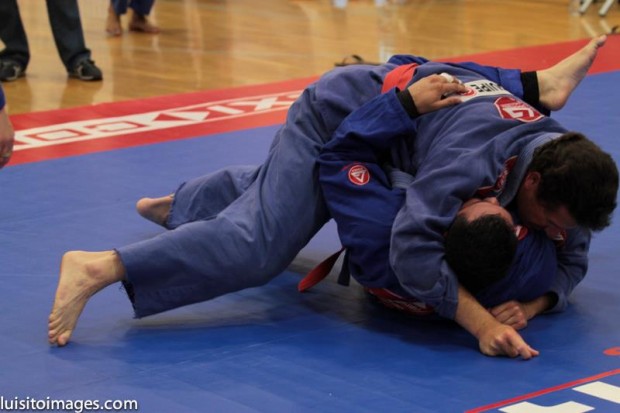
Kids Martial Arts, Submission to the Process of Learning Jiu-Jitsu

gbknoxkids's avatar

BJJ Submission

Submission to the Process of Learning Jiu-Jitsu

“But, when will I get good?” How often have I asked that over the last two years of training at Gracie Barra? When will I be good enough? When will I reach a level of competence? Why do I feel like people think I’m horrible? Why am I horrible? When will I be able to submit someone with no problem?

Submission.submission

To submit someone on the mat is the highest form of victory in Jiu-Jitsu, right? There are no points to be counted, no referees to decide a winner, and no disputed outcome. For many training at Gracie Barra, across the world, the goal is to become so good that submissions come easily.

This is a laudable goal and one for which we should all strive if we want to improve our technical skill, but I would propose that we, as practitioners of…

View original post 543 more words

Yue Jia Quan training in Yantai Shandong


Yue Jia Quan
 is the Yue family fist directly attributed to General Fei of the Southern Song Dynasty (1127-1279).

Yue Jia Quan is a short boxing combat system based primarily upon the principles of combining inner and outer bodies in theory and application. Emphasis is on low stances centreline and body strikes that over power opponents and the efficient use of kicks. This combat style comes from the principal philosophy of the positive and negative and combines the five elements of the heart, liver,lung, spleen and kidney in the human body.

Yue Jia Fist training consisting of:

Forms practice, combat strength and conditioning drills, free sparing, breathing exercises, hard body conditioning as well as active and standing qigong.

If you would like to study Yue Jia Quan with a traditional master with years of actual combat experience as opposed to forms competition experience follow the link. http://www.studymartialarts.org/master/master-sui-peng-fei/49.html

Master Sui Peng Fei is based in Yantai, Shandong. It is a very pretty and relatively small costal city on the east coast of China. At present we are offering serious students the chance to enrole in a 1 year Chinese course, (1 year visa included), plus 1 year training with Master Sui and accommodation in a new 2 bed apartment for 1 year – Short term options with or without a Chinese language course are available on request. Accommodation would either be at the University and a 3-6 month language course would have to be applied for or alternatively with an invitation letter organised through SMA we have the opportunity to set those interested in this up with a Home-stay Family. All this can be done through only through http://www.StudyMartialArts.Org

Master Sui Peng Fei