Taekkyon: the Original Martial Art of Korea

f0064134_4cb5e92f7d049Almost everybody has heard of Taekwondo and Hapkido these days, but Taekkyon, the original indigenous martial art of Korea, is almost unheard of.  Almost wiped out during the Japanese colonisation of Korea, the art is now making a revival, and is listed both as a national treasure of Korea, and is the first martial art on the UNESCO intangible cultural heritage list.

The history of Taekkyon goes back to the mid Joseon Dynasty, around the 1700s, where it was practiced as a competitive sport with a winner-stays-on type rule set. It is believed Taekkyon evolved out of an even older, but now lost art called Subak. Little is known about Subak, but it is believed that it may have been the martial art of the Hwarang warriors of the Silla Dynasty (57BC-935AD). During this time martial arts were reserved for the ruling class, but after the fall of the Silla became popular among common folk. During the Joseon Dynasty it fell out of popularity among the Yangban elite, who thought that educated people should stay away from martial arts and focus on scholarly pursuits. It was probably around this time that the competitive “game” version evolved as a game for the farmers and peasant classes.

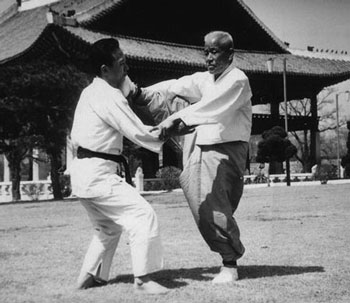
During the Japanese occupation, the art almost died out, but one man kept the art alive; Song Duk Ki. HeSong-Duk-Ki-foot-slapping1 is credited with reviving the art in modern times. Song Duk Ki was born in 1893 in Seoul. He began training at a young age, under Master Lim Ho, of the Widae style. During that time many young people practiced Taekkyon, and there were two main styles: Widae, which was practiced by people in the city centre, and Ahratdae, which was practiced by people on the outskirts of the city. Big competitions were held between the two styles and rivalry was fierce. Then, after the 1910 Japanese invasion of Korea, Song Duk Ki changed his focus to Gung-do (Korean archery), one of the few arts not shunned by the colonisers. He continued his Taekkyon practice in secret, and after the surrender of Japan, he began to promote the art, gaining the rank of a “national living treasure” by the South Korean government.

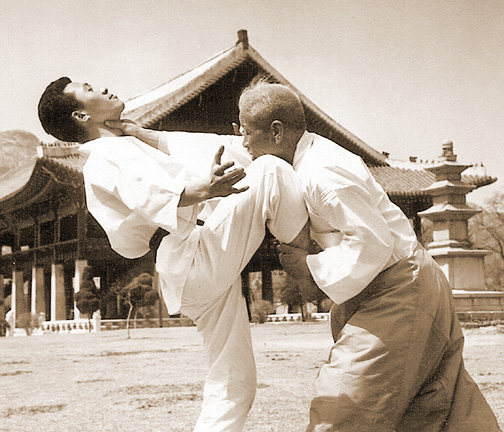
Taekkyon has both a competitive, game-like version, and a combat version. The game, which is called Kyulyun, was played where two teams gathered, with a winner stays on format, until one team was completely wiped out. This 1377954_581442335256536_660695014_ngame had a dance like feel, as players stepped around each other while drums were played. Players had to either throw the opponent, or kick them in the head. Like modern day sports martial arts, a player could tap out to surrender. The ring was often made by laying down straw mats, but could also be on dirt or grass. The largest competition would typically be held on the 15th day of the 5th lunar month, which was called Tano, which also held Ssireum, Korean wrestling, tournaments. There was no prize, but the winner would be treated as a hero by both sides. It is said the focus on kicking techniques in Korea is due to the mountainous terrain; people had naturally strong legs from spending so much time climbing hills.

As far as combat, similar techniques are applied as in the game. The main difference however is the target areas and the power used. Pressure point techniques, eye gauges and locks are also common. The rhythmic steps and constant 1926801_647747588626010_174977634_nmotions of the hands distract the opponent, setting up for a kick or sweep. Unlike taekwondo, flying or spinning kicks aren’t often used, rather, low kicks to the shins or knees, sweeps and trips, and direct push kicks to the body are more common.

A typical Taekkyon class is very different to conventional martial arts: there is no warm up or stretching as such, rather, the class begins by practicing stepping patterns in a dance-like rhythm to traditional Korean music.  The stepping is done in a triangular pattern, based on the Chinese character 品. Strikes and kicks are added in, as well as patting of the body and clapping to stimulate blood flow. This is all done in time with the music. Sparring is taught within the context of the stepping patterns. Opponents square off and step in time with each other, constantly changing feet and seeking an opportunity to sweep or trip their partner.

I have just began my training in Taekkyon, here in Seoul, South Korea. I will be regularly updating my website about my training here, as well as continuing my writing about Chinese martial arts. http://www.monkeystealspeach.co.uk

Training with Master Zhou

SMA – Baji Zhandao UK training camp visit to Tianjin to train with Master Zhou.

Master Zhou Jingxuan teaches in Xi Gu park in Hong Qiao District. Historically this park continues to attract many of Tianjin’s famous martial arts masters and students. The park is a hive of activity throughout the day.

Master Zhou teaches the rare inner courtyard Shaolin martial art of Jin Gang Ba Shi. In addition to that he also teaches Piguazhang, Xingyi quan, Baji quan, Li style Taichi and Chou Jiao. As our trip to visit with Master Zhou was relatively short we focused our learning on the basics of two specific styles Piguazhang and Bajiquan.

After a warm welcome in Tainjin and some photos we enjoyed two hours of great training in Xi Gu park with Master Zhou. After the training we were invited for dinner with Master Zhou his senior students and a number of representatives from the Tianjin Martial Arts Association.

The following is an assortment of clips from the two day seminar as well as a short clip from a discussion on the evolvement of Bajiquan in Tainjin.

All the training you see in the video took place in Xigu Park where Master Zhou regularly teaches.

For further information on studying with Master Zhou, the Shang Wu Zhai Academy as well as a host of other masters in China and Thailand check out the http://www.StudyMartialArts.Org website.

Bajiquan International Training Center

maxresdefaultEarlier this week we announced the addition of a new full-time martial arts school to the StudyMartialArts.Org site.

The Bajiquan International Training Center is one of the best places in China to learn the martial art of Bajiquan. All the masters at this school are dedicated and trainined primarily in this art. The Masters skills, the Wu family lineage and knowledge plus the teaching focus on the practical use of the art, the standardized comprehensive curriculum and the Mengcun facility itself are all huge draws.  9461051

The Bajiquan International Training Center simply put is one of the biggest and most famous Bajiquan schools in the world. How students will learn Bajiquan at this school as opposed to some other Shaolin or Wudang based schools which teach to a smorgasboard of styles is very different.

The location of the school in Mengcun on the outskirts of Cangzhou City firmly puts the focus on training. Site seeing opportunities in Mengcun and Cangzhou City are limited. With so few distractions for students it makes the 6 day training regime easy to stick to. This is one reason why the facilities at the school are so good.

Additionally, another benefit of the school is that it can easily cater to both western and muslim cultures, this makes the Bajiquan International Training Center an attractive multicultural choice.

To see our full review plus prices click the link below. http://www.studymartialarts.org/school/bajiquan-international-training-center/71.html Remember though you must book through us to access our special discounts and additional resources for your training adventure at the school.

Message us privately for our full free school and travel consultation. StudyMartialArts@gmail.com

The Life of Pai

IMG_0905

Stepping of the plane in Chiangmai, I instantly liked the place. The warmth of the air was somewhat different to the dry February cold of Beijing.

Rather unwisely though I failed to print of the directions and contact number for where I would spend the next 3 weeks training. “Mai Pen Rai” with a single step I’d quickly adopted the Thai go with the flow attitude like a natural, after all I was in Thailand and what better why to honor my hosts.

I’d only just touched down in Thailand and the journey was already exceeding my expectations and I felt completely relaxed about the weeks ahead. What I love about traveling is meeting people. My experiences to date have shown me that people vibrate on different frequencies depending on their state of mind. When people are on similar frequencies it’s natural for them to attract and connect. With my mind on exploration, discovery and anticipation for the journey ahead it would be this energetic principle that had drawn me to meet a fellow martial arts traveler.

Energetic principle or fait I met Dr David Lertzman at the boarding gate at Hong Kong international airport heading for Chiangmai. Both of us where surveying the room for a suitable plug socket to charge our respective apple products.

David a professor from Calgary University in Canada was a man who’d spent the last 7 years working with indigenous tribes in the Amazon rainforest. He was traveling to a place called Pai for 3 weeks of Shaolin training in order to follow a passion for martial arts that remained with him from his youth.

We rearranged our seats on the plane and from Hong Kong to Chiangmai the professor and I swapped stories and enjoyed the back and forth of good conversation.

IMG_0856
Walking Street

An instantly likeable and approachable man he had a way of making people around him feel comfortable. I pondered the thought of how this character trait would be one that would serve him well in the rain forests of the Amazon where he would have to communicate with numerous indigenous peoples. I pictured him bounding through the rain forests like Sean Connery from the medicine man.

We parted company in Chiang Mai with the intension of staying in touch to share our separate training experiences. He set off for the Nam Yang Shaolin Kung Fu Retreat in Pi and I to meet and train with Sifu Mark Rasmus.

Arriving late at Susan Pailomn it was dark but with a warm welcome and smile I was greeted by Sifu Rasmus. I could feel I was in a good place geographically, mentally and spiritually. Mark showed me to my chalet and we headed out to grab some food.

We talked about our respective martial arts journeys, about the training ahead, about life in Chiangmai, places to eat and places to visit. I new I was in the right place studying with the right master. When we finished it was late.

My first night in Chiangmai my plan ahead of arrival had been to make it to base camp familurize myself with the area and get a good nights rest. Mission accomplished.

Nestled among bamboo groves and trees I woke up from my first nights sleep to the morning chants of Buddhist monks and bell chimes, refreshed and ready to begin my training.The days ahead in Chiang Mai would be filled with excellent tuition under the supervision of Sifu Rasmus.

In addition to this there would be amazing temple visits and location based training, delicious local food and one or two healing Thai massages.Each evening as part of my training regime I would journal my progress. Likewise Professor David Lertzman had also been chronicling his training experience in Pai and was emailing the details of what would become a great blog for those thinking about training at Nam Yang Shaolin Kung Fu School. This is a blog I will post at a later date on the SMA bloggers wordpress site.


IMG_0866
The School

Before we parted company in Chiangmai I’d told David about the Study Martial Arts project, about our mission statement and company ethos. I also explained how I was always on the lookout for quality schools and masters to work with, so any insight he had about the school would be much appreciated.

With David’s regular up dates and emails filling my inbox with detailed accounts of his experience I knew that if an opportunity presented itself I would head to Pai, visit the school and catch up with my fellow martial arts adventurer.

On the second week of training a Thai national holiday fell on the Friday. Intuitively, Sifu Rasmus a keen motorcyclist proposed the idea of a road trip to Pai. With his help I rented a scotter and followed Sifu Rasmus along the beautiful, and somewhat infamous winding road from Chiangmai to Pai. We arrived in Pai dropped off our bags then headed out to explore Walking Street.

Walking Street Market in Pai is located on Rungsiyanon Road. It is a shopper’s paradise offering a wide range of souvenirs big and small, unique handicrafts, lacquerware and hand-made clothes some of which come direct from highland villages or local artists. Along with these gift stalls and shops I delighted in the sights smells and tastes of the authentic street food. Thai, Chinese, Western in such variety all fresh and delicious. The Thai street food experience was living up to the hype. The following day a Saturday would be a day off from training for the students at Nam Yang, so I explored Pai a little soaking in the Friday night before returning to my hotel. After breakfast I headed out to the school to meet David and also one of the instructors Eddie.

The school a ten minute bike ride away from my hotel is on the outskirts of Pai close to its small airport. David met me and showed me around the school and introduced me to some of his fellow students.

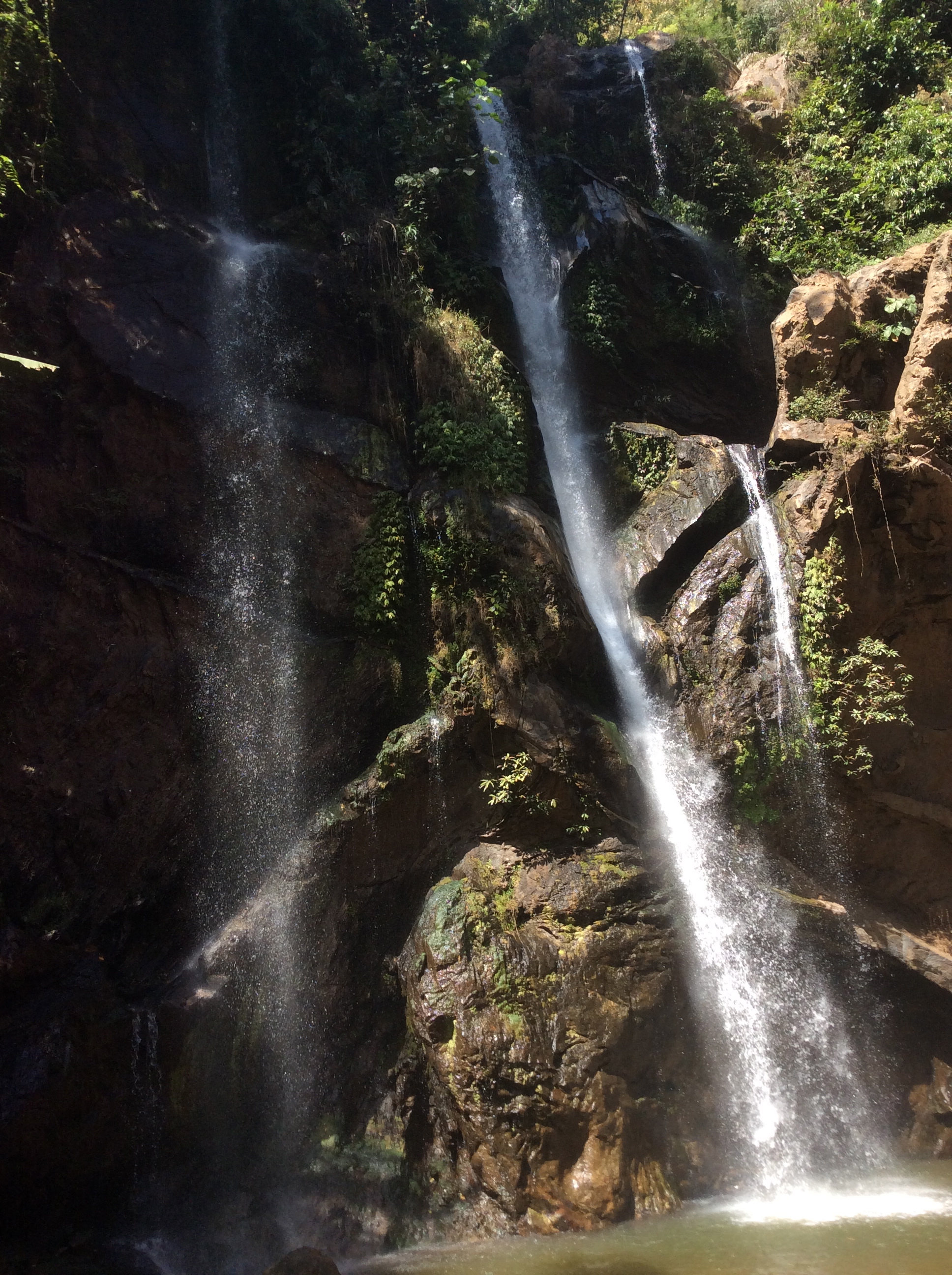
Mork Fa Waterfall
Mork Fa Waterfall

Some of these students were beginners studying martial arts for the first time, others had been students who had studied in China and were somewhat jaded of the experience and some were seasoned and experienced martial artists. After David showed me around he demonstrated one of the forms he’d been working on, then we sat and took tea with Eddie who at the time was one of the schools instructors.”Out door training areas”Normally the journey from Chiangmai to Pai takes 3-5 hours depending on your pace. I’d recommend taking it slow and taking in the scenery. The road itself is super fun but beware, those that get carried away and go to fast might end up as one of the roads numerous casualties. Both experienced and inexperienced drivers have cut short their holiday on this road which snakes it’s way up and over the mountains to Pai.

We stopped midway for lunch on the journey up and on the return I cooled down with a swim at this amazing waterfall at Mork Fa. For more information on martial arts training at this school or training experiences throughout China and Thailand visit the http://www.StudyMartialArts.Org website.

The StudyMartialArts.Org website has discounts on martial arts training and travel experiences as well as exclusive offers only available to those who book through SMA.

Taiji Fajin, Hermetics & Metaphysics

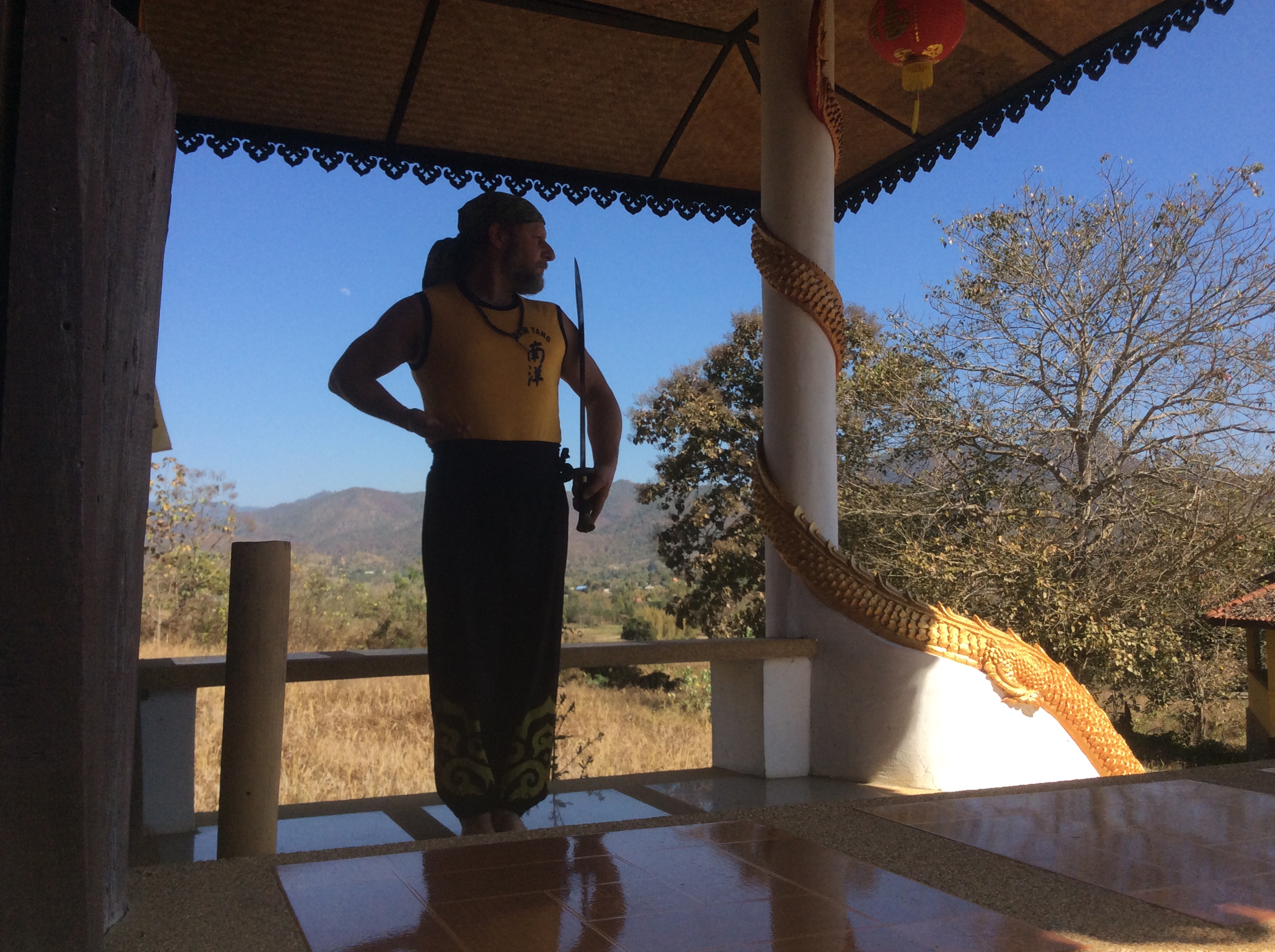
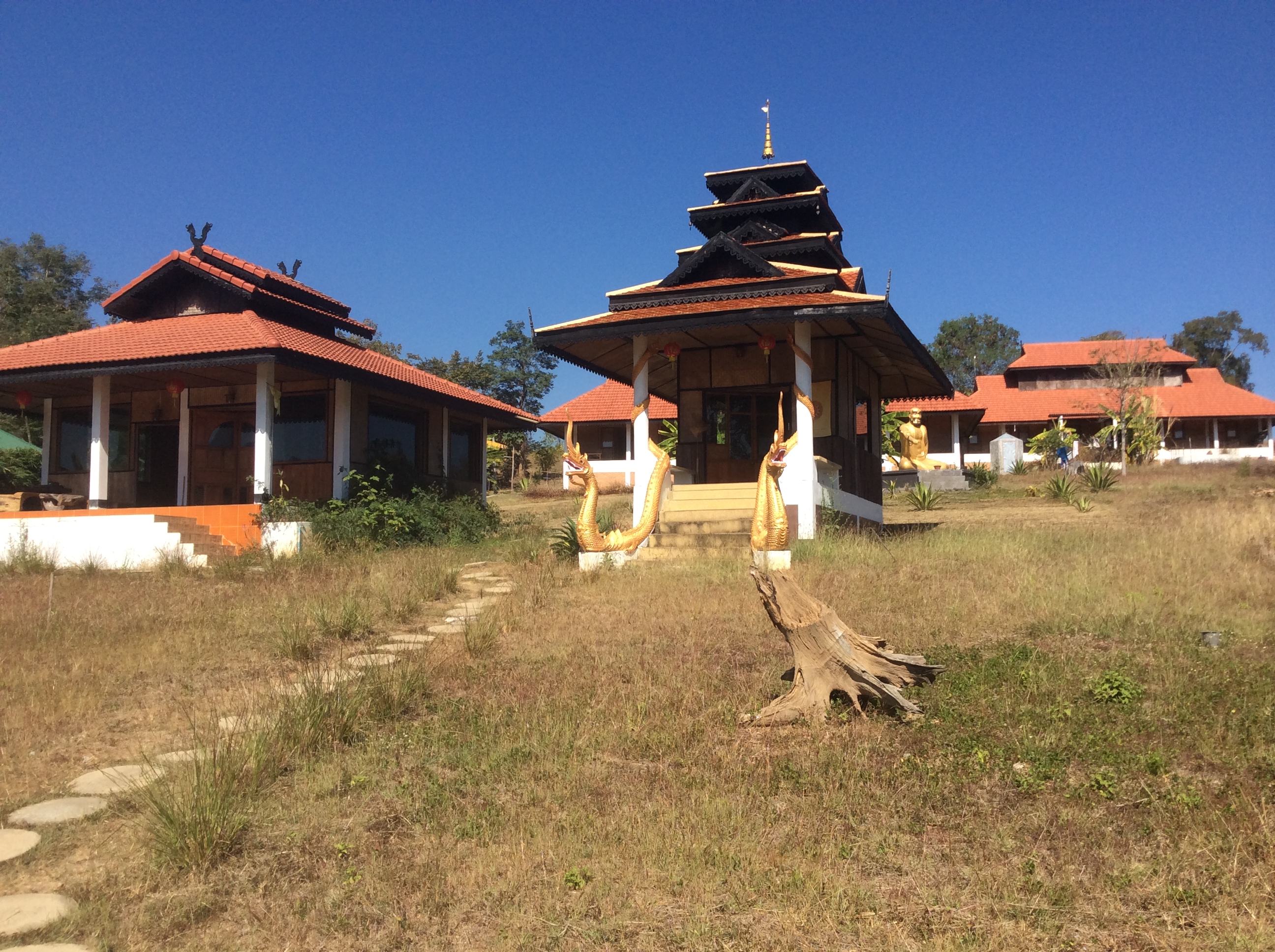
The following modest wooden house is where I stayed in Chiang Mai, Thailand when I trained with Sifu Rasmus. Sifu Rasmus teaches Taji Fajin, Hermetics and Metaphysics in this idilic setting nestled at the foot of a mountain and within ear shot of a buddhist retreat.
Leaving the cold and smog of Beijing behind I headed to Chiang Mai for 1 month of intensive training.Sifu Rasmus courses run from 1 to 12 weeks or longer depending on the content. His students tend to be instructors or masters who are looking to add greater depth to their knowledge or a more internal flavour to their art.
During the training period Sifu Rasmus would from time to time hold his class in the grounds of some of Chiang Mai’s most spectacular temples. In this visual blog I share three of my favorite. Below you will see a picture of an impressive nagga (Nāga, a group of serpent deities in Hindu and Buddhist mythology).

Wat Umong

A place were I began training the air element, metaphysics and meditation.

Wat Umong was built in 1927 by King Manglai of the LAN dynasty underneath the stupa above there are caves and shrines, and in the grounds you can find a garden of broken sculptures and a fasting bodhisvista. A place of tranquility where resident monks provide willing students a meditation retreat.
“Where talking trees have words of wisdom”
The hidden jungle temple of Wat Palad below has a special energy and was overall my favorite temple in Chiang Mai.
“The monastery at the sloping rock, visited by the God of the Earth”

3 transformations at Wat Chedi Luang.

“Please, come to the monk chat”
The ancient temple of Wat Chedi Luang in the centre of Chiang Mai’s walled city is one of the most important temples in Chiang Mai. It houses the ashes of the 14th century King Saen Muang Ma’s father. The big stupa is guarded on each of its four sides by two mythical serpent naga’s at the base and further up by rows of elephants. Peaceful in the evening the stupa vibrates with energy. Monks and nuns chant sutras and welcome conversation with travelers.

Climbing to the top of Wat Phra That Doi Suthep.

“Wat Phra That Doi Suthep’s Emerald Buddha overlooking Chiang Mai”
I visited this temple on the festival of Makhachkala Bucha. The festival honours the event when 1,250 of Buddha’s disciples congregated to hear an important sermon.Buddhists carry flowers, lightened candles and joss sticks while walking around the stupa three times on the day and night of the full moon in February.
Although this visual bog focuses on the temples I visited while training in Chiang Mai. It would be a miss of me not to say something of my training time with Sifu Rasmus. So I’ll keep it short and simply say that training with Sifu Rasmus was an excellent decision that helped demystify some of the secrets of Taichi fajin, as well as principles and themes explored in hermetics and metaphysics. Overall the course has been a great help for my own practice and I’d like to say a big personal thank you for Sifu Rasmus, guidance, welcome, coffee and of course friendship. Sifu Rasmus’s YouTube Channel – http://www.youtube.com/user/SifuMarkRasmus

Muay Thai in Chiang Mai

On our latest scouting trip to find you the best martial arts schools in Thailand I visited Chiang Mai in north Thailand. Chiang Mai is thee largest city in north Thailand and is a city packed full of culture, beauty and of course temples, but in addition to practicing martial arts and seeing the temples maybe you’d also like to see a Muay Thai fight?

Seeing a Muay Thai fight is usually on the to-do list of everyone who visits Thailand, and Chiang Mai has three very distinct venues on offer. Most tourists will encounter touts and posters pointing them towards the two most convenient locales, where the fights may arguably be less authentic. The third place is an old stadium where local Thais go to see the fights, and it might take a little more work to get there.

First off, the cheapest fights in town can be had at the Loi Kroh Entertainment Complex with its assortment of lady and ladyboy bars surrounding the arena. It’s possible to sit at any of the bars and enjoy the fights, being solicited to tip out some of the fighters occasionally after their matches. Tipping around 20 baht is appropriate, and considerably cheaper than what it costs to see a match at the other two popular venues. Keep in mind that the fights are generally not much more than training sessions between rival schools, and the bouts are not so serious, though some nights you might catch some good action. The Loi Kroh Boxing Arena is the cheapest, most relaxed route to go, but you also get what you pay for.

Another venue that is quite convenient for visitors, but which hosts arguably more ‘real’ fights, is at the Thapae Boxing Stadium right behind Thapae Gate on Moonmuang Road. Because of its central location, fights are often fought before a well-packed crowd of mostly foreign tourists. Look for a tout on the sidewalk to point you in, or let the noise coming from the back guide you as you take the stroll down the narrow alley entrance. Admission is about 500 baht, with a higher price for VIP seats closest to the ring. This is a place where visitors who feel uneasy about the sport, or who don’t wish to go out of their way can sit in relatively familiar comfort surrounded by a good number of fellow tourists. The fights may be Thai on Thai or Thai on Westerner bout, and can be quite exciting. There is plenty of alcohol available as well, as the boxing area also contains a small grouping of bars. The celebratory atmosphere of so many young holidaymakers enjoying the fights over drinks makes this a fun venue and a good night out.

For those that are inclined to find the most ‘realistic’ fighting venue, it’s necessary to hop in a tuk-tuk and go across the river to the old Kawila Boxing Stadium. This place gets less press, is less convenient, and the fighting events are longer. The price is about 500 baht per person, with a chance to pay more for ringside seats, just as at the Thapae arena. Fights in the older and well-worn Kawila Boxing Stadium feel much more authentic than at the two tourist-drag locations. General admission bleacher seats give plenty of visibility, but the people at Kawila are also generally ok with people coming down from the stands to crowd closer to the ring. One small word of advice: As this place is the real thing, in case you do witness any gambling over the fights, it’s advisable to simply look on and not participate. Have fun, enjoy the show, and take a tuk-tuk back to your hotel or guesthouse – the Kawila Stadium is further than you think, and there’s a good chance you’ll get lost otherwise.

Check out full-time martial arts training schools in Thailand here www.StudyMartialArts.Org

Kung Fu & Dreams

Master Lu

An opportunity for those that are daring enough to make the leap and change there lives!

I’m flying to Beijing on Jan the 15th for intensive martial arts studies.

I’m looking for 2 people to join me on this journey, if your interested read on…

I will be training with Master Lu Sheng li who is the author of quite a few martial arts books in Chinese, English and Spanish. He is one of Wang Pei Shengs (WPS) top students and was selected by WPS to travel around America to help him conduct seminars while he was alive.

Grand master WPS was considered one of the greatest Taichi masters of his time and was the last master of the last martial arts golden age. He was a master in many Chinese internal and external systems such as Bagua, Xingyi, Tongbei, Tantui and Baji. WPS comes from very impressive lineages of great masters, who passed on their skills to WPS intensely over many years from a young age.

Master WPS also wrote what is said to be one of the best books on Taichi out there. You can read about who WPS was, his life and his achievements here in this Article Titled Remembering WPS. It’s a great read for any one who loves martial arts, culture or just the back ground story of a highly accomplished individual…

http://ycgf.org/WPS_Eulogy/WPS_Eulogy.html

The training we will under go will be under the Yin Chen Gong Fa association training methods, styles and principles. The best information available I can find in English about this group and what they train can be found on this site (ycgf.org) read the opening page, click English and scroll down, the information is quite informative and vast and will give you an idea of what you could expect if you join us and train.

The base of the training will be in Taichi but the training will be customized to each individual’s personal level to insure a proper foundation is built and a higher potential or mastery is reached in your time.

The training period is 100 days and is “everyday” for a minimum of 6 hours a day. (Ill be training a minimum 10 hours a day including Chinese language learning and theory) Master Lu’s students are movie stars, CEO’s of large companies, like the CEO of Intel and Lenova. He charges in some cases $450 an hour. Master Lu has earned a great reputation among masters with in the Beijing martial arts community and worldwide.

The 100 days of training for those who qualify to join me will be at a location Master Lu has rented in Beijing.

This is not an opportunity I would normally make public but the chosen 2 people who were aiming to come with me, now can’t make it, due to changing circumstances in there life. Everything happens for a reason, so now there is a chance for 2 lucky individuals to join us.

This will be a very transformational journey for who ever is up for the challenge.

This could also be an amazing start for a martial artist or a great way for a former martial artist to deepen their skills in real internal training and practices.

It’s short notice but I feel it’s important to put this opportunity out there. Maybe it’s a possibility for one of my friends here to join us. When I started my martial arts journey a chance like this would have been something I would have only dreamed of finding!

Master Lu has set aside this time to be committed purely to transmitting his kungfu skills and knowledge by setting up the ideal environment for us to grow and train. He has cancelled all of his commitments in this period to train other students and will be focusing purely on my self and the other students who join the group. He has rented a house that we will all live in, including master Lu for the 100-day period.

This really is a lucky opportunity and is not something you would find advertised publicly. The reason I am looking for other students to join is as follows.

1. Two spots are now available and since master Lu has put on hold all his training and teaching commitments to his other students over the 100 day period, I want to insure master Lu regains his cost for the commitment he is making, renting a house, providing food and training etc. Since the other 2 guys can’t make it there is an opportunity for 2 other students to join.

2. Although one on one is great with a master, for long term training it’s better to have others students to train with on the journey, so we can push each other, practice techniques 1000 of times to refine our skill level and discus the principles and ideas to gain a more broader perspective.

That’s my main two reasons. The last one is simply having another person in the world who gets affected by the attributes of internal martial arts training I believe sincerely and firmly, is a huge benefit to his/her family and friends and the world in general.

To qualify for this opportunity will come down to work ethic, and good character/personality. If you’re interested, send me a PM or comment below and Ill get in contact with you to arrange a call. You may also add me on Skype just msg me for my details.

I will be helping those who come advance out side in personal training time to insure we all grow together. Master Lu will be with us 6 hours a day daily and is Renowned for his attention to detail and his focus on transmitting skills to his students.

Since the date of commencement is literally right around the corner, those who can make it for a minimum of 1 week and up to 3 months may apply. Although preference will be given to those who wish to train more long term, as well as those who express a keen interest in training hard and pushing them selves to create a positive training environment. So from Jan the 15th through to April the 25th there is a chance to live and train with a world class Kungfu master.

Included in the cost is nourishing food, which is designed for the hard training and long days, accommodation and personal instruction from a world-class internal martial artist.

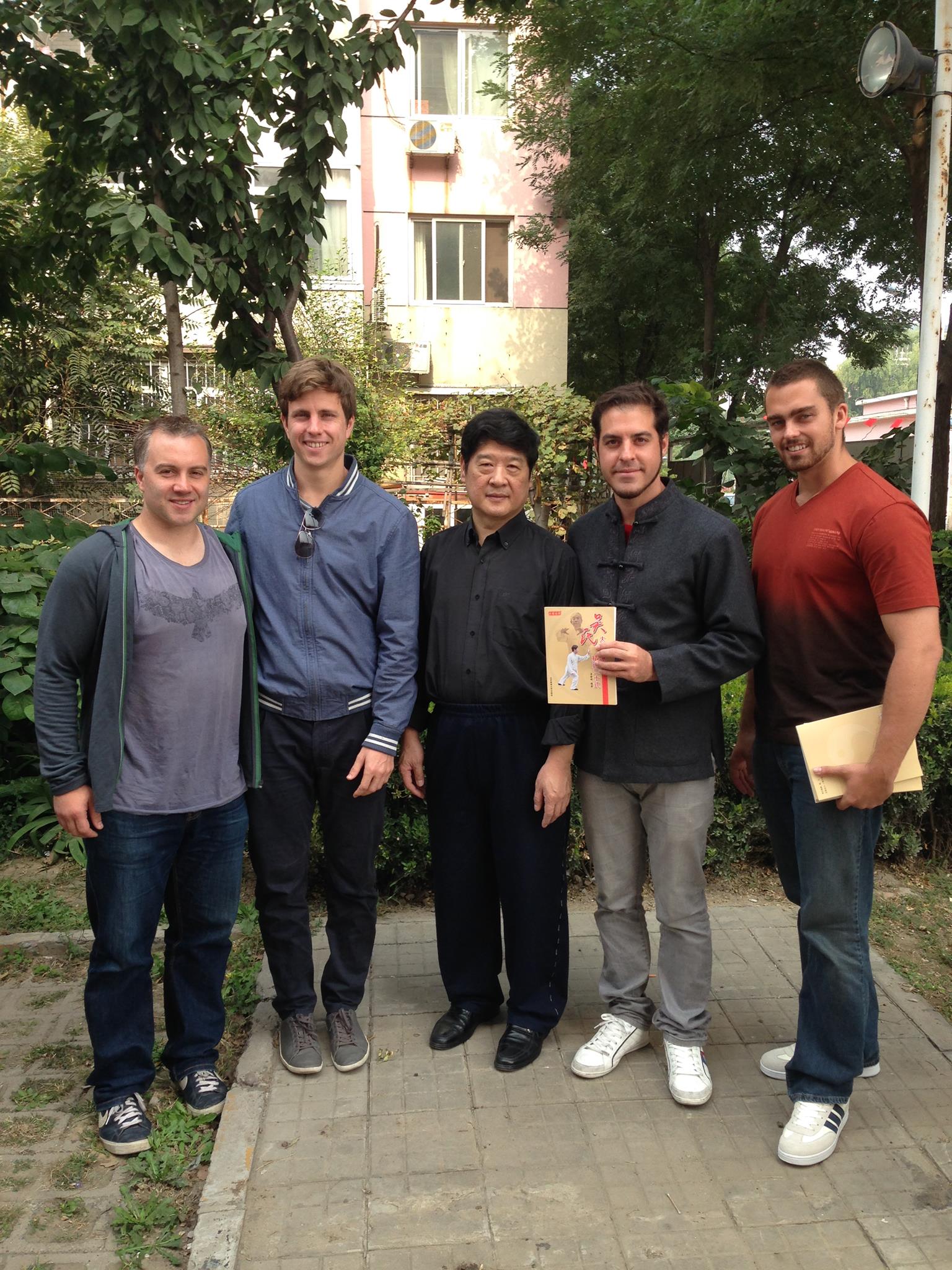
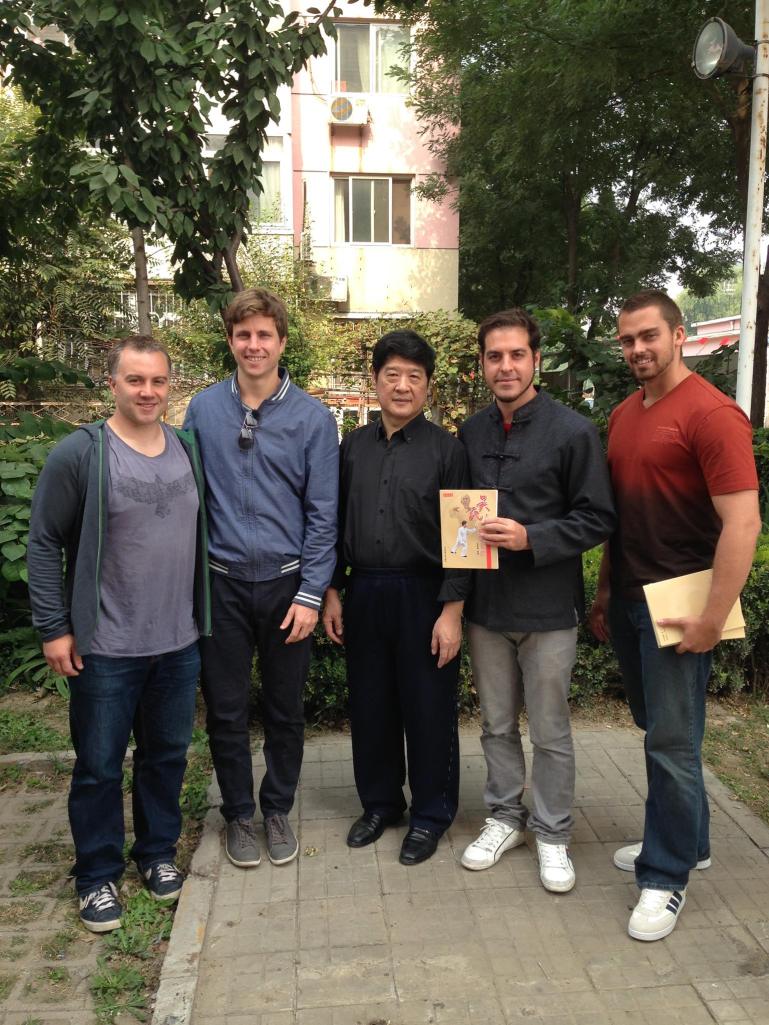
Below is photo of master Lu and some of my students and friends that joined me in Beijing late last year on a StudyMartialArt.Org tour.

I’m holding his recently publicised book on Wu style Taichi. (Currently in Chinese Only)

Over the 100 days there will be a focus on Wu style Taichi but also students may start to practice, Xing Yi, Bagua, Tong Bei, Baji, Qigong or Tantui depending on master Lu’s development plan. What ever the path is we will be heavily involved in the principles and philosophy, which lead to high-level practice.

This opportunity is not for the light hearted but beginners are welcome to apply. Personally I would rather people more experienced to push my self but that’s just my personal preference, Ill be pushing my self on my own to new heights with who ever joins me and I expect the same of them.

Other then the benefits of self defense, confidence, knowing one self and the spiritual attributes that arise from this style of training, that make you relaxed and cheerful. The health and longevity benefits are of the hook and have been well proven by the masters before us and explored and backed by scientific research.

Master Lu is 62 or 63 in this photo his movements are graceful, powerful and very precise in there attention to detail!

If any one would like me to elaborate in more detail about the lineage, the training, Wu style Taichi, WPS or master Lu please feel free to ask. I certainly don’t have all the answers, many I will discover on the path for my self but I have been studying all the above a couple of hours a day, most days over the past 3 months and have lived in China for many years, training martial arts full time. Since I’m investing allot of time and money I wanted to insure everything was what I truly wanted. I looked at it objectivity and tried to find faults to make sure I made the right decision. It passed my test and I’m sincerely looking forward to 100 days of intensive training with Master Lu Sheng li and training in the Yin Chen Gong Fa family!

The food, training, accommodation and the personal instruction 6 hours a day from master Lu will cost 100 USD per day which when you look at the time you get with a great master alone, it’s a pretty small asking price since we will be living with him also. This is something I did well to negotiate.

Master Lu is sincere in seeing that the Internal arts of China get passed on to dedicated practitioners, in the Yin Cheng Gong Fa association founded by WPS. They hold nothing back, there interested in the true and proper passing on of the skills and training methods as the generations have before them so the arts stay alive in full expression.

Other systems and masters do hold things back unfortunately this is why Chinese kungfu is dying or in some aspects have been lost and only held by a few, its different with the YCGF family.

Thank you for your time and tuning in!

If you have any questions, please feel free to ask.

I will have my personal Site/Blog up very soon which Ill be writing in and giving updates to my progress over the 100 days training and living in Beijing.

When I return I will teach a one-week intensive seminar and open my first official martial arts school in Australia!

Best wishes for the New Year everyone and if your interested in this opportunity dive in, make it happen for your self and don’t waste time, it may never happen again!

You can read about Master Lu on this links

http://ycgf.org/Articles/Lu16/arti_Lu16.htm

and here is one of his books on amazon. Note most of his books are in Chinese.
http://books.google.com.au/books?id=dkPTM3IzeawC&printsec=frontcover&dq=Wang+Pei+Sheng+taichi+book&hl=en&sa=X&ei=MyvOUpmpNo7QkQXuuoHYAQ&ved=0CD0Q6AEwAg#v=onepage&q=Wang%20Pei%20Sheng%20taichi%20book&f=false

You can check out Grand Master WPS book here which is considered one of the best books on Taichihttp://www.plumpub.com/sales/taichi/collbk_wuTC1.htm
.
You can read about Wu style taichi in this book also,
note that master WPS was the successor of the Northen Wu style Taichi group passed down from the founder Quan you. This book was written by WPS younger Kungfu brothers female disciple, who is a champion in her field. It gives a great introduction to the lineage, the style, the founder etc as well as other famous masters. This will give some idea on what Wu Style Taichi is about and an idea of some of the training.

http://books.google.com.au/books?id=nu3jRBsgv6gC&pg=PA21&dq=Northern++wu+style+Taichi+beijing&hl=en&sa=X&ei=nirOUunTOoiXkwXyg4GwDA&ved=0CDAQ6AEwAA#v=onepage&q=Northern%20%20wu%20style%20Taichi%20beijing&f=false

Please feel free to share this if you think there is someone in your network that would be interested in joining me for this amazing training experience. Maybe you yourself are interested? if so email me at Rhynsma@gmail.com to find out more.

Kind regards

Rhyn

___________________________________________________________________________________

Rhyn Nasser is a partner in StudyMartialArts.Org and has been traveling the world teaching and studying  martial arts with some of the best martial arts masters on the planet.

www.StudyMartialArts.Org
Martial Arts & Language Learning in China

If you’ve ever wanted to Study Martial Arts in China, an awesome way to do that would be with one of these combined Martial Arts and University Language Courses.

The benefit of one of these programs will be the practical skills you can learn throughout the experience that can actually legitimately add value to your CV and future employability. These programs allow participants to develop their martial arts and also their understanding of Chinese culture and also importantly the language. It’s a unique way to study with a high level master outside the normal international kung fu school route as that all important Chinese visa will be got through the University.

This video clip above was taken in Yantai, Shandong province. Yantai is a small second tier Chinese City on the northeast coast of China. It has cheap housing and has a good environment. Yantai is famous for a number of kung fu styles including Taichi Mantis, Tongbei quan, Baguazhang and more.

The city itself is a little hot bed of kung fu schools and masters and is well worth a look.

For details of our Traditional Martial Arts and Language Learning programs contact us now! Study Mandarin and Traditional Chinese Martial Arts in China – http://www.StudyMartialArts.Org

Check out Master Sui’s full biography and training schedule here – http://www.studymartialarts.org/master/master-sui-peng-fei/49.html — with Bernard De Premonville in Yantai, Shandong.

A Guide to Teaching English Abroad & Studying Martial Arts

Do you have friends or classmates that have taught English in China, Japan, or Thailand and wondered to yourself, “How can I get paid to live in China,  Japan or Thailand and follow my passion for Studying Martial Arts?”  With millions and millions of people learning English in Asia, the demand for native English-speaking teachers is insatiable and virtually any native or fluent English speaker can gain employment teaching English abroad.  But like any great endeavor in life, moving to a foreign country to teach English and follow your martial arts path requires research, planning, initiative – plus a few tips from teaching abroad experts like those at StudyMartialArts.Org who have experience of combining English teaching with Martial Arts studies.  Take a peak at these 12 crucial tips and pointers for teaching English abroad to help you get started.

teach-english-in-china1. Know that virtually anybody can teach English abroad

With approximately 1 billion people learning English worldwide, the demand for native English-speaking teachers is insatiable and virtually any native or fluent English speaker can gain employment teaching English abroad. Remember this:

  • A background in education or professional teaching experience is not required to teach English abroad.
  • You do not need to speak a foreign language to teach English abroad.
  • Prior international travel experience is not a prerequisite to teach English abroad.
  • A college degree is not required to teach English abroad. But it certainly will help. As more and more people take the English teaching route to discover Asia the market is becoming increasingly flooded with job seekers. With this increase tighter controls are being applied. Visas require more often now those with experience and so a TEFL certificate is becoming more handy. Ultimately, the more qualified and well connected you are the better employment opportunities you will get. Because after all you are here for the most part to study kung fu so the last thing you need is to be stuck in a job that requires too much travel, too little work to make ends meet or too many hours.

Remember that hiring standards will certainly vary from country to country, so remember to consider what countries you are qualified to teach in.

2. Research your tail off

If you plan to move halfway around the world to teach English and Study Martial Arts, you owe it to yourself to research all aspects of your great international adventure to make it as rewarding and successful as possible. To start, focus on the martial aspect. Where is that Shifu you have dreamed of learning from?What styles are you interested in? Also check out this country chart which compares salaries, hiring requirements, interview procedures and visa information for teaching English abroad in more than 50 countries around the world. Also, check out our other articles for more information about teaching English abroad. When you’re ready to start diving into program options, be sure to read reviews and weigh all of the possibilities. Salary, livability, conditions, benefits, time commitments, and the potential for an incredible and positive experience will all play major factors in your decision.

05.brucelee3. Make sure to earn your TEFL certification

Even though you don’t need a degree or professional teaching experience, if you want to teach English abroad professionally, you need to take an accredited TEFL certification course, especially if you have no background in teaching English as a foreign language (our guide to TEFL helps lay this all out for you). An accredited TEFL certification course will provide you with the skills you need to competently run 4-6 classes a day, and will outline the best ESL teaching tools. TEFL certification will also provide you with a recognized qualification that most schools and language schools around the world seek when hiring new teachers. Remember, most schools around the world will not hire you off the street to teach English professionally simply because you are a native or fluent English speaker! One of the biggest difficulties that new teachers face is the challenge of creating fun, engaging, and plenty of activities for the ESL classroom. TEFL courses will give you insight on the types of games and lessons that are successful with different age groups. Get a head start by reading our tips for lesson planning or take notes of the 10 best games for ESL teachers.

4. Consider whether to go with an organized program or independently

Many TEFL training schools do provide job placement assistance and it’s definitely something to check for when researching your options, because quality assistance should insure that you don’t have to pay for a job placement. Many top programs provide it for free with the course tuition. Others may charge additional fees for placement or assistance. Teaching abroad through an organized program is a great option for first-time travelers to a new region, especially if the local language is one you’re less-than-absolutely-fluent-in. For most people looking to go abroad, there are enough jobs and plenty of resources in the way of free job boards, recruiters, and other resources, that there really should not be a need to pay hundreds or thousands of dollars for a placement. Also, programs that guarantee or receive payment for placements will limit you to job options offered by the program, which are a drop in the ocean of the thousands of job opportunities worldwide that you may be qualified for. If you are looking to teach English in Asia, Russia or the Middle East, you may consider working with recruiters that interview and hire English teachers from the U.S., Canada and elsewhere on behalf of schools in these countries. Typically you should not pay such recruiters for placement. Working with recruiters can make the process of interviewing and lining up a position abroad easier though as they can provide assistance and guidance with matters like setting up interviews and arranging documents for your visa. The key, as always, is to research and work with reputable, well-established recruiters. But be aware, most recruiters who do this will then get paid by the school you work for so their payment could be coming out from your potential monthly wage.

5. Remember: hiring and interview procedures vary from country to country

Be flexible and open to new experiences

Remember demand is high in Asia so schools hire all year-around, nevertheless elementary and high schools recruit primarily during the spring, summer and winter for positions beginning in Jan/Feb and September. Many Asian schools will hire new teachers directly from their home country, this is good for a number of reasons one being securing that all important visa and having the right papers from day one. This means that if you want the security of having a job waiting for you when you hop on a plane to your teaching destination, you should concentrate your efforts here.

6. Plan to break even

This means that even as a first-time English teacher teaching you can expect to earn enough to pay your bills – rent, food, daily transportation, etc. – and live comfortably, though modestly. This means that you’ll be able to travel and go out on the weekends and engage in other personal pursuits like taking language lessons and martial arts. However, this will often be very dependent on luck, your color and whether you are a native speaker. You shouldn’t expect, at least at first, to be making enough salary to put money in the bank at the end of every month. This can take time and it is often 6-12 months before you start earning back on your initial investment, the money you spent on settling in job, hunting and securing accommodation and finding with the right kung fu master.

640x450_thai_boxing7. If you want to make more money, this is possible but very dependent on your qualifications and experience

Most people don’t go into teaching for the money, but if you’re looking to make enough to save for extra travel it is possible with the right qualifications and connections. English teachers can typically make enough to save 30%-50% of their income after expenses, and often receive benefits like free airfare and housing. Monthly savings typically range from about $400 a month in a nation like Thailand up to $1000 or more in South Korea. However, be realistic. More and more these opportunities are limited to those with experience, the right papers and longer term commitment.

8. Consider using a Martial Arts School as a springboard

The growing number of martial arts schools in both China and Thailand offer a great opportunity for the savvy martial arts adventurer to use the schools as a base from which to explore teaching opportunities and of course training with other masters outside the international kung fu school system. To make the most out of these opportunities your current school location or planned schools location will be the key.

Rural schools in the depths of the Chinese, or Thai countryside will not be the most suitable if you’re limited to weekend for finding a school or another master. The good news is that StudyMartialArts.Org offers a great Free consultation service. They can easily help advise you both on potential schools, masters near by and that all important teaching job or employment contact.

9. Set a realistic timeline and plan ahead

Getting a job and moving half-way around the world to teach English or Study is not like choosing which parties you’re going to hit this weekend or selecting what you’re going to wear to the gym – it’s not a spur of the moment sort of deal. While hiring cycles and procedures vary worldwide, you should usually plan on taking 3-6 months from the point when you begin your TEFL certification and job search to actually getting on a plane and taking off to go abroad and begin your teaching job. In some cases, as when applying for government public school programs like JET in Japan. Remember the process of applying, interviewing and making travel arrangements may take 6-9 months or even longer.

10. Be prepared for start-up costs

Teaching English abroad may be the most cost-effective way to live and travel overseas for an extended period, but like most major undertakings in life, it requires a degree of financial planning. Major start-up costs typically include:

  • TEFL Certification: $1,000 – $2,500 for a fully accredited online or in-person class – trust me, it’s worth it.
  • Transportation to your destination country: typically $300-$1000 for North Americans traveling to other continents.
  • Support in your new country until you start getting paid: even if you have a job waiting for you when you arrive, you won’t typically get paid on your first day of work. These expenses can range from $500, if your housing is provided and your job is pre-arranged, to even higher while you interview for a position, wait for the right job, rent an apartment or find a conveniently placed master that you want to study with.

Although start-up costs for teaching English abroad in Asia are typically lower because in many cases you can line up your job in advance, and many schools, particularly in South Korea and China, cover airfare and housing costs. But more than often these are not paid until a trial period has been complete or certain part of your contract. In addition to this as your purpose is not just to teach but also to study kung fu extra complications and few choices may be available to you. This is why some managed programs with initial costs are worth considering.

11. Engage your friends and family

You will need their love and support, and in some cases, their advice and financial assistance. At the same time, don’t let their fear of losing you stop you from going abroad – Mom will just have to understand that you’re going to miss a Thanksgiving or two. The good news is that thanks to technology, it’s easier than ever to stay in touch from all corners of the globe. Email, Facebook and other social media make conversing and sharing photos a cinch, and with Skype, you can enjoy video calls with friends and family as often as you like, for free.

Guilin12. Be open-minded and flexible

If you won’t even consider teaching anywhere but places that are just like the home, you’re only cheating yourself. The fact is that you are unlikely to get a job just like at home. This should not stop you from experiencing the adventure of living and traveling abroad, whether it be in China, Thailand, Japan or anywhere else. Also, bear in mind that you are not limited to one destination – you can always teach in one country or region and then move on to another and as in any field, the more experience you gain, the more opportunities will come your way.


Essentially the only way that you can’t teach English abroad is if you don’t have the initiative to make it happen – so let’s go! That means researching your options, getting a TEFL certification and putting together a timeline. Be realistic and organized, but don’t hesitate to broaden your horizons and take chances either. Moving abroad is meant to be adventure, so embrace it! Inspired by – Go overseas.

SMA School Visit – Rising Dragon Martial Arts School (Part 2)

Arriving in Shanghai a little later than expected due to some technical problems. I walked through Terminal 2’s of Shanghai’s Hongqiao airport and bought my ticket to Zhenjiang. The ticket was reasonably priced at 109 rmb for the 1.5 hour journey. Considering the various transfers and rural transport modes I’m used to taking to visit schools this was going to be a very straightforward journey and one that even the most green western adventure martial artist with little to no Chinese language skills could accomplish with relative ease.

1.5 hours later I was in Zhenjiang and heading to the Xijindu area of the city where I would be meeting up with Scott and would also be staying for the duration of my trip.  Xijindu is located in the northern foot of Yuntai Mountain below a stunning pogoda over looking the city. It’s composed of the Ancient Xijin Ferry and Xiaomatou Street and the area contains the most and best-preserved cultural relics and historical sites of Zhenjiang. The area is picturesque has handcraft shops, restaurants and bars, and more. All of which are blended into a historic setting.  http://www.tripadvisor.com/Attraction_Review-g297444-d1724025-Reviews-Xijindu-Zhenjiang_Jiangsu.html

Xijindu Area
Xijindu Area

Normally, when I visit a school I stay in the standard student accommodation to get a feel for the school and also so I can get stuck into the school training with the various masters. This time however, as the school’s accommodation was still being developed and most of the masters have yet to arrive I stayed in a hotel Scott recommend and treated myself to a soft bed and an air conditioned room, which considering the heat was thoroughly made use of.  A room for a night in at the holiday inn in Xijindu works out at approximately 300 rmb per night. For those on a budget hostel accommodation in the same area works out at 55-200 rmb for either a shared or private room.

Rested and refreshed I met up with Scott in the hotel lobby and we headed to a local restaurant also in Xijindu to grab a bite to eat and catch up. Scott explained that at his kung fu school the food was good but simple and healthy so wherever away from the school on business or when traveling he enjoyed eating some of the things he couldn’t get back in Taining, Fujian.

Not one to turn down good food we headed to a local restaurant. and sat down to a 5 course meal for 160 rmb. I figured that the 5 courses and the restaurants relaxing environment would give me ample time and a great opportunity to quiz Scott on his new martial arts school and the challenges ahead.

The awesome food of Xijindu

1. Scott you came to China in 2003 with every intention of staying a year then returning to the UK. What happened that changed your mind? And how did that lead you to becoming the first western to open a residential Martial Arts School in China? “When I came to China I went to a school in Siping. I’d no real idea what it would be like but expected the training to be hard and the quality to be high. Unfortunately, that didn’t happen and it was that experience that led me in 2007 to open the Rising Dragon Martial Arts School in Taining County, Fujian Province.”

2. Scott, I remember the first time I visited RDS in Fujian and was blown away by its stunning location and the talented group of masters you’d brought together to teach your western students.  Your school has even performed live on TV with Jackie Chan and has also been featured in Chris Crudelli’s latest kung fu documentary series. With the foundation of such a successful school in Taining why the move? “Since starting RDS my drive has always been to make my school one of the best martial arts school’s in China. Each year the school has continued to grow and expand and I have been working hard to  improve the schools existing facilities and accommodation. As a result I drafted up a redevelopment plan for the site with better accommodation choices a temple within the grounds. These plans were then given the ahead by the local government however, when the recent change in Chinese national and local government happened everything slowed down to a stand still. I guess I just got tired of the small town mentality in Taining.

Chris Crudell visits Rising Dragon School to film a part of his new kung fu documentary series.
Chris Crudelli visits Rising Dragon School to film a part of his new kung fu documentary series.

I’ve worked hard for seven years without a break on the school in Taining and since that time I have continued to evolve.  With that so has my ideas and plans for the school. So now its time for a change.”

3. Okay, so before we move on to the next part of our interview which will be all about your new school and will let our readers and indeed potential future students know about the plans you have for the school, can you first tell us what things you’ll miss about the old school. I am sure there will be lots of returning students visiting your new school that will relate to this and have fond memories about RDS Taining? “Although I have some great memories of the old school, to be honest I’m really not that sentimental about the move. Actually, I’m really excited about the change and can’t wait to move.

When I first opened the school in 2007 I wanted a location that was remote and I found one that was stunning. Now I want something that offers a great environment for studying martial arts but also more of the creature comforts. But if I there was something it would be our mountain training runs. The run was about 5 km and we used to run along a mountain path to a remote lake where you could cool off and swim. Luckily however, the new location is going to be equally as good.”

A view from the mountain path along side the lake RDS Taining students used to run along during special training sessions.

The final installment and full details on Scott’s plans for RDS II coming soon…….

If you want to study martial arts in China make http://www.StudyMartialArts.Org your first contact for information on schools, training discounts and travel and training resources all at no additional cost.