Research Note: Kung Fu Diplomacy During the Cultural Revolution

benjudkins's avatarKung Fu Tea

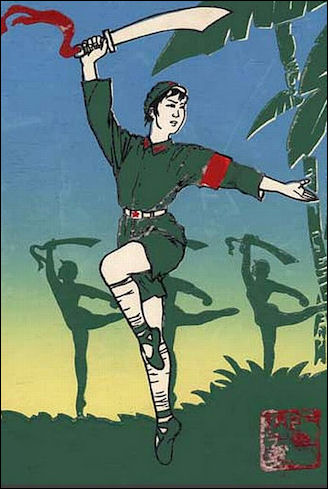
An advertisement for a “revolutionary opera.” Many such shows were staged during the Cultural Revolution.

The History of Practice vs. The History of an Idea

This post continues an occasional series looking at the ways in which the traditional Chinese martial arts were discussed in the PRC’s propaganda and cultural diplomacy efforts from roughly the early 1950s to the early 1980s.  We have previously seen some newsreel footage of important martial artists during the early part of this period, as well as an English Language article on a critical event in the development of modern Wushu which was staged in 1953. This article is a little different in that it jumps ahead and examines a discussion of the TCMA dating to the final years of the Cultural Revolution.  Published in China Reconstructs (the PRC’s premier Cold War era English language propaganda magazine) it is an important (if somewhat…

View original post 3,215 more words

Martial Arts and Politics: Silat in Defense of Religion and the Malay Nation — Kung Fu Tea

Lawrence N. Ross. 2017. “Demi Agama, Bangsa dan Negara: Silat Martial Arts and the ‘Third Line’ in Defense of Religion, Race and the Malaysian State.” In Sophie Lemiere (eds.) Illusions of Democracy: Malaysian Politics and People. Vol. II. Strategic Information and Research Development Centre: Malaysia. Martial Arts and Modern Politics Over the last few […]

via Martial Arts and Politics: Silat in Defense of Religion and the Malay Nation — Kung Fu Tea

Chinese Martial Arts in the News: March 22, 2019: Kung Fu and its Discontents — Kung Fu Tea

Introduction Its been over a month since our last news update, which means that there is no better time to get caught up on recent events! For new readers, this is a semi-regular feature here at Kung Fu Tea in which we review media stories that mention or affect the traditional fighting arts. In addition to discussing […]

via Chinese Martial Arts in the News: March 22, 2019: Kung Fu and its Discontents — Kung Fu Tea

Master Si Jun Tao – Wudang Taiji 24

This short post is dedicated to Master Si Jun Tao. Who in the video clip performs Wudang Taiji 24 Step. This summer I trained with him on Wudang Shan, and brought a group of students to learn both qigong, taichi at his school.

The school is uniquely located just 3.4 kilometres from the Golden Top. Staying at his school is a unique experience. You’ll be welcomed as one of the family and treated to expert taichi tuition followed by traditional Chinese tea.

Master Si Jun Tao’s daoist name is Li Jing and his lineage is of the Xuan Wu Sect of Daoism. Master Si Jun Tao has won a number of competitions for his Martial Arts. In the Shenzhen 5th wushu competition he received a gold medal for his fist and sword forms. In the Shenzhen 1st traditional martial arts boxing competition he received a gold medal for his staff form and in the traditional martial arts competition he won the 65kg Sanda title in 2007. Master Si Jun Tao focuses on helping his students reach their training goals. Master Si has a very pleasant nature and is currently in his mid thirties and is both energetic and enthusiastic about teaching his students.

www.StudyMartialArts.Org – Best for Martial Arts Adventure Travel & Training.

“Old Sports” in New China – Reporting the 1953 National Exhibition and Tournament

benjudkins's avatarKung Fu Tea

A poster from 1957 showing various Chinese national sports.

The Source

As part of my ongoing research on the role of the traditional martial arts within the creation of China’s public diplomacy strategy, I am reviewing several propaganda sources produced in the 1950s and 1960s.  By in large these printed outlets have little to say on the subject, preferring to focus their rhetorical energies on the rapid pace of China’s industrial growth, or its success in the building of massive dams and hydro-electric power plants. This is very much the sort of material one would expect to find in a Communist country’s propaganda from early in the Cold War.  But occasionally some mention of the martial arts does manage to fight its way through this tide of socialist progress, and it is worth considering how China’s new Communist government discussed these practices when presenting them to the world.  What follows…

View original post 2,792 more words

Yang Lu Chan’s old house and Tai Chi in Yongnian — The Tai Chi Notebook

The Wu Yu Xiang style Tai Chi I found this video recently of an old gentleman called Mr Han practicing his Tai Chi form in the courtyard in front of the old house of Yang Lu Chan (the founder of the Yang style, pictured top left) in Yongnian County, Hebei province. The video says he’s […]

via Yang Lu Chan’s old house and Tai Chi in Yongnian — The Tai Chi Notebook

The Tai Chi form of Yang Shau-Hou

Nonviolence and Martial Arts Studies — Kung Fu Tea

***One of my goals in creating Kung Fu Tea was to inspire more enthusiasm for (and participation in) the scholarly discussion of martial arts. As such, I am happy to share a reader’s lengthy response to a recent essay. After seeing his original comment I felt that it could be expanded to make a […]

via Nonviolence and Martial Arts Studies — Kung Fu Tea

How to get better at push hands — The Tai Chi Notebook

Today’s Tai Chi tip is all about how to get better at push hands simply by adjusting your posture. Push hands should really be an exercise in which we get to test our ability to absorb Jin from an opponent and project it into an opponent as required, to uproot them. It shouldn’t devolve into a […]

via How to get better at push hands — The Tai Chi Notebook

Want to keep your brain in shape? Get physical!

I’m no longer the spring chicken I was. I’m approaching 40, and I want to maintain a healthy brain as well as healthy body. Turns out according to this article in Psychology Today that I’m on the right path, because Physical Activity is the No.1 way to keep your brain young. This article explains the link between aerobic fitness and cognitive function. Christopher Bergland the author of the article goes further stating that maintenance of close knit social bonds are second only to exercise in terms of maintaining longevity and psychological well-being.

Great news for martial artists

This is great news for martial artists practicing in quality clubs and gyms. Not only are they getting the benefits of exercise on cognition but also the psychological well-being of close knit bonds with their martial arts classmates. Provided of course you’re training at the right kind of club or gym.

The benefits of finding the right club

This highlights the benefits of finding the right club where not only you receive great instruction but also the support, help guidance and camaraderie of your classmates. I’ve been lucky throughout my martial arts journey and when creating my company StudyMartialArts.Org to meet and learn from the right kind of people. At present I’m based in Beijing and loving the training and the community at Big King BJJ and Muay Thai (insert shameless plug).

So what about the science?

Well according to Richard A. Friedman’s article in New York Times.

“Intriguingly, exercise in humans and animals increases the level of a protein called brain-derived neurotrophic factor, or BDNF, in the blood and brain. BDNF promotes the growth and formation of new neurons, and it may be responsible, in part, for a remarkable effect of exercise on the brain: an increase in size of the hippocampus that is linked with improved memory.

Conversely, adverse experiences like major depression can lower BDNF levels and are associated with hippocampal shrinkage, a phenomenon that helps explain some of the cognitive impairments that are a hallmark of depression. Aside from making people feel better, antidepressants can block the depression-induced drop in BDNF, so these drugs are, in a sense, neuroprotective.”

This helps to explain the double whammy benefits of physical training with the right kind of people. Whether your martial arts training involves BJJ, Kung Fu, Karate, Boxing, or MMA etc a large part of that will be focused on individual students physically learning a new skills, as well as ways to move, or being tasked with problem solving, through martial arts puzzles of the body, distance, technique or timing. I.e. Controlled sparing or combat sports competition. All that being said this article doesn’t even touch on the other psychological benefits of martial arts that cover increased self confidence and general mental health.

If you’d like to read more about training your mind and body check out Christopher Bergland’s book The Athlete’s Way: Training Your Mind and Body to Experience the Joy of Exercise.