The Dark Side

by Phillip Starr

For many martial arts enthusiasts the main goal of training is to become stronger and faster, and to master fighting techniques and tactics so as to defeat any aggressor who dares assault them. Basic techniques are drilled over and over while muscles scream and the breath comes in gasps. Forms are practiced over and over and then studied and analyzed in minute detail until their true meaning is understood. Students leave their blood on the striking post and their sweat on the training floor. But underneath it all is something more, something personal, insidious, and dark.

We’ve all faced times of hardship and times of “testing” as we’ve traveled the martial path. These difficulties come in all manner of shapes and sizes, from minor to major injuries, illnesses, delays, loss of interest, problems with relationships…and there is simply no way to intellectualize or buy your way out of them. Oftentimes, you must work or even fight your way through them and at other times you must simply grit your teeth and wait them out. Sometimes simply staying on the path is all you can do. The legendary founder of aikido, Morihei Uyeshiba, put it succinctly:

“In extreme situations it seems as if the entire universe has become our foe.
At such critical times unity of body and mind is essential.
Do not let your heart waver.
Bravely face whatever God offers.
One should be prepared to receive 99% of the enemy’s attack and stare death right in the face in order to illuminate the path.
Transcend the realm of life and death and you will be able to make your way calmly and safely through any crisis that confronts you.”

In the practice of martial arts we must eventually confront our own “shadow side.” All of us have fears – from a simple fear of the dark to fears of pain, financial ruin, loneliness, and disease. And although these fears seem to come from outside of us, I think they are often the result of an internal process. This is a process of which we may not be consciously aware, a process that lies below our surface personality.

In training we strive to perform correctly, even under pressure. It usually doesn’t take long for inhibiting problems to begin to surface; poor attitudes, envy, self-pity, criticism (of self or others), insecurities, anger bubble to the surface to be seen by everyone. You can’t hide them although you may try and then it becomes obvious that you’re trying to conceal them!

The fact is that we’ve lived with these “shadows” for so long that we’ve developed our own personal ways of handling them. They’ve become a part of us – habits, if you will – and we’ve become so accustomed to carrying them around that we don’t even notice them until we get involved in martial arts training, which is really very different from most other physical activities because we’re dealing with the basest form of human relationships…a punch in the mouth. We have to learn to respond appropriately to physical attack while we must simultaneously “be with ourselves” under gradually increasing levels of physical and emotional pressure.

Before long we must face the ways in which we typically handle this and other forms of stress; how we armor ourselves against them, how we withdraw (into ourselves) or attack aggressively and what we see may not be pleasant. We’re exposed not only to ourselves but to all of our classmates as well. The way we defend ourselves under great pressure (as when a partner tries to punch us in the face) shows us how we work to survive in daily life.

As Wilhelm Reich said, your body acts as a “prison” that holds “you” (or what you perceive as “you”) in place. Although you can see an open door before you, you are held back in your “prison” by your limiting beliefs, attitudes, and so forth.

A skilled and caring instructor will see immediately what you see but he cannot present you with an instant “cure.” All he can do is encourage and guide you and you must listen. He’s been where you are. Your chosen martial art can be used as a vehicle to explore those things that you find undesirable in yourself – your fears, what threatens you, feelings of inadequacy and inferiority, and so on. It is at this time, when we recognize various aspects of our “dark side” that we must take master Uyeshiba’s advice to heart.

You face your opponent (your training partner) and he becomes you. You project your fears, your weaknesses, and even your strengths onto him and confront them as you practice fighting. And as you strive to “not lose”, it isn’t really your opponent who you are trying to defeat. It’s your “shadow side.” This is why practice fighting is so very important because in actual combat it’s the same thing. Your opponent, whether he’s just a training partner or a real assailant, is a mirror.

I believe that the willingness to face our “dark side” and striving to understand and eventually overcome our weaknesses, fears, and the many things about ourselves that we would rather keep stashed away is what makes a true warrior. You must begin by being bold enough to admit the truth of what you see about yourself. Then you must be strong enough to resolve those aspects of yourself that you find undesirable. This can be accomplished through correct martial arts training but it isn’t easy and many students will quit training in order to avoid having to face themselves although many of them, perhaps even the majority of them, are unaware that this is the reason they’re quitting.

Remember the word of master Uyeshiba.

moriheiueshiba“In extreme situations it seems as if the entire universe has become our foe.”
(Ever felt like the whole world – maybe even the whole universe – was against you?)

“At such critical times unity of body and mind is essential.”
(First, recognize the situation and the feelings it evokes. Then “Get One-Point” and exercise reverse breathing. Unify your body and mind!)

“Do not let your heart waver.”
(Don’t get cold feet. Don’t even think about the possibility of giving up or failing. Ever. Those are not options.)

“Bravely face whatever God offers.”
(Face the problems directly and remember that every problem you face has a hidden gift to give you.)

“One should be prepared to receive 99% of the enemy’s attack and stare death right in the face in order to illuminate the path.”
(Like the old Japanese saying; “You only live twice. Once when you are born, and once when you look death in the face.” )

“Transcend the realm of life and death and you will be able to make your way calmly and safely through any crisis that confronts you.”
(When you have overcome your fear of death, you can make your way calmly through any crisis.)

Old Wu style Tai Chi video

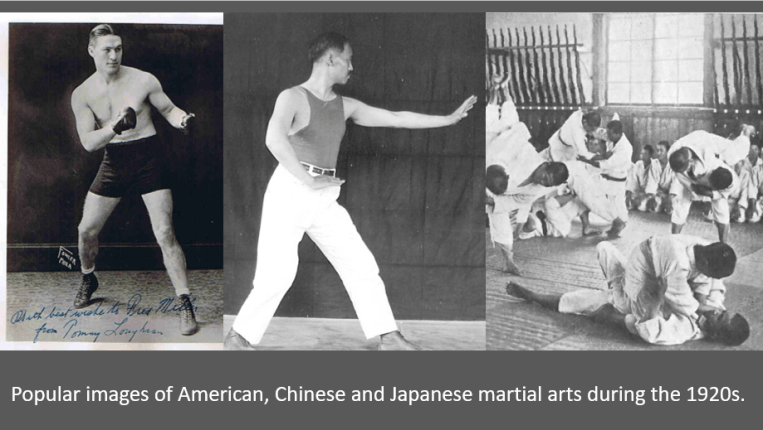
Mixed Martial Arts in Shanghai, 1925

benjudkins's avatarKung Fu Tea

I recently had a chance to explore and organize a large database of vintage newspaper articles. This material was gathered as part of my on-going “Kung Fu Diplomacy” project. Yet every so often I ran across news items which, while not really related to that project, are still quite interesting.

We generally talk about the rise of the mixed martial arts as though it is a totally new phenomenon, but in truth it is only the latest incarnation of a very old impulse within the Asian martial arts. It is hard not to look at the specific histories of certain styles (Jingwu, Choy Li Fut and Five Ancestors all come to mind) and not notice a similar acquisitive impulse.

Still, if we fast forward to the early 20th century one can find much more direct analogues. As the forces of imperialism and globalization brought the fighting arts of East and…

View original post 1,988 more words

Traditional vs Brazilian Jiujitsu

The Forgotten Style: Moral Art!

Top Ten Figures Who Shaped the Asian Martial Arts – Part II

benjudkins's avatarKung Fu Tea


Welcome!  This is the second (and concluding) section of my list of the top ten figures who helped to shape the development and spread of the modern Asian martial arts.  Putting such a list together is easy, but once you start to explain why certain individuals made the cut, or what their contributions were, things inevitably start to run long.  If you are just joining us now, you probably want to start here, with section one.  My goal has been to select the most influential individuals from a variety of styles, professions and areas of the world so that we can better understand these global fighting systems.

The broad nature of “the Asian martial arts” probably makes this an impossible task.  Still, it is fun to speculate and I think that the experiment is a helpful one as it forces us to consider the many social functions…

View original post 1,847 more words

January forms challenge!

Kung Fu in the Snow

benjudkins's avatarKung Fu Tea

Winter is Coming

There are many attributes that make Cornell unique among America’s top universities. One could choose to focus on its philosophy of undergraduate education, beautiful setting or its long and pioneering history of Asian studies. All of that is true and good. The library’s collections are stunning. And yet the campus has a dark side.

The first hints suggest themselves shortly after halloween when small signs begin to appear on campus staircases and walkways warning unwary travelers that these paths will not be maintained during the winter. One undertakes the journey at your own risk. At first all of this seems like the ramblings of an over enthusiastic legal team. The staircases and walkways in question are not in some deserted corner of “the plantations.” These signs dot the campus’ main quads. They are referring to the areas that one will likely traverse.

By January the situation comes…

View original post 2,229 more words

Capoeira as Graceful Resistance

benjudkins's avatarKung Fu Tea

***I am happy to announce that our first substantive essay for 2018 will be a guest post by Lauren Miller Griffith.  While this is Prof. Griffith’s first appearance on Kung Fu Tea she is already  leaving her mark on the wider Martial Arts Studies community.  Her recent book, In Search of Legitimacy: How Outsiders Become Part of the Afro-Brazilian Capoeira Tradition(Berghahn Books, 2016) will be of great interest to anyone who employs ethnography, or participant observation, as a research method.  It is also a wonderful addition to the growing literature on capoeira.  Her current post tackles a critical question, namely, to what degree might participation in a martial arts community influence someone’s social and political views? How does this process typically unfold?  As a political scientist I have always found these questions to be very interesting, and I think that after reading her thought provoking essay you will as…

View original post 3,704 more words

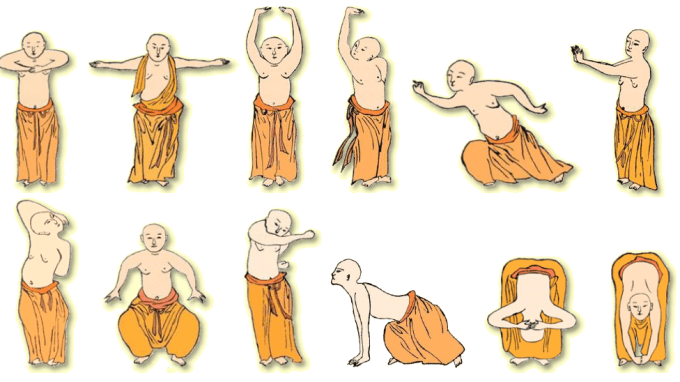
Tips for practicing Yi Jin Jing

Integration of mind and body with a relaxed spirit

Yi Jin Jing is a qigong set and like most other qigong sets it should be practiced with a relaxed spirit and peaceful mind. The mind should thus follow the movements and should be coordinated with the circulation of qi with the body’s movements. Meanwhile concentration is required to accompany individual movements.

For Example:

  • The mind should concentrate on the palms during the Wei Tuo Presenting the Pestle 3 routine
  • The mind should be focused on the Mingmen point at the back of the waist while fixing the eyes on the upper palm during the routine 4 of Plucking a Star and Exchanging a Star Cluster.
  • The mind should be focused on the palms during the Black Dragon Displaying Its Claws routine.

Other movements require imagination, not consciousness to accompany them. Among them are:

  • Three Plates Falling on the Floor
  • Displaying Paw Style Palms like a White Crane Spreading Its Wings
  • Pulling Nine Cows by Their Tails
  • Bowing Down in Salutation

Natural Breathing

  • Breathing throughout the exercise should be relaxed and easy. This is particularly important when:
  • lifting the hands during the Wei Tuo Presenting the Pestle 3 routine
  • when expanding the arms and chest during the Pulling Nine Cows by Their Tails routine,
  • and when expanding the arms and chest and relaxing the shoulders during the Nine Ghosts Drawing Swords routine.

This is because the chest cavity expands and contracts during these movements, and should be allowed to do so freely and to the full.

Free and unrestrained inhalation is particularly required when:

  • lifting the hands during the Wei Tuo Presenting the Pestle 3 routine,
  • and when expanding the arms and chest during the Nine Ghosts Drawing the Swords routine,
  • while natural exhalation is required when relaxing the shoulders in this routine,
  • when withdrawing the arms in Pulling Nine Cows by Their Tails routine,
  • and when pushing out the palms in Displaying Paw-style Palms like a White Crane Spreading Its Wings routine

The reason for this is because the chest cavity expands and contracts during these movements, and should be allowed to do so freely and to the full.

YiJinJing

Softness in toughness with the interplay of the substantial and insubstantial

“The softness and toughness of the exercise movements interchange throughout the practice. When stretched or relaxed, they display a dialectical relationship of a unity of opposites, in the same way as the reactions of Yin and Yang, the two opposing and interactive aspects of the body according to traditional Chinese medicine. Various movements require the practitioners to relax for a while after strength is applied, and suitable force is required after softness or relaxation. In this way, the movements will not be stiff and restrained or slack and fatigued.” – Chinese Health Qigong Association

Movements should be appropriately firm and gentile instead of going to extremes. Whether with too much force or with too much slackness.

Flexibility in performance and articulation of “HAI”

The range of movements and extension of postures in Yi Jin Jing are adaptable for all ages working from easier to more difficult.

When squatting and pressing the hands down during the Three Plates Falling on the Floor routine, the sound “HAI” is made. By doing this the practitioner helps move the breath and vital energy to the Dantian. It also has the advantage of avoiding restraint of the lower limbs caused by the squatting motion and upward flow of air back to the head. It also helps to strengthen the Dantian and the kidneys. The sound should be produced from the throat and concentrated at the Yinjiao point of the upper gum.

Full video teaching the Yi Jin Jing from the Chinese Health Qigong Association.

This article has been based on the information provided from the Chinese Health Qigong Association. If you would like to learn Yi Jin Jing there are a number of special qigong retreats where this is possible.