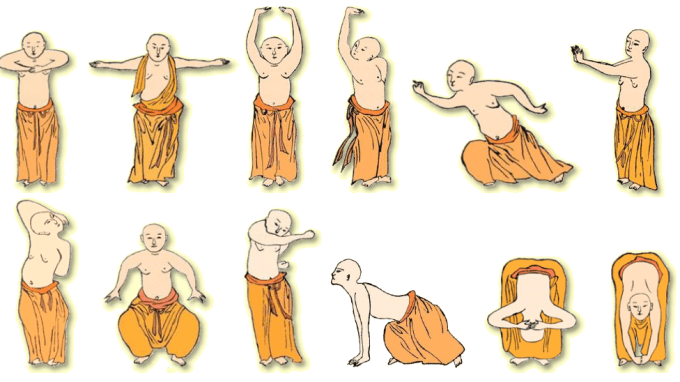
Liu Zi Jue is a set of Qigong exercises for health and fitness. During the exercise breath work, pronunciation and movement are combined. The following provides beginners and advanced practitioners with tips for perfecting the exercise.
Adjusting the mouth forms and feeling the air flow
Mouth forms should be done correctly with particular attention given to pronunciation and air flow. Beginners should find the right mouth form and then exhale with gently making the sound.
Combining the mind with breathing and movements
RenmaiDumai meridian
During practice the mind should be relaxed and in tune with the movements and the accompanying prolonged breathing and pronunciation. Excessive effort in the mind and body should be avoided. Focus should be on the breath work in a way that it is combined with physical movements that assists and compliment and enhance the practice.
It helps to relax the body and calm the mind, and dredge such meridians as Renmai (or conception vessel extending along the anterior midline of the body) to improve the circulation of the blood and vital energy.
Breathing with slight control
Liu Zi Jue should be done naturally using regress breathing.
Regress breathing occurs when inhalation is done through the nose and the chest is expanded while pulling in the abdomen. On the out breath this should be reversed through the mouth, increasing upward and downward movements diaphragm. This process both massages the organs and improves the circulation of blood and vital energy. Excessive efforts should be avoided.
Coordinating breathing with slow, realised and gentle movements
During practice even, prolonged and relaxed breathing and pronunciation will achieve the best results.
Step by step for consistency
Find a quiet place to practice in peace, be consistent in your practice. An environment that relaxes and allows the mind to be at peace is essential as is confidence in the exercises health benefits.
This article is based on studies and guidance compiled by the Chinese Health Qigong Association.
Meaning “Hiding in the Clouds School“, Kumogakure Ryu was founded by Heinaizaemon Ienaga Iga (of the Iga clan) in the middle 16th century. Like Togakure Ryu, which was paired with Kumogakure Ryu by the Toda family in the 17th Century, it is a ninjutsu school of thinking. Both schools teach that violence can basically be avoided. You learn how to go with the flow so that you can achieve what is best for yourself. It is all about adapting oneself to one’s environment.
The Taijutsu (body movement) of Kumogakure Ryu is almost identical to Togakure Ryu. Soke Hatsumi has demonstrated the Kumogakure taijutsu in the past, which was reminiscent of walking in a woman’s kimono; the feet taking small steps, which allows the knees to remain very close together (bent inwards), protecting the groin. This is of course very similar, if not identical to Wing Chun Kung Fu.
One of the special weapons of the school is the kamayari (a cross-bar spear). This was originally a type of grappling device for climbing onto ships, but proved useful for combating sword bearers too. An infamous ninja called Sarutobi Sasuke who was known for his amazing ability to leap form one tree to the next, used the Kamayari in order to swing from branch to branch like a monkey.Despite the close feet, the Kumogakure is known for its great leaps during close combat. Takamatsu Sensei was reputed to be able to leap 8 feet from standstill. Another taijutsu proficiency was the use of double blocks and strikes, as well as strikes against the forearm, yet again, similar to Wing Chun Kung Fu.
In the same vain, the Ippon Sugi Noburi (a metal pipe with an extendable chain inside and 3 claws at the end) was used for both climbing trees and as a flexible weapon in the Kumogakure Ryu. As well as leaping through trees, the Ninja’s of the Kumogakure would wear demon’s masks to frighten their opposition, and they would use the horns on the masks much like an animal would; by headbutting their opponents. They would also use torches that burnt when wet and other survival tactics for extreme environments, making them appear super human or like demons to their rivals. These types of deception and mind games were common implements for the ninja.
To visit Fane Hervey’s site or read more of his writing’s on Ninjutsu visit – www.ninjutsulondon.com
A frequently remembered moment among my staff (which are also my students) was an episode at a martial arts business event where several instructors ask me how I generate so much content; this blog, my facebook posts, my youtube, my DVD’s, my books, my secret facebook group(s) (YES, several0, etc etc yadda yadda. To which […]
Introduction Welcome to “Chinese Martial Arts in the News!” Lots has been happening in the Chinese martial arts community, so its time to see what people have been saying. For new readers, this is a semi-regular feature here at Kung Fu Tea in which we review media stories that mention or affect the traditional fighting arts. In […]
Liu Zi Jue is a traditional Chinese health practice. Liu Zi Jue or Six Healing Sounds is an exercise that regulates and controls the rise and fall of Qi inside the body and related in halation and exhalation through different mouth forms.
The six healing sounds are “XU, HE, HU,SI, CHUI and XI” and their aim is the strengthening of the liver, heart, spleen, lungs, kidneys and sanjiao (the three portions of the body cavities housing the internal organs). The exercises are designed to be completed slowly, gently, with extended and graceful movements.
Practitioners of these exercises report not only that they have experienced a general improvement in their quality of life but also that they have experienced an improvement in their social relationships. With decreased family frictions ranking among the top benefits of this practice. This is likely due to the calmness brought about by the gentile breathing movements. Other medical tests have shown positive improvements and curing of hypertension, hyperlipidemia and high blood sugar.
This article is based on the work of the Chinese Health Qigong Association.
Origins and Development of Liu Zi Jue
The term Liu Zi Jue first appears in ‘Caring for the Health of the Mind and Prolonging the Life Span’, – Tao Hongjing of the Southern and Northern Dynasties (420-589).
According to Tao Hongjing a leading figure from the Maoshan School of Taoism. “One has only one way for inhalation, but six for exhalation – CHUI, HU, XI, HE, XU and SI. CHUI gets rid of heat; HU sweeps away wind; XI eliminates worries; HE promotes the circulation of energy; XU drives away cold; and SI reduces stress. Those with heart disease should practice CHUI and HU, to drive away cold and heat. Those with lung disease should practice XU, to relieve swelling. Those who have spleen trouble should practice XI, to eliminate stress. As for those who suffer from liver disease, HE will help to cure it.”
Zou Pu’an of the Song Dynasty (960-1279) in his book ‘The Supreme Knack for Health Preservations’ recommends.
“Don’t listen to anything when pronouncing the sounds. Close your mouth, lower your head after finishing, breath in fresh air from the universe slowly through the nose. Don’t listen to anything when inhaling.”
In terms of the practice it was not until the Ming Dynasty (1368-1644) that body movements where introduced.
“Open the eyes wide when doing the XU Exercise for the liver. Raise the arms when doing the SI Exercise for the lungs. Stick head up and cross the hands when doing the HE Exercise for the heart. Keep the knees level when doing the CHUI Exercise for the kidneys. Thrust and round the lips when doing the HU Exercise for the spleen, and lie down when doing the XI Exercise to drive heat from Sanjiao”
There are a number of exercises which use elements of Liu Zi Jue. These include Yi Jin Jing (Tendon-Muscle Strengthening Exercises), Emei Zhuang (Emei Stake Exercises), Xing Yi Quan (12-Animal Shadow Boxing), Bagua Zhang (Eight-Diagram Palm), and Da Yan Gong (Wild Goose Exercises). For these exercises the sounds are used to aid these dynamic physical exercises.
Theory
The theoretical basis of the Liu Zi Jue is Traditional Chinese Medicine‘s (TCM) Five Elements (metal, wood, water, fire and earth), and Five Solid Viscera (heart, liver, spleen, lungs and kidneys).
Characteristic
Mouth forms required for pronunciation
Liu Zi Jue features six special mouth forms and methods of pronunciation to regulate and control the rise and fall of qi in the body and related to inhalation and exhalation.
Combining breathing and movements with cultivation of energy
Through combined use of breath work, pronunciation, and physical movement practitioners can benefit from “proper internal circulation of energy vital for the health, and those who know the ways to apply strength and the ways to relax can expect a long life’ – Ge Hong of the Eastern Jin Dynasty (317-420).
Dynamics infused in calmness and flowing grace
During practice pronunciation should be even and extended and the movements relaxed and slow. Regulated breathing should be even during the postures cultivating a calm and dynamic state.
Simple, reliable and effective
The six sounds are pronounced during exhalations and accompany nice movements as well as the preparatory and concluding postures. The exercise is easy to learn and practice making it practical.
Well, it’s nice to check in with you all again. I thought I’d say thanks as always for checking in with my now less regular than I’d like blog. You must of had a slightly less exciting than usual Easter because I had a lot of visits. That’s always good to see. Although I keep […]
Boy Scouts practice Kendo in California, 1928. Source: Vintage Press Photo. Author’s Personal Collection.
Of Boy Scouts and Kendo
A recent post focused on the role of the global scouting movement in promoting the spread of the Asian martial arts during the first half of the 20th century. In that essay I mentioned a photograph of Japanese-American and Caucasian scouts practicing Kendo together in California during the 1920s. Yet observant readers may have noticed I did not actually include that photo in the post.
Sadly I had misplaced that particular photo so it didn’t make it into that piece. But it recently resurfaced as I was shuffling through my collection. Better yet, I came across another related item which also helps to add detail to our understanding of Kendo in America prior to 1941.
I quite like the first of these press photos. In it we see two figures seemingly…
Structure and Agency Contrary to popular opinion, nature does not love parsimony. This frequently repeated opinion is more an aesthetic judgement on the part of some scholars rather than an empirical observation about the actual functioning of the natural or social worlds. When looking at questions as complex as the global spread of the […]
The ‘Tiger Knocking Down School‘ does not really have an exact origin. Like Gyokko Ryu, it is thought to have originated from China, being brought to Japan by a monk called Chan Busho, but when, or even if this is true, remains a mystery. This makes it hard to really tell what influenced it from a Chinese kung fu perspective. On one hand, the linear fashion of Koto Ryu would indicate something of a Xing yi origin, although Xing yi itself is steeped in legend and the exact origin of that art are also unknown. Maybe that’s just a coincidence! Certainly though, Xing yi has an older claim, with its originator supposedly being Yue Fei, the famous Song Dynasty general (10th-13th century). The first Soke of the Koto Ryu; Sakagami Taro Kunishige, is dated as being 16th century. It could also have easily originated from a monk, Xing yi being a popular Taoist martial system.
The second Soke of Koto Ryu was meant to be Bando Kotaro Minamoto Masahide, but unfortunately he was killed in battle around 1542. Therefore the sokeship past to Sougyoku Kan Ritsushi, who was the 17th generation Soke of Gyokko Ryu. So since then, the Koto Ryu and Gyokko Ryu, follow the same lineage. Traditionally only the next soke was taught the Koto Ryu, whereas any student could have been taught the Gyokko Ryu. However, there are instances of many ninja knowing both, so it would appear that this was not a steadfast rule.
Koto Ryu is a hard natured discipline, so it really requires conditioning and tough training. This used to be done by punching and kicking stones and gravel. Supposedly this would empower the practitioner to puncture a tree with 5 holes from a ‘shako ken’ – claw strike!!!
The name of the school, knocking a tiger down, implies that the techniques are for hitting a larger, more powerful opponent.The techniques are rough in their execution and the attitude is a ‘do or die, no mercy’ type of mentality. It is a very brutal system.
Koto Ryu is known for its koppojutsu, (bone breaking/attacking) , shurikenjutsu, and kenjutsu. Unlike the Gyokko Ryu which plays more with distances, Koto Ryu is very close in its execution and is far more offensive. The angling of the attacks can often be at 90 degrees to the opponent, so the timing and rhythm of the practitioner must be excellent in order to be successful. However, the starting distances in the densho for the Koto Ryu are often quite far apart, so this would indicate that it was designed more for the battlefield, rather than confined spaces.
So technically the Gyokko Ryu (and therefore Gikan Ryu) and Koto Ryu complement each other really well, and they form the basis of self defense in the Togakure Ryu too. However, you should not forget that the Koto Ryu is also a system in itself, independent from the Gyokko Ryu, with unique ways of moving.
This school is taught inside the “Bujinkan”, “Genbukan”, and “Jinenkan”, even though Soke Hatsumi is actually the only registered Soke of the school.



 SMA bloggers