Best Kung Fu School in China for Location

This is my list of the best kung fu schools in China for 2017. In this article I have chosen only the very best kung fu schools based on what they offer in terms of training, location, food and how well they cater to kids. Each year we will update this list based our school visits and student reviews.

Best Location

Studying Martial Arts in China is gaining in popularity as an adventure travel experience. Part of that experience along with intensive martial arts training is being able to train hard all year round in an environment that not only inspires but adds to your development. Rising Dragon Martial Arts School provides one of the best places to learn martial arts in China.

Best Kung Fu School for Location

Located in Yong Ping county in Southern Yunnan the province is mountainous and borders Myanmar, Laos, and Vietnam, and has an average altitude of 1980m. Yong Ping has a population of around 170,000, and is roughly in between the two Cities of Dali and Bao Shan. Dali and Bao Shan are an hour away from the school.

Immediately surrounding RDS is an area steeped in history. There are numerous temples, scenic areas, mountains, lakes and even natural hot springs for attending students to visit. The School is 15 minutes away from Yong Ping town and is within a million square meter private park. This park is filled with beautiful multi-coloured plants, amazing wild-life, statues, lakes, forests of wild bamboo, as well as RDS’s own temple.

Despite being at an altitude of 1,700m there are many neighbouring mountains that tower over the school reaching altitudes of 4000+m, which make for many a challenging hike during your free time. Considering the schools remoteness it is still quite easy to get to with airports in Bao Shan, Dali City, and Lijiang International airport. The capital, Kunming, is only a 40-minute flight from Dali and Bao Shan making travel very convenient. There are many Kung Fu schools in China, but few can complete with this in terms of location, and low pollution levels.

To find out which school I recommend for Best Location, Best for Kids and Best for Food. Click here. Learn Kung fu in China with StudyMartialArts.Org

To learn kung fu in China or learn more about any of these schools. Visit the StudyMartialArts.Org website or email us direct at info@studymartialarts.org

Trends and Stories that Shaped the Chinese Martial Arts in 2017

benjudkins's avatarKung Fu Tea

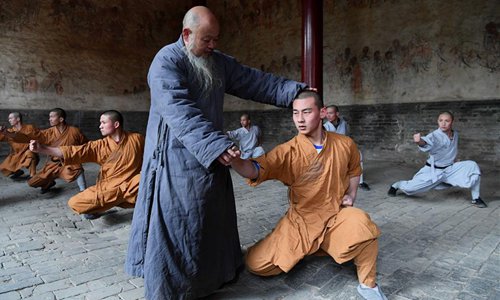
Kung Fu training at the Shaolin Temple. Source: Global Times.

This is the time of year when it is only natural to pause and reflect on where we have been and what may be coming next.  2017 has been a busy year in the Chinese martial arts.  Progress has been in made in certain areas, while suggestions of trouble have arisen in others.  Lets explore all of this together as we count down the top ten news stories of the last year.  As always, if you spotted a trend or article that you think should have made this list, please feel free to leave a link in the comments below!

10.  Lets start things off with one of the more interesting trends that has been evident in the TCMA community for the last few years.  While we normally focus on the “transmission” of living traditions, projects that focus on the…

View original post 2,753 more words

ABSORB WHAT IS USEFUL…

by Phillip Starr

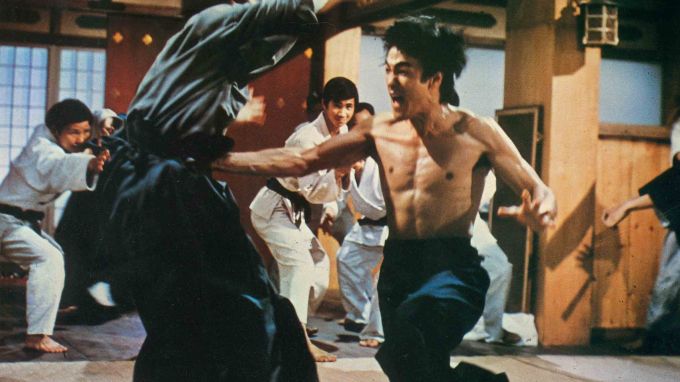
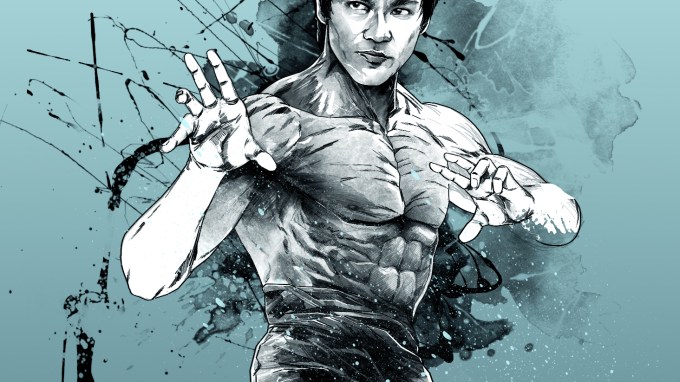
One of the very worst pieces of advice ever given to the martial arts community at large came from the lips of Bruce Lee.
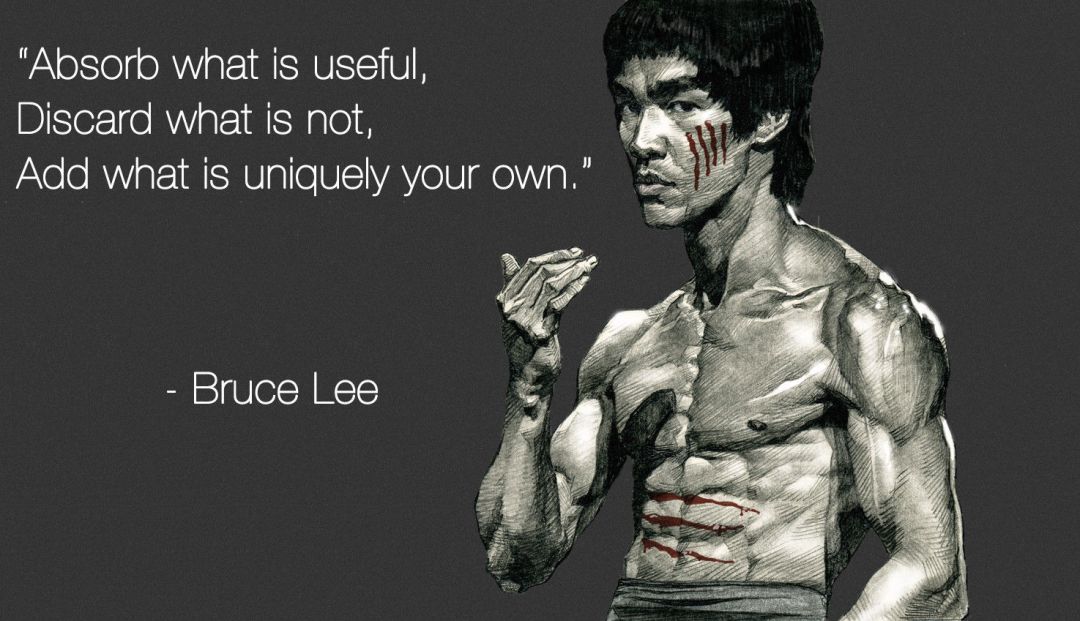
226580-Absorb-What-Is-Useful

Determining just what is useful and what isn’t is quite a daunting task and one that should be examined closely. After all, a goodly number of today’s so-called “mixed martial arts” crowd as well as followers of numerous eclectic martial ways state very clearly that traditional martial arts aren’t entirely applicable to modern combat or combat at all. They believe that numerous techniques that are taught within the traditional martial arts either don’t work very well or, in some cases, not at all. This, they say, is why they have chosen to follow their “own paths.”

Executing a correct reverse punch, front snap kick, kotegaeshi, or o-soto-gari is a pretty daunting task for most raw beginners who have had little or no previous martial arts training. The new student can spend hours working on any one of these techniques for a whole month and it still is practically worthless in a real fight. The reason why is obvious; to develop any technique so that it is truly usable requires a great deal of practice over a period of time! There are no short cuts. My teacher said that developing effective technique is like making tea. It can’t be hurried and any attempt to do so will only ruin the drink.

It would be easy but very premature and terribly foolish for the novice to simply dismiss these fundamental techniques as being “useless.” The same holds true for other, more advanced techniques that he or she will eventually learn. I’m sure that you’ve encountered techniques that just didn’t work at first. I know I have. Still do. But with patience, some introspection, and lots of practice you’ve been able to see how they should be done, where your mistakes were, and suddenly they become functional!

When you learn a technique that doesn’t seem to work well for you, ask yourself, “why?” What are you doing wrong? Sometimes the error lies in the physical execution of the technique but sometimes it is hidden in a less obvious place. Maybe it’s your timing that’s off – and that can be indicative of a mental/psychological error or block of some kind, can’t it? Perhaps it’s your approach to the application of the technique or your approach (physical, mental, or even spiritual) towards your training “opponent.” Regardless, the error is thine. Find it and correct it. Sometimes it’s the finding of the error that corrects it.

To say that techniques of the traditional martial arts are not effective (in self-defense) is a blatant display of one’s own ignorance, and perhaps, one’s unwillingness to put in the required practice (which is a nice way of saying “lazy”). In days long since past, professional warriors (e.g., policemen, soldiers, bodyguards, and their teachers) relied on these arts for their very survival. Back then, it was pretty easy to determine if a given technique worked. If it didn’t, you died. Those who developed techniques that didn’t work took their failures with them to their graves. For the most part, we’ll never know what they were.

The techniques that did work are still with us to this day. If they didn’t work, they would have been buried long ago. So, to say that the surviving traditional techniques don’t really work is, in my opinion, a statement made by someone who has never learned genuine traditional technique…or who is unwilling, for one reason or another, to put in the time and training required to develop effective technique.

Beginning piano students dare not say that the classics are worthless and no longer functional! The masters who contributed to the creation of the traditional martial disciplines are our Bachs, Beethovens, and Mozarts.

To truly understand a technique and how it should be performed correctly requires at least 10,000 repetitions. In karate or kung-fu this isn’t terribly difficult, considering that you can easily practice 100 punches each day. In 100 days you should be able to perform the technique correctly, more or less. That doesn’t mean it can’t be improved, though.

But that’s not the same as making it workable. To be able to perform a technique effectively in combat requires much more practice. You see, the effectiveness of a given technique, whether it’s a punch, a kick, a joint twist or throw from aikido or judo…involves much more than just being able to perform the physical aspects of the technique correctly. Much. More.

Back when I trained in forms of Japanese karate, I could not, for the life of me, get a roundhouse kick to work. Actually, it took MONTHS before I figured out how to do it correctly. I guess I just had a mental block and I couldn’t imagine how to do it…but once I was able to throw a roundhouse kick, I couldn’t figure out how such a kick would ever be useful in fighting! I suppose Mr. Lee would have told me to reject it because, as far as I was concerned, it was pretty useless…

Then came Baguazhang. At first glance, this art seems to have about as much in common with combat as a fish does to a bicycle. It would have been all too easy to simply toss it away as being some sort of pointless, flowery, Chinese bilge water. But I didn’t. I stuck with it and studied it…in depth. I examined it carefully, examined myself, examined its strange footwork and body movements…and I practiced and then when I was sick of it, I practiced some more. And when I had problems making it work (which was pretty much all the time, at first), I stayed with it and figured out WHY I was having problems.

In any given martial discipline, at least a decade (or more) is required if one wants to truly understand the art. The problem is that most Westerners don’t want to spend that much time in training. They want “instant martial arts.” We’re accustomed to having “instant food” (which isn’t really food), “instant entertainment”, and now we want “instant martial arts.” But there isn’t such an animal…never was, and never will be.

So, rather than absorbing what you find immediately useful and rejecting what you think is useless, just ABSORB.
Breathing and Balance

By Phillip Starr

There is a very real and close relationship between breath and balance; loss of one usually results in loss of the other. So, let’s first examine just what we mean by “balance.”

Balance refers to two forms of stability, physical and mental. Physical balance is pretty easy to understand. The body should maintain stability at all times, when standing still and when moving. As martial arts enthusiasts, we practice a variety of exercises that are intended to improve our physical balance and quite a number of the techniques and postures that we employ require a pretty fine sense of physical stability.

4530bf0bbe418e709ccea186839c15e9--surfing-martial-arts

The other form of balance (which we usually don’t consider) is mental balance. Just as the body must be stabilized at all times, so the mind must also be steady. Conditions such as extreme fear (which seems to paralyze us), panic, and hysteria are obvious states of mind that involve loss of mental balance. However, the same thing holds true (although to a much lesser degree) for extreme anger, worry, and even joy. Carried to an extreme, they can de-stabilize the mind.

If one has learned the correct form of breathing, which is known as “ breathing”, instability (whether it’s physical or mental) becomes very unlikely. Reverse breathing (discussed in detail in my books MARTIAL MECHANICS and DEVELOPING JIN) fosters a strong physical “root” so that physical balance is greatly enhanced and it also stabilizes the mind.

However, what do most people do if they are suddenly frightened? They gasp for air, right? If a mouse runs across your wife’s foot (or your husband’s sandwich), she’ll likely place one hand on her chest and inhale up high in her chest. That causes an instantaneous “loss of breath (control)” and the end result is mental instability, which immediately leads to a weakness in physical balance. Her knes may become weak and her legs “feel like rubber.” This is loss of mental balance causing loss of physical balance. The two are interrelated. An unexpected thing such as a sudden, unexpected loud noise or anything that may be perceived as danger can cause this to occur. We’ve all heard the expression “paralyzed with fear”, which is an extreme example of this principle.

And when someone slips (on ice, for stance) and loses his physical balance, he becomes very fearful… and the same high, shallow breath often occurs. This is a loss of physical balance causing a loss of mental balance.

But note that there is a common denominator in both cases (loss of physical balance causing loss of mental balance, and sudden loss of mental stability causing a loss of physical balance…and that is the BREATH. In both kinds of situations, the breathing is high and shallow, usually coming in gasps.

However, in both types of situations, if the breath is dropped to the lower abdomen and a strong “reverse breath” is performed, loss of balance needn’t happen. Reverse breathing enhances physical and mental stability…when you begin to lose your physical balance or if mental balance is starting to slip, execute a strong reverse breath and maintain your overall stability!

B-vdDv1UsAEhtXA

Many years ago, a study was made regarding hysteria and it was found that in most cases, the brain releases a certain chemical that actually fosters hysteria. However, it was also found that deep, abdominal breathing prevents this from occurring! It is largely impossible to become hysterical if one is breathing deeply from the abdomen (as it is done in reverse breathing).

So there’s more to breathing than just making your techniques more powerful. And the masters of the past knew it. That’s another reason why they focused so hard on proper breathing (and taught their students to do the same). But breathing isn’t particularly exciting to practice (as are kicks and punches) and consequently, many (breathing) exercises were tossed by the wayside and forgotten. Some schools openly taught breathing as a method of enhancing balance (such as those that emphasize certain kata such as Sanchin), while others taught (physical) balancing exercises (because great physical balance cannot be maintained unless one’s breathing is correct) as a way of teaching proper breathing to their (unknowing) students. The schools of Shorin-ryu were known for this. A number of schools did both (breathing exercises and balance routines).

Use this information to augment and upgrade your daily practice. You’ll find it more than a little useful.

A Brief History of Nostalgia and the Future of the Martial Arts

benjudkins's avatarKung Fu Tea

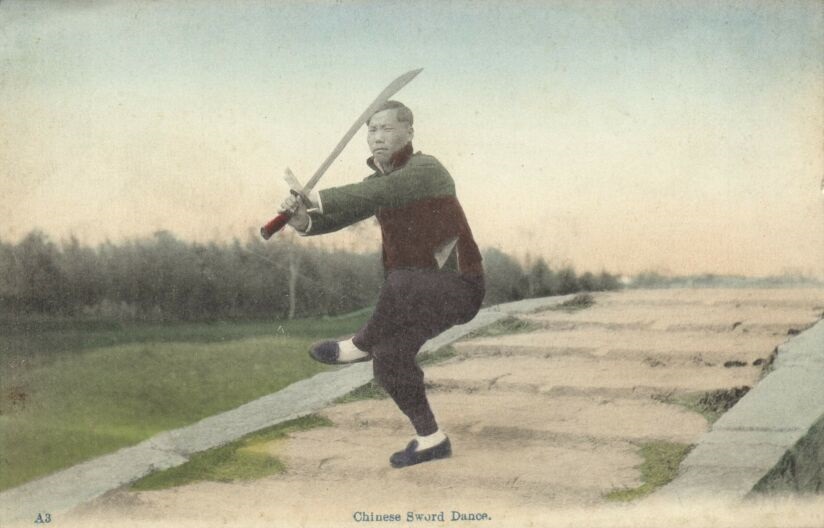
Chinese Sword Dance. Vintage postcard. Source: Author’s personal collection.

That Special Time of Year

It must be that time of year again.  December is the season in which Disney unleashes a new Star Wars movie on an eager public, complete with a weaponized marketing campaign. Sitting in the sacred dark, viewers are transported backwards to a realm of childhood heroes.  There is also the small matter of Christmas.  If New Years looks towards a hopeful future, Christmas is marked with the experience of nostalgia in a way that no other holiday can hope to match.

Nor do we all experience nostalgia in the same way.  Some individuals derive a sense of comfort from these longings, whereas for others the memory of the past can be painful (a sensation that is more in keeping with the term’s original definition).*  Very few people have strong feelings about President’s Day or Labor Day. …

View original post 2,809 more words

Guest Post: Martial Arts in the British National Press

benjudkins's avatarKung Fu Tea

Martial Arts in the British National Press
Paul Bowman
Cardiff University
JOMEC Research Seminar, Cardiff University, 13th December 2017

Introduction

This research project looked at stories, items and features about martial arts in the UK national press.[1] The basic area of enquiry is into the kinds of stories that have been and are being told about martial arts and martial artists in mainstream British popular culture.[2]

This study of the press is only one part of a larger research project, which is looking at the representations of martial arts in a range of different realms of British popular culture, such as films, adverts, magazines, music videos and books.[3]

The project is specifically interested in non-specialist publications, non-specialist texts, and non-specialist contexts. This is because I am interested in finding out what kinds of stories about martial arts circulate in mainstream contexts; what kinds of representations dominate…

View original post 5,147 more words

Framing Kung Fu in the Information Age

benjudkins's avatarKung Fu Tea

Who doesn’t feel inspired by an epic martial arts infused landscape shot?

Algorithms and Hand Combat

This essay began as a thought experiment.  After that it evolved into a real experiment.  It is not a terribly scientific exercise, certainly not the sort of thing that involves actual databases and statistical analysis.  Still, it might be heuristically useful as we attempt to unravel some questions about the place of the martial arts in modern society.  Specifically, in a crowded marketplace, how do people go about deciding which martial art to study?  In what way do popular culture representations of these practices (often created by non-practitioners) play a role in this?

As I mulled over the kernels of these questions it occurred to me increasingly its not just film directors, comic book artists or video game designers who are creating pop-culture impressions of the martial arts.  It may not even be human…

View original post 2,652 more words

Kung Fu Comes to Australia in 1886

benjudkins's avatarKung Fu Tea

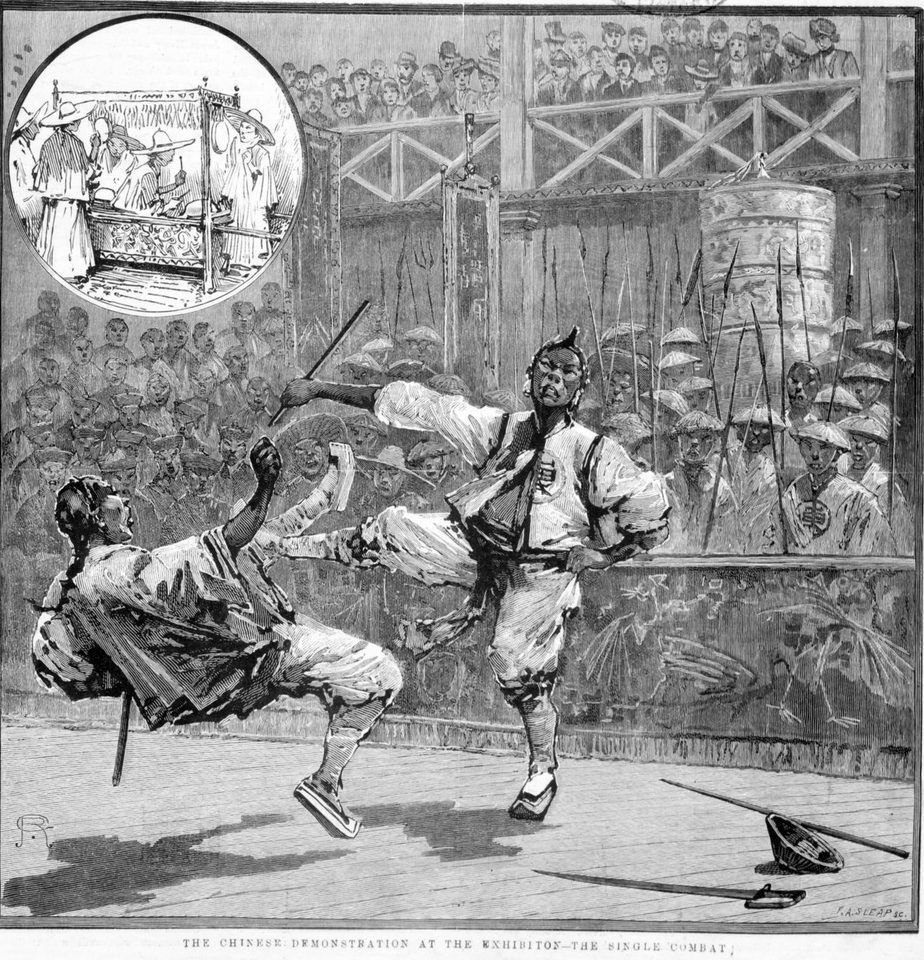
The Illustrated Australian News. Wednesday 26th, May 1886. Cover.

A month ago I was chatting with my friend Joseph Svinth (a prolific author and editor within the field of Martial Arts Studies) over email.  At the time I was still recovering from the last round of conferences and let things slide. But earlier this week I decided to take another look at one of his most interesting finds.  It is an engraving (executed by F. A. Sleap) that graced the cover of the Illustrated Australian News on Wednesday the 26th in May of 1886.

This image will be of immediate interest to any student of Chinese martial studies.  It shows two individuals engaged in armed single combat.  The ferocity of their fight is suggested by the fallen sword, pole and bamboo helmet that have been discarded in a lower corner of the frame.  Behind them sits a large…

View original post 2,237 more words

Muay Thai and the Two-Level Game

benjudkins's avatarKung Fu Tea

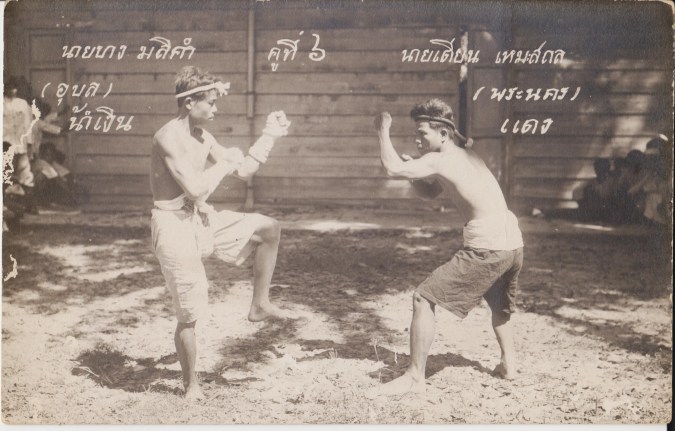
Thai Boxing. Vintage postcard, circa 1910s. Source: Author’s Personal Collection.


Introduction

Earlier this morning I was faced with a choice.  Should I write about Nietzsche (and a certain martial art), or Robert Putnam (and an entirely different fighting system).  Its hard to sit down and read the news these days without thinking of Nietzsche, so I opted for Putnam.  Both provided interesting thought experiments, but the second path has the added advantage of introducing new concepts, metaphors, authors and arts that are not often discussed in the current martial arts studies literature.

Putnam himself is a good example of this.  While not the most frequently invoked thinker within the field of martial arts studies, I certainly run across Nietzsche’s name from time to time.  Yet despite a high-profile career at Harvard University, the supervision of a generation of brilliant graduate students, and his many contributions to the social sciences…

View original post 4,082 more words

Invisible Systema — The Tai Chi Notebook

I recently came across these “invisible Systema” videos, and I thought they were so well made they were worth a share, but I thought I’d also say a few words about Systema first. Having met lots of people who have trained with Vladimir Vasiliev now, some for quite a period of time, the description I […]

via Invisible Systema — The Tai Chi Notebook