Learn the Yi Jin Jing

Introduction

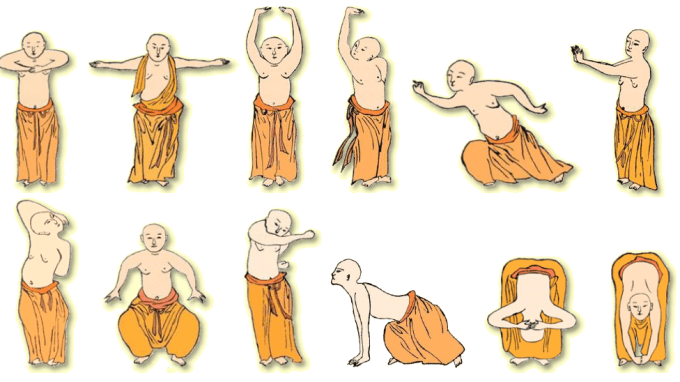
Yi Jin Jing is an exercise from ancient China. The features of this classical traditional Chinese health practice include extended, soft and even movements that flex the spine invigorate the limbs and internal organs. As an exercise it should be performed in a way that integrates the mind, body and spirit, during the practice practitioners must remain relaxed. If you would like to learn Yi Jin Jing there are a number of special qigong retreats where this is possible.

This article details guidance from the Chinese Health Qigong Association on how to best perform the exercise.

The origins

According to some historians the Yi Jin Jing has its origins in primitive shamanistic rituals. Prototypes of these basic movements where found in a 2000 year old text called Illustration of Qi Conduction. Others however, credit Bodhidharma the Indian Buddhist monk and originator of Shaolin Kung Fu with the creation of the Yi Jin Jing. Whether this is true or not it is undisputed that the monks of the Shaolin Temple played a significant role in the evolution of the Yi Jin Jing exercises.

Learn Yi Jin Jing
Learn Yi Jin Jing

“The earliest account of the modern 12 movement exercises is included in the Illustrations of Internal Exercise compiled by Pan Wei in 1858 in the Qing Dynasty. As traditional Yi Jin Jing relies heavily on traditional Chinese medicine theory of the Five Elements – metal, wood, water, fire and earth – different schools of the exercise have sprung up emphasising this aspect in many works.” – Chinese Qigong Association.

Characteristics

Smooth and extended movements to stretch the bones and tendons

A full range of motion is required related to the bones and joints. Bones are flexed and muscle groups along with tendons and ligaments are stretched. The result leads to improved blood circulation and nutrition supersession in the soft tissues. Thus enhancing mobility and strength in all directions.

Soft and even movements for coordinated grace

The modern version of the Yi Jin Jing links the 12 movements making the exercise both easier to understand as well as graceful. Limbs are flexed in curved natural range with the joints axis. When strength is required it is applied gradually combined with a tenderness of movement.

Focus on spine turning and flexing

The Yi Jin Jing movements focus on the spines, vertebrae, ligaments and the spinal cord through twisting and stretching movements. The movements must be done with a relaxed body and mind in order to gain the most health benefits. These benefits include improved fitness, prevention of disease, longevity and improved intellect.

Chinese Martial Arts in the News: December 4th, 2017: China Clamps Down on the Traditional Martial Arts

benjudkins's avatarKung Fu Tea

Introduction

Welcome to “Chinese Martial Arts in the News!”  Things have been pretty busy around here for the last couple of months, and we haven’t had a news update since September.  Yet lots has been happening in the world of the traditional Chinese martial arts, so its time to do something about that.

For those who may have forgotten, this is a semi-regular feature here at Kung Fu Tea in which we review media stories that mention or affect the traditional fighting arts.  In addition to discussing important events, this column also considers how the Asian hand combat systems are portrayed in the mainstream media.

While we try to summarize the major stories over the last month, there is always a chance that we may have missed something.  If you are aware of an important news event relating to the TCMA, drop a link in the comments section below.  If you…

View original post 2,353 more words

Best Kung Fu School in China for Training

This is my list of the best kung fu schools in China for 2017. In this article I have chosen only the very best kung fu schools based on what they offer in terms of training, location, food and how well they cater to kids. Each year we will update this list based our school visits and student reviews.

Best Training

Wudang Principles
Best Kung Fu School for Training

Consistently the best kung fu school for training in terms of structure, tuition and depth of transmission is WDP China. The instructors are mostly bi or multi lingual. The school training schedule runs 6 days per week. 7 hours per day. You can see a typical training schedule below.

  • 06:30 – Get Up
  • 07:30-09:40 – Warm Up & Hun Yuan Fa Li, Standing Qigong, Walking Meditation
  • 09:50-12:00 – Morning Class
  • 16:00-17:30 – Afternoon Class
  • 19-00-21:00 – Evening Class

The school curriculum has been systematically developed and taught with modern teaching methods in mind. This curriculum features 8 Trigrams IN-BETWEEN the 4 Instructor-Levels.

Students can choose:

  • WDP CLASSIC (All traditional styles with specific basics, qigong, tao lu and style specific applications)
  • WDP COMBAT (realistic fighting skills using INTERNAL PRINCIPLES of all styles).

In addition to the regular curriculum the school also has, online training, seminars in sword, push hands, body conditioning, hand conditioning, neigong and much more throughout the year.

To find out which school I recommend for Best Location, Best for Kids and Best for Food. Click here. Learn Kung fu in China with StudyMartialArts.Org

To learn kung fu in China or learn more about any of these schools. Visit the StudyMartialArts.Org website or email us direct at info@studymartialarts.org

A Kung Fu Pilgrim: Travel, Community and the Production of Knowledge

benjudkins's avatarKung Fu Tea


The Pilgrim’s Progress

Observers have noted that while the meaning and object of worship varies, the pattern is universal.  I cannot help but agree as I contemplate the events of the last month.  First there was the ritual separation from family and friends.  While many have doubted the actual effectiveness of the TSA in stopping attacks, I don’t think that anyone would question their expertise in the construction of imposing ‘liminal barriers.”

The journey had been accompanied by all of the normal discomforts that come when one turns your mind to greater matters, rejecting the routine of daily life.  There is nothing quite like two days spent in airports, hotels and cabs to encourage the contemplative examination of one’s destiny.  As the expedition progresses one becomes ever more aware that travel is never a solitary venture.  Everywhere one sees their community of “common affliction,” also being shuttled from one…

View original post 3,852 more words

Purple Belts will Need IBJJF Membership Starting in 2018

Huh, well that’s something: according to White Belt BJJ, (and then I checked on the IBJJF website- not due to lack of trust, I just wanted to see where this was mentioned) purple belts will need to register with the IBJJF in order to compete in tournaments, starting in January of 2018. I imagine as […]

via   — A Skirt on the Mat

A Lost Kung Fu Manual and Nature of “Chinese Boxing”

benjudkins's avatarKung Fu Tea

1860s photograph of a “Chinese Soldier” with butterfly swords. Subject unknown, taken by G. Harrison Grey.

Introduction

This is my keynote address from the recent (Nov. 9-10th, 2017) conference on fightbooks held at the German Blade Museum in Solingen.  A full report on this event is coming soon, but I am eager to share this with the readers of Kung Fu Tea.  Enjoy!

A Man and A Book

As my colleague Brian Kennedy has noted, there is no subject more beloved in the world of kung fu fiction than the lost training manual.  Countless films, tv programs and wuxia novels have focused on the image of a lost (or better yet, stolen) book that holds the secrets to ancient fighting prowess.  Heroes and heroines go to amazing lengths to procure such a book and to unravel its secrets.  Both a source of knowledge and an outward sign of martial…

View original post 5,223 more words

2017 Christmas Shopping List: Martial Arts Equipment and Long Reads to Get You Through the Winter Months

Its That Time of Year Again! Welcome to Kung Fu Tea’s sixth annual holiday shopping list! These are some of my favorite posts to pull together. They also serve as a great reminder to continue to make time for martial arts practice and study during the festive seasons. In fact, training can be a great way […]

via 2017 Christmas Shopping List: Martial Arts Equipment and Long Reads to Get You Through the Winter Months — Kung Fu Tea

MAO DUN ZHUANG – Combat Stance and Variation

Mao Dun Zhuang or Combat Stance is an essential posture for developing martial power. Sometimes called ‘Shield and Spear,’ it is a fully back-weighted side stance which trains among other things, both lifting and sinking power. There is little or no weight on the front leg and the front heel is very slightly lifted. Because […]

via MAO DUN ZHUANG – Combat Stance and Variation — Inside Zhan Zhuang

SMABloggers – The Liebster Award

This week SMAbloggers was nominated for the! The Liebster award is an award for bloggers, nominated by other bloggers. A kind of chain letter if you will that highlights new blogs and the great stories these bloggers they are sharing.

For this nomination a big thank you goes to Will at monkeystealspeach.com. Will, as you may know has in the past contributed some excellent blog posts here at SMAbloggers. As well as this Will also has his own excellent blog full martial arts stories, interviews, travel tips and tea culture.

So here’s how the award works.

  1. Thank the person who nominated you and post a link to their site.
  2. Display an image of the award and write a post about your nomination on your blog.
  3. Answer the 10 questions your nominee has asked in their blog post.
  4. Nominate 5-10 other deserving new bloggers for the award and ask them 10 questions of your choice.
  5. List the rules of the award in your blog post.

Will’s 10 Questionsimg_2484

1.Tell us a bit about yourself

In the summer of 2007 while on a break from my urban planning job back in Belfast I made the decision to travel to China and study traditional kung fu. I craved adventure and a change from the daily grind. Most of my friends had gone travelling between school and university or between university and work. I’d created a window of opportunity and felt this was the right time to use the money I’d saved. My martial arts experience at that time was limited to my regularly Jeet Kune Do classes. Despite my lack of sashes or belts I wasn’t worried. What I lacked in experience I knew I had in determination to work hard and learn as much as I could. Like most of you reading this I’ve an interest and passion for martial arts as well as a growing interest in learning more about the spiritual and healing arts of China. As a teen I used to day dream about what it would be like to visit a land where a monkey could become a king.

China here I come…

Immediately I set to the task of researching kung fu schools in China. I craved being taught in a traditional way without distractions. I wanted to learn how to deal with confrontation effortlessly and improve every aspect of my life.

So I took action and found a school, got my visa and boarded a plane. 13 hours later I arrived in Beijing totally unprepared. I stayed the night in a hotel near the airport and the next day I boarded my internal flight to my end destination with high hopes. I was as green as the grass I’d left back in Ireland. From that moment until now it’s been one hell of an adventure.

Over the last few years I’ve visited a lot of kung fu schools and met a number of students studying at these schools. Some have come for martial arts, some adventure, some for health and fitness and some simply to create space for changing past bad habits. Your reasons for seeking this type of experience are your own. But what they should have in common is a desire to improve. Focus should be on the training and the experiences and other benefits will follow.

2. What was your first trip and how did it change you?

The first really great trip that I undertook was a month long visit to Krakow and Poland. via Prague. At the time I was madly in love and was reading Zen and the Art of Motorcycle Maintenance: An Inquiry Into Values by Pirsig, Robert M. (2006) . Discovering places new with a person you love took the trip to a whole new level. It was a time I will never forget and inspired in me a desire for further growth.

3. What’s the biggest thing you’ve gained from travel?

Lasting friendships life lessons, and new learnings.

4. What kind of a traveler are you (backpacker/luxury/solo/group etc)?

I’m not much of a solo traveller. I have always gained more from being able to share my experiences with others. Maybe my next journey will be one of solo travel.

5. What’s your favourite destination so far?

This questions is very difficult. Rather than a physical place I think I will say that my favourite destination has been a state of mind. This can be reached through meditation, and mindfulness. I found myself there most when I was constantly practicing baji quan zhang zhuang. Hours of practice creates the space for certain changes take place not only in the body but the mind. You become more grounded, charged, calm and blissful.

6. What’s your most memorable experience?

In 2007 when myself and my buddy Rhyn Nasser first decided to travel around China visiting martial arts schools and masters to include on the http://www.StudyMartialArts.Org website. What an amazing journey this was. It was packed with adventure, discoveries and meetings with so many amazing martial artists.

7. What’s your worst/most disappointing experience?

When I was a young child and first realised how stupid and selfish grown ups where.

8. Where do you plan to go next?

This I don’t yet know. For the past ten years I’ve been happily living in China. Last year I completed my postgraduate in Education so there could be a new challenge on the horizon. For now though my plan is to focus on BJJ and my general physical and spiritual health.

9. How did you get into blogging?

Honestly, I got into blogging through necessity. I wanted to do two things. Drive traffic to my website and help others passionate about travel and martial arts. I guess it was a logical progression.

10. What are your plans for your blog this year?

At the moment I’m running two blogs essentially, http://www.StudyMartialArts.Org/blog and http://www.SMAbloggers.com. For both blogs I’m the main contributor.  So what I’d like is to be able to produce more unique content for them. Whether that is written by me or another passionate writer I don’t really mind. What I don’t want is to compromise on quality. With this and better automation and planning I want to see both blogs achieve, move views, visitors and ultimately more people experiencing martial arts travel and training through www.StudyMartialArts.Org.

I Nominate The Following Bloggers For the Liebster Award:

chinesemartialstudies.com

Hownottogethit.com

primalmove.com

skirtonthemat.wordpress.com

monkeystealspeach.com

Civil Society, Mimetic Desire and China’s Republican era “Kung Fu Diplomacy”

benjudkins's avatarKung Fu Tea

TY Wong standing with butterfly swords, center, during a San Francisco street parade during the 1940s. Source: Photo courtesy of Gilman Wong.

Introduction

This paper was recently read at the International Conference for the 1st World Youth Mastership held at Cheongju University on Nov. 3-4, 2017.  Many thanks go to Prof. Gwang Ok for making this event possible and extending an invitation for me to attend.  A special note of thanks also goes to the Cornell University East Asia Program for helping to support this research.  My report on this conference is coming soon, but I first wanted to share some of the things that I have been working on for the last six weeks with the readers of Kung Fu Tea.  Enjoy.

Civil Society, Mimetic Desire and China’s Republican era “Kung Fu Diplomacy”

Today I would like to talk about an overlooked period in the globalization of the…

View original post 4,598 more words