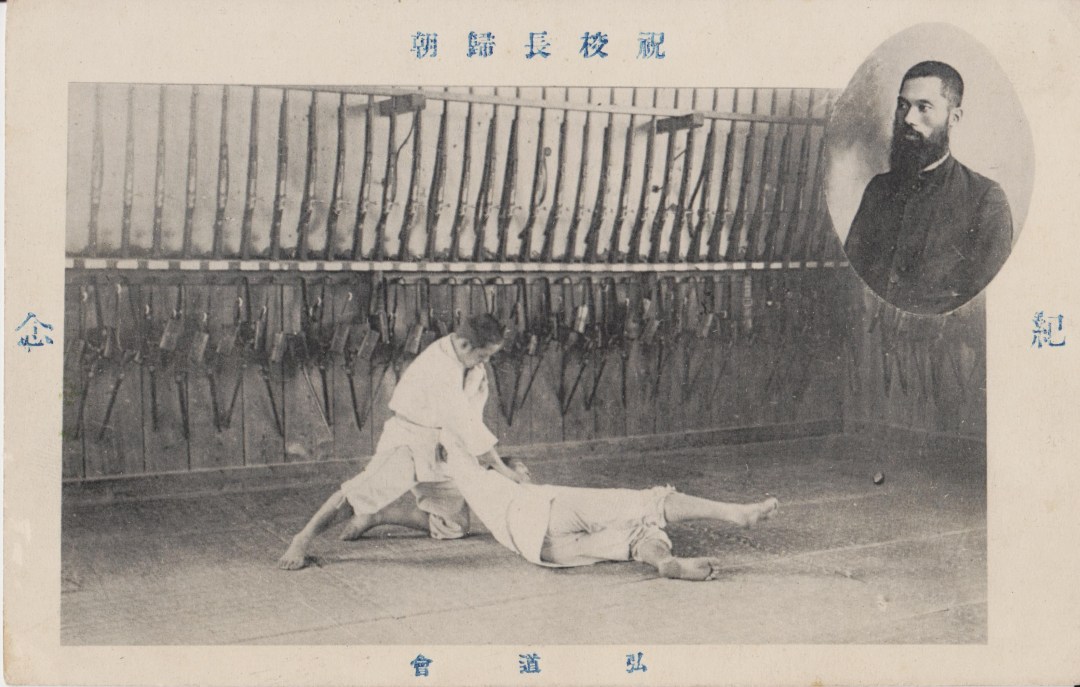
Rifles and bayonets for a school military drill class behind two Judo students. Vintage Japanese postcard, late 1930s. Source: Author’s personal collection.
Introduction
Greetings! If all has gone according to plan, I am now on a plane returning to the United States from Korea. I will be posting both my paper and a full report on the conference later. But first I need to head to Germany for the much anticipated Fightbook Conference which is being hosted at the German Blade Museum in Solingen. As such, I will be sharing a few more of the keynotes from the 2017 Martial Arts Studies in conference in Cardiff. And to tell you the truth….I think I recognize that guy….
All joking aside, I am pretty happy with the way that this paper turned out, and the conference organizers did a great job of integrating my slides into the video of my…
One of my few disappointments about the 2017 Martial Arts Studies conference was that a change in travel plans forced me to miss the final afternoon of the event. As such, I was not able to take part in the closing workshop which addressed a number of topics that are important to the emerging field of Martial Arts Studies. Of these the most basic would have to be, “How do we talk about our personal experience with these fighting systems in our academic studies of them?” Luckily this debate was just posted on YouTube, and I plan on watching Parts I and II on my flight to Korea.
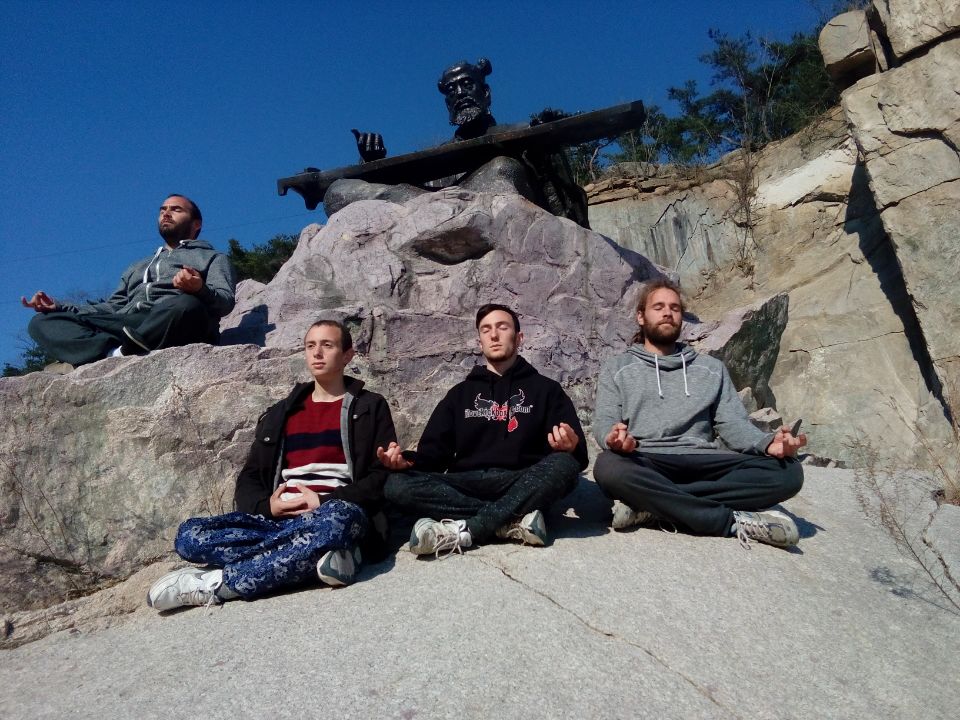
An experience to enrich the body and soul. The Academy is a great place to live and to learn; the masters are very supportive and the students are like family to me – it feels like a community of like minded people all pulling in the same direction. The location: the Shengjing Shan mountain is breathtakingly beautiful – the many temples and trails and walkways are very serene and tranquil. The surrounding towns can be difficult to navigate around so best to learn from fellow students but you’ll soon find your way around.
Learning a moderate amount of Chinese would be preferably before coming to China because hardly anyone speaks English. There aren’t any Chinese classes at the Academy but it shouldn’t stop you from learning – you’re in China! With language books and language apps you will be able to learn, it just takes time and discipline (luckily you’ll find both here at the academy). Don’t expect to learn in a classroom environment.
I found the accommodation satisfactory and as expected in rural china – you’re staying in a kung fu school, not a hostel. The food is good and again, you’re staying in a kung fu school, not dining out at a restaurant each night. Although there are some authentic Chinese restaurants nearby for special occasions.
Tips: bring cash with you and make sure you can draw money out of your debit/credit card as it can be tricky in China. If you have a problem, it will be difficult to go to a bank and find someone who speaks English. Download a VPN for your phone/laptop so you can access western sites and social media apps, if not, you may find speaking with family and friends back home to be quite difficult. It’s also good to have a hobby outside of training, some learn Chinese, some are working on their own books, some cook, some learn instruments, some just chill and watch movies, some do all of the above. It’s had a profoundly positive affect on me mentally and physically and I am mentally much stronger and more resilient.
“Nathan visited Shengjing Shan Kung Fu Academy for his experience. Others may go else where. Wherever you go whatever you choose to learn. For the majority that decide to learn kung fu in China it is life changing and a positive experience they never forget. For my part I feel blessed not only in helping people find the right school but get the most out of the experience. For the schools it is always my pleasure to send them quality students.” – David Kelly – StudyMartialArts.Org
One of my few disappointments about the 2017 Martial Arts Studies conference was that a change in travel plans forced me to miss the final afternoon of the event. As such, I was not able to take part in the closing workshop which addressed a number of topics that are important to the emerging field of Martial Arts Studies. Of these the most basic would have to be, “How do we talk about our personal experience with these fighting systems in our academic studies of them?” Luckily this debate was just posted on YouTube, and I plan on watching Parts I and II on my flight to Korea.
Introduction I am happy to report that all of the conference papers and book chapters I have been working on for the last month are now finished. Unfortunately, my blogging sabbatical must continue a little while longer. I am now preparing to hop on a plane for a few weeks of transoceanic travel and […]
Introduction Greetings from my short writing sabbatical! There are two subjects that have been on my mind. The first is Korea as I spent much of the day editing a 15 page conference presentation down to a svelte 7 pages for an event that will be held at Cheongju University in the first week […]
Introduction The “writing sabbatical” continues and I am happy to report that the book chapters and papers are progressing nicely. This weekend’s post comes to us from the early days of Kung Fu Tea, and it covers a topic that has played a central role in the creation mythology of many of Southern […]
Ba Duan Jin or Eight section exercises dates back to the Song Dynasty (960-1279). Ba Duan Jin is characterised by easy movements and impressive health benefits for practitioners that dedicated themselves to correct and regular practice.
Clinical tests undertaken in China have proven the medical benefits of Ba Duan Jin practice. These include improvements to the respiratory system, limb strength, flexibility of the joints and fortification of the nerves as well as overall enhanced balance. Improved cardiovascular function from consistent practice helps cure coronary artery scleroses and osteoporosis. Other benefits include strengthening the immune system and increasing overall longevity and vitality.
Origins and Development
“When practiced between one in the morning and noon Ba Duan Jin brings practicionares into harmony with the universe” – Gao Lian, Ming Dynasty Scholar (1368-1644)
Ba Duan Jin was traditionally practiced both sitting and standing. The standing being the easier and more popular of the two which where practiced.
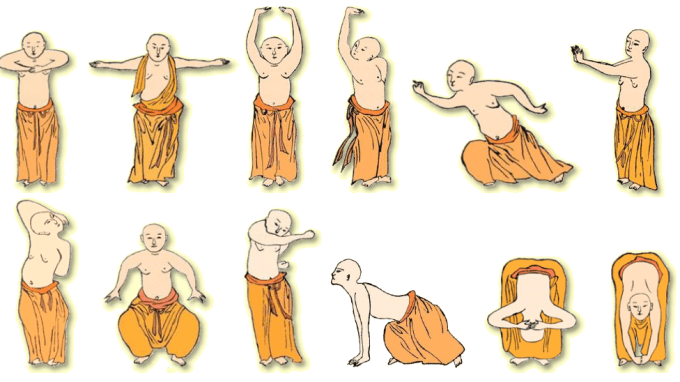
“Holding the with palms up to regulate the internal organs, and posing as an archer shooting both left and right handed. Holding one arm aloft to regulate the functions of the spleen and stomach, and looking backwards to prevent sickness and strain. Twisting the head and lower body to relieve stress, and moving the hands down the back and legs and touching the feet to strengthen the kidneys. Thrusting the fists and making the eyes glare to enhance strength, and raising and lowering the heels to cure various diseases.” – Newly published Health and Fitness Illustrations, Qing Dynasty (1644-1911)
The Development of Ba Duan Jin
The southern school is characterised by being primarily a gentler standing style while the northern school is characterised by being primarily a firmer sitting style. There is no one person credited with Ba Duan Jin’s creation. Instead it is more like to be a working health care exercise added to by specialists throughout the ages.
Characteristics
Chinese Health Qigong Association
Gentile slow smooth and consistent
In order to gain the maximum health benefits of Ba Duan Jin the movements should be gentle, relaxed and gracefully extending, on the basis of a well balanced stance. The flowing movements of the postures should be initiated by the spine to the extremities in a coordinated manner. Calmness and uninterrupted flow helps smooth the internal circulation of vital energy and improve the partitioners health and vitality.
Rhythmic combination of relaxation and strength, and dynamism and inertia
The relaxation of mind, muscles and joints is essential. The mind, should guide the breath gently in a relaxed state of being without compromising correct stance and posture. Stance and posture should gradually be deepened from the exterior to the interior.
Strength should be applied during the practice only for a moment between the end of the previous movement and the start of the next one.
For example:
with the hand movement in “Holding the Hands High with Palms up to Regulate the Internal Organs,”
the archer’s horse stance in “Posing as an Archer Shooting Both Left and Right handed,”
the one-arm lift in “Holding One Arm Aloft to Regulate the Function of the Spleen and Stomach,”
the head and hand movement in “Looking Backwards to Prevent Sickness and Strain,”
the horse stance in “Swinging the Head and Lowering the Body to Relieve Stress,”
the hand movement in “Moving the Hands down the Back and Legs, and Touching the Feet to Strengthen the Kidneys,”
the fists thrust in “Thrusting and Fists and Making the Eyes Glare to Enhance Strength,”
and the head movement and retraction of the toes and buttocks in “Raising and Lowering the Heels to Cure Diseases.”
Strength is required only for an instant, when changing movements; relaxation should be maintained at all other times. This gives a desired balance between Yin and Yang. When applying strength calmness should remain as the mind guides.
Combining Mind and Body to Cultivate Vital Energy
Mind in Qigong refers to one’s mental state, and how the movements are guided by thoughts. These must be combined and in harmony for best practice to occur. Harmony and symmetry should be seen within movements, sections, and the practice as a whole. When the mind, body and spirit is combined in practice profound inner strength can be seen outwardly in the form, which will display firmness and gentleness. In practice, spiritual cultivation and physical exercise combine to improve health and fitness. This is enhanced through deep natural breathing.



 Rifles and bayonets for a school military drill class behind two Judo students. Vintage Japanese postcard, late 1930s. Source: Author’s personal collection.