Chinese Martial Arts News

Introduction Welcome to “Chinese Martial Arts in the News!” Its great to be back at the blog. I am happy to report that the conference in Utah went very well and I had a chance to talk with a number of political scientists about the work that we are doing in Martial Arts Studies […]

via Chinese Martial Arts in the News: May 22nd, 2017: Wing Chun, Missing Ninjas and the Viral Fight — Kung Fu Tea

Do you give it your all in training?

via Finish On Empty —

Cheng Zongyou, Shaolin’s Martial Missionary

Introduction Few individuals have influenced our understanding of the martial arts during the late Ming dynasty more than Cheng Zongyou. His manuals provide historians a glimpse into a world of martial arts practice that is at the same time familiar and strange. His works describe an environment that is characterized by a […]

via Lives of Chinese Martial Artists (19): Cheng Zongyou, Shaolin’s Martial Missionary — Kung Fu Tea

A Duandao, Looting, and the Image of the Chinese Boxing in the West — Kung Fu Tea

What is it? The first question seems straight forward. This sword was purchased at auction a few years ago. It is a short saber, often called a duandao by martial artists. Its blade is just under 18 inches (46 cm) long, and its tang (broken at the end where the […]

via Three Questions: A Duandao, Looting, and the Image of the Chinese Boxing in the West — Kung Fu Tea

Jingwu and the Female Martial Artists of 1920 — Kung Fu Tea

Introduction I am interested in the frequent, seemingly unconscious, way in which the word “traditional” is appended to the name “martial arts” in modern speech and writing. One does not simply study “Japanese wrestling” or “Chinese physical culture.” From about the 1970s onward everyone became a student of the “traditional martial […]

via Research Notes: Jingwu and the Female Martial Artists of 1920 — Kung Fu Tea

Shuhari

Aikido master Endō Seishirō shihan stated: “It is known that, when we learn or train in something, we pass through the stages of shu, ha, and ri. These stages are explained as follows. In shu, we repeat the forms and discipline ourselves so that our bodies absorb the forms that our forebears created. We remain…

via Shuhari! — WHITE TIGER MARTIAL ARTS

The Boxer Rebellion and Stories We Tell about Chinese Martial Arts

benjudkins's avatarKung Fu Tea

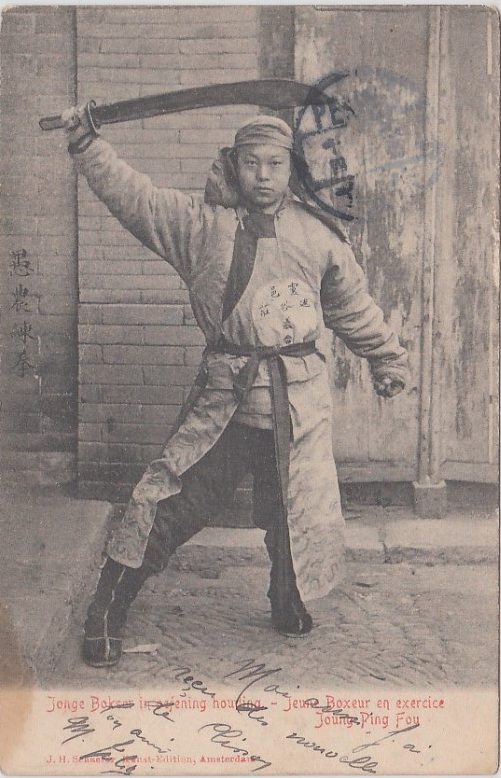
Vintage postcard showing a “Young Boxer” with sword. Early 20th century. Source: Authors personal collection.

Confronting the Boxers

It is probably an irony that I have written so little on the Boxer Uprising during my casual and academic discussion of the martial arts.  It was a chance encounter with the Boxers some years ago as I was exploring the connection between religiously generated social capital and violence that first convinced me to take a closer look at the Chinese martial arts as a possible research area.  Still, it has been a slow return to a case that first inspired me.

There are multiple reasons for this.  As my research progressed I found myself more drawn to the Republic period.  The ill-fated Boxers of Shandong sit as a perpetual prologue to most of the questions that I ask.  Further, my practical interests in Wing Chun led me to focus on Guangdong…

View original post 4,793 more words

Iron fist – The flowerie Kung Fu technique

I’ve just watched all the episodes of Iron Fist on Netflix and I think it was average to good. I liked it but it’s definitely not my favourite of all the Netflix Marvel shows. I’d place it above Luke Cage and below Jessica Jones for me – Daredevil is still my favourite. I don’t really […]

via Iron Fist – the flowerie Kung Fu technique! — CheekyChi

Infinite Dao – 偶识太极 Taiji by Chance

Extracts from Patrick Kelly’s book ‘Infinite Dao’ Chapter 1. (Part 1)

偶识太极 Taiji by Chance

我按师傅的建议研读了中华武术类书籍后逐渐意识到,禅宗的基础是折合佛教与道教于一身的禅(中国佛教),而某些更深层次的东西更有可能在中华武术(日本武术的基础)中找到答案。那个年代并没什么教授中华武术的课,但碰巧当时有名中国学生要在校园开个小型武学班,我听说后就起来转学的念头。对此,我的空手道老师鲍勃·麦克鲁姆毫不反对,这为我的修行之路开了一个好头,对他的支持,我也毕生感激。就在那一年,没什么练习经验的我,带着从神学图书馆书本里领悟出来对内修的那点理解,坚定地踏上了灵修之路。With that information in mind and after investigating the martial arts of China as advised, it became apparent that some deeper inner content would more likely be found in these Chinese arts (which were of course the basis for the Japanese Arts). I understood also from my reading that Zen was based on Chan (Chinese Buddhism) which was itself an eclectic mix of Buddhism and Daoism. Though classes in the Chinese arts were rare, seemingly by chance I heard that a Chinese student was about to begin teaching a small class of some such art at the university. I informed my Karate teacher, Bob McCullum, of my decision to change. He was fully understanding about it and I was forever thankful for the start he had given me. That year, with its inefficient practices and minimal inner-understanding gleaned from the books in the Theosphical Library, had nevertheless set my feet firmly on the Way.

Beginning Taiji

1973年我开始学习太极。虽然我当时并不明白太极是什么,但我相信它能助我在灵修上取得进步。我的太极师傅姓周,他的父亲是马来西亚古晋人。我后来才知晓师傅的父亲曾是黄大师训下的一名资深弟子,其实黄大师当时就住在古晋。只上了一节太极课,我就知道这是门更有深度的学问。最初课堂上只有三名学员,上课以普通话进行,学习的内容包括:松身五法,短式太极和长式太极,以及基础对练(太极推手)。So in 1973 I began Taiji, not knowing what it was. I only trusted that through it I could travel a little further on the path of inner evolution. It transpired that the teacher, Mr Choo, was the son of one of Master Huang’s senior students from Kuching, Malaysia, where Master Huang, unknown to myself at the time, was then living. From the first class I sensed that this was a teaching with more depth than I had met up until that point. Initially there were just 3 students in the class. We were taught in Mandarin, learning the 5 Loosening Exercises, the Short Taiji-form and Long Taiji-form and the basic two person exercises (Taiji Pushing-hands).

Mr Choo

19731974年,我都在跟周先生学太极,1974年我也终于完成了数学学位的学习。只可惜周先生自己也不过是个只有六七年太极经验的年轻人,所以一段时间之后,他对我就已经教无可教。我急需一个有长时间深度修行经历、经验丰富之人,一个能为我答疑解惑的指路人。为了更高层次的学习,我开始做长期计划安排,准备拜访生活在马来西亚的黄性贤大师。I continued to learn from Mr Choo throughout 1973 and 1974, while finally completing my degree in pure mathematics. Although the art of Taiji gave me a beginning, still Mr Choo was only a young man with 6 or 7 years’ Taiji experience. It became apparent after a time that the art was not enough in itself. I needed someone with long and deep experience on the path of inner development whom I could trust to answer my questions and guide me on the path. I began to formulate some long range plans to visit Master Huang Xingxian in Malaysia in order to continue my training towards the deeper levels.

pk2web克利 Patrick A Kelly

began Taiji with an experienced student of Master Huang Xingxian in 1973. In 1977 he moved to Kuala Lumpur, Malaysia where he studied full time in Master Huang’s school. In 1979, following tradition, Master Huang accepted Patrick as his personal disciple – the only non-Chinese to ever enter Huang’s inner-school. From that time Patrick Kelly travelled and taught beween Asia, Australasia and Europe while continuing to learn personally with Master Huang untill his death late 1992. Simultaneously Patrick worked closely both with the Naqshibandi Gnostic Sage Abdullah Dougan for 14 years until Abdullah’s death in 1987 and for 30 years with the Raja Yogi Mounimaharaj of Rajasthan who died in 2007 at more than 105 years old.

1973年,派瑞克利开始向黄性贤大师的一位资深学生学习太极。1977年,他来到马来西亚吉隆坡,在黄性贤大师的学校全日制学习太极。1979年,遵循传统惯例,黄性贤大师收派瑞克利为徒,他成为了黄性贤大师唯一的非华人入室弟子。自那时起,派瑞克利往来于亚洲、澳洲及欧洲教拳,同时继续私下向黄性贤大师学习,直至大师于1992年末去世。同一时期,派瑞克利还跟随纳什般迪派和诺斯替派哲人阿卜杜拉多安学习十四年,直到1987年阿卜杜拉去世,跟随拉贾斯坦的胜王瑜伽大师穆尼玛哈拉吉学习三十余年,直至穆尼大师在2007年以105岁高龄去世。
The Spiritual Path of Budo and Zen

by Ken Jeremiah Studying the martial arts is a spiritual pursuit, but at the beginning, students rarely understand this. They see everything in black and white. There are no shades of grey. Techniques are nothing more than devise used to control or injure another, and many practitioners do not progress beyond this point. They throw…

via The Spiritual Path of Budo and Zen [Video] — Tambuli Media