Part of my job at StudyMartialArts.Org involves visiting and reviewing martial arts schools. I take this responsibility very seriously. Only by actually visiting the schools and taking part in the training can I genuinely say I know the schools, masters and the training. This means that each year, I pack my bag and set of to visit both new schools and revisit existing schools. This weekend I visited my friend Shifu An Jian Qiu in Dezhou at his new school.
Setting off early Saturday morning I boarded the fast train to Dezhou from Beijing south railway station. The journey to Dezhou along the Jinghu High-Speed Railway that links Beijing to Shanghai takes 1.5 hours. Trains on the Jinghu High-Speed Railway line travel up to 300km per hour so be-careful not to miss your stop!
This was my third visit to Dezhou. The first was in the summer and the second in winter during Chinese new year. The last time I’d been to the school was almost two years ago so I was excited to see the new school and the progress he’d made. An Jian Qiu runs and manages a traditional family kung fu school steeped in hundreds of years family tradition and history. There are very few martial arts schools remaining like this in China that are as easily accessible to western students. His school offers full-time and part-time classes to both Chinese and International students. International students attending the school are primarily taught by An Jian Qiu or his father. An Shifu’s school caters to both short and long term students providing accommodation and food on site. All-inclusive training package range from 6700 rmb per month on a sliding scale depending on how long your stay.
An inside scoop that I’ve brought back for our readers is that Jian Qiu is planning to offer intensive and training camps in Xingyi and Bajiquan next year for instructors and experienced martial arts students. These are likely to be scheduled at either end of the summer. A two week Xingyi quan training camp around June-July and a month long Bajiquan training camp during August. For further information you can email me david@studymartialarts.org – The sooner I hear from you the better the early bird discount I’ll be able to secure for you. Another interesting opportunity discussed over the weekend with Master An were his plans to accept an experienced trainee instructor(s) who would be willing to commit 1+ years, and become one of his long term disciples. If accepted you would be expected to help him teach and manage his school in exchange for free accommodation, tuition and food.
Over the coming month I will be helping Jian Qiu with these plans and assist him in his search to find a disciple(s) and trainee instructor(s) so stay tuned or email me for further information.
A warm Dezhou welcome (Sharing a meal with An Shifu, two of his students and a number of representatives from Dezhou martial arts community).
In all martial arts, many students will one day ask themselves:
“Is practicing forms important for real fighting? Should I just be performing drills, or sparring?”
The answer to this is not a simple yes or no because it depends on how you practice your forms:
Do you let your mind wander, or are you incredibly focused?
Do you ‘take it easy’ and treat it as a warm-up, or are you challenging yourself each time with deep stances and powerful movements?
Are you just ‘following the motions’, or do you have a specific goal in mind?
At An Wushu, we believe form training done correctly is incredibly important for developing your kung fu:
Forms develop what we call your ‘kung fu body’. Strength and endurance are a very important part of kung fu, but can be developed by many activities; the specific attributes you need for perfecting your kung fu, however – such as flexibility, timing & chi skills – can be best developed through forms
Forms teach movements in a logical sequence (e.g., “Strike… if they block, then you do this”) and create useful muscle memory*
If you practice your forms the way you fight – with spirit, power, and accuracy – then you’ll fight the way you practice your forms
*Many students are also curious about the applicability of ‘grander’ movements, such as flips, spins, kicks and so on. There are a few schools of thought on this:
In years past, it was not uncommon for future masters to be taught incredibly slowly, often learning a single form over five years! If you have practiced a movement 100,000 times or more, you will definitely be able to use it in combat – even if it is perhaps not as efficient as it could be
Many movements are taken to their extreme to better develop the body: e.g., if you train with your horse stance at parallel, spending minutes then hours in this position each day for many years, your legs will become incredibly strong. If you only stand at ‘fighting height’ for these years of training, you will miss out on this strength.
In some styles, there are moves that are simply not meant to be used in combat, e.g., backflips, and are simply there to develop the body of the practitioner. Similar to Point 2, if you spend years training backflips, you will have much more explosive muscles and better co-ordination than if you didn’t. (Note: There are no movements like this in An Wushu, however, as part of a complete training system this is a great way to train.)
Much of the power generated in kung fu is difficult to do in a small way until you can do it in a big way: e.g., even a beginner can sharply twist their body, push off their heel and throw a strong ‘cross’ punch (albeit at the probable cost of their balance). But if they limit their twist to only 1-inch, can they generate power? The answer is no. By starting with an over-exaggerated movement, a beginner is able to gain the internal feeling needed for any movement and gradually refine the movement to its usable form.
So, is practicing forms important for real fighting? As with anything in kung fu and in life, you only get out what you put in.
To learn more about An Wushu or how to study with Master An full-time in China visit www.StudyMartialArts.Org we work exclusively to help dedicated students connect to quality martial arts schools. This includes visa assistance and independent information all at no additional cost to you. Check us out with no obligation.
Thanks to my wonderful colleagues at StudyMartialArts.Org, I’m able to share this list of full-time Martial Arts School Reviews. Click the link and you’ll be able to compare and contrast Martial arts schools based on student reviews, price and StudyMartialArts.Org’s independent assessment.
Below you’ll find a list of schools that currently have the most reviews on the www.StudyMartialArts.Org website. Please note that after 5 page views you’ll be asked to login to the site. This is easy and nothing to worry about. If you find the site useful and want to learn more contact StudyMartialArts.Org for a full consultation on schools, training and travel. The consultation service is free and there is no obligation. However, to keep the service free, make your booking through them. Booking through SMA is the smart thing to do as it affords students who use there service two essential things that should give you piece of mind.
Firstly, you get extra support!
And secondly schools are less likely to bullshit you or rip you off.
A comprehensive list of martial arts schools and masters reviewed by students and experts.
Here are some links to schools which have either been reviewed by students directly or have been collected to provide site users more information to help you narrowing your choice down.
Tianmeng Shaolin Kung Fu Academy primarily focuses on teaching the traditional Meihua Quan (Plum Blossm Fist) which has both internal and external elements. In addition to Meihua Quan, Shaolin Kung Fu, Qigong, Qin Na, Tai Chi, Xingyi, Bagua, are also taught here. The school itself is relatively new and it has all the facilities that students will require to build a solid foundation in Martial Arts or reach higher levels. The school is unique for Meihua poles and Meihua training methods. These are designed to impove balance, internal power and footwork in a very short time.
Master Chen Fusheng’s Martial Arts Academy is located in Lixian Zhen, Daxing District of Beijing. Here you will learn traditional Bagua, Bajiquan, Pigua, Qi gong, Tai Chi, Tong Bei, Gong Li, Xi Yang Zheng, Hei Hu, Xingyi and Praying Mantis. Master Chen will teach you the best aspects of each of these styles for combat as well as his own Qi gong and fighting style Ba Ji Zhan Dao this is translated as Baji Battle Way. Master Chen has a vast wealth of knowledge in traditional martial arts and also in martial, healing and longevity qigong.
Rising Dragon Martial Arts School is location in Yongping county in Southern Yunnan Province. Yongping County is a very mountainous region which borders Myanmar, Laos, and Vietnam and has an average altitude of 1980m. YongPing has a population of around 170,000. and is located roughly in between the two Cities Dali and BaoShan, which are both no more than an hour’s drive away. The area is steeped in history with numerious temples, senic areas, mountains, lakes and even natural hot springs to visit.
Kunyu Mountain Shaolin Martial Arts Academy is a popular and long running International Kung Fu Schools in Shandong Province. Located in a beautiful rural setting on the edge of the Kunyu Shan National Park the school offers students of all abilities the chance to learn Shaolin Kung Fu, Taichi, Qigong,Wing Chun, Xingyi, Bagua, Baji, Northern Praying Mantis and Sanda.
Kunlun International Martial Arts School is a traditional Chinese kung fu school in rural Yantai. The school adjoins and uses the facilities of an ex-military base so as a result has excellent facilities. The school employes translators and has support staff in Yantai City. The School specialises in Seven Star Praying Mantis Boxing, Plum Blossom Praying Mantis Boxing, and Throwing Hand Praying Mantis Boxing as well as traditional Shaolin Kung Fu, Qi Gong and internal styles such as Bagua, Chen Style, Tai Chi and Xing Yi.
Wudang Hongdao Kung Fu School’s lineage comes from the Xuan Wu Sect of Daoism and is located near Zhong Guan Temple on Wudang Shan. Situated on the Mountain and with training taking place in and around the temple. The school offers a unique experience and the chance to study martial arts as well as study the healing arts of internal alchemy, qigong on herbal studies. Students should have some level of Chinese and knowledge of TCM to get the most out of their healing arts studies. Part of their studies will involve finding and identifying various mountain herbs for the Zhong Guan Temples daoist monks as well as learning about their uses.
Lion Muay Thai is Phuket’s fastest growing Muay Thai camp offering students an opportunity to learn a new martial art, get fit and have fun in the paradise island of Phuket. Nestled amongst lush greenery in an area called Rawai the camp offers seclusion without being too far away from the local amenities. Students who attend this school include seasoned fighters and beginners. This is because the gym caters to every need. As a result students may get a chance to train alongside or rub shoulders with world champion fighters who appear on international fight shows and work with some of the best trainers in Thailand.
The Kung fu School, China offers Sanda, Shaolin Kung fu and Taichi quan intensive martial arts training. All this is provided by an equally intensive master. Master Wang Xinglong is a 32nd generation disciple of the Shaolin Temple. At the age of 12, he joined the Shaolin Temple and studied traditional Shaolin martial arts under the 31st generation disciple, Master Shi DeQian. At the school students should expect to train 8 hours each day, five days per week. All skill levels are welcome at the school and each student gets personalised training where Master Wang Xinglong considers your skills, strengths weaknesses, preferences and goals. Progress is solely determined by the effort you put in and your ability to learn and practice the skills.
The Maling Shaolin Kung Fu Academy is located in Xingyi City in Norther Jiangsu Province. Headmaster Bao founded the school recently, having previously been training international students at other academies. He has set up a fantastic place to train and live, where students can learn 7 different styles of Chinese martial arts. The main style is of course, Shaolin Kung Fu, although you can also learn Baji Quan, Tai Chi, Xingyi, Qigong, Sanda (Chinese kickboxing) and Bagua.
Yangshuo Taichi School was the first registered International Taichi and Kung fu training School in Yangshuo. The school is located in a tranquil and truely stunning location a bike ride from Yangshou. The school headmaster, Master Huang is a National Taichi Champion who is enthusiastic and dedicated to teaching Taichi as a martial art, as a healing art and also a philosophy.
Qufu Shaolin Kung Fu School is a medium sized Shaolin Kung Fu school that has a freindly and welcoming feel. A perfect alternative to the often overly busy and inpersonal Shaolin Kung Fu Schools located in and around Dengfeng. This school is located on the outskirts of Qufu City, the birth place of Confucius and was founded in 2008 by 34th Generation Shaolin Warrior Monk Master Shi Yan Jia. Although the school is not located in and around Dengfeng it is one of only a few that have been given the seal of approval by the venerable Shi Yong Xin Head Abbot of the Songshan Shaolin Temple in Henan. This is a direct result of the Schools links to the Shaolin Temple’s Warrior Monk demonstration team.
Songshan Shaolin Traditional Wushu Academy is located inside the Original Shaolin Temple in Henan Province. The Shaolin Temple is was included in the UNESCO’s World Cultural and Natural Heritage List in 2010. And training at this school will uniquely allow you access to this amazing iconic cultural site. Indeed the training grounds of the school are located in areas where Temple monks train regularly.
The Yuntai Mountain International Culture and Martial Arts School was founded by Shi Yan Lin, a vastly experienced Shaolin Kung Fu master who teaches both Chinese and international students. The Martial Arts training at the school will primarily focus on the various Shaolin fists and weapons as well as Sanda and Taichi. In addition to the Martial Arts training the school also offers students the opportunity to study Chinese in combination with their martial arts training. The school itself is located in the famous Yuntai geological park, which attracts thousands of tourists every year. This area is widely regarded as one of the most beautiful place in Henan Province.
Zen Martial Training is located in Les Mamelles. The school offers authentic Chinese traditional martial arts with traditional Asian healing arts along with the combat sport of Taekwondo. The head instructor of the school has over 20 years of experinece in competitive martial arts and has lived and studied martial arts in China for over 6 years. The Head instructor of the school speaks, Chinese, English, Spanish & French and is certified as a Yue Jia Quan Master, has a 5th degree belt in Mantis Fist, 3rd Dan in Taekwondo and is certified in acupunture and herbalist.
I’m continually being asked which VPN I use to blog use, access youtube, facebook, all the other commonly used social media sites. I always tell them ExpressVPN. Having trailed all the brand leaders Express is still the most consistent. And now they have improved ExpressVPN further. Here is how.
ExpressVPN’s New Device Policy Means More Connections and Less Restrictions
ExpressVPN is excited to announce a new subscription policy, which allows for up to three simultaneous connections.
Users can take advantage of the new policy by securing any three Internet-enabled devices concurrently, without needing any additional subscription plan.
ExpressVPN’s change of terms is a bespoke response to the Internet-thirsty demands of today’s society. The days of a single shared PC at home are long gone, and many of us access the web on a host of different devices.
That’s why ExpressVPN has made it even easier for you to remain private and secure across every platform you use. The new policy will help ensure the Internet privacy and security users have come to know and love.
ExpressVPN Offers the Connections, You Choose the Devices
If you want to browse securely and simultaneously on your iPad, Android, and Mac — No problem. How about Windows PC, iPhone, and AppleTV? — No problem. Three PCs at once? — No problem!
You get the picture: Surf securely anywhere, anytime, on anything.
Privacy advocates can rest easy knowing ExpressVPN is continually looking for ways to improve an already best-in-class service.
For users who wish to use ExpressVPN on more than three devices simultaneously, additional subscriptions will be required.
In China dedicated martial arts students who plan to make the most of their time generally fall into two categories.
Type A – You’re a martial arts student in China and you’ve reached a level where in order to further develop your understanding and skill as well as make your life easier you’ve got no choice but learn the language.
Type B – You’re a Chinese language student who’s always been interested in martial arts but has yet to take the step into training. But things have finally come to a head and you’ve had enough of conversations about where you’re from, how much you earn and whether you like Chinese food, girls or football.
Chances are a few of you reading this post have had at least contemplated at least for a second combining martial arts with language learning.
You might have considered the following options. A university course with a certain amount of martial arts training, finding an elusive badass master and informally studying the language or by joining one of the many international kung fu schools and taking their free classes.
The benefit of combining martial arts and language learning can be found in the practical skills you learn that not only add to the experience but also your CV. Indeed such a step can take many in completely new directions abound with opportunities for the wily foreigner. Overall these programmes allow participants the opportunity to develop their martial arts and deepen their own understanding of Chinese culture and language.
“It’s a unique way to study with a high level master outside the normal international kung fu school route as that all important Chinese visa can be provided relatively cheaply through a University.”
Find a badass kung fu master
This video clip above was taken in Yantai, Shandong province.
Yantai is a small second tier Chinese City on the northeast coast of China. It has cheap housing and has a good environment. Yantai is famous for a number of kung fu styles including Taichi Mantis, Tongbei quan, and Baguazhang. Locally with a little care you can find good masters. The city itself is a hot bed of kung fu schools and is well worth a look.
“Yantai is a hot bed of kung fu schools and masters on the east coast of China”
For details of our Traditional Martial Arts and Language Learning programmes in Yantai email info@studymartialarts.org. You can also check out Master Sui’s full biography and training schedule here. Or you can have a look at this school Kunlun International Kung Fu School which has links to Ludong University in Yantai for long term visas and currently has a very good Shaolin Kung Fu and Mantis Kung Fu master that you can study martial arts with.
Two alternatives that may be more suitable for those who are less independent or would prefer an all-inclusive experience are The Yuntai Mountain International Culture and Martial Arts School founded by Shi Yan Lin, also known as Xie Xu Yong. This school is the only martial arts school currently offering a quality half day martial arts and half day language learning programme. The other option I would recommend is Capital Sport University of Physical Education in Beijing.
Yuntai half and half programme
Master Shi Yan Lin is a master with over 10 year experience in teaching to both Chinese and International students Shaolin Martial Arts. The school is located in the famous Yuntai geological park, which attracts thousands of tourists every year and is fairly close to the fabled Northern Shaolin Temple. The Martial Arts training at the school will primarily focus on the various Shaolin fists and weapons as well as Sanda and Taichi. The school building formally a hotel has been converted into student accommodation, as a result the rooms are comfortable and comparatively of a high standard. The newly built training area and performance hall is five minute walk from the main accommodation area, so everything you need is close at hand.
The Chinese language course organised as part of the half martial arts, half language learning programme is available in partnership with Jiaozuo University. These courses can be specially tailored and intensive. This, makes the school a very real prospect for serious Chinese language learners. This close relationship between the martial arts school and the university means that long term student visas can be obtained for long term International students of the school.
The down side to the programme primarily relates to the schools relative isolation and the management insistence for compulsory school line ups throughout the day. Sometimes this can make students feel like they’re prisoners rather than students.
University Programme
Captial University of Physical Education & Sports is one of Beijing’s premier Martial Arts Training Universities providing top-ranking conditions for international and domestic students. The university is supported by Hanban and Confucius Institute offering Chinese Language Learning Programs, Martial Arts University Programs, TCM, Sports & Health Care Programs.
The University offers the following programs; 4 Year Undergraduate Programs, 3 Year Master Programs, 3 Year Ph.D Programs, 1-2 Year Non-degree Programs and Short-term Programs.
The Universities Featured Programs are:
1. Chinese Language Programs The University employs a special team for teaching Chinese as a Foreign Language. This team is specializes in training international students who want to learn Chinese Culture and speak the Chinese Language. Class sizes are smaller than other universities and attention and help given to students is higher than at other Universities. Thjs helps to ensure that students acquaire the language competences sufficent for their speciality studies in China. Small classes of differnt levels are provided as well as one-to-one teaching to meet students needs.
2. Martial Arts Programs According to the period of study students can expect to study martial arts from martial arts champions who are experienced in both teaching and competitions for performance and also sport.
3. TCM Sports Health Care Programs
The instructor for this program is Ru Kai an assistant professor of Sports Rehabilitiation Department of Schools of Sports Science and Health. He is also the successor and master of Xisui Neigong, Baduanjin and Yijinjing.
One of the main benefits from studying Mandarin at Capital Sports University is obviously the facilities, access to top coaches plus relatively small class size for language learning.
If you would like to learn more about studying martial arts and learning Chinese check out these great articles.
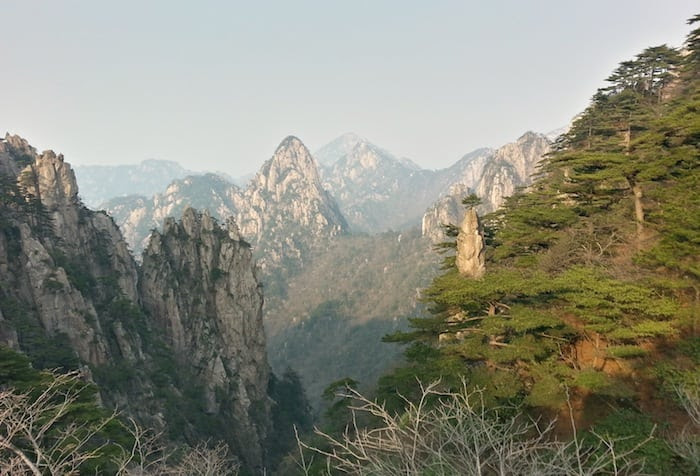
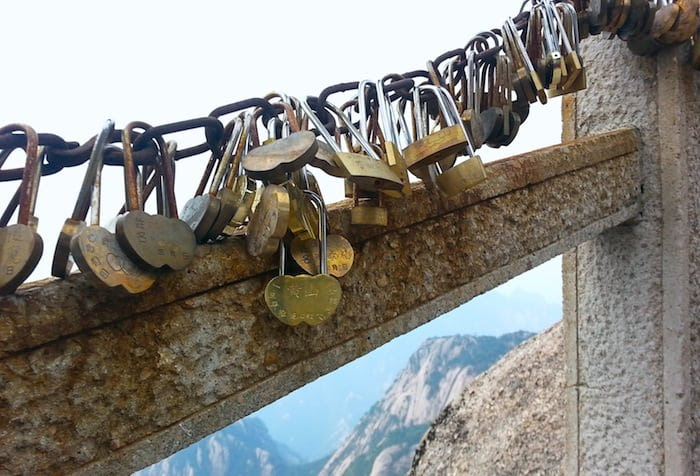
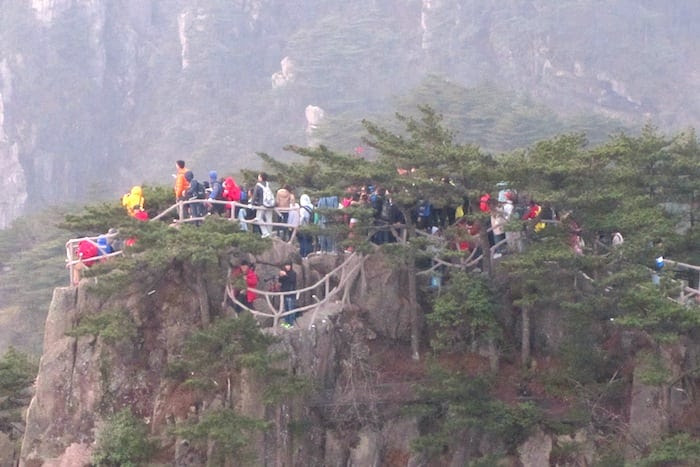
The Yellow Mountain (Huang Shan, 黄山) is among the most visited and notable mountains in China. For those looking for a unique natural landscape and don’t mind having to compete for it with swarms of other tourists, this is the place for you.
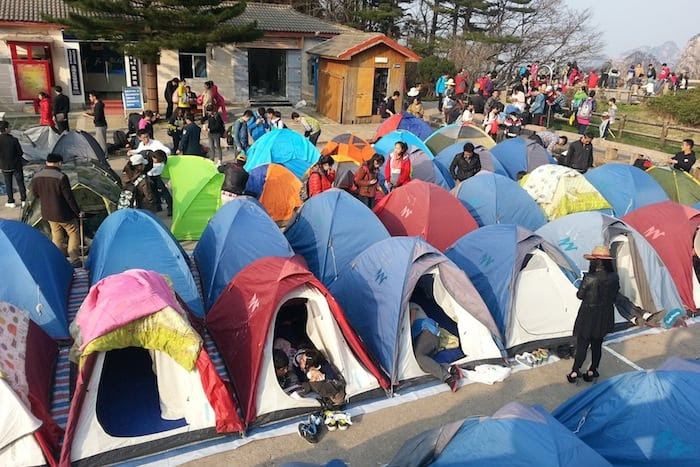
You might have to use the new martial arts skills you’ve been learning at your Kung Fu School in order to fend off the other tourist that will be fighting for rooms and places to stay on this mountain. This is not a joke nor an exaggeration. Tensions can get pretty high over the last rooms when the alternative could be a cold sleepless night on this huge rock.
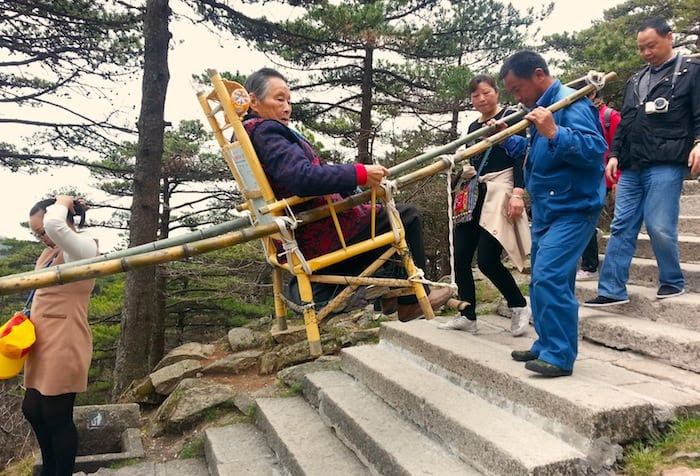
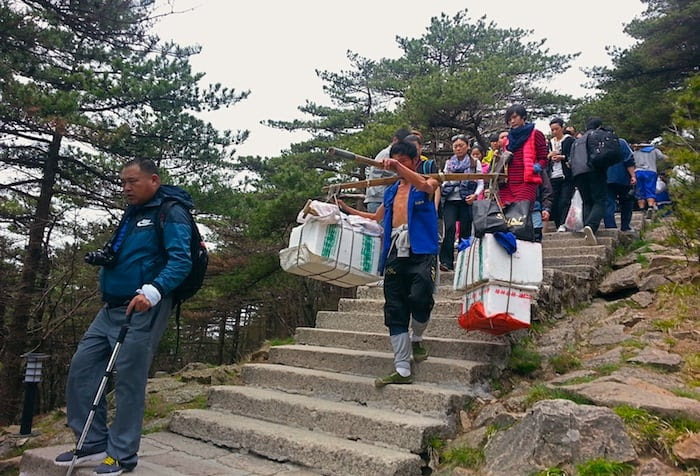
Once your rooms are secured you have two options to get to the top of the mountain. The first is to hike up the mountain stairs. This is the best way to get a good view of the landscape. The other is by Cable Car. The earlier you get the cable car the better. It’s not unknown for their to be kilometre long lines of people even at the break of dawn. If you successfully get on the cable car, expect more hiking.
Once at the top book into another hotel (this should be done in advance). That way you can relax and enjoy both sunset and sunrise the next day. In terms of the hotel quality, expect them to be overpriced, and rough. Prices range from 200 rmb to 1,000 rmb. For the 200 rmb range think refugee camp conditions.
To avoid disappointment I’d recommend you plan to visit off season, defiantly not on a Chinese holiday. Pre-buy and take with you any expensive food items. Whether expensive snacks or a cheeky bottle of rice liquor everything will be way more expensive at the top.
Huangshan, is a mountain range in southern Anhui province in eastern China. Vegetation on the range is thickest below 1,100 meters, with trees growing up to the treeline at 1,800 meters. Wikipedia
Address: Huangshan, Anhui, China
Elevation: 6,115′
Highest point: Xuelian Feng
Province: Anhui
Country: China
Phone: +86 559 558 0033
Listing: Ultra-prominent peak
Mountains: Tian Du Feng, Xuelian Feng, Guang Ming Ding
Plan ahead, check the weather and make sure its off season.
Book your accommodation in advance
Expect lots of people and cues
Bring your survival and luxury rations
Expect things to be more expensive
How to get to Huang Shan
Huang Shan is located in the western part of Anhui province. Below are a couple of options by train from either Shanghai or Beijing.
Shanghai (5 hours on the G1509, leaving in the morning at 8.27);
Beijing (there are fast trains from 8 in the morning to 15.30, and the trip lasts a little under 7 hours) and on the same line, Tianjin;
From the city of Huang Shan, where long distance options arrive, shuttles depart for Tangkou (汤口), adjacent to the entrance to the Park, at the foot of the mountain. If you choose to climb on foot, the climb starts at Tangkou. If instead you’re going for the cable cars, there are shuttles that connect directly to the station, airport and the city of Tangkou obviously. These city buses don’t cost more than 20 Yuan for the longest trip. Even taxis and tuk tuks are available if you arrive from the airport or station, but to get to the cable cars you can only use designated buses.
Hua Shan has 5 peaks, the deadliest of these is the infamous Plankwalk. For those looking for a unique and frightening challenge while taking some deserved R&R from kung fu training this is for you.
Arriving in Huayin (the town at the foot of the mountain) the day before is advisable. That way you can get a rest the night before. Do make sure you book because this place gets busy.
Once your room is secured you have two options to get to the top of the mountain. The first is to take a 6 hour hike up the mountain stairs. This is the best way to get a good view of the landscape. The other is the new West Cable Car (140 RMB/pp each way, $22 or 100 RMB/pp with student car, $16) the earlier in the morning the better. If you successfully get on the cable car, expect a further 4-6 hours of hiking.
To avoid disappointment I’d recommend you plan to visit off season, defiantly not on a Chinese holiday.
Plan ahead, check the weather and make sure its off season.
Book your accommodation in advance
Expect lots of people and cues
Bring a change of underpants
What to expect from the Plankwalk
‘During the actual walk you are walking across a narrow plank walkway nearly 5,000 ft in the air after all during the least intense part of the hike. The remainder of the trail is composed of iron rods protruding from the mountain, small cut outs in the actual rock for your feet and/or chains for gripping yourself close to the mountainside.
The path itself is TWO-WAY traffic for the entire day, which means you are sharing an already extremely treacherous path with limited space often. You will be required to move your harness over other hikers heads and step on the outside of them, sometimes only having room for one foot to stabilize. It gets especially tricky when sharing either of the ladder areas and/or cliff cut outs, as they have even less real estate to offer. (http://blog.unboundly.com)’
You owe it to yourself not to be the drunken foreigner and more importantly the wrong type of drunken foreigner and let yourself down. Remember the purpose of your journey is to Study Martial Arts. Heavy drinking won’t help you reach your aims and objectives and may cause you, your hosts or school and Shifu to loose face (embarrassment).
Drinking in China and smoking is common place. With cheap alcohol and cigarettes everywhere, this is not the best place to run away to if you want to change these bad habits. This must start at home.
Most social drinking in China is primarily associated with eating. Most drinking takes place around the dinner table and meals as a way to cement relationships and do business. As a topic this subject could easily have a series of blog entries but that will be a story for another day.
Here are my top 5 tips for surviving drinking in China in brief.
1. Showing respect when drinking is probably one of the first things someone will explain to you. When drinking tea or when drinking alcohol with a superior clink your cup/glass lower. Its super simple and easy to remember. But its much appreciated by your elders, fellow guests, shifu’s. The rest of the customs and rules need not be learnt straight away and are things you’ll pick up on or learn as you go. As a foreigner you’ll not be expected to know them or everything.
2. When inviting or being invited out for dinner or meals in China. The standard rule of thumb is usually the inviter pays unless stated otherwise.
3. When drinking follow the lead of others at the table in terms of speed quantity and times. Whatever you do avoid mixing baijiu and beer. You should remember drinking in China can start very slowly but once the individual toasting starts it can be rapid and all those small cups will start catching up on you especially if you’ve insisted on drinking out of turn.
4. If you don’t want to drink have an excuse prepared in advance or warn your host of this. Excuses related to health tend to be the best. Having tried many over the years these where best received by hosts and guests. If you’re not going to be drinking much but still want to show respect have tea ready in your cup and don’t empty the cup (ganbie) just drink as you wish (suiyi).
5. Eat, eat and eat. Show appreciation and be a good guest.
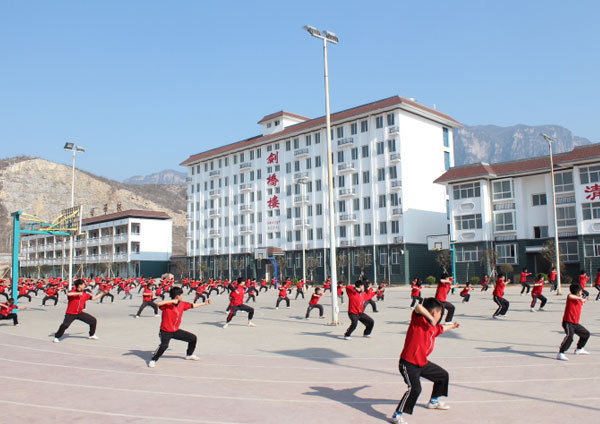
An Wushu International Martial Arts School is a kung fu school steeped in family tradition. Located in Prefactured City of Dezhou within Shandong Province the school is just two hours from the capital Beijing by fast train. Dezhou and the School is therefore easily accessible for those wishing to experience traditional Chinese martial arts training.
The school offers both full-time and part-time classes to both Chinese and international students with the international students primarily being taught by An Jian Qiu.
Teaching at the school takes place in a picturesque setting and there is both indoor and outdoor facilities. This school offers a warm welcome to those who are serious about studying martial arts and learning about Chinese culture. Recent improvements to the school mean that it can cater for long term students providing both accommodation and food.
This modern wushu form in the video below was created by Jet Li in 1989 and is based on one of his favourite poems Man Jiang Hong.
Mǎn Jīang Hóng (满江红; literally means All are red in the River) and it is the title of a set of lyrical poems sharing the same pattern. If unspecified, it most often refers to the one normally attributed to legendary Song Dynasty general and Chinese national hero Yue Fei.
Man Jiang Hong
My wrath bristles through my helmet, the rain stops as I stand by the rail;
I look up towards the sky and let loose a passionate roar.
At age thirty my deeds are nothing but dust, my journey has taken me over eight thousand li
So do not sit by idly, for young men will grow old in regret.
The Humiliation of Jing Kang still lingers,
When will the pain of his subjects ever end?
Let us ride our chariots through the Helan Pass,
There we shall feast and drink barbarian flesh and blood.
Let us begin anew to recover our old empire, before paying tribute to the Emperor.




 SMA bloggers