Fit Is Not Healthy: A Shaolin Monk’s Guide To Exceptional Wellness — shifuyanlei

In the age of social media, many people train for a body they perceive looks attractive to other people. When I was training at the Shaolin Temple, we didn’t even have a camera. Nothing was documented. We trained to conquer our mind and body and become the best we could in our chosen art form. Since […]

via Fit Is Not Healthy: A Shaolin Monk’s Guide To Exceptional Wellness — shifuyanlei

Rules

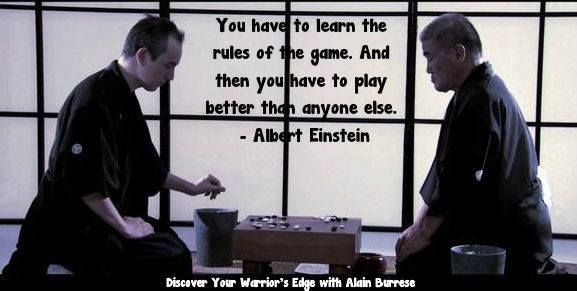
There are SO many aspects to this thought. When I saw the picture below posted on Alain Buresse’s Warrior’s Edge page, it struck me immediately. The irony of the game below, Go, has very few rules but can take hours, even days, to play.Rules-Eistein


One aspect is that of academia. You can regularly see posts from parents who are disgruntled with school districts and their testing requirements. I agree. There is WAY too much focus on taking tests to provide memorized information that don’t truly score knowledge or intelligence.

Since that is part of the game, though, parents need to help the younglings understand it. The hardest part of playing any game is not knowing the rules. A person who can learn them from the experiences of others will progress more quickly.

This leads nicely to a couple blog posts by Anna Valdiserri. Over the past couple weeks she’s posted these – Rule of Dumb -1 and Rule of Dumb -2. Both of which discuss following the rules and those who won’t. She makes some very good points about stuff you may think are obvious…but no one had said them. The key to figure out here is how you can stay within the rules (honor, integrity) and not get trashed by those who won’t play by them.

Maybe a good development tool is your martial arts (or other) training. A common occurrence during class is asking about which stance should be in that movement. Is that a back stance? Yes, it is. But you had your foot over there (3 inches different from typical)? This kind of exchange happens all the time but has no real bearing on the movement or technique.

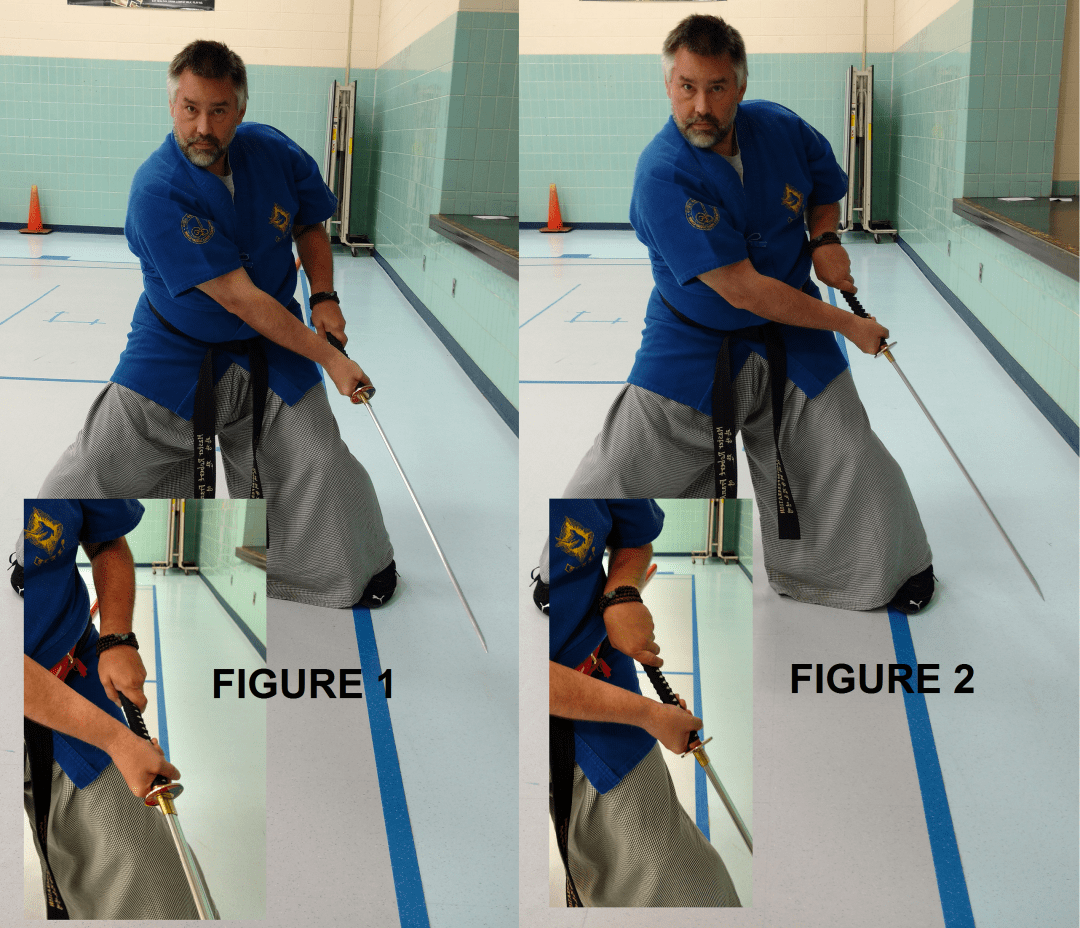
Now, some rules take precedence over other rules. Cutting with a sword has several of these. One example comes from Saseong Neri Bagi (big angle downward cuts). When doing a Left (to right) cut, it is rather easy to follow the rule “the sword stops nearly directly your side” as the twist through your torso will allow this as does help having your hands placed on the sword properly.

The struggle comes while trying to do a Right (to left) cut. As the hand placement on the sword affects your reach, the sword doesn’t get directly to the left side. This can cause the student to try still follow the rule of stopping directly to the side (figure 2). The problem with this is that it usually ends up violating a more important rule – “No kinky wrists.” By allowing the hand to turn or twist of the handle or the wrist to bend greatly, the student puts the sword in an awkward position where control is lost. The student following the more important rule of “No Kinky Wrists” (Figure 1) will find that the sword stops pointed about 45 degrees forward but allows proper cutting of targets.CuttingHands-1

Generational Leadership

General Stanley McChrystal discusses the ideas of leadership from his military experience. I think he hits several key points that carry over into the experiences that I’m having as I try to teach martial arts classes. One key point is the idea of generational leadership. The recognition that experiences can be vastly different from one student to another due to age needs to be kept in mind.

Now, I run a school that is different from most in the industry. I don’t have kid’s classes. Those younglings who are of a minimum age are in the regular class and are expected to keep up. Their age is an advantage as they can absorb a lot of information and repeat most of it almost immediately. Their brains aren’t biased by their past experiences and failures. Most believe that they can do anything…until they find something they can’t. This is where the adult students in class become the examples and lead the way. This is kind of an obvious example of generational leadership but it is very basic.

This leadership can take the form of “follow the leader” and younglings can mimic well. The challenge comes from trying to explain and illustrate what they should be doing. When most of the younglings today don’t know who John Wayne was, it can make it tough for some adults to use words for instruction. Then there are the other experiences that may or may not be common. I had one 11 yer old ask me why I kept calling them younglings. I asked if he knew that it came from Star Wars. He said “I do but no one else in class understands that!” So, at the beginning of class, I asked who knew the term and, truly, everyone raised their hands. At this point, a 12 year old asked when they’d get to become Padawans.

Knowing that many of the students are on the geeky side is why I tend to use Star Wars and Star Trek references in class often. The other regular references are from anime, which fits the geeky ones and many of the younger. I’ve been fortunate to not need to get into video game references as the anime stretches my limits and the video game experience is non-existent.

I’ve included General McChrystal’s TED Talk here for your enjoyment. he has some other insights that may show up in future posts.

Rules For Life

KillHouse_RulesThis came across a newsfeed recently. I think it is awesome! They may be a little blunt but they easily fit the rules for life. Taken from a combat setting, they can be applied to the every day World without much adjustment.

There have been many posts about wanting “safe places” and trying to twist situations for their own benefit. One example are those who feel they can claim their opinion as the only correct way and are offended to the point of taking legal action when offended. The mother who can’t believe that her son could ever do anything bad is another example.

Now, I will completely agree that it is very beneficial to have a support system, but…

The more important point is that people need to make sure they are working to their fullest BEFORE calling upon their support system. A few things like a vehicle breakdown or emergency room trip should use the support immediately. Even those are based on the degree of severity. I can’t fix many things on a vehicle but I can change a tire (and the oil) and make sure that those tools are included in the vehicle. If I can’t manage the situation, then I’ll call upon the support system. The recognition that no one is coming to save me is a mindset that can be established in these little incidents to be enabled in more serious situations.

Which brings us to the idea that YOU are responsible for everything. This, to me, clearly means that you must act on everything that happens and be held accountable to everything that you do. When the time comes, do you run toward danger or away from it? This is an extreme example but accurate for a society that has had many active shooter incidents. Have you trained well enough to be helpful is this situation or are you a hindrance? In daily life, this rule fits into things as simple as cleaning your room or taking out the trash. If you see that it needs to be done, do it. If you have to be told, you’re sheeple and not a warrior.

Save those who need to be saved fits simply into any bullying situation. If you, as a warrior, don’t stand with the person being bullied, then you are not a warrior. Be aware of the “educational beat down” (see Rory Miller’s “Facing Violence”), because that is NOT something to get involved with. Those who don’t respond when others are in need, don’t fit the warrior way. If you don’t at least call 911 to report the disabled vehicle, you are not being responsible. I will agree that family safety comes first but not calling to inform of the vehicle and provide mile-marker information is cowardly.

I really don’t encourage killing but this next rule can easily be applied to stopping bullies, reporting disabled vehicles and protecting those who have had “one too many” from possible ugly situations. Standing up with those who need help is as good as killing those who need killing.

Personally, I see “always keep working” in the same light as keep learning, challenge yourself, don’t stop getting better. In an emergency situation, moving from one problem to the next and getting the most accomplished is called triage. This is where all of your training and knowledge is put to the test AFTER he fact. I promote that you make sure that your training will stand up to the test but making sure you have everything you need ready to go and have conducted stress testing to reinforce it.

If you work these rules into daily life, your preparation to handle adversity will increase exponentially. You will probably enjoy life more as being of service to others is important.
“What’s your style?” – Bringing the Training Hall to the Lecture Hall — Kung Fu Tea

Introduction: “What’s your style?” A couple of months ago a conversion emerged between a few of my colleagues which got me thinking about the effects of personal training on those who wish to write on martial arts studies. Simply broaching such a question tends to elicit a number of knee-jerk responses. […]

via “What’s your style?” – Bringing the Training Hall to the Lecture Hall — Kung Fu Tea

Becoming Brave

The martial arts are centered around the personal development of the student. This development is for improving the quality of life for the student. Providing skills and techniques that provide the skills necessary to be successful at problem solving and leadership.

In order to accomplish this, the student needs to develop physical  skills to introduce the principles and concepts that will guide them through the dangers. This is evident in the credos of Song Moo Kwan.

The Four Credos of Taekwondo by Supreme Grandmaster Byung Jick Ro are:
1. Yehsi-Yehjong: Begin with courtesy and End with courtesy
2. Solseon-Soobeom: Lead by example
3. Budahn -Nohryeok: Never ending efforts
4. Hasa-Bulseong: Nothing is Impossible

The dangers vary from student to student. Something as basic as an elementary school math test to a presentation to the board of directors. The physical techniques and the principles provide the base skills to fight these fights. These principles are the way to help create bravery within yourself. Only through bravery does the student learn to step outside their comfort zone. Each time the student does this they further develop their bravery.

Brave_KidThe little guy in this video didn’t care about the size of the opponent but he was willing to charge in and help save the girl. He didn’t know that it was more play than threat and he didn’t care! That is bravery.

The unfortunate part is that bravery diminishes as we get older. We start playing it safe and stop taking the step outside of the comfort zone that we’ve created.

It is important to take the challenge. It is important to step past the things that you already know and step up to meet whatever is around the corner. Most of the time we under-estimate ourselves and our capabilities. After seeing students for the past 25 years, I have watched students rise to, maybe,  about 60%  of their capabilities. All because they still won’t push themselves beyond the last step they took.

If you look at any hero story, you find that they all follow the same story. Meet the challenges, fix the wrongs and make something better for those who follow the hero.

Whatever challenge arises, the hero will step up the engage it and succeed. The hero (and his help, whether it be a sidekick or comrades) push forward through the fear and doubt to accomplish the trial or task. In fact, several stories show that several attempts were needed to complete the trial or task (Budahn -Nohryeok: Never ending efforts). This only emphasizes that failure is only true if you quit (Hasa-Bulseong: Nothing is Impossible). Through their actions and continued efforts, they build bravery.

Seek to find the challenges that push you beyond your comfort zone. You will amaze yourself with what you can actually do and find true friends (comrades-at-arms) along the way.

I Just Did My Form Five Times!

Pre-testing for their next rank is a good review for students. On one side it gives them renewed confidence as they get to present the new material that has been learned.

Until_told_to_StopIn Taekwondo, they have spent the last months working on the new hyung (form) and one-step self defense and kicking requirements. For the Haidong Gumdo program, they have been working on new gumbub (sword form) and Focus drill and gyuk-gum (fighting drill). They have done them hundreds of times. They know the order of techniques and stances in the form. Usually, they can even tell you the order of techniques and which stance it should be.

On the other side, it also shows the glitches in their technique. It is very easy to fall into the habit of doing the material without truly studying it. The mere repetition of the form or technique doesn’t ensure that you are improving in skill. In fact, it will only re-enforce bad habits and mistakes. These habits will take a long time to correct.

Never-mistake-activity-for-achievement.-John-Wooden-700x525This is where the concept of correct work comes into play. Students hear in my Taekwondo classes that a Front stance has certain parts that need to be in place to make the stance correct. They can even recite those parts to me, BUT…
Merely doing the form or drill doesn’t KEEP the stance correct. The phrase “practice make permanent” is very fitting to martial arts (and personal protection) training. The correctness disappears after training without focusing on keeping all the parts in place. Unless the student actively works at keeping all the parts to all the techniques in all of the form, the training time can be wasted.

If training in the martial arts is a method of personal development, then all studying should include the in-depth review and analysis. The physical techniques being performed must fit into the principles of the martial arts.

Why people choose us

At StudyMartialArts.Org we are passionate about Martial Arts and Travel. We believe that the combination of both provide a powerful catalyst for greater awareness. Our mission is based on connecting you to the right schools, masters or instructors.

Below you will find a testimonial from one of our past students Arvid Velt. Arvid first joined the SMA 1 month intensive martial arts travel and training tour. On this tour we combine historic sites fun and travel with training with a variety of high level masters throughout China. During that time we assisted him and advised him on the next move to bring his training to the next level.

Arvid at the time of the filming through our support and that of his Master studied in China for two years.

For further information contact us at info@StudyMartialArts.Org or visit our website. www.StudyMartialArt.Org Or why not view our other testimonials here.

Approaching the “Armed Martial Arts of Japan”: Thoughts on Comparison, Theory and Progress in Martial Arts Studies


Introduction

Opportunities come in many forms, even in the guise of a sore throat. Since I have been feeling a bit under the weather I decided to use the next few days to catch up on …

Source: Approaching the “Armed Martial Arts of Japan”: Thoughts on Comparison, Theory and Progress in Martial Arts Studies

From Dali to Shangri-la | Off-the-beaten tracks itinerary in Yunnan

The road that links Yunnan’s three main backpackers haven from Dali old town (大理古城) to Lijang (丽江), the former capital of the Naxi Kingdom, and the ancient Tibetan town of Shangri-la (香格里拉) a…

Source: From Dali to Shangri-la | Off-the-beaten tracks itinerary in Yunnan