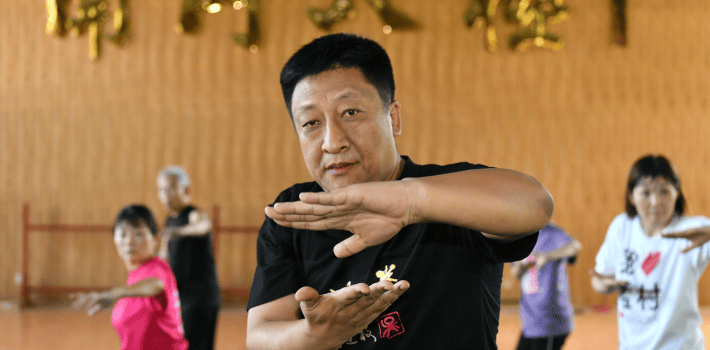
I arrived in Mengcun with two suitcases, a year of inconsistent martial arts experience, and no idea what to expect from training at the Baji Quan International Training Center in China. I left with something I had not planned on: a genuine feel for one of China’s most respected fighting arts, and an unexpected education in a culture I barely knew existed.
Mengcun is not where most foreigners learn kung fu. The famous schools cluster around Shaolin, Wudang, and the big cities. The Baji Quan International Training Center in Mengcun sits in Hebei Province’s farmland, and what it offers instead of fame is a focus on one style liked with a provincial pride. This is the birthplace of Baji Quan, a style developed here over three hundred years ago, and the school at its center is run by the family that has carried the art for eight generations. Grandmaster Wu Lianzhi is the officially recognized National Intangible Cultural Heritage inheritor of the style, and he and Master Wu Dawei still oversee training personally. Within my first week, a coach adjusted my stance with his hands in a way that fixed in one minute what months of videos had not. That is the difference between learning an art and learning about it.
The training itself is honest work. Mornings belong to fundamentals — low stances, the style’s famous single techniques, and internal post work that looks gentle and burns like nothing else. Afternoons rotate through forms, traditional weapons, combat application, and, for those ready, the body-striking post conditioning that Baji is known for. I will not pretend the post work was enjoyable. It was, however, effective, and the masters monitor it closely enough that you push hard without breaking anything.
The cultural dimension was the surprise I had not booked. Mengcun is a Hui Autonomous County, meaning a large share of the local population are Chinese Muslims, descendants of traders and settlers who arrived centuries ago. I came to know this first through the food, which was some of the best I ate in China — hand-pulled noodles, beef dishes built on the county’s famous braised beef craft, all halal by default. Then through the soundscape: the county’s many mosques, including Ming-era buildings in the old town, add a call to prayer to the rhythm of village life, and attending a Friday prayer as a respectful observer (with permission, and after explaining myself) was one of the most memorable hours of my stay. The school’s own heritage carries this thread too — Baji Quan’s founder, Wu Zhong, was a Hui Muslim, and the masters speak of the art’s principles as drawing on Islamic thought alongside China’s other traditions. As a non-Muslim, I never felt like an outsider in that story. I felt like a guest being shown something worth knowing.
A fair review needs the other side. Mengcun is small, quiet, and far from tourist infrastructure. English is rare outside the school, winter is cold, and evenings are what you make of them. If you need nightlife, variety of styles, or Western comforts, a bigger school will suit you better. Come here if you want depth instead: one art, taught properly, in the place it was born, surrounded by a living culture most travelers to China never encounter.
I came for kung fu and got that — real, structured, demanding kung fu. But when I think back, the training and the county are tangled together in my memory: the morning stances, the noodle shops, the old mosque, the masters’ corrections. That combination is what I would recommend to anyone, of any background, willing to trade comfort for authenticity.

