Chinese Martial Arts in the News: Oct. 22 2018: Archery, Kung Fu Villages and the Lives of Detective Dee

benjudkins's avatarKung Fu Tea

Introduction

It has been a busy weekend, so this news update will be brief. Nevertheless, I wanted to comment on some of the more interesting stories that have been floating around. For new readers, this is a semi-regular feature here at Kung Fu Tea in which we review media stories that mention or affect the traditional fighting arts.  In addition to discussing important events, this column also considers how the Asian hand combat systems are portrayed in the mainstream media.

While we try to summarize the major stories over the last month, there is always a chance that we may have missed something.  If you are aware of an important news event relating to the TCMA, drop a link in the comments section below.  If you know of a developing story that should be covered in the future feel free to send me an email.

Its been way too long since our…

View original post 1,976 more words

Muay Thai Sangha school mission explained…

Check out this article on on Kru Pedro Solana by Janine Yasovant. Janine writes for the Scene 4. Enjoy!
Screen Shot 2017-11-03 at 4.17.59 PM

I would like to introduce you to a Spaniard who has a passion for martial arts especially Muay Thai and Thai weaponsHis name is Pedro Solana. Currently, he is living and operating a training camp in Mae Taeng District, Chiang Mai Thailand to teach Muay Thai and Thai weapons to students who come from over the world

Pedro Solana was born in Spain. He entered the martial arts world training in judo when he was only six years old. In the 80’s he was introduced to Muay Thai by Ajarn Eugenio Fraile, where his fighting career began. In the early 90’s he moved to the USA to further his Muay Thai skills under Ajarn Surachai Sirisute and continued fighting professionally for a number of years. During those years he trained other disciplines including Wing Chun under Sifu Francis Fong, Kali under Guro Dan Inosanto, and various other masters of grappling (Machado brothers, Royce Gracie, Ricardo Murgel and Jacare Calvalcante).
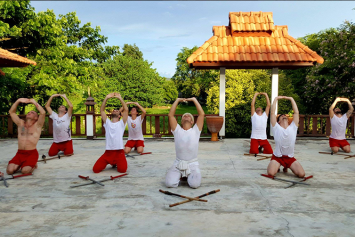
Screen Shot 2017-11-03 at 4.18.27 PMIn 1998, after becoming the United States Muay Thai Middle Weight Professional Champion, he decided to travel to Thailand for a full year to expand his Muay Thai and Krabi Krabong skills. In 2000 he opened the Thailand Arts Institute in Atlanta, GA. to support his fighting career. In 2002 he permanently moved to Thailand to continue learning. After becoming a monk he went to train in Muay Thai Chaiya under Kru Lek and came back to Krabi Krabong (Thai Weapons) training under Ajarn Sila Mesaman from the Wat Buddhai Sawan School. In 2003, Pedro Solana opened his first school in Thailand. In 2010 he expanded into various other forms of South East Asian martial arts including Silat Minangkabau Ground Fighting, Bokator and Kalaripayattu. From his exposure to different martial arts he created a unique and effective system of self defense known as “Muay Thai Sangha Fighting Arts“.

Later on, through experience, deep reflection, and self discovery, Solana realized in meditation that certain aspects in the ‘Fighting Arts’ were missing. In 2013 he decide to blend these internal concepts together and develop a new form of self defense called “Kshatria Sangham Internal Arts” which included all the concepts from his past experiences of fighting.

His work now is involved in teaching seminars around the world, and creating documentaries to expose an important message for humanity related to overcoming inner fears and developing and understanding the “Self” through the path of martial arts.

Screen Shot 2017-11-03 at 4.18.42 PM

You can read the full interveiw here…. 
Welcome to a world of FISTS, FOES and FOOD-BLOGGING

by Jason Ho

Welcome to a world of FISTS, FOES and FOOD-BLOGGING. Welcome to Johnny Wong’s Rockabilly Restaurant Reviews, a new web series that will satiate your desire for fighting and food.

This show is especially great for the martial arts fan out there who loves seeing fight choreography mixed within modern day settings and storylines, and characters that derive their larger-than-life persona from classic golden-age era movies of 80’s Hong Kong and Japan.

Written and Directed by director Jason Ho (www.dreamnineteen.com), who grew up on Jackie Chan, Kung Fu and Chinese food–he’s always wanted to combine the things he’s loved into a show that brings back good ol’ fashioned heroes who have swagger and bravado.

So Who is Johnny Wong? He’s a hard-hustling, fist-fighting cocky dude who’s all about making money. Who is Riley Reece? She’s a food-blogging, fashion-fanatic little sweetheart looking for that next slice o’ pizza. Both are on a mission to make as much money as possible…why? Because Riley is dying.

Check out the action-packed trailer and first episode here!

Trailer
https://youtu.be/M-o6EfN8cSg

Episode 1
https://youtu.be/2loL9jPr-gI

Old Irish Martial-Arts — The Wandering Fist

the heart swells with blood rage sunders the world (Carson 204) To travel in search of a great master, in the hope of acquiring new skills; trials to determine whether the student deserves the tuition; a period of intense and intimate practice devoted to the study of special techniques: this is martial-arts culture as known […]

via old Irish martial-arts — The Wandering Fist

Chinese Martial Arts in the News: September 24th, 2018: Shaolin, Bull Fights, and So Many New Books…. — Kung Fu Tea

Introduction Welcome to “Chinese Martial Arts in the News.” I recently finished the heavy lifting on my draft chapter, so I am now returning to a normal posting schedule. Thanks for your collective patience! A (long overdue) news update seems like the perfect way to ease back into things. For new readers, this is […]

via Chinese Martial Arts in the News: September 24th, 2018: Shaolin, Bull Fights, and So Many New Books…. — Kung Fu Tea

Shengjing Shan Kung Fu Academy – Review

圣经山

Learning kung fu in China with Master Qu

by Tim Miller – from the USA
My experience at Shengjing Shan kung fu academy has been one of the best experiences in my life.  I have been here for 8 months and I am in the best physical and mental condition I’ve ever been in.  I have lost the most weight I’ve ever lost in my life (30 pounds).  It is deep in the mountains and has very little to no distractions which makes it a great location if you’re looking to focus on learning kung fu.  The student environment is also very friendly.  Everyone is very nice to each other and is there to help you when you need it.  I’ve met some of the most interesting people I’ve ever met before at this academy. Master Qu is one of the best masters you could hope for.  He teaches each student at their own pace based on their ability and condition, yet at the same time he pushes you to become stronger and better than you were yesterday.  It is clear he cares about his students, not only on a physical and mental level, but also as a person in general.  He has made this place feel like a second home.

Learning kung fu in China

Sheng Jing Shan Kung Fu Academy specializes in the teaching of traditional Chinese Kung Fu and culture to students coming from all around the world. The main subjects taught include Shaolin kungfu, Bagua Palm, Mantis Fist, Tai Chi, Qigong and Sanda. In addition to martial arts the school also offers Chinese culture lessons, including Daoism, massage, and acupuncture. Here you can learn kung fu in China and experience Chinese martial arts and TCM culture.

Facilities: Indoor and outdoor training areas.

To learn more about the school and see a full independent review visit StudyMartialArts.Org

Through a Lens Darkly (55): Taijiquan and the Soft Power Paradox

benjudkins's avatarKung Fu Tea

As previously noted, I have been taking a couple weeks off from the blog to focus on another writing project that needs my attention. Nevertheless, I ran across an image that I wanted to share. As I did a bit of research it occurred to me that this photo suggests a theoretical dilemma that may be relevant to that project as well. It seems that I just cannot stay away from Kung Fu Tea. But in this case that might actually be for the best.

Let us begin with the photograph that tempted me out of my blogging vacation.  It is an eight by eleven-inch glossy print showing three Chinese martial artists with swords (jian) in a Beijing park.  This particular photo was previously part of the Houston Chronicle’s photo archive before I purchased it at auction.  The stamps on the back indicate that it was published on December 26

View original post 2,282 more words

An Wushu – School Review

From soft-arts beginner

I previously trained for 1 year full-time with Shifu An Jian Qiu, where I learned the family basic sets (stances, stretching, bone hardening etc.) and then progressed on to Bajji Quan and San Da. After returning to live in Dezhou for 2 years and unable to train full-time, I’m very grateful that An Shifu allowed me to continue my studies with part-time training. It was great being able to join in training sessions with other full-time students and see how quickly they improved, and An Shifu truly made me feel part of the family despite my limited time, even inviting me along to the incredible International Baji Quan demonstration hosted in Dezhou and QingYun this summer (2018). He allowed my training to fit seamlessly into my busy schedule, and it remained the highlight of my week throughout my time back in Dezhou. As I’m still dealing with a neck injury sustained while practicing wrestling back in Europe, I asked Shifu if he could start to teach me the internal arts to compliment and aid in my recovery.

To my first complete Bagua form

As a total beginner to internal arts, I’m very grateful for the many long conversations we had about internal training methods and goals, as well as the details and differences of the 3 styles Xing Yi, Bagua, and Tai Chi. I feel that under his instruction I have gained a useful understanding of what I am actually aiming to achieve when practicing internal kung fu, and the images he uses to describe his internal sensations help me to imagine the feeling I will one day achieve. Stood in San Ti Shi posture for 20 minutes, I imagine my arms as leaves gently floating along a stream.

In total, I learned the basic stances and fists of Xing Yi, then a first basic Bagua series before learning Bao Zhen Bagua Zhang. I wouldn’t have imagined I would be able to learn so many complex movements in this time, but my year of full-time training in the past provided me with good enough basics to learn quickly. It was very hard work, following the detailed corrections of An Shifu week after week, and I feel it will still be years before I can be truly soft in all these movements. However, I am very confident now to take what I have been taught and gradually develop my internal kung fu through daily practice. Sadly leaving Dezhou once again, I am already looking forward to coming back to deepen my knowledge of the An family system further, and hopefully next time I will arrive injury free!

Spreading the Gospel of Kung Fu: Print Media and the Popularization of Wing Chun (Part II) — Kung Fu Tea

Introduction In the first part of this series (which you can read here) we discussed the earliest works on the Chinese martial arts to appear in English, and looked at two sources on Wing Chun. The first was an article in a 1968 edition of Black Belt Magazine (the publication of record for the […]

via Spreading the Gospel of Kung Fu: Print Media and the Popularization of Wing Chun (Part II) — Kung Fu Tea

Great Myths about “Self Defense” — Sifu David Ross

This Sunday, September 9th, I am holding another self defense seminar. If you are interested you can learn more and register at https://events.membersolutions.com/event_register.asp?content_id=76051. I guess that is why these “great myths” about “self defense” come to mind. #1: People will tell you that in “self defense” you want to use your open hand, i.e. your […]

via Great Myths about “Self Defense” — Sifu David Ross