– 向愷然先生練太極拳之經驗 MY EXPERIENCE OF PRACTICING TAIJI BOXING by Xiang Kairan [written in 1929, published in Wu Zhiqing’s 太極正宗 Orthodox Taiji, 1940] [translation by Paul Brennan, July, 2016] – 前淸丁未年間。我在日本會見一位直隸朋友。就聽他說起北方練拳術的人。有幾個大派別。一派是練八卦拳的。一派是練形意拳的。一派是太極拳的。還有一派練岳氏散手拳的。後來由岳氏散手。又產生一派。謂岳氏連拳。此外雖尚有不少的家數。然練習的比較人少。不能自成一派。我當時聽了這些話。不過知道有這些名目罷了。究竟各派是些什麼手法。彼此分別之點。在什麼地方。因那位直隸朋友。不能一一演給我看。無從知道。直到民國癸卯年。遇見李存義的弟子葉雲表、郝海鵬。纔見着了形意拳。八卦拳也看了一部份。太極拳。仍是不曾見着。不過曾聽得葉、郝二人說起太極拳意義。使我增添了許多向往之心罷了。 In 1907, I was in Japan visiting a friend from Hebei, and I happened to hear him talking about northern practitioners of boxing arts: “There […]
Introduction Welcome to “Chinese Martial Arts in the News.” This is a semi-regular feature here at Kung Fu Tea in which we review media stories that mention or affect the traditional fighting arts. In addition to discussing important events, this column also considers how the Asian hand combat systems are portrayed in […]
Thanks to my wonderful colleagues at StudyMartialArts.Org, I’m able to share this list of full-time Martial Arts School Reviews. Click the link and you’ll be able to compare and contrast Martial arts schools based on student reviews, price and StudyMartialArts.Org’s independent assessment.
Below you’ll find a list of schools that currently have the most reviews on the www.StudyMartialArts.Org website. Please note that after 5 page views you’ll be asked to login to the site. This is easy and nothing to worry about. If you find the site useful and want to learn more contact StudyMartialArts.Org for a full consultation on schools, training and travel. The consultation service is free and there is no obligation. However, to keep the service free, make your booking through them. Booking through SMA is the smart thing to do as it affords students who use there service two essential things that should give you piece of mind.
Firstly, you get extra support!
And secondly schools are less likely to bullshit you or rip you off.
A comprehensive list of martial arts schools and masters reviewed by students and experts.
Here are some links to schools which have either been reviewed by students directly or have been collected to provide site users more information to help you narrowing your choice down.
Tianmeng Shaolin Kung Fu Academy primarily focuses on teaching the traditional Meihua Quan (Plum Blossm Fist) which has both internal and external elements. In addition to Meihua Quan, Shaolin Kung Fu, Qigong, Qin Na, Tai Chi, Xingyi, Bagua, are also taught here. The school itself is relatively new and it has all the facilities that students will require to build a solid foundation in Martial Arts or reach higher levels. The school is unique for Meihua poles and Meihua training methods. These are designed to impove balance, internal power and footwork in a very short time.
Master Chen Fusheng’s Martial Arts Academy is located in Lixian Zhen, Daxing District of Beijing. Here you will learn traditional Bagua, Bajiquan, Pigua, Qi gong, Tai Chi, Tong Bei, Gong Li, Xi Yang Zheng, Hei Hu, Xingyi and Praying Mantis. Master Chen will teach you the best aspects of each of these styles for combat as well as his own Qi gong and fighting style Ba Ji Zhan Dao this is translated as Baji Battle Way. Master Chen has a vast wealth of knowledge in traditional martial arts and also in martial, healing and longevity qigong.
Rising Dragon Martial Arts School is location in Yongping county in Southern Yunnan Province. Yongping County is a very mountainous region which borders Myanmar, Laos, and Vietnam and has an average altitude of 1980m. YongPing has a population of around 170,000. and is located roughly in between the two Cities Dali and BaoShan, which are both no more than an hour’s drive away. The area is steeped in history with numerious temples, senic areas, mountains, lakes and even natural hot springs to visit.
Kunyu Mountain Shaolin Martial Arts Academy is a popular and long running International Kung Fu Schools in Shandong Province. Located in a beautiful rural setting on the edge of the Kunyu Shan National Park the school offers students of all abilities the chance to learn Shaolin Kung Fu, Taichi, Qigong,Wing Chun, Xingyi, Bagua, Baji, Northern Praying Mantis and Sanda.
Kunlun International Martial Arts School is a traditional Chinese kung fu school in rural Yantai. The school adjoins and uses the facilities of an ex-military base so as a result has excellent facilities. The school employes translators and has support staff in Yantai City. The School specialises in Seven Star Praying Mantis Boxing, Plum Blossom Praying Mantis Boxing, and Throwing Hand Praying Mantis Boxing as well as traditional Shaolin Kung Fu, Qi Gong and internal styles such as Bagua, Chen Style, Tai Chi and Xing Yi.
Wudang Hongdao Kung Fu School’s lineage comes from the Xuan Wu Sect of Daoism and is located near Zhong Guan Temple on Wudang Shan. Situated on the Mountain and with training taking place in and around the temple. The school offers a unique experience and the chance to study martial arts as well as study the healing arts of internal alchemy, qigong on herbal studies. Students should have some level of Chinese and knowledge of TCM to get the most out of their healing arts studies. Part of their studies will involve finding and identifying various mountain herbs for the Zhong Guan Temples daoist monks as well as learning about their uses.
Lion Muay Thai is Phuket’s fastest growing Muay Thai camp offering students an opportunity to learn a new martial art, get fit and have fun in the paradise island of Phuket. Nestled amongst lush greenery in an area called Rawai the camp offers seclusion without being too far away from the local amenities. Students who attend this school include seasoned fighters and beginners. This is because the gym caters to every need. As a result students may get a chance to train alongside or rub shoulders with world champion fighters who appear on international fight shows and work with some of the best trainers in Thailand.
The Kung fu School, China offers Sanda, Shaolin Kung fu and Taichi quan intensive martial arts training. All this is provided by an equally intensive master. Master Wang Xinglong is a 32nd generation disciple of the Shaolin Temple. At the age of 12, he joined the Shaolin Temple and studied traditional Shaolin martial arts under the 31st generation disciple, Master Shi DeQian. At the school students should expect to train 8 hours each day, five days per week. All skill levels are welcome at the school and each student gets personalised training where Master Wang Xinglong considers your skills, strengths weaknesses, preferences and goals. Progress is solely determined by the effort you put in and your ability to learn and practice the skills.
The Maling Shaolin Kung Fu Academy is located in Xingyi City in Norther Jiangsu Province. Headmaster Bao founded the school recently, having previously been training international students at other academies. He has set up a fantastic place to train and live, where students can learn 7 different styles of Chinese martial arts. The main style is of course, Shaolin Kung Fu, although you can also learn Baji Quan, Tai Chi, Xingyi, Qigong, Sanda (Chinese kickboxing) and Bagua.
Yangshuo Taichi School was the first registered International Taichi and Kung fu training School in Yangshuo. The school is located in a tranquil and truely stunning location a bike ride from Yangshou. The school headmaster, Master Huang is a National Taichi Champion who is enthusiastic and dedicated to teaching Taichi as a martial art, as a healing art and also a philosophy.
Qufu Shaolin Kung Fu School is a medium sized Shaolin Kung Fu school that has a freindly and welcoming feel. A perfect alternative to the often overly busy and inpersonal Shaolin Kung Fu Schools located in and around Dengfeng. This school is located on the outskirts of Qufu City, the birth place of Confucius and was founded in 2008 by 34th Generation Shaolin Warrior Monk Master Shi Yan Jia. Although the school is not located in and around Dengfeng it is one of only a few that have been given the seal of approval by the venerable Shi Yong Xin Head Abbot of the Songshan Shaolin Temple in Henan. This is a direct result of the Schools links to the Shaolin Temple’s Warrior Monk demonstration team.
Songshan Shaolin Traditional Wushu Academy is located inside the Original Shaolin Temple in Henan Province. The Shaolin Temple is was included in the UNESCO’s World Cultural and Natural Heritage List in 2010. And training at this school will uniquely allow you access to this amazing iconic cultural site. Indeed the training grounds of the school are located in areas where Temple monks train regularly.
The Yuntai Mountain International Culture and Martial Arts School was founded by Shi Yan Lin, a vastly experienced Shaolin Kung Fu master who teaches both Chinese and international students. The Martial Arts training at the school will primarily focus on the various Shaolin fists and weapons as well as Sanda and Taichi. In addition to the Martial Arts training the school also offers students the opportunity to study Chinese in combination with their martial arts training. The school itself is located in the famous Yuntai geological park, which attracts thousands of tourists every year. This area is widely regarded as one of the most beautiful place in Henan Province.
Zen Martial Training is located in Les Mamelles. The school offers authentic Chinese traditional martial arts with traditional Asian healing arts along with the combat sport of Taekwondo. The head instructor of the school has over 20 years of experinece in competitive martial arts and has lived and studied martial arts in China for over 6 years. The Head instructor of the school speaks, Chinese, English, Spanish & French and is certified as a Yue Jia Quan Master, has a 5th degree belt in Mantis Fist, 3rd Dan in Taekwondo and is certified in acupunture and herbalist.
Xilam is a modern Mexican martial art that is inspired by pre-Hispanic warrior cultures of ancient Mesoamerica, namely the Aztecs (Mexica), Maya and Zapotec cultures. It provides a noteworthy case study of a Latin American fighting system that has been recently invented, but aspires to rescue, rediscover and relive the warrior philosophies that existed before the Spanish Conquest and subsequent movements beginning in 1521.
Introduction Greetings! If all has gone according to plan I am now back in the United States, recovering from jet lag, reviewing my notes from the conference and preparing a report on the events of the last week to share with all of the readers of Kung Fu Tea. In the mean time, please […]
I’m continually being asked which VPN I use to blog use, access youtube, facebook, all the other commonly used social media sites. I always tell them ExpressVPN. Having trailed all the brand leaders Express is still the most consistent. And now they have improved ExpressVPN further. Here is how.
ExpressVPN’s New Device Policy Means More Connections and Less Restrictions
ExpressVPN is excited to announce a new subscription policy, which allows for up to three simultaneous connections.
Users can take advantage of the new policy by securing any three Internet-enabled devices concurrently, without needing any additional subscription plan.
ExpressVPN’s change of terms is a bespoke response to the Internet-thirsty demands of today’s society. The days of a single shared PC at home are long gone, and many of us access the web on a host of different devices.
That’s why ExpressVPN has made it even easier for you to remain private and secure across every platform you use. The new policy will help ensure the Internet privacy and security users have come to know and love.
ExpressVPN Offers the Connections, You Choose the Devices
If you want to browse securely and simultaneously on your iPad, Android, and Mac — No problem. How about Windows PC, iPhone, and AppleTV? — No problem. Three PCs at once? — No problem!
You get the picture: Surf securely anywhere, anytime, on anything.
Privacy advocates can rest easy knowing ExpressVPN is continually looking for ways to improve an already best-in-class service.
For users who wish to use ExpressVPN on more than three devices simultaneously, additional subscriptions will be required.
By Dr. Mark Wiley For martial artists, one of the most important themes for developing better quality of life is maintaining a wide perspective on health and fitness, one that is based on connecting mind, body, and spirit with the physical actions of the martial arts. A glance at the local school or gym tells a different story.…
For anyone who uses Zhan Zhuang, Qigong or Tai Chi for Stress Management, here is an interview I did recently which may give you some new or additional methods to increase the effectiveness of ‘decompressing’ and rebalancing. Interview: Zhan Zhuang, Qigong & Tai Chi for Stress Management
Festivals bring people together in affirmations of community. This article looks at two festivals in coastal locations in Indonesia and Brazil with a close inspection of performances of fight-dancing included within both festivals. The improvisatory or choreographed organization of the fight-dancing performances echoes the manner in which the festivals themselves are assembled. As these festivals grow in popularity, the process of inventing tradition is heterogeneously co-constituted by those parties who actively invest in the symbolic capital of the events. Verbal and non-verbal forms of expression reinforce each other in the construction of a multivalent sense of regional traditions. The corporeal engagement of organisers and participants blurs the boundary between embodied remembering and narrative accounts. Based on archival research and ethnographic fieldwork, this article explores the interweaving of fight-dancing with the history, growth, and post-colonial expression of regional festivals.
Qigong is an essential component of Traditional Chinese Medicine and a powerful system of healing. It is the art and science of using breathing techniques, gentle movements, and meditation to cleanse, strengthen, and circulate the life energy (qi). Qigong practice leads to better health and vitality and a tranquil state of mind. Qigong can also be called nei gong (inner work) and dao yin (guiding energy). The documented history of this health and longevity art qigong goes back approximately 2,500 years. However Chinese archaeologists and historians have found references to qigong-like techniques at least five thousand years old.
Qigong is an essential component of Traditional Chinese Medicine and a powerful system of healing.
Because qigong includes both dynamic and gentle techniques that can be practiced from standing, seated, and supine postures, it is suitable for both the young and the old. Practices can be tailored to individual needs making it an ideal aid to recovery from illness or injury. Qigong is a form of complementary medicine working well with other forms of therapy but should not substitute for necessary treatment by a physician.
The two major areas of qigong for health and healing are Healing qigong or Yi Going and external qi healing or Wai Qi Zhi Liao
Qigong for health and healing involves two major areas of application:
Healing Qigong (Yi Gong). Healing Qigong (sometimes translated “Medical Qigong”) is the preventive and self-healing aspect of Chinese medicine. We are all exposed to stress. Qigong teaches us how to control our reactions to stress so that life events do not cause such symptoms as high blood pressure, frustration, or anxiety. Healthy people practice qigong to become super-healthy. Healers use qigong to prevent “healer burn-out” and to maintain a positive presence.
External Qi Healing (Wai Qi Zhi Liao). Qigong includes a sophisticated system of health assessment and non-contact treatment called External Qi Healing (EQH). The healer learns to tap into a well of healing energy in nature and “funnel” it through his or her body. Unlike some purely intuitive systems, EQH includes exercises that increase sensitivity to energy fields and efficacy of treatment. The more you practice External Qi Healing exercises and meditations, the more effective your healing treatment. External Qi Healing techniques may be used as a stand alone form of wellness treatment or may be combined with qigong massage, acupuncture, Therapeutic Touch, osteopathy, or any other form of body-work. Because treatment is generally performed at a distance from the body, EQH does not violate psychotherapists’ professional ethics (which do not allow touching the patient) and is thus an ideal adjunct to body-centered psychotherapy.
Active Healing Qigong Exercises
In order to get the maximum health benefits from qigong self practice, moving or active qigong is believed to be more important than sitting or still meditation. This is because moving exercises increase qi circulation in specific organs and so restore their normal functions. Active Qigong is for maintaining health and longevity and curing illnesses caused by qi imbalances. To learn more about mediation and qigong residentially retreats.
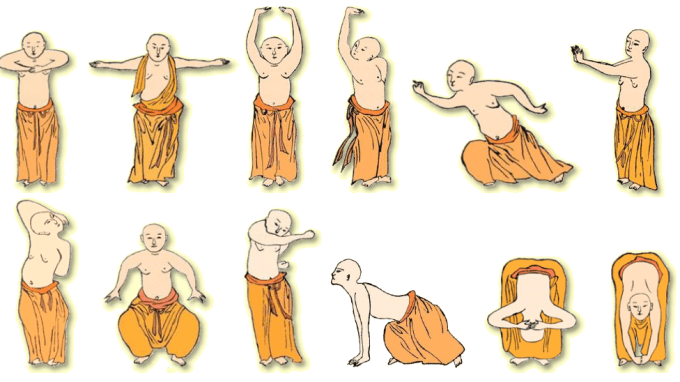
If you’re mostly interested in qigong for health and longevity, then qigong exercises derived from the Bone/ Marrow Washing Classics are typical qigong sets famous for being able to bestow strong and healthy bodies on dedicated practitioners. Qigong exercises derived from the Muscle/ Tendon Changing Classics (Yi Jin Jing) however, are said not only good for health but also have the added benefit of being able to increase the power of martial arts techniques.
It is said Da Mo imparted these works to the Shaolin priests because he believed they where not strong enough for the rigorous demands of training for enlightenment.
Both these books are often attributed to Da Mo the famous Indian Buddhist priest who brought Zen or Chan Buddhism to China, however it is more likely they were written and re-written by a number of different scholars and schools of thought before and after the fabled Da Mo. Nevertheless if we follow the traditional Shaolin view it is said Da Mo imparted these works to the Shaolin priests because he believed they where not strong enough for the rigorous demands of training for enlightenment.
In truth a combination of exercises derived from the brain washing and tendon changing classic are likely to be the most beneficial depending on your purpose and existing age and health. The main four main health qigong exercises recognised and promoted by the Chinese Health Qigong Association are as follows.
Muscle-Tendon Change Classic (Yì Jīn Jīng 易筋经).
Five Animals (Wu Qin Xi 五禽戲).
Six Healing Sounds (Liu Zi Jue 六字訣).
Eight Pieces of Brocade (Ba Duan Jin 八段錦).
In 2010, the Chinese Health Qigong Association officially recognized five additional health qigong forms:
Tai Chi Yang Sheng Zhang (太极养生杖): a tai chi form from the stick tradition.
Shi Er Duan Jin (十二段锦): seated exercises to strengthen the neck, shoulders, waist, and legs.
Daoyin Yang Sheng Gong Shi Er Fa (导引养生功十二法): 12 routines from Daoyin tradition of guiding and pulling qi.
Mawangdui Daoyin (马王堆导引术): guiding qi along the meridians with synchronous movement and awareness.
Da Wu (大舞): choreographed exercises to lubricate joints and guide qi.
Below is an official video from the Chinese Health Qigong Association providing an introduction to Qigong as a health exercise.
Do you feel that? Olympic fervor is once again in the air. As we prepare for the 2016 Summer Games in Rio there has been a distinct uptick of Olympic advertising on the TV. Athletes whom we have not seen for four years are once again making regular appearances on the news. Even some […]


 Both these books are often attributed to Da Mo the famous Indian Buddhist priest who brought Zen or Chan Buddhism to China, however it is more likely they were written and re-written by a number of different scholars and schools of thought before and after the fabled Da Mo. Nevertheless if we follow the traditional Shaolin view it is said Da Mo imparted these works to the Shaolin priests because he believed they where not strong enough for the rigorous demands of training for enlightenment.
 SMA bloggers