“The lightsaber has become an important touchstone, both within the films and within our culture…They serve as a source of identification and identity. They are the ultimate commodity: a nonexistent object whose replicas sell for hundreds of dollars. This is not bad for something that defies the laws of physics and cannot and does not […]
Whether you intend to or not, you’ll start to make changes in your life for jiu jitsu: and the thing is, they won’t happen all at once.
Maybe you’ll stop going to that happy hour that all of your non-jiu jitsu friends love to go to, or maybe you’ll find yourself ordering less fried food takeout when you realize that it really just makes you feel like trash the next day and it keeps you from training the way you usually do. You find yourself running on a treadmill maybe, or picking up a weight lifting program to help your strength and cardio while you train.
I know that I’ve stopped a good deal of bad habits because really, I just don’t have the time or energy to feel like junk as often as I used to. I barely drink that much alcohol anymore, and I’m pretty sure the time…
San Ti Shi is the basic stance used in Xing Yi. This helpful new video by Byron Jacobs takes you through the stance, the positioning of arms and legs and what to do as you stand.
There’s a great article over on Kung Fu Tea about the life of one of the most influential Chinese martial artists of all time, Sun Lu Tang. One of the persistent problems that I see in amateur discussions of “Chinese martial studies” is a lack of understanding of how broad the traditional martial arts really […]
Tai Chi is opening and closing happening simultaneously. That’s one of the secrets of Tai Chi, right there. Unfortunately, as with much of the truths about Tai Chi Chuan, the statement doesn’t make any sense unless you already know what it means. As an art, much of Tai Chi is self secret like this. […]
I used to ask my students, “Have you lost your mind?” They’d look at me quizzically and I’d continue with my query, “Where did you put it?” And they’d continue to stare at me…
When someone grabs you or punches at you, where does your mind go? Where does it fix itself? For most people, the mind instantly becomes attached to the spot where they are being seized or on the opponent’s fist…and this is a serious error. Remember, where your mind goes, so does your attention, your body, and your energy.
As an experiment, have a partner firmly grasp your wrist. If you place your mind and your attention on where he has clutched you, you will be unable to free yourself or move much at all. However, if you focus on your One-Point (my term for the dantien or “tanden” in Japanese) you will find that your body can move in any direction. Your elbow and your shoulder have not been immobilized either, and you can move them quite easily. Thus, you have many options for dealing with this form of attack…unless you fix your mind on the spot where you have been attacked.
If your partner intends to punch you, you mustn’t focus your attention on his fist. In swordsmanship, you are told not to focus your mind on your opponent’s sword. If you do, you will very likely lose the battle.
So, where should you fix your mind, you ask? The best example I can think of has to do with swordsmanship. You are holding your sword and are poised in front of your opponent who also wields a sword. What is your objective? If you answer that your primary intention is to stay alive, then you will probably fail. The correct is, of course, to cut your enemy! Your mind and intention should be fixed on him rather than on yourself, his weapon, or where he intends to cut you.
The opponent is, of course, at a disadvantage; he must attach his intention to a particular part of you. He must know if he’s going to direct his cut at your head or shoulder, if he’s going to punch you in the nose, or seize your left wrist or right lapel. This means that HIS MIND IS FIXED and not free to move about. His mind is focused on a particular form of attack, which is directed at a specific target. Consequently, it cannot immediately respond to any kind of counter-measure. It can only direct its single attack; it cannot react defensively. This is the great flaw of attack.
So next time you practice, especially with a partner, make sure you don’t lose your mind…
Get the inside view on the recent BBC Shaolin Temple documentary from a YouTuber who lived there for 3 years training Shaolin Kung Fu. What is real and what is fake? Find out here:
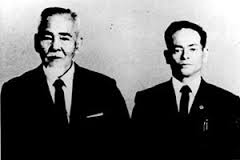
It is commonly believed that Grandmaster Shigeru Nakamura founded the Okinawa Kenpo Karate and Kobudo system; this is an erroneous belief. The martial art that we call Okinawa Kenpo migrated from China to Okinawa in the 7th Century. Then known as Kempo, it was taught only to members of the Okinawan Royal family, until, 1472 AD. In that year, Naha Bushi Sakiyama agreed to accept students outside of the Royal family. To ensure the lineage of the system’s grandmasters would stay within his family, he developed a scroll to document each successive grandmaster. In 1925, Shigeru Nakamura become the 10th grandmaster listed on the Sakiyama scroll and head of his family’s martial art. At this point in time, the Nakamura family’s karate system was known as Tomari-Te (tay). The Nakamura Family’s system of karate is the oldest documented style of Okinawan karate. And the Sakiyama scroll is the only ancient Okinawan karate artifact to survive the U.S. invasion of Okinawa during WWII.
Without getting to far into the weeds of Okinawa Kenpo history, in the early 1920’s, Shigeru Nakamura became upset with the Japanese for two reasons. First, the Japanese government had placed a prohibition on karate dueling to the death. This ban greatly disturbed Grandmaster Nakamura, who had participated in many duels. Shigeru publicly denounced the ban, arguing that “If there is no full-contact dueling, then effective combat techniques will be replaced with ineffective ones.” The second reason for his ire, the Japanese had high-jacked their native martial art, turned it into a sport (like Judo), and proclaimed it a Japanese martial art. His strategy for countering, what he perceived as a Japanese assault on Okinawan karate, was to unite all the schools of Okinawan karate under one style designation, and that designation was “Okinawa Kenpo.” Henceforth, Grandmaster Nakamura co-founded the Okinawa Kenpo Remmei (league) as an Okinawan karate umbrella organization.
In 1969, Shigeru Nakamura passed away. The result of his passing, organizationally, was the disintegration of the Okinawa Kenpo Remmei. However, before his death, Grandmaster Nakamura designated Okinawa Kenpo to be the official title of his family’s martial art.
To honor Grandmaster Shigeru Nakamura and promote his family’s martial art, on April 1, 2019, the Okinawa Kenpo Karate and Kobudo Association (founded in Okinawa) and Grandmaster Taketo Nakamura’s Okinawa Kenpo karate and Kobudo Remmei, in a joint venture, founded the Shigeru Nakamura Ryukyu Martial Arts Institute as their organizations’ educational platform.
Full contact
In the decades after Shigeru Nakamura’s death, in the United States, Okinawa Kenpo Karate and Kobudo evolved into an Americanized form of karate. As a result, the Institute’s mission is two-fold: First, re-establish the original Nakamura’s family’s martial art as Okinawa Kenpo Karate and Kobudo in the United States and to instruct and practice Okinawa Kenpo as Grandmaster Shigeru Nakamura mandated it. Second, to provide everyone, who desires it, an opportunity to learn and study Nakamura Okinawa Kenpo Karate and Kobudo, regardless of their financial status and/or geographic location. In Okinawa there is a saying: “All karate sensei have full-time jobs.” As this saying implies, Okinawan karate is an art to be shared – not commercialized, and as a result, only offered to those who have the financial means to pay for commercially priced instruction. Moreover, there are places in rural areas of the United States (and in other countries) where the people do not have access to martial arts instruction.
It is for these reasons that the Nakamura Institute offers on-line, video, classes through the Patreon, video streaming, channel for five dollars per month for private lessons and ten dollars per month for group lessons. Currently, we offer private lessons for teen/adults and separate private lessons for seniors. In October, we will have our group lessons on-line. And by December, we will have private lessons available for childern, we call them Wee-Warriors. Our lessons are available on our Patreon channel: patreon.com/nakamura_institute
To preview our educational content and training programs, we have sample presentations on two YouTube channels: Nakamura Institute (for videos, less than fifteen minutes) and Howard Webb ACCJT (for videos longer than fifteen minutes). We have no idea why YouTube has placed a time-limit on the Institute’s channel. For more information about the Shigeru Nakamura Ryukyu Martial Arts Institute, go to our website – www.nakamurainstitute.net
I hope you will take advantage of our training opportunities, regardless of your martial art or skill level. I look for to training with you. Train hard and often.
Howard Webb
Howard Webb is a nationally and internationally recognized criminal justice liability management and use of force expert, who authored the four‐hundred and four page liability management and use of force treatise: MANAGING THE USE OF FORCE INCIDENT For Officers, Supervisors, and Administrators. Howard’s textbook and his proactive liability management and use of force training program has been adopted by national and international criminal justice agencies and police academies as an effective solution to their civil litigation challenges, media relations difficulties, and Department of Justice civil rights investigations.
In my last post on Yoga I mentioned the political situation here in the UK at the moment. If you’re in the US, Europe or elsewhere and you can’t figure out what’s going on in the UK then welcome to the situation! Neither can we. The whole thing is madness. I recently read something that […]
Fragmentation and Unification Recently I had a chance to catch up with one of my old Kung Fu training brothers. We had a great time training at the same Wing Chun studio. That was years ago. Then I left Salt Lake City for Western New York and, a few years later, our Sifu relocated to […]