The Martial and Mandarin: Are you a type A student or a type B student?

In China dedicated martial arts students who plan to make the most of their time generally fall into two categories.

Type A – You’re a martial arts student in China and you’ve reached a level where in order to further develop your understanding and skill as well as make your life easier you’ve got no choice but learn the language.

Type B – You’re a Chinese language student who’s always been interested in martial arts but has yet to take the step into training. But things have finally come to a head and you’ve had enough of conversations about where you’re from, how much you earn and whether you like Chinese food, girls or football.

Chances are a few of you reading this post have had at least contemplated at least for a second combining martial arts with language learning.

You might have considered the following options. A university course with a certain amount of martial arts training, finding an elusive badass master and informally studying the language or by joining one of the many international kung fu schools and taking their free classes.

The benefit of combining martial arts and language learning can be found in the practical skills you learn that not only add to the experience but also your CV. Indeed such a step can take many in completely new directions abound with opportunities for the wily foreigner. Overall these programmes allow participants the opportunity to develop their martial arts and deepen their own understanding of Chinese culture and language.

“It’s a unique way to study with a high level master outside the normal international kung fu school route as that all important Chinese visa can be provided relatively cheaply through a University.”

Find a badass kung fu master  

This video clip above was taken in Yantai, Shandong province.

Yantai is a small second tier Chinese City on the northeast coast of China. It has cheap housing and has a good environment. Yantai is famous for a number of kung fu styles including Taichi Mantis, Tongbei quan, and Baguazhang. Locally with a little care you can find good masters. The city itself is a hot bed of kung fu schools and is well worth a look.

“Yantai is a hot bed of kung fu schools and masters on the east coast of China”

For details of our Traditional Martial Arts and Language Learning programmes in Yantai email info@studymartialarts.org. You can also check out Master Sui’s full biography and training schedule here. Or you can have a look at this school Kunlun International Kung Fu School which has links to Ludong University in Yantai for long term visas and currently has a very good Shaolin Kung Fu and Mantis Kung Fu master that you can study martial arts with.

Two alternatives that may be more suitable for those who are less independent or would prefer an all-inclusive experience are  The Yuntai Mountain International Culture and Martial Arts School founded by Shi Yan Lin, also known as Xie Xu Yong. This school is the only martial arts school currently offering a quality half day martial arts and half day language learning programme. The other option I would recommend is Capital Sport University of Physical Education in Beijing.

shaolin-schule-yuntai

Yuntai half and half programme

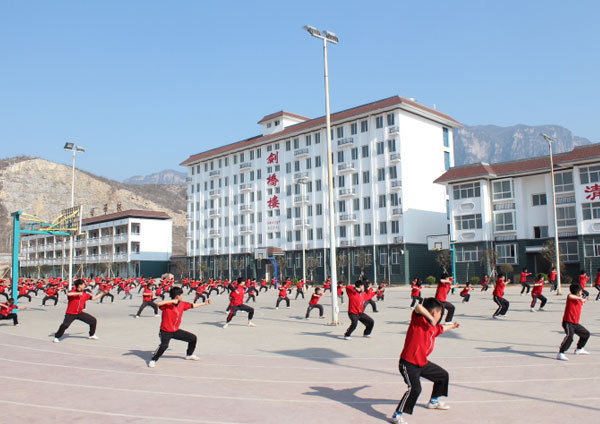
Master Shi Yan Lin is a master with over 10 year experience in teaching to both Chinese and International students Shaolin Martial Arts. The school is located in the famous Yuntai geological park, which attracts thousands of tourists every year and is fairly close to the fabled Northern Shaolin Temple. The Martial Arts training at the school will primarily focus on the various Shaolin fists and weapons as well as Sanda and Taichi. The school building formally a hotel has been converted into student accommodation, as a result the rooms are comfortable and comparatively of a high standard. The newly built training area and performance hall is five minute walk from the main accommodation area, so everything you need is close at hand.

The Chinese language course organised as part of the half martial arts, half language learning programme is available in partnership with Jiaozuo University. These courses can be specially tailored and intensive. This, makes the school a very real prospect for serious Chinese language learners. This close relationship between the martial arts school and the university means that long term student visas can be obtained for long term International students of the school.

The down side to the programme primarily relates to the schools relative isolation and the management insistence for compulsory school line ups throughout the day. Sometimes this can make students feel like they’re prisoners rather than students.

high-speed-premium-vpn-728x90-d5b5ef120ae5ca0c69e501d3a6d39f94

University Programme

Captial University of Physical Education & Sports is one of Beijing’s premier Martial Arts Training Universities providing top-ranking conditions for international and domestic students. The university is supported by Hanban and Confucius Institute offering Chinese Language Learning Programs, Martial Arts University Programs, TCM, Sports & Health Care Programs.

The University offers the following programs; 4 Year Undergraduate Programs, 3 Year Master Programs, 3 Year Ph.D Programs, 1-2 Year Non-degree Programs and Short-term Programs.

The Universities Featured Programs are:

1. Chinese Language Programs
The University employs a special team for teaching Chinese as a Foreign Language. This team is specializes in training international students who want to learn Chinese Culture and speak the Chinese Language. Class sizes are smaller than other universities and attention and help given to students is higher than at other Universities.  Thjs helps to ensure that students acquaire the language competences sufficent for their speciality studies in China. Small classes of differnt levels are provided as well as one-to-one teaching to meet students needs.

2. Martial Arts Programs
According to the period of study students can expect to study martial arts from martial arts champions who are experienced in both teaching and competitions for performance and also sport.

3. TCM Sports Health Care Programs
The instructor for this program is Ru Kai an assistant professor of Sports Rehabilitiation Department of Schools of Sports Science and Health. He is also the successor and master of Xisui Neigong, Baduanjin and Yijinjing.

Screen Shot 2015-08-19 at 22.44.23

One of the main benefits from studying Mandarin at Capital Sports University is obviously the facilities, access to top coaches plus relatively small class size for language learning.

If you would like to learn more about studying martial arts and learning Chinese check out these great articles.

9 Mistakes to avoid when learning Chinese at a Kung Fu School in China

The things Chinese People Say


Demystifying Power Generation: Fali? Fajin? Fa-who-what-where-why?

by Master An Jian Qiu

What is Fali? What is Fajin? Are they the same? Are they different?

A lot of time is spent on power generation at An Wushu. There is, of course, a huge amount of depth to this topic not covered in this article.  This is just a short article as we often receive this question.

(Don’t worry if it doesn’t clear everything up! It’s not supposed to: In the West, we usually Learn then Do. At An Wushu, you Do then Learn: An Shifu will explain a small amount about a concept before showing you how to develop it. You’ll go away and practice it for many repetitions, and then when you have the feeling/experience of it, An Shifu will explain much more and it’ll truly make sense. For kung fu, this is almost always the best way to learn.)

Fali

Fali means to ‘release explosive power’ and is something anyone can do to a certain degree. If you go to the gym and lift a heavy weight off the floor, you are using (a low level of) fali.

Fali is performed by compacting the chi inside the body, and the body itself, then reversing this process to strike the opponent. In this way, fali requires a ‘wind-up’, like stretching your arms back before throwing a ball.

A strike performed with fali is a fairly ‘committed’ strike, meaning that even if your opponent moves during your strike, you are still committed to your path. (Do not think fali is not useful for this reason… a fali strike can still be incredibly fast!)

At An Wushu, we believe fali is best exemplified by Bajiquan. The video below shows some Bajiquan to see fali in action.

Fajin

Fajin is the joining of the whole body together (muscle, bone, tendon, ligament, and Yi [intent]) to send out a huge amount of power over a very short distance. Bruce Lee’s famous 1-Inch Punch is what a high level of fajin looks like.

Fajin can be considered ‘super fali’ as it requires no ‘wind-up’. It will naturally be developed as a practitioner’s body control increases from many hours of fali training, however certain styles train specifically for it.

While a strike performed with fajin does of course have momentum and therefore is ‘committed’ in a sense, a practitioner will be able to change directions very quickly compared to a strike powered by fali.

View the video below to watch some Xingyiquan to see fajin in action. Being a shorter body movement than fali, fajin is easier to feel than see; however, if you watch Xingyiquan after watching Bajiquan, you’ll see the explosive movements in each style have a different quality.

To learn more about An Wushu or how to study with Master An full-time in China visit www.StudyMartialArts.Org we work exclusively to help dedicated students connect to quality martial arts schools. This includes visa assistance and independent information all at no additional cost to you. Check us out with no obligation.

Why people choose us

At StudyMartialArts.Org we are passionate about Martial Arts and Travel. We believe that the combination of both provide a powerful catalyst for greater awareness. Our mission is based on connecting you to the right schools, masters or instructors.

Below you will find a testimonial from one of our past students Arvid Velt. Arvid first joined the SMA 1 month intensive martial arts travel and training tour. On this tour we combine historic sites fun and travel with training with a variety of high level masters throughout China. During that time we assisted him and advised him on the next move to bring his training to the next level.

Arvid at the time of the filming through our support and that of his Master studied in China for two years.

For further information contact us at info@StudyMartialArts.Org or visit our website. www.StudyMartialArt.Org Or why not view our other testimonials here.

The Importance of Hard Qigong in Chinese Traditional Martial Arts

by An Jian Qiu

At An Wushu, we believe that if you want to use your kung fu in combat, you must train hard qigong.

(What is hard qigong? Breathing and conditioning exercises that make your body harder, more resistant to pain, and able to give and take more force without becoming injured. Breaking a brick with your hand is probably the most well-known example.)

Many schools don’t share this belief, so it makes sense you may be wondering why…

Let’s look at a hypothetical scenario: Imagine if you were to go and punch a brick wall as hard as you could, right now. What do you think would happen? You’re probably thinking about:

Hurting your hand badly, maybe even breaking your fingers or wrist
Losing your calm due to the pain
Instinctively hunching over your posture and holding your damaged hand to your chest
Why did this happen?

Obviously, the brick wall was much harder than your hand and wrist… or put differently: your body wasn’t strong enough to deliver your strike.

And what if you’d been fighting a live opponent? Losing focus so drastically can be the difference between life and death or victory and defeat.

Of course, hopefully your opponent isn’t as hard as a brick wall(!), but the difference is small when you’re both moving at high speeds and impacting at the strange angles of real combat, not “straight-on” like when you hit a bag. If you’re unconditioned, it doesn’t take a lot of force to become seriously injured.

Hopefully this has shown you why hard qigong is so important for offense.

What about for defense?

The example is obvious: imagine you get punched in the stomach so hard that you lose track of your senses. The next hit is definitely coming for your head!

At An Wushu, one of the things we recommend all new students do is ask Shiye (Grandmaster) An De Sheng if you can touch his stomach. No, we aren’t crazy… despite being 67-years-old, an age where most will have lost all their muscle mass, Shiye’s stomach is harder than steel from years of hard qigong. (The look of surprise on a new student’s face when they poke Shiye’s stomach is always a fun moment for older students.)

This is what days and days of hard qigong training does to the body: your body becomes not just firm like from working out, but literally hard like iron. This is where the name ‘Iron Body’ comes from.

As you progress through lower levels of training, you’ll find yourself taking less damage: receiving less bruises from sparring and watching them disappear much more quickly.

At higher levels of training, this protects you from even more harm, you heal amazingly quickly, and eventually, your opponent will hurt themselves by hitting you! The level of focus you can now have in training and fighting is what it needs to be for you to reach a truly high level of kung fu skill.

As a bonus, the hard chi that is packed into your body by hard qigong also greatly increases your physical health, your strength and your ability to fali/fajin (generate power). There are schools of Daoism that practice hard qigong purely for its health benefits.

These days, hard qigong isn’t so popular and has been lost from many styles, but in the years of true masters, hard qigong was a core part of all traditional kung fu systems. The ability to survive both your own offence, and your opponent’s, is a non-negotiable for a true fighter.

An Jian Qiu, is the headmaster of An Wushu International Martial Arts School in Dezhou, Shandong Province, China.

For further information on studying at An Wushu or other traditional martial arts schools in China visit www.StudyMartialArts.Org


Timing, Placement and Power

by Sifu Adam Mizner

When I am teaching classes or workshops on taijiquan I always emphasize the three principles of timingplacement and power.

These three skills are not only fundamental to acquiring real world taijiquan skills but are fundamental to the successful application of any martial arts technique.

TIMING

Timing Placement PowerBruce Lee and other famous martial artists often talk about speed as one of the most important attributes of a successful martial artist.  This is not untrue, though I would say that timing is more important than mere speed. It is certainly possible to miss the mark because one arrives too early or is too fast.

Understanding this we should strive to master timing rather than just speed. When we arrive “on time” in this way, our opponent is where we perceived him to be and our technique is neither early nor late.  In tai chi chuan this ‘correct time’ is when the opponent has “fallen to emptiness”, he is off balance and frozen or double heavy.  This is the right time to attack and finish the confrontation. Many attacks delivered with the wrong timing are not as effective as one that is delivered on time, whether it be delivered fast or slow.

PLACEMENT

The skill that is most often overlooked in modern martial arts training is the skill of being in the right place at the right time, not just applying the technique at the right time.  This is referring to the footwork, angle of attack, distance and also the impact area. The training to develop this skill of placement is honed and refined in tai chi chuan within the arena of push hands practice. It is here within pushing hands that we can investigate and ingrain all the different body positions and their advantages and disadvantages.

Push hands allows one to train this in a safe way and to get familiar with the up close and personal fighting range of tai chi chuan, a range that is shared by very few styles, somewhere between the clinch range and the striking range. This taiji range gives us the advantage of being able to strike or throw without changing range and keeps us in a range that most opponents simply are not familiar with.

When you placement is correct you naturally exploit the weakness in your opponent’s structure while capitalizing on the strength of your own.   The application of Da or Fa will leave you in a perfect structure, neither confined nor over extended and the placement and angle of the body and arms should make you as safe as possible, whilst still being able to apply your technique on the opponent.

POWER

It is said in Chinese martial arts that Gong Li or power is the most important skill a martial artist can possess.  I consider this to be absolutely true and in my teaching and training I place a great deal of effort into the development of power.

Just imagine fighting with a small child who has many techniques, has good timing and good placement but lacks power. The child would be unable to finish the fight and we, as grown adults could easily defeat the child simply with power, even with little technique.  This illustrates the importance of Gong Li or power in martial arts.

Waijia cultivates Gong Li with many methods, including various kinds of weight lighting and resistance training, striking bags to develop powerful full body coordination and conditioning of the body to make the body hard and resistant to impact.  Within the Neijia schools the development of Gong li is equally important, however the method to attaining it and the kind of force we generate is very different.  This is where the differentiation between Jin and Li becomes important.  While Li is generated by the contraction of muscle and the acceleration of mass, Jin is generated by the release of tension and the propagation of waves of force through the body.  This topic is beyond the scope of this short article, we can look at it in a future blog.

For practical purposes, in taiji quan the jin is cultivated through the practice of standing pole, form practice and sometimes heavy weapons.  Although the jin is cultivated in such solo trainings it is in the partner practice of pushing hands and fajin that we learn to refine this power and how to apply it with timing and placement. When these three skills of timing, placement and power come together, we have the almost magical looking effortless power that tai chi chuan is famous for.

In the below video you can see a demonstration of timing, placement and power.

Sifu Adam Mizner teaches Yang Style Taijiquan (Tai Chi Chuan), in the tradition of Huang Sheng Shyan and Yang Shao HouWith his Discover Taiji online training programme you will find one of the most complete and powerful traditional Tai Chi Chuan systems available today.  The programme openly provides all of the tools, methods and training secrets his personal students at the Heaven Man Earth Taiji school have been enjoying.

An Family Martial Arts School

Here is our latest StudyMartialArts.Org Video. In this video you’ll see footage from our visit to An Wushu Family Martial Arts School.

An Wushu International Martial Arts School is a kung fu school steeped in family tradition. Located in Prefactured City of Dezhou within Shandong Province the school is just two hours from the capital Beijing by fast train. Dezhou and the School is therefore easily accessible for those wishing to experience traditional Chinese martial arts training.

The school offers both full-time and part-time classes to both Chinese and international students with the international students primarily being taught by An Jian Qiu.

Teaching at the school takes place in a picturesque setting and there is both indoor and outdoor facilities. This school offers a warm welcome to those who are serious about studying martial arts and learning about Chinese culture. Recent improvements to the school mean that it can cater for long term students providing both accommodation and food.

Like and share…


Screen Shot 2015-08-19 at 22.44.23

Can you become a true fighter without great sparring?

by An Jian Qiu,

If you ask any Muay Thai coach… no!

If you ask any Boxing coach… no!

But if you ask some kung fu teachers… the answer is yes?

There are many kung fu schools nowadays who practice applications in a slow, controlled way. This is a great strategy for beginners, who are still learning the movements, but it simply won’t turn you into a real fighter who can compete or defend themselves:

The difference between applying a technique slowly to a willing partner and using a technique in a stressful, high-speed situation is like night and day.

At An Wushu, we believe sparring is of critical importance. A student following our standard schedule performs Sanda (Chinese kickboxing, a mixture of punching, kicking, wrestling and takedowns) 5 days a week: 3 long sessions to build skills and 2 shorter ones to refine them. Most sessions include some sparring and reaction drills.

There are 3 primary reasons for this:

  • There has never been a Grandmaster or Master in the An Family who did not perform true sparring – full speed, full power, trying to overcome an opponent who’s trying to do the same to you
  • There is a difference between moving fast, which you can develop by (for example) hitting a bag, and reacting fast: your ability to see the micro-movements in your opponent’s body and attack them before they can attack you!
  • Imagine you are a champion boxer and are put in a fight with a wrestling champion: very likely, you will hit them often, but they will throw you often, because while you both are very skilled, you may not be used to defending that style of attack. In our current age, most opponents you face will be a boxer, MMA fighter or street fighter. If you haven’t trained these attacks yourself, you won’t see them coming.

At the end of the day, it’s scientific fact that the body develops specifically:

  • If you lift light weights, you won’t be able to lift heavy weights.
  • If you run slowly, you won’t get better at training fast.
  • If you don’t stretch, you won’t become more flexible.

And if you don’t spar… you won’t become a real fighter.

Screen Shot 2015-08-19 at 22.44.23

An Jian Qiu, is the headmaster of An Wushu International Martial Arts School in Dezhou, Shandong Province, China.

For further information on studying at An Wushu or other traditional martial arts schools in China visit www.StudyMartialArts.Org 

Yang Family Fajin

by Sifu Adam Mizner

The idea of fajin is highly debated in Taijiquan circles, where some consider it the be all and end all of taiji quan skill, while others who have never experienced it, consider it a fallacy. In truth, fajin is a fundamental method of taijiquan.

No matter what one might think or argue, the fact remains that fajin is a standard part of the tai chi chuan skill set and has been practiced and developed by tai chi masters since the founding of the art until present day.

Below are excerpts from an article by Li Ya Xuan, one of the top students of Yang Jien Hou and Yang Chen Fu, on Yang family fajin.

2015-06-03-001353_1366x768_scrot

1. “Yang Lu Chan’s fajin was empty, leaving the opponent not knowing what happened or how the jin was released. His jin was so perfected as to be called mysterious.”

2. “Yang Ban Hou’s fajin was SUDDEN, like lightning without rain, emerging from nowhere with the sounds of «Pa!». One fajin would send the opponent out many zhang ( 1 zhang = 3.3 meters). His jin would leave people in pain and injured.”1. Yang Luchan 2. Yang Ban Hou 3. Yang Jian Hou 4. Yang Shou Hou 5. Yang Cheng Fu

3. “Yang Jien Hou would use the lightest of touch, his sticking energy was so high that people could not disconnect, then they would be suddenly released like an arrow from a bow.”

4. “Yang Shao Hou’s jin was ever spontaneous and song to the extreme, fast beyond compare. His body skills were mysterious and treacherous like a ghost appearing and reappearing, fooling his opponents so they would have no idea what was happening or how to defend themselves until they had fallen to his jin before even knowing it.”

5. “Yang Chen Fu’s fajin was powerful with great sudden dantien force. Before he would fa there was a deep intention; when he would fa it was like Guang Gong taking off a head with a single stroke…”

6. “Wu Hui Chuan used song elastic energy preferring to use just a little jin to send his opponents out, he did not lose face as a student of the Yang family. His students could produce long jin, both song and sunk, not bad.”

7. “Cui Yi Shi was skilled in fajin both song and sunk. Before he would fa he would inhale one time and use the elastic jin. His jin was song and springy, propelling his opponent away. On release the jin would cause the opponent to release a sound from the mouth as the wind was knocked from them. This is the kung fu of the qi striking the qi.”6. Wu Hui Chuan 7. Cui Yi Shi 8. Li Xiang Yan 9. Dong Ying Jie 10. Zheng Man Qing 11. Tian Zhao Lin 12. Li Ya Xuan

8. “Li Xiang Yan in his youth studied and trained deeply in long fist, after which he followed Yang Feng Hou taijiquan and achieved great gong li. He was dedicated to study and practice and achieved jin that was full and hard, penetrating deep inside the opponent. Later he bowed to Yang Chen Fu as his teacher.”

9. “Dong Ying Jie liked to use Rou Cou Jin, pressuring his opponent from side to side, forward and back until they fell defeated.”

10. “Zheng Man Qing would use light touch and clean sticking energy, entering close with his body before firing the opponent out with jin. He was small but had kung fu and courage and was skilled at penetrating the defense of his opponents.”

11. “Tian Zhao Lin’s kung fu was soft and penetrating, breaking his opponents as they were knocked down, amongst other skills.”

12. “I myself Li Ya Xuan use many strange changes, making it difficult to follow. The jin is fast like lighting. I don’t like to just play sticking and circling.”

As a picture is worth a thousand words and a video worth a thousand pictures, here are some videos of past taiji masters demonstrating fajin,

Wang Yong Quan – student of Yang Jien Hou, Yang Shao Hou and Yang Chen Fu:

Dong Hu Ling – son of Dong Ying Jie:


Ma Yue Liang
 – Student and step son of Wu Jian Quan:


Fang Ning
 – student of Cui Yi Shi:


Yang Jien Hou
 said:

When you hit people with Fa Jin it must cause both your opponents feet to leave the ground and jump back. They should feel pain on both feet (because of jumping) but not on the contact point, they just feel it as soft and fast. This is correct!! “

We can see examples of this correct fajin in the videos above as well as demonstrated by some present day teachers. Real taijiquan fajin is not lost.

Translation: Adam Mizner, from Thai, with assistance from 梁德华, the original translator from Chinese original article from 杨氏太极拳诠真 by 陈龙骧

Works cited: Chen, Long Xian. Yang Family Tai Ji True Transmission. Beijing: Beijing Physical Education University, 2008. Print. 陈, 龙骧. 杨氏太极拳诠真. 北京: 北京体育大学, 2008. 打印

This article was written by Sifu Adam Mizner. 

Sifu Adam Mizner teaches Yang Style Taijiquan (Tai Chi Chuan), in the tradition of Huang Sheng Shyan and Yang Shao HouWith his Discover Taiji online training programme you will find one of the most complete and powerful traditional Tai Chi Chuan systems available today.  The programme openly provides all of the tools, methods and training secrets his personal students at the Heaven Man Earth Taiji school have been enjoying.

How an American Dancer Introduced Tai Chi to America

In 1954, at the Museum of Modern Art in New York City, a 51-year-old woman in loose, comfortable clothing moved through a series of movements. A crowd gathered amidst abstract paintings to watch her. With the grace of a dancer, she slowly raised and lowered her hands, shifted her weight from side to side, and bowed her head. Her face was calm and serene.

The woman’s name was Sophia Delza. She was a dancer of some renown in the world of modern dance. When she first performed solo at the Guild Theater in New York at age 27, the New York Times called it “a distinguished debut” that “revealed her as an artist of individuality and authority.”

Although the woman’s slow pace would have bored a concert hall audience, her practiced movements radiated power. She moved like a coiled spring, full of harnessed energy. To the MoMA audience in 1954, Delza’s demonstration was a novelty. Today, many Americans would instantly recognize that she was demonstrating tai chi, the Chinese martial art.

Americans often don’t think of tai chi, which is commonly practiced by senior citizens in public parks, as a martial art. Although many variations exist, tai chi fundamentally involves moving slowly and fluidly through postures with names like “The Snake Creeps Down” and “The Golden Cockerel Stands on One Leg.” Tai chi often looks more like slow yoga than judo or karate-two martial arts that involve kicking and grappling. For this reason, many people practice tai chi as a gentle exercise, without any interest in its martial component.

Photo by Jakub Haiun

Yet tai chi has been translated as “supreme ultimate fist” and “great extremes boxing.” As practitioners like Sophia Delza understood, tai chi’s slow pace represents control-not weakness. Mastering the movements allows devotees to develop strength, balance, and a unity between mind and action. This is useful for both longevity and self-defense-and tai chi training that involves sparring and weapons.

In the 1950s, Eastern martial arts, and particularly tai chi, were not well known. Sophia Delza’s 1954 performance at the Museum of Modern Art was likely the first public demonstration of tai chi in the United States. Delza had studied tai chi with a master of the Wu style while living in China. When she taught, demonstrated, and wrote about tai chi on her return to the United States, she was one of the first, if not the first, to do so extensively outside Chinese-American communities.

This makes Sophia Delza a pioneer of American tai chi. Although she never achieved the fame of martial arts legends like Bruce Lee, she is worth remembering. Like tai chi, she had a gentle side that hid a powerful will. Delza loved dance, wrote academically, and de-emphasized the martial applications of tai chi. She was also one tough lady: Although American women did not have the right to vote until Delza was 17-years-old, she engaged in radical politics that made her a federal person of interest, and burst through barriers to forge a career in dance and, ultimately, as a mother of American martial arts.

Well-Behaved Women Seldom Make History

Long before Peggy Olson broke the glass ceiling at the Sterling Cooper ad agency in Mad Men, Sophia Delza lived the mantra “well-behaved women seldom make history.”

Delza was born in Brooklyn in 1903, an environment likely to produce an artist, but not a martial artist. She majored in the sciences at Hunter College, a women’s college, but pursued dance due to the influence of her older sister Elizabeth, who became a professional dancer and Sophia’s first dance teacher.

When Sophia followed her sister’s footsteps, she had to compete for a limited number of professional dance opportunities. She took a variety of jobs in plays and films until she triumphed with her successful solo performance at the Guild Theater in New York. When she next performed a series of original compositions, a New York Times reviewer praised her “strong feeling for visual line” and “general good taste.” Delza also developed a performance style that mixed monologues and dance, studied composition in Paris, and traveled to Mexico to study folk dances.

Her career was remarkable in an era when less than a third of women worked. It is downright daring when you consider that her work was very political-and that she kept at it despite the risk of rabid anti-communist backlash.

Delza did not study folk dance in Mexico merely out of artistic interest. According to scholar Ellen Graff, Delza associated with a close community of artists who supported socialist and communist causes. Delza studied folk dance to make a proletariat argument for embracing traditional dances by describing them as “mass dances” that could unite communities. When civil war broke out in Spain in 1936-and became a cause celebre among artists and intellectuals-Delza created and performed works that criticized the fascism of General Franco and raised money for the leftist forces in Spain that opposed him. Later in her life, Delza donated time in her dance studio to radical dance groups.

Today communism and socialism are only associated with the failings of the Soviet Union, but in the 1920s and 1930s, they represented progressive politics. The American Communist Party organized marches of tens of thousands to advocate for the unemployed. Nearly every intellectual, including George Orwell and Ernest Hemingway, admired or supported socialism.

The 1920s was also the beginning of the Red Scare and apocalyptic fears over the spread of communism in America. Both Sophia and her sister Elizabeth were the subjects of reports for the House Un-American Activities Committee, which investigated “disloyalty” and “subversive activities” among American citizens and leftist groups. Sophia’s brother Leo Hurwitz (Sophia had adopted Delza as a stage name), an award-winning documentary filmmaker, also appeared in the reports and was blacklisted by the film industry in the 1950s due to his political views.

This opposition to radical politics does not seem to have stopped Sophia or her siblings. In an interview, Sophia’s nephew explained that Sophia and his father Leo “felt… that they really could change the world.” The Communist Party in America, he continued, “spanned progressive causes like the desire to fight Fascism as it was growing in Europe, the growth of unions, the desire to stop people from being evicted from their houses, and the movement for racial justice.”East Meets West

In 1948, at age 45, Sophia Delza was married and moved to Shanghai with her husband, Cook Glassgold. China was recovering from its occupation during World War II, and Glassgold had a diplomatic posting as Director of International Refugee and Relief Operations. During the couple’s four year stay, however, Delza did much more than appear on her husband’s arm at official functions.

Delza engaged in a vigorous cultural exchange. She taught modern dance, which was novel in China, and studied and learned Chinese dance and theater. Her zeal for exploration changed her life during a trip to Beijing, where she discovered tai chi. Delza later wrote about the dramatic scene she stumbled upon at dawn in T’ai Mizo Park:

Dozens of people, young and old, were each doing his exercise, each clearly centered on himself. No outside sound of voice or instrument directed the movement. The slow, continuous flow of form and the impeccably even tempo seemed to come not only from some mastey within each one but also from the intrinsic nature of the action itself.

Delza was fascinated. “Looking amazingly light and stable at the same time,” she recalled, “each person’s movements seemed effortless.”

Screen Shot 2015-08-19 at 22.04.55

In context, it seems obvious that a modern dancer would be one of the first outsiders to appreciate tai chi. When Delza described her “first unforgettable impression” of the Chinese Theater in Peking, she wrote, “The colorful creatures moved so quickly that it seemed the stage itself were revolving.” Her recollection of the next scene marvels at the same slow, graceful aspects that struck her when she saw tai chi:

A simple, elegant figure, entering from the upstage right corner, quietly took a deliberate pose. He balanced himself on one leg, and extended the other in easy lightness, head high. Then replacing his leg in slow motion, he moved diagonally across the stage with the restraint and simplicity and… grace of a fairy-tale god.

At the Beijing park that morning, Delza quickly realized that “it was not dance [she] was seeing.” Yet she wanted to know more. She was introduced to Ma Yueh-liang, a famed teacher of tai chi in the Wu style, and his wife Wu Ying-hua, his co-instructor. She convinced the couple to teach her, and took up regular practice.

As Ben Judkins notes in a blog post about Sophia Delza, this put her in the unique situation of receiving several years of training “directly from one of the most talented martial artists of his generation.” She came to appreciate how, in her words, maintaining “a consistently slow tempo” in tai chi “is an indication, not only that the body has acquired strength and control, but also that the mind is in harmony with the action.”

When Delza and her husband returned to New York in 1951, she had trained for years with a foremost authority on Wu tai chi, and knew more about the practice and philosophy of tai chi than almost any American.

Bringing Tai Chi to Manhattan

In the 1950s, the practice of Eastern martial arts existed in the United States, but it was not widespread.

Hundreds of thousands of mainly Chinese immigrants passed through San Francisco’s Angel Island from 1910 to 1940, bringing with them martial arts like tai chi and judo. American soldiers stationed in Japan after the war returned to open dojos. Gene Lebell-who is now a mixed martial artist famous for teaching Chuck Norris and allegedly choking out Steven Seagal until he soiled himself-won an amateur National Judo Championship held in the United States in 1954.

But Americans like Lebell-who learned Eastern martial arts despite being outsiders to Asian communities-were rarities. Choy Hok Pang, a well-known, early teacher of tai chi in 1940s America, taught almost entirely Chinese students until the 1960s. It was not until Bruce Lee and Hong Kong “kung fu” films exploded in popularity in the 1970s that Americans widely adopted martial arts training. Some casual histories of tai chi simply write that it was introduced to the United States in the 1970s.

When Delza returned to New York from China in 1951, it was in this environment in which martial arts, and particularly tai chi, were known but relatively unfamiliar outside Asian communities.

The cover of Sophia Delza’s book, the first tai chi book published in English

Delza acted as a cultural emissary on her return, lecturing, writing, and teaching tai chi and Chinese theatre. Ultimately tai chi became her main focus.

The initial response was modest. One early student at the tai chi school Delza opened in New York regretfully recalled that her classes were poorly attended. When Delza performed tai chi at the Museum of Modern Art, it was the first demonstration of its kind, but also seems to have been a minor event. The demonstration does not turn up in the MoMA’s archived schedules from 1954, and one author credits Delza with giving the first public demonstration of tai chi in the United States two years later at the United Nations.

This did not deter Delza, who kept teaching and writing. In 1961, she published the first English language book about tai chi. As the popularity of tai chi and martial arts increased in the 1960s, partially thanks to her efforts, she appeared on television and her tai chi school thrived.

Her influence can be seen in a 1960 Popular Mechanics article about tai chi that is unmistakably a trend piece. The author-who breathlessly writes that “In Shanghai, where matches have been held, no Western boxer has yet beaten a boxer who trained on T’ai Chi to get balance and power”-makes Sophia Delza the focus of his article. He notes that her television appearances result in hundreds of inquiries from around the country, and that her students include “stage and screen stars.” Another article from 1963 relates that tai chi schools are overflowing with more students than teachers like Sophia Delza can handle.

If Bruce Lee-who more than anyone popularized martial arts in America through karate competitions and action films-was a Hollywood blockbuster or comic book, then Sophia Delza was an art film or New Yorker article. Delza taught from a studio in Carnegie Hall, which members of the Actor’s Guild could attend for free, and instructed celebrities and famous actors. In a move that foreshadowed Americans’ adoption of yoga purely as an exercise, Delza de-emphasized the martial aspects of tai chi in favor of its health and concentration benefits. Yet she always retained her academic bent, writing about the philosophy and history of tai chi in journals and books.

Sophia Delza’s role was to be one of the first advocates for tai chi, and to translate it for a non Chinese-American audience. At a time when articles marvelled at an exercise that did not involve barbells, medicine balls, or even sweat, Delza told her students that “We in the West are apt to overexert ourselves in exercise and sports, believing that a hard, tense movement indicates strength.” In tai chi, she continued, true strength, energy, and balance comes from exercise that does not strain the muscles or leave one winded.

Delza also lamented that “Too often I am asked no question other than whether this or that movement will make one thin.” She challenged her American students to appreciate other benefits of exercise, including the mental challenge of perfecting the tai chi postures.

Despite her academic inclinations, Sophia Delza is remembered as a teacher more than a scholar. Today, former students leave warm comments on blog posts about Delza that praise her instruction. One man who studied with Delza when she was in her eighties remembered her as “a tough lady” who taught tai chi “the same way a ballet master would teach.”

In 1996, Sophia Delza passed away. It had been almost 50 years since she first saw tai chi performed at dawn in T’ai Mizo Park, and she had spent over three decades as an instructor. When Delza published her first book in 1961, she had to explain every aspect of tai chi. The year she died, the State University of New York Press published her final book on tai chi. By then, it was almost impossible to imagine an America where people did not know about tai chi or martial arts. Few people know it, but that is Sophia Delza’s legacy.
A guest post from www.udemy.com – We’re the world’s online learning marketplace, where 8 million+ students are taking courses in everything from programming to yoga to photography–and much, much more. Each of our 32,000+ courses is taught by an expert instructor, and every course is available on-demand, so students can learn at their own pace, on their own time, and on any device.

Screen Shot 2015-08-19 at 22.04.55

Wudang Gong Fu & Health Academy

For sometime I’ve been looking to connect to the best Wudang Kung Fu schools located on Wudang Shan. Using the StudyMartialArts.Org network of respected fellow martial artists, friends and kung fu brothers I’ve researched visited and connected to a number of schools over the years.

One of the best on Wudang Shan that we have recently connected to is Master Tang’s academy close to Taichi Lake.

The Wudang Gong Fu & Health Academy is a small school with a detailed and structured education program.

Students who wish to enter and be accepted onto one of their special education programs covering the essential training of Wudang Xuan Wu Pai have the chance of becoming a Wudang Disciple and genuine linage holder of Wudang Internal Martial arts. Pending suitable performance and dedication of course.

The headmaster Tang Li Long is one of the main disciples of Grand Master You Xuan De. Master Tang has years of experience teaching Internal Wudang Martial Arts. He has created a system that teaches the essence effectively and under his guidance students will learn the tradition preserved on the mountain.

Tang Li Long’s vision is to spread the Wudang Daoist knowledge around the world in order to preserve the traditional teachings of dào fǎ zìrán ”the natural way” (道法自然) and the 10 Taoist principles of Wudang Pai. His school has a family feel to it where kung fu brothers and sisters from different countries, backgrounds and experiences can all share their knowledge in order to better understand the way of the Dao.

tll-200415

ABOUT MASTER TANG LI LONG

Master Tang Li Long is a 15th generation Wudang Daoist Martial Arts Master of the Xuan Wu Pai. Encouraged by his father he started training Martial Arts in his home town at a young age. Later, after studying Wudang Taiji Quan in Wuhan for a well known master he was told to go to Wudang Mountain to become a Wudang Disciple. He’s master sent a mail to the Wudang Shool of Martial Arts and some time later he was invited to come and study for 14th generation Wudang Master You Xuande, who was the Abbot of the Wudang Temples and the keeper of the Wudang Martial Arts.

Wudang Disciple 1994 he arrived at Wudang Mountain and started to learn from Grand Master You. After a long time of hard training Master Tang became one of the main diciples of You Xuande. With a genuine background with in Taiji Quan his skills and understanding where different from other students. He worked close to Master You and helped him write down ideas about Martial Arts and Daoism. Tang Li Long is now one of the “5 Dragons of Wudang” and a linage holder of the Wudang Xuan Wu Pai. 1998 he won a Medal in the 1st World Traditional Wushu Championships and 1999 he was awarded as a outstanding Master in a big Wudang Taiji Quan gathering.
p505_d20120809161424
Tang Laoshi, Master Tang Li Long, or “Tang Laoshi” as most people call him, has almost 20 years of experience of Wudang Martial Arts and have a system of teaching that is different from other schools on the mountain. He teaches the foundations of the style and focus on Basics, Qi Gong and Applications. His long time students has won many competitions and gained high skills in Wudang Wushu. His main skill is his ability to bring out good quality of the training and the students and teach the essence of Wudang Internal Martial Arts. He holds a position as secretery of the International Wudang Mountain Taiji Gongfu Association and have done performances in China, Korea and Germany. He has publiced articles in the Chinese Martial Arts Wudang Wind Magazine and Hubei Daily Newspaper. He was mentioned in a book about famous Gongfu Masters in 2010 (“Chinese Folk/Unofficial Gongfu Masters” – “Zhongguo Mingjian Wushu Mingjia”). In 2010 set up the school and the present location in Wudangshan, same year his student Jakob Isaksson, Sweden, won a Silver and Brons Medal in the 4th World Traditional Wushu Championships.

Tang Li Longs philosophy is to wholeheartedly train the disciples and carry on the tradition.

Learn more about Master Tang’s Academy including full training curriculum and prices.