An interview with Marc Meyer the writer of Taichi: The Story of a Chinese Master in America

Last month I had the pleasure of interviewing Marc Meyer a writer, martial artists and musician about his latest book Taichi: The Story of a Chinese Master in America.

Marc’s novel tells the story of a man who leaves China in the early 1960’s to open a T’ai Chi school and reconnect with his Asian American family in Chinatown, New York City. The main character in the story was once the bodyguard of Mme Chiang Kai Shek. It’s bright red cover below spells out the words T’ai Chi Chuan in Chinese pictograms. And the novel is a must read for lovers of tai chi  and Asian American fiction alike. It was inspired by the legendary T’ai Chi grandmaster Cheng Man-Ching and his American students during the period of the 1960’s in New York City. It tells of a time, years before the advent of Bruce Lee movies, when the Kung Fu art of T’ai Chi Chuan was first introduced into the United States and was secretly practiced only in small enclaves of America’s Chinatowns.

Marc can you tell me little about your book? And some of the Characters in it?

Allow me to reiterate my book is a work of fiction.  As you are possibly aware, authenticity when it comes to T’ai Chi Chuan in and of itself is a murky business, due mainly to the fact that much of the teaching we have was passed down to us orally by it’s forebears. Very little about it was actually written down. Many of the forebears of T’ai Chi chuan were illiterate and its origins go back several thousand years. This makes the art form somewhat mysterious which is actually what I like about it. I’ve found Douglas Wyle’s books to be one of the more reliable sources of reference when it comes to the origins and practice of T’ai Chi Chuan, specifically Yang style which I practice and one that I draw upon recurrently in my book. Specifically on the subject of Yang style T’ai Chi which I’ve been practing and studying for the past 18 yrs. Let me stress that study and practice of T’ai Chi should occur simultaneously and continuously for the dedicated teacher.

In the book, a T’ai Chi master named Kuo Yun San leaves mainland China in the 1960’s for what he thinks is the last time. His goals are simple, he envisions opening a successful T’ai Chi school and strengthening the bonds between himself and his Asian American family in Chinatown with whom he has had little to no communication in years.  The results are surprising as Master Kuo finds himself trading one Cultural Revolution for another and his newfound friends and family members, thinking they were going to educate him into adopting an American lifestyle, find he has more to teach them.

From some of the details in your book its obvious you have a solid martial arts background. Can you tell me about your own martial arts experience? 

I came to T’ai Chi Chuan through the back door in a sense. A dining club my girlfriend and I belonged to offered lessons in T’ai Chi on the beach where I live in Naples Florida as one of the perks of its membership. Fortunately for me, though I didn’t know it then, both instructors who taught this class had been students of Bob Amaker, a resident of Florida who co-authored books with Cheng Man-Ching. Cheng Man-Ching was one of the main proponents of Yang style T’ai Chi Chuan in this country. I subsequently went on to receive what’s known as form correction from Lawrence Galante, a student himself of four T’ai Chi Chuan grandmasters, Paul Guo, Yu Chen Hsiang, TsunTsai Liang and Chen Man-Ching. I received final instruction from a first generation student of Professor Cheng as he was called, from Maggie Newman, one of his last living pupils in 2006, then in her mid eighties.

In your book you discuss the student teacher relationship. Can you tell us a bit more about where that inspiration came from?

It’s my firm belief that every teacher involved with T’ai Chi has something to contribute to the student’s education, although many times the approaches can be radically different and often make a student doubtful about the quality of instruction that he or she is receiving. If you are getting instruction from someone in Taichi you’re unsure about, my advice is to be patient and hang in there. Looking back you may find what they had to teach gave you useful insight even if you didn’t think so at the time. For example one of my teachers had a very holistic and somewhat esoteric approach but I learned much from him about some of the more mystical aspects of T’ai Chi I might not otherwise have been privvy to. Another was very “nuts and bolts” about his approach but taught me the kind of accuracy that is absolutely essential for the study and practice of the art. I actually recommend that if you intend to take up T’ai Chi as a practice, that you go out of your way to learn from different teachers because you can often come away with a rounder and more beneficial education from doing so. Remember if you take up the practice of T’ai Chi you’re in it for the long haul. It can take up to a year to learn just one single form properly and up to ten years to learn it as an applicable martial art. “It’s all about the journey” sounds cliched but in the case of T’ai Chi it’s absolutely true and ongoing. You’re constantly perfecting and polishing that stone every day week, month and year of your life, which for me has turned out to be a blessing and one of it’s most cherished aspects.

62a22866b19fa96e64dbe979ed370b60

The book mentions a number of important martial arts milestones. Can you share a few of the most important ones?

Another one of the more interesting perspectives of this fascinating, mystical and multi-faceted art is its tendency to tailor itself individually to the practitioner. For me it has offered something of use from a health standpoint at almost every age related juncture of my life since i began practicing it in my early forties. In my forties I struggled with the onset of tinnitus, a horrible and constant high pitched ringing in the ears. T’ai Chi helped to calm me down, calm my anxious feelings about it and sleep better. After I found I could sleep more easily, the problem didn’t seem to bother me so much during the day and has finally faded into the background to the point where I don’t even notice it anymore. Another more serious problem developed when I turned sixty called Neuropathy. Another constant painful nerve related chronic disease which had equilibrium problems as one of it’s symptoms. It has taken a full year but thanks in part to Taichi I have been able to manage my symptoms and get them under control. When the doctor later asked me if if I wanted to take a class in learning how to keep my balance to prevent myself from falling I was happy to tell her “I TEACH balance!”.T’ai Chi Chuan is literally the gift that keeps on giving.

Finally, what’s next for Marc Meyer?  Do you have other books in the pipeline?

I have at least three more novels in me that I have begun working on simultaneously. One is a memoir, one is about an elderly batchelor who finds his way toward the end of his life and one is a young adult novel about five very unusual preteens in the possesion of individual healing powers. Of course getting ideas is easy, setting them down in a readable form that will capture an audience’s interest is very hard.

You can find Marc’s book here by clicking the amazon link  to the left. Any purchase you make via the affiliate link we will put back into www.StudyMartialArts.Org in order to help more students connect with genuine Master of Martial Arts.


Can you become a true fighter without great sparring?

by An Jian Qiu,

If you ask any Muay Thai coach… no!

If you ask any Boxing coach… no!

But if you ask some kung fu teachers… the answer is yes?

There are many kung fu schools nowadays who practice applications in a slow, controlled way. This is a great strategy for beginners, who are still learning the movements, but it simply won’t turn you into a real fighter who can compete or defend themselves:

The difference between applying a technique slowly to a willing partner and using a technique in a stressful, high-speed situation is like night and day.

At An Wushu, we believe sparring is of critical importance. A student following our standard schedule performs Sanda (Chinese kickboxing, a mixture of punching, kicking, wrestling and takedowns) 5 days a week: 3 long sessions to build skills and 2 shorter ones to refine them. Most sessions include some sparring and reaction drills.

There are 3 primary reasons for this:

  • There has never been a Grandmaster or Master in the An Family who did not perform true sparring – full speed, full power, trying to overcome an opponent who’s trying to do the same to you
  • There is a difference between moving fast, which you can develop by (for example) hitting a bag, and reacting fast: your ability to see the micro-movements in your opponent’s body and attack them before they can attack you!
  • Imagine you are a champion boxer and are put in a fight with a wrestling champion: very likely, you will hit them often, but they will throw you often, because while you both are very skilled, you may not be used to defending that style of attack. In our current age, most opponents you face will be a boxer, MMA fighter or street fighter. If you haven’t trained these attacks yourself, you won’t see them coming.

At the end of the day, it’s scientific fact that the body develops specifically:

  • If you lift light weights, you won’t be able to lift heavy weights.
  • If you run slowly, you won’t get better at training fast.
  • If you don’t stretch, you won’t become more flexible.

And if you don’t spar… you won’t become a real fighter.

Screen Shot 2015-08-19 at 22.44.23

An Jian Qiu, is the headmaster of An Wushu International Martial Arts School in Dezhou, Shandong Province, China.

For further information on studying at An Wushu or other traditional martial arts schools in China visit www.StudyMartialArts.Org 

Yang Family Fajin

by Sifu Adam Mizner

The idea of fajin is highly debated in Taijiquan circles, where some consider it the be all and end all of taiji quan skill, while others who have never experienced it, consider it a fallacy. In truth, fajin is a fundamental method of taijiquan.

No matter what one might think or argue, the fact remains that fajin is a standard part of the tai chi chuan skill set and has been practiced and developed by tai chi masters since the founding of the art until present day.

Below are excerpts from an article by Li Ya Xuan, one of the top students of Yang Jien Hou and Yang Chen Fu, on Yang family fajin.

2015-06-03-001353_1366x768_scrot

1. “Yang Lu Chan’s fajin was empty, leaving the opponent not knowing what happened or how the jin was released. His jin was so perfected as to be called mysterious.”

2. “Yang Ban Hou’s fajin was SUDDEN, like lightning without rain, emerging from nowhere with the sounds of «Pa!». One fajin would send the opponent out many zhang ( 1 zhang = 3.3 meters). His jin would leave people in pain and injured.”1. Yang Luchan 2. Yang Ban Hou 3. Yang Jian Hou 4. Yang Shou Hou 5. Yang Cheng Fu

3. “Yang Jien Hou would use the lightest of touch, his sticking energy was so high that people could not disconnect, then they would be suddenly released like an arrow from a bow.”

4. “Yang Shao Hou’s jin was ever spontaneous and song to the extreme, fast beyond compare. His body skills were mysterious and treacherous like a ghost appearing and reappearing, fooling his opponents so they would have no idea what was happening or how to defend themselves until they had fallen to his jin before even knowing it.”

5. “Yang Chen Fu’s fajin was powerful with great sudden dantien force. Before he would fa there was a deep intention; when he would fa it was like Guang Gong taking off a head with a single stroke…”

6. “Wu Hui Chuan used song elastic energy preferring to use just a little jin to send his opponents out, he did not lose face as a student of the Yang family. His students could produce long jin, both song and sunk, not bad.”

7. “Cui Yi Shi was skilled in fajin both song and sunk. Before he would fa he would inhale one time and use the elastic jin. His jin was song and springy, propelling his opponent away. On release the jin would cause the opponent to release a sound from the mouth as the wind was knocked from them. This is the kung fu of the qi striking the qi.”6. Wu Hui Chuan 7. Cui Yi Shi 8. Li Xiang Yan 9. Dong Ying Jie 10. Zheng Man Qing 11. Tian Zhao Lin 12. Li Ya Xuan

8. “Li Xiang Yan in his youth studied and trained deeply in long fist, after which he followed Yang Feng Hou taijiquan and achieved great gong li. He was dedicated to study and practice and achieved jin that was full and hard, penetrating deep inside the opponent. Later he bowed to Yang Chen Fu as his teacher.”

9. “Dong Ying Jie liked to use Rou Cou Jin, pressuring his opponent from side to side, forward and back until they fell defeated.”

10. “Zheng Man Qing would use light touch and clean sticking energy, entering close with his body before firing the opponent out with jin. He was small but had kung fu and courage and was skilled at penetrating the defense of his opponents.”

11. “Tian Zhao Lin’s kung fu was soft and penetrating, breaking his opponents as they were knocked down, amongst other skills.”

12. “I myself Li Ya Xuan use many strange changes, making it difficult to follow. The jin is fast like lighting. I don’t like to just play sticking and circling.”

As a picture is worth a thousand words and a video worth a thousand pictures, here are some videos of past taiji masters demonstrating fajin,

Wang Yong Quan – student of Yang Jien Hou, Yang Shao Hou and Yang Chen Fu:

Dong Hu Ling – son of Dong Ying Jie:


Ma Yue Liang
 – Student and step son of Wu Jian Quan:


Fang Ning
 – student of Cui Yi Shi:


Yang Jien Hou
 said:

When you hit people with Fa Jin it must cause both your opponents feet to leave the ground and jump back. They should feel pain on both feet (because of jumping) but not on the contact point, they just feel it as soft and fast. This is correct!! “

We can see examples of this correct fajin in the videos above as well as demonstrated by some present day teachers. Real taijiquan fajin is not lost.

Translation: Adam Mizner, from Thai, with assistance from 梁德华, the original translator from Chinese original article from 杨氏太极拳诠真 by 陈龙骧

Works cited: Chen, Long Xian. Yang Family Tai Ji True Transmission. Beijing: Beijing Physical Education University, 2008. Print. 陈, 龙骧. 杨氏太极拳诠真. 北京: 北京体育大学, 2008. 打印

This article was written by Sifu Adam Mizner. 

Sifu Adam Mizner teaches Yang Style Taijiquan (Tai Chi Chuan), in the tradition of Huang Sheng Shyan and Yang Shao HouWith his Discover Taiji online training programme you will find one of the most complete and powerful traditional Tai Chi Chuan systems available today.  The programme openly provides all of the tools, methods and training secrets his personal students at the Heaven Man Earth Taiji school have been enjoying.

Want to be a kung fu master? Stand on your head for hours and sleep on a plank

Interview by  from the Guardian

Londoner Matthew Ahmet left school at 16 to learn kung fu at China’s famous Shaolin temple. After years of gruelling training he now makes a living from performing with the monks around the world

I have always loved martial arts. Growing up I was inspired by Bruce Lee movies and I began training at the age of six, studying karate, win chung and others. Then when I was 11 the Shaolin monks put on a UK show for the first time. Seeing martial arts on TV was one thing, but seeing these guys perform incredible feats – such as a one-finger handstand – just blew me away. It gave me the long-term dream to want to travel to China and make martial arts my livelihood.

When I was 16 I decided to move to China. School wasn’t necessarily negative but it wasn’t challenging me and I felt bored. I was doing well but every year I was counting down the days until the chance I could pursue martial arts. I was always told to wait and that it was going to get better – but I just didn’t feel like it was the right path for me.

Shaolin temple training

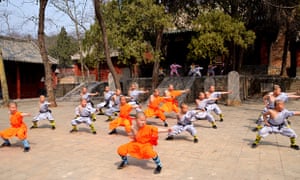
When I arrived at the temple, I was thrown in the deep end. Straight away you’re waking up at 5am and training 10 hours a day. It’s very intense and the level of discipline and focus is extremely different to what we’re used to in the UK. It’s strict with a lot of punishment. If you’re not lined up on time in the morning, you get beaten with a stick. I didn’t see any abuse but I did see a lot of discipline. Everyone knew that if they stepped out of line they would be getting punishment. It was either some sort of beating, or you were made to hold a headstand on concrete for hours on end. Which is extremely painful. So that aspect of it was shocking.

It was a culture shock. In western cultures, it’s all about looking good and feeling good – but in eastern cultures it’s about being the best you can be. Everything was about how you can get rid of that ego. In the UK I had everything – PlayStations and TVs – but I didn’t even make my bed. In China I had nothing. My thin bed was just a plank of wood with bed sheets that had to be folded every morning. Living like that at the start was challenging. Forget the training, just the lifestyle change was immense.

I never wanted to leave, but I did miss home. You get lonely at the start, but what kept me going were the others training alongside me, some of whom were as young as five years old. When I was struggling to balance a handstand, I would look to my left and see two five-year-olds just holding it. They were also in pain, but their focus allowed them to push through it and achieve their goal. There were times when I felt like giving up, but I think being in that community motivates you. It’s a very close relationship – you live, sleep and train with these guys. They’re your brothers.

When I started to do small performances around different provinces in China, I felt like I’d made it. I had always wanted to become a Shaolin monk and now I was living in the temple and learning their philosophy. It really felt like the pinnacle of my journey.

Screen Shot 2015-08-19 at 22.04.55

My career highlight was appearing in the Wheel of Life show. It was just incredible because that was the same show that inspired me when I was young. And 10 years later my wheel of life had continued to turn and I ended up being in the very same show. So it really touched my heart and gave me focus and passion for what I was doing.

Kung fu is something that anyone can put their mind to. All you have to do is remember that without struggle there is no progress. It’s not going to be easy, but with hard work and dedication you can achieve anything.

If you want to become a Shaolin monk, you can’t rely on your teachers. You personally have to give it 100% and make it happen. And don’t listen to anyone who tells you no or gives you any negativity, they will be the same people congratulating you 10 years on.

Matthew Ahmet is a London-born practitioner of Shaolin kung fu, and performs shows with the Shaolin temple worldwide. In 2009 he set up the Shaolin temple Cheshunt, home to the Shaolin Warriors London.

Original article – http://www.theguardian.com/careers/2015/nov/03/want-to-be-a-kung-fu-master

Fascia. What is it and why should I care?

by Luke Sherrell / Director of Operations class

AMN Academy

spot-14-infraspinatus-main-m

What do you think is more important, Strength and Power, or Coordination and Flexibility?

It depends on the goal I hear you cry! Plus, how strong or how flexible are we talking here? There is a big difference between achieving box splits when compared with touching your toes or bench pressing 200kg’s vs nailing a pull up.

These are fair comments so let me put this another way. If you could be naturally gifted with strength and power or coordination and flexibility, which would you choose?

In the absence of specific goals, the way I’d answer this question is to consider which of the movement qualities are the most difficult to acquire? Without wishing to upset vast numbers of strength and conditioning enthusiasts and coaches, having worked with hundreds of clients for many years, I am inclined to say that it is a simpler process to gain strength and power than it is to become more coordinated and flexible!

Note that I said simpler and NOT easier.

The pursuit of high levels of strength is hard work but if you utilise a progressive training system that involves the manipulation of intensity (load) and volume, over time, you will get stronger. If you also practice moving quickly while applying force, you will become more powerful. I would also like to point out that depending on the individual, the constant pursuit of these two qualities exclusively is often to the detriment of overall movement quality.

Flexibility, mobility and coordination are a little more complicated to acquire. Gaining large increases in flexibility for example is such a long and slow road that many trainers simply don’t include it in their programming. If a client came to you and said I want to become more coordinated, it would be understandable if you felt a little out of your depth. You would first need to understand why the individual is poorly coordinated, which systems to stimulate and which sort of movements are appropriate.

In the world of body weight training, people who are coordinated and flexible require less strength. They have the capacity to manipulate their bodies into angles of leverage that are advantageous instead of fighting against their own tensions and having to muscle their way through things.

Image

Effortless coordination also suggests that someone also has a highly developed motor system. The peripheral nervous system, cerebellum, pre-motor and motor cortices are well educated, they have a large movement vocabulary, or as I like to call it they have a high level of Movement Intelligence.

So are the elusive skills we speak of more important than strength and power? That really is open to debate, a debate that I do not wish to get in to at this stage. Maybe it’s not that coordination and flexibility are vastly harder to achieve, rather most trainers are less comfortable with how to coach these qualities.

In the AMN system, skill work is the expression of all four qualities and I would like to make a case as to why we should start looking at skill movements as viable exercise options for clients.

Stuntman Olympics 

If there was such a thing, I would be there to watch every single year because of all the athletes I’ve worked with, stuntmen are simply the most awesome.

To be a successful stuntman in modern movies you need to be able to perform:

Acrobatics

Martial Arts, Gymnastics, Parkour, Tricking, Diving, Deep sea diving and Swimming and at some point become comfortable with explosions and being set on fire. These guys are the most impressive athletes I’ve ever seen and their movement skills completely eclipse those of traditional sports.

Our skill based movement system is designed to give the novice trainee, that’s the vast majority of personal training clients and with all due respect, most trainers, somewhere to start learning skill based movement. But its not just friend impressing awesomeness that is up for grabs here.

Skill work combines the expression of strength, power, coordination, mobility, flexibility and balance. There are untold benefits to this kind of movement neurologically but in an industry obsessed with mechanics, many will be pleased to hear that its pretty good for the fascial system too.

Fascia is not simply a mechanical system, far from it! In fact there is no part of the human that is simply mechanical.

Fascia

Fascia has had a pretty big push in the manual therapy and Health & Fitness literature over the last 10 years or so, putting it right at the top of the most popular and often talked about tissue in the human body, and quite rightly so, it’s very important and influential stuff.

Fascia is the primary connective tissue of the body and has many recognisable guises such as ligaments, retinacula, tendons, aponeuroses, fascial bands, plura, meninges, perimysium, epimysium and even the pericardial sac. It is the very fabric that makes the body one single unfathomable piece of genius engineering!

There are a several fascial researchers and therapists whom I greatly respect. Luigi Stecco of Fascial Manipulation is one of them;

Fascia, what is it?

“In medicine, it has always been considered to have a mere function, or role, of containment or restraint, a type of packing material. In recent times, this view has changed somewhat. Fascia actually extends within the muscle, via the perimysium and the endomysium. This continuity means that the contraction of each single muscle fibre transmits to the deep fascia, or the outer most layer of muscle compartments. It is now thought that the fascia could be considered as a conductor of an orchestra playing a symphony of movement, where it synchronises the crescendo of some muscles and the diminuendo of others. The result is harmonious motion.”

Interview of Luigi Stecco by Massimo Ilari

Since some very smart surgeons and anatomists realised that fascia may be more than just the white stuff you need to cut away to get to the muscles, research and hypotheses have come out thick and fast. While some of the claims of fascial based manual therapy techniques may still be unsubstantiated, one description of the fascial system seems to hold true.

Slipping and Sliding 

“Musculoskeletal dysfunction is considered to occur when muscular fascia no longer slides, stretches, and adapts correctly and fibrosis localises in the intersecting points of tension, known as cc and cf. Subsequent adaptive fibroses can develop as a consequence of unremitting non-physiological tension in a fascial segment”.

A Pilot Study: Application of Fascial Manipulation(c) technique in chronic shoulder pain – Anatomical basis and clinical implications. By Day JA, Stecco C, Stecco A (JBMT, 2009)

Whilst I would add a few different and influential factors to explain musculoskeletal dysfunction, I accept the fact that the fascial system works optimally when it is mobile.

Form follows function?

Is a principle associated with modernist architecture and industrial design in the 20th century. The principle is that the shape of a building or object should be primarily based upon its intended function or purpose

We’ve all heard this phrase used within the health and fitness industry to promote a term I hate; ‘functional training’. Well, I don’t really like this statement about form and function either. In an evolutionary sense and with regards to movement, the function of the body was to be capable of interacting effectively with the environment.

Walk, Run, Jump, Hunt, (fight), Climb and Swim : Adaptable Locomotion 

A hypothesis as to why we have such incredibly powerful brains is due to our capacity for complex motion, the variance of the environment and a necessity to be able to predict outcomes of such interactions so as to promote our survival.

These days, the function of the human body is having the freedom and potential to do whatever we want with it. Our form, our design if you will, affords us near limitless movement potential.

Move in a manner that promotes and integrates our form and improved function will follow

Move in a manner that over simplifies our form and function can degrade

Collagen

In response to regular physiological strain, collagen, the basic compound of our connective tissues adapts by altering its architectural properties to meet the imposed demand.

In healthy subjects 50% of collagen fibrils are replaced annually as part of the natural cycle of cellular life. There are hypotheses to suggest that certain movement practices can influence this cycle so as the renewal process promotes improved extensibility, hydration and sliding of fascia which is displayed via increased mobility through open joint angles.

As ever I shall point out that fascia is not alone in this process. In fact it is the proprioceptive sensory system that does the learning, the tissues do the adapting. 

If you’ve ever been amazed, annoyed or both at how incredibly mobile kids are, don’t worry. The example thrown around comparing adult mobility to that of a toddler is plain stupid and in fact, it annoys me! The connective tissue matrix of a child is structurally different to that of an adult. The collagen structure of a child is more undulating, making it naturally much springier. The elderly show fascia that is much flatter and less responsive and there’s even variability in these qualities from person to person.

My 3 year old may have a pretty sweet looking straddle with no training but ask him to jog on the spot as silently as possible and he’ll bash around like a baby rhino.. He may have springy fascia but it’s not all its cracked up to be without motor control!’

Whether it’s been proven in a lab or not, (and apparently it has been) anecdotally we see it all the time. Tissue extensibility improves with the right kind of movement practices. It’s no coincidence that the connective tissue AND nervous systems of Capoeiristas, Gymnasts and Dancers allow them to move with grace and fluidity through full ranges of motion and those of your average weights trainee does quite the opposite.

How we choose to move is important. 

Counter movement and elastic recoil

As if learning to be awesome wasn’t enough! The pursuit of athletic drills and movement skill practice is right on the money to enhance the energy store and release capacity of fascia.

The elastic storage capacity of fascial tissue can be enhanced with correct practice. When performing an athletic warm up we kick shoes off and coach clients to stay on the balls of the feet. We advise that ground contact time should be minimal and they should aim to be as quiet as possible.

Becoming fast and reactive through the lower limbs is a product of training. It strengthens the feet and goes a long way to improving athletic movement in ball sports such as tennis and squash. Some have it naturally while others have to earn it, but it can always be learned and improved.

The energy returning, recoil extensibility of the connective tissue matrix is subconsciously utilised any time we ever jump, throw or kick a ball, it’s also present in just about every one of the dynamic skill movements we provide in the fundamentals.

Flexibility

Flexibility is not gained with a single approach. It is the net result of several complimentary practices of which movement skills like cartwheels, handstands, rolling, athletic drills, bridges and scoots are part of.

With this in mind, let me conclude this article with another question.

“What is more useful and rewarding for you and your clients?”

1. Learning to move in complex patterns that build strength, mobility, coordination, are in tune with our form, improve the brain by engaging in the process of learning and make you look awesome at house parties?

Or 

2. Generic dumbbell rows and chest presses?

I’m a bit biased so I’ll leave you to decide on that one. 

ExpressVPN

How to Stream the 2015 Rugby World Cup for FREE with a VPN

Wondering where and how to watch the world cup while in China?

Maybe you’re out in the sticks and there’s no way for you to scrum your way into a crowded bar for some overpriced Guinness to watch your favourite teams beat and bash the living shit out of each other. Maybe you’re in a secluded kung fu school and the closest city just doesn’t cater to showing western sporting events. Despite this, its still possible for the savvy www.StudyMartialArts.Org student to watch your favourite sporting events. You can do access this or footballing events via illegal streaming sites or our preferred method, with the use of a VPN.

Watch all your favorite sports all the time with a VPN!

Here is a link to our list of reviewed VPN providers. Below you’ll find out how we do it using our most reliable VPN provider to date.

Stream the Rugby World Cup directly on your laptop, tablet, or smartphone.

Here’s how:

  1. Sign up for an ExpressVPN account.
  2. Install ExpressVPN on any device you want to watch the Rugby World Cup on.
  3. Connect to a VPN server location in the UK to bypass content regional content blocks.
  4. Stream the games on ITV! (Note: You will need to register with ITV Player in order to access ITV)

connect to one of our servers in the uk to watch rugby

Get ExpressVPN

Why Do You Need a VPN?

You need a VPN to access georestricted content.

cannot watch itv without a vpn

With a VPN, you can use different IP addresses to access content in different countries!

watch all the live world rugby cup matches with a vpn

Get ExpressVPN

Rugby World Cup Fixtures

Last updated 24th September 2015, based on information from ITV:
(all times are in British Time)

Thursday, 24th September 2015
20:00 New Zealand v Namibia on ITV

Friday, 25th September 2015
16:45 Argentina v Georgia on ITV4

Saturday, 26th September 2015
14:30 Italy v Canada on ITV
16:45 South Africa v Samoa on ITV
20:00 England v Wales on ITV

Sunday, 27th September 2015
12:00 Australia v Uruguay on ITV
14:30 Scotland v USA on ITV
16:45 Ireland v Romania on ITV

Tuesday 29th September 2015
16:45 Tonga v Namibia on ITV4

Thurs 1st October 2015 ITV4
16:45 Wales v Fiji on ITV
20:00 France v Canada on ITV4

Friday 2nd October 2015
20:00 New Zealand v Georgia on ITV

Saturday 3rd October 2015
14:30 Samoa v Japan on ITV
16:45 South Africa v Scotland on ITV
20:00 England v Australia on ITV

Sunday 4th October 2015
14:30 Argentina v Tonga on ITV
16:45 Ireland vs Italy on ITV

Tuesday 6th October 2015
16:45 Canada v Romania on ITV4
20:00 Fiji v Uruguay on ITV4

Wednesday 7th October 2015
16:45 South Africa v USA on ITV
20:00 Namibia v Georgia on ITV4

Friday 9th October 2015
20:00 New Zealand v Tonga on ITV4

Saturday 10th October 2015
14:30 Samoa v Scotland on ITV
16:45 Australia v Wales on ITV
20:00 England v Uruguay on ITV

Sunday 11th October 2015
12:00 Argentina v Namibia on ITV
14:30 Italy v Romania on ITV
16:45 France v Ireland on ITV
20:00 USA v Japan on ITV4

View our current article on the best VPN’s for China.

Who Will Come Out On Top?

Will New Zealand defend their 2011 win?

COME ON IRELAND!!!

Leave a comment and let us know your top picks and predictions!

How an American Dancer Introduced Tai Chi to America

In 1954, at the Museum of Modern Art in New York City, a 51-year-old woman in loose, comfortable clothing moved through a series of movements. A crowd gathered amidst abstract paintings to watch her. With the grace of a dancer, she slowly raised and lowered her hands, shifted her weight from side to side, and bowed her head. Her face was calm and serene.

The woman’s name was Sophia Delza. She was a dancer of some renown in the world of modern dance. When she first performed solo at the Guild Theater in New York at age 27, the New York Times called it “a distinguished debut” that “revealed her as an artist of individuality and authority.”

Although the woman’s slow pace would have bored a concert hall audience, her practiced movements radiated power. She moved like a coiled spring, full of harnessed energy. To the MoMA audience in 1954, Delza’s demonstration was a novelty. Today, many Americans would instantly recognize that she was demonstrating tai chi, the Chinese martial art.

Americans often don’t think of tai chi, which is commonly practiced by senior citizens in public parks, as a martial art. Although many variations exist, tai chi fundamentally involves moving slowly and fluidly through postures with names like “The Snake Creeps Down” and “The Golden Cockerel Stands on One Leg.” Tai chi often looks more like slow yoga than judo or karate-two martial arts that involve kicking and grappling. For this reason, many people practice tai chi as a gentle exercise, without any interest in its martial component.

Photo by Jakub Haiun

Yet tai chi has been translated as “supreme ultimate fist” and “great extremes boxing.” As practitioners like Sophia Delza understood, tai chi’s slow pace represents control-not weakness. Mastering the movements allows devotees to develop strength, balance, and a unity between mind and action. This is useful for both longevity and self-defense-and tai chi training that involves sparring and weapons.

In the 1950s, Eastern martial arts, and particularly tai chi, were not well known. Sophia Delza’s 1954 performance at the Museum of Modern Art was likely the first public demonstration of tai chi in the United States. Delza had studied tai chi with a master of the Wu style while living in China. When she taught, demonstrated, and wrote about tai chi on her return to the United States, she was one of the first, if not the first, to do so extensively outside Chinese-American communities.

This makes Sophia Delza a pioneer of American tai chi. Although she never achieved the fame of martial arts legends like Bruce Lee, she is worth remembering. Like tai chi, she had a gentle side that hid a powerful will. Delza loved dance, wrote academically, and de-emphasized the martial applications of tai chi. She was also one tough lady: Although American women did not have the right to vote until Delza was 17-years-old, she engaged in radical politics that made her a federal person of interest, and burst through barriers to forge a career in dance and, ultimately, as a mother of American martial arts.

Well-Behaved Women Seldom Make History

Long before Peggy Olson broke the glass ceiling at the Sterling Cooper ad agency in Mad Men, Sophia Delza lived the mantra “well-behaved women seldom make history.”

Delza was born in Brooklyn in 1903, an environment likely to produce an artist, but not a martial artist. She majored in the sciences at Hunter College, a women’s college, but pursued dance due to the influence of her older sister Elizabeth, who became a professional dancer and Sophia’s first dance teacher.

When Sophia followed her sister’s footsteps, she had to compete for a limited number of professional dance opportunities. She took a variety of jobs in plays and films until she triumphed with her successful solo performance at the Guild Theater in New York. When she next performed a series of original compositions, a New York Times reviewer praised her “strong feeling for visual line” and “general good taste.” Delza also developed a performance style that mixed monologues and dance, studied composition in Paris, and traveled to Mexico to study folk dances.

Her career was remarkable in an era when less than a third of women worked. It is downright daring when you consider that her work was very political-and that she kept at it despite the risk of rabid anti-communist backlash.

Delza did not study folk dance in Mexico merely out of artistic interest. According to scholar Ellen Graff, Delza associated with a close community of artists who supported socialist and communist causes. Delza studied folk dance to make a proletariat argument for embracing traditional dances by describing them as “mass dances” that could unite communities. When civil war broke out in Spain in 1936-and became a cause celebre among artists and intellectuals-Delza created and performed works that criticized the fascism of General Franco and raised money for the leftist forces in Spain that opposed him. Later in her life, Delza donated time in her dance studio to radical dance groups.

Today communism and socialism are only associated with the failings of the Soviet Union, but in the 1920s and 1930s, they represented progressive politics. The American Communist Party organized marches of tens of thousands to advocate for the unemployed. Nearly every intellectual, including George Orwell and Ernest Hemingway, admired or supported socialism.

The 1920s was also the beginning of the Red Scare and apocalyptic fears over the spread of communism in America. Both Sophia and her sister Elizabeth were the subjects of reports for the House Un-American Activities Committee, which investigated “disloyalty” and “subversive activities” among American citizens and leftist groups. Sophia’s brother Leo Hurwitz (Sophia had adopted Delza as a stage name), an award-winning documentary filmmaker, also appeared in the reports and was blacklisted by the film industry in the 1950s due to his political views.

This opposition to radical politics does not seem to have stopped Sophia or her siblings. In an interview, Sophia’s nephew explained that Sophia and his father Leo “felt… that they really could change the world.” The Communist Party in America, he continued, “spanned progressive causes like the desire to fight Fascism as it was growing in Europe, the growth of unions, the desire to stop people from being evicted from their houses, and the movement for racial justice.”East Meets West

In 1948, at age 45, Sophia Delza was married and moved to Shanghai with her husband, Cook Glassgold. China was recovering from its occupation during World War II, and Glassgold had a diplomatic posting as Director of International Refugee and Relief Operations. During the couple’s four year stay, however, Delza did much more than appear on her husband’s arm at official functions.

Delza engaged in a vigorous cultural exchange. She taught modern dance, which was novel in China, and studied and learned Chinese dance and theater. Her zeal for exploration changed her life during a trip to Beijing, where she discovered tai chi. Delza later wrote about the dramatic scene she stumbled upon at dawn in T’ai Mizo Park:

Dozens of people, young and old, were each doing his exercise, each clearly centered on himself. No outside sound of voice or instrument directed the movement. The slow, continuous flow of form and the impeccably even tempo seemed to come not only from some mastey within each one but also from the intrinsic nature of the action itself.

Delza was fascinated. “Looking amazingly light and stable at the same time,” she recalled, “each person’s movements seemed effortless.”

Screen Shot 2015-08-19 at 22.04.55

In context, it seems obvious that a modern dancer would be one of the first outsiders to appreciate tai chi. When Delza described her “first unforgettable impression” of the Chinese Theater in Peking, she wrote, “The colorful creatures moved so quickly that it seemed the stage itself were revolving.” Her recollection of the next scene marvels at the same slow, graceful aspects that struck her when she saw tai chi:

A simple, elegant figure, entering from the upstage right corner, quietly took a deliberate pose. He balanced himself on one leg, and extended the other in easy lightness, head high. Then replacing his leg in slow motion, he moved diagonally across the stage with the restraint and simplicity and… grace of a fairy-tale god.

At the Beijing park that morning, Delza quickly realized that “it was not dance [she] was seeing.” Yet she wanted to know more. She was introduced to Ma Yueh-liang, a famed teacher of tai chi in the Wu style, and his wife Wu Ying-hua, his co-instructor. She convinced the couple to teach her, and took up regular practice.

As Ben Judkins notes in a blog post about Sophia Delza, this put her in the unique situation of receiving several years of training “directly from one of the most talented martial artists of his generation.” She came to appreciate how, in her words, maintaining “a consistently slow tempo” in tai chi “is an indication, not only that the body has acquired strength and control, but also that the mind is in harmony with the action.”

When Delza and her husband returned to New York in 1951, she had trained for years with a foremost authority on Wu tai chi, and knew more about the practice and philosophy of tai chi than almost any American.

Bringing Tai Chi to Manhattan

In the 1950s, the practice of Eastern martial arts existed in the United States, but it was not widespread.

Hundreds of thousands of mainly Chinese immigrants passed through San Francisco’s Angel Island from 1910 to 1940, bringing with them martial arts like tai chi and judo. American soldiers stationed in Japan after the war returned to open dojos. Gene Lebell-who is now a mixed martial artist famous for teaching Chuck Norris and allegedly choking out Steven Seagal until he soiled himself-won an amateur National Judo Championship held in the United States in 1954.

But Americans like Lebell-who learned Eastern martial arts despite being outsiders to Asian communities-were rarities. Choy Hok Pang, a well-known, early teacher of tai chi in 1940s America, taught almost entirely Chinese students until the 1960s. It was not until Bruce Lee and Hong Kong “kung fu” films exploded in popularity in the 1970s that Americans widely adopted martial arts training. Some casual histories of tai chi simply write that it was introduced to the United States in the 1970s.

When Delza returned to New York from China in 1951, it was in this environment in which martial arts, and particularly tai chi, were known but relatively unfamiliar outside Asian communities.

The cover of Sophia Delza’s book, the first tai chi book published in English

Delza acted as a cultural emissary on her return, lecturing, writing, and teaching tai chi and Chinese theatre. Ultimately tai chi became her main focus.

The initial response was modest. One early student at the tai chi school Delza opened in New York regretfully recalled that her classes were poorly attended. When Delza performed tai chi at the Museum of Modern Art, it was the first demonstration of its kind, but also seems to have been a minor event. The demonstration does not turn up in the MoMA’s archived schedules from 1954, and one author credits Delza with giving the first public demonstration of tai chi in the United States two years later at the United Nations.

This did not deter Delza, who kept teaching and writing. In 1961, she published the first English language book about tai chi. As the popularity of tai chi and martial arts increased in the 1960s, partially thanks to her efforts, she appeared on television and her tai chi school thrived.

Her influence can be seen in a 1960 Popular Mechanics article about tai chi that is unmistakably a trend piece. The author-who breathlessly writes that “In Shanghai, where matches have been held, no Western boxer has yet beaten a boxer who trained on T’ai Chi to get balance and power”-makes Sophia Delza the focus of his article. He notes that her television appearances result in hundreds of inquiries from around the country, and that her students include “stage and screen stars.” Another article from 1963 relates that tai chi schools are overflowing with more students than teachers like Sophia Delza can handle.

If Bruce Lee-who more than anyone popularized martial arts in America through karate competitions and action films-was a Hollywood blockbuster or comic book, then Sophia Delza was an art film or New Yorker article. Delza taught from a studio in Carnegie Hall, which members of the Actor’s Guild could attend for free, and instructed celebrities and famous actors. In a move that foreshadowed Americans’ adoption of yoga purely as an exercise, Delza de-emphasized the martial aspects of tai chi in favor of its health and concentration benefits. Yet she always retained her academic bent, writing about the philosophy and history of tai chi in journals and books.

Sophia Delza’s role was to be one of the first advocates for tai chi, and to translate it for a non Chinese-American audience. At a time when articles marvelled at an exercise that did not involve barbells, medicine balls, or even sweat, Delza told her students that “We in the West are apt to overexert ourselves in exercise and sports, believing that a hard, tense movement indicates strength.” In tai chi, she continued, true strength, energy, and balance comes from exercise that does not strain the muscles or leave one winded.

Delza also lamented that “Too often I am asked no question other than whether this or that movement will make one thin.” She challenged her American students to appreciate other benefits of exercise, including the mental challenge of perfecting the tai chi postures.

Despite her academic inclinations, Sophia Delza is remembered as a teacher more than a scholar. Today, former students leave warm comments on blog posts about Delza that praise her instruction. One man who studied with Delza when she was in her eighties remembered her as “a tough lady” who taught tai chi “the same way a ballet master would teach.”

In 1996, Sophia Delza passed away. It had been almost 50 years since she first saw tai chi performed at dawn in T’ai Mizo Park, and she had spent over three decades as an instructor. When Delza published her first book in 1961, she had to explain every aspect of tai chi. The year she died, the State University of New York Press published her final book on tai chi. By then, it was almost impossible to imagine an America where people did not know about tai chi or martial arts. Few people know it, but that is Sophia Delza’s legacy.

A guest post from www.udemy.com – We’re the world’s online learning marketplace, where 8 million+ students are taking courses in everything from programming to yoga to photography–and much, much more. Each of our 32,000+ courses is taught by an expert instructor, and every course is available on-demand, so students can learn at their own pace, on their own time, and on any device.

Screen Shot 2015-08-19 at 22.04.55

From Your Heart! Passion is a must

Originally posted on the White Tiger Martial Arts website. ‎
Mind-HandsWhen students perform their techniques, whether in drills or patterns, it is very easy to tell if they are actually trying or merely dancing around. This is one of the tricky parts within training…or any education.

I had a student tell me that the way to fix that is to make them work harder. How does that get accomplished? Make the drills longer? Count louder? Stand over them the whole time? Nope. Never going to make their training better that way. If their passion hasn’t developed yet, no external factor will change the behavior.

Does training actually fit their goals? Are they looking for physical improvement? Maybe they just want the socialization in a subject matter that interests them. The only way that a student will improve and develop skill is when they choose to. This is a deceiving point, too, though. I’ve asked students to adjust technique to make them more effective and have gotten “That’s what I’m doing!” as a response. (We won’t discuss the respect issue now) But since it makes no sense that I would waste my time asking for things to be adjusted/corrected for no reason, they still haven’t chosen to learn the technique past what they “think” it is.

Now, I’ll give credit to those putting in effort and working but poor technique can only be helped so much by strength and commitment. There is some passion there, although needing direction. I came across a saying the other day which is very accurate. It stated “If you can’t do it slow, you can’t do it right.” which fits the piece above. The idea of being able to go slow would mean that your mind is in the work as well and that will show in your hands (and legs).

SimonSinek-Stress_vs_PassionI would wager that, if you are able to put your mind into the focus of the work, your heart is involved also. This changes the fear and anxiety and nervousness into enjoyment. Those feelings and emotions fade as the passion grows. The development of your passion is seen in the performance of your techniques. You start to see deeper and understand more. The desire to see others succeed rises and helps create the desire in you to work harder and learn more. It brings students together as a community…family…who supports each other off the floor as well as on. You are now building your passion.

These factors to improve your training are the same as those you need to develop your career, regardless of the field. If you don’t have a passion for what you are doing, how can people believe that you are knowledgeable and competent? Make sure your heart is in your training.

WTMA_Logo-2015-Web_BannerPlease comment, like and share this (and my other posts) if you have found it worthwhile.

Thank you!
Robert Frankovich

Tibetan Sky Burial

by Kerrie Henderson

“Separation of the body and soul”

photo 1(2)This morning, in the hostel in Kangding a Chinese guy asked me whether I’d been to Sida or not. For a lot of young Chinese people it seems to be this years ‘In’ destination… “and did you see the ‘tianzang’ (i guess he didn’t know the right words in English…) ?… I really want to see…” I did, but at Sida I wasn’t that comfortable with it.

I’ve seen one before, 2-3 years ago whilst biking through Gansu province. A body was carried up a hill and a gathering of Tibetan relatives and lamas stood or sat watching. There were a few foreigners there too, but we all knew that our cameras were to be kept inside our bags. We stood watching for around an hour or so… in awe of the birds, their size, their grace and the way they sat on the hill silently, waiting for their turn to pick at the remains….

In Sida its very different. Around 12.00 a handful of drivers stood outside the hilltop hotel yell ‘去天葬吗 ?and Chinese tourists haggle over prices or ask around to find others to fill up their cars. Around 12.30 most of the cars have made their way down to the bottom of the monastery complex and are beeping at each other as they negotiate their way through the muddy bumpy truckstop village at the bottom. The beeping and racing continues as the cars go down the road, turn and go up a smaller narrower mountain road. Its raining but the car park is already half full and its hard to see the end of the line of cars still making their way up the mountain. There are already around a hundred or so tourists, all Chinese stood behind a rope when I arrive. A couple of lamas and nuns (maybe real… maybe tour guides dressed up… I’m really not sure now…) were telling people to stay behind the line and not to take photos of the body or of the people surrounding it. I pointed my camera at the birds, as awesome as I remembered sat waiting patiently on the top of the hillside, looking for the right moment to make their way further down.photo 2(2)

I have no idea when the ceremony started. There was a nun singing ‘o-mani…’ and lots of Chinese people talking. I guess the ceremony wasn’t quite what the Chinese were expecting as most had left within 1/2 an hour or so. I stayed watching the crowd thin, and staring at the line of vultures sat on the hill above me. I couldn’t help wondering why the the vultures were more interested in watching their friends than eating lunch, and then realised I was doing the same thing, not really watching the ceremony and the proceedings but the behaviour of the crowd, and the way the Chinese people reacted to what they were watching. There were a lot of ‘i’m very cold’ and ‘I’m hungry’ ‘s… There were people taking pictures of the birds squabbling over the body (the very thing the monks told them not too…. and, yeah I know I shouldn’t have taken 2 of the pics. here but my iPad doesnt have the same super sized zoom lenses that many of the Chinese photographers cameras do…) A few Tibetan people were gathered around the monument at the bottom, near the pit where the body and vultures were and a few more groups were scattered around the hillside sat quietly. I wondered what they thought about what they were seeing… their relatives death being turned into a macabre tourist attraction, and how westerners would react if a group of Chinese tourists turned up at a church burial wanting to watch when and how the coffin was lowered into the ground and to take pictures of it.  photo 3

I can’t help thinking that death and the ceremonies that surround it are a personal thing, for the families and friends of the person that died. In western culture funerals are usually sad events, but in other cultures (and sometimes in the west, but not often), they are happier occasions, a celebration of the deceased’s life… and that being invited to watch the ceremonies associated with it is a privilege, not something that people should expect to see when they go to a Tibetan tourist place.

photo 4

I wonder whether the monastery is deliberately encouraging the tourist crowds. The sky burial site has a large white monument and construction is underway to make it and the car park alongside it bigger. In Gansu, the ceremony and the place where it took place was simple, the surroundings natural. There was a weird beauty to the proceedings. In Sida there was nothing ‘natural’ about it. 10 minutes or so later when a young boy took my ipad off me to look at my photos I realised that the tour guide/nun had stopped singing and had disappeared. A few minutes later I saw her lead a group of people across the grass, one of the places where were told not to go. The people in her group were pointing their cameras at the vultures and the body below and no one was stopping them. By this time the crowd had thinned out. Horns were beeping as the cars were pushing past each other to make their way out of the car park. The vultures were still picking away or watching and waiting. I stayed a while longer, watching the birds, the snake of cars slowly making its way down the hillside and the small groups of Tibetans sitting in the distance. I couldn’t help wondering who were the vultures. I don’t think the monastery intended to promote this type of tourism, but now that seeing a 49 day old corpse being pulled apart by vultures is one of the latest ‘in’ things for Chinese tourists heading to Sida to see I don’t think it will be easy for them to control.

photo 2(3)

But back to the story… I asked the guy why he wanted to go and see one. ‘because… because everybody talks about it. It sounds good. I really want to see. People say Sida is the best place to see it.’ ‘Maybe you should see it.’ I told him ‘It might make you think…’ but, judging by the group of tourists I watched 4 days ago… I doubt it.

The Tibetan sky-burials appear to have evolved from ancient practices of defleshing corpses as discovered in archeological finds in the region. These practices most likely came out of practical considerations, but they could also be related to more ceremonial practices similar to the suspected sky burial evidence found at Göbekli Tepe (11,500 years before present) and Stonehenge (4,500 years BP).[citation needed] Most of Tibet is above the tree line, and the scarcity of timber makes cremation economically unfeasible. Additionally, subsurface interment is difficult since the active layer is not more than a few centimetres deep, with solid rock or permafrost beneath the surface. (Wikipedia)

Screen Shot 2015-08-19 at 22.04.55

Some Benefits I Have Received From Training Martial Arts

DSCN2270I have trained martial arts for over ten years now, in Britain, China, Hong Kong and South Korea. I’ve been lucky in that I have had a lot of unique experiences and have really learnt a lot in my time studying martial arts. I want to share a few of the benefits I feel that I have gained from my training.

  1. Confidence

Martial arts has helped me go from a shy, quiet and geeky teen to a strong, confident and assertive person.  Martial arts training is constantly forcing us to step out of our comfort zones to develop.  It’s only through stepping out of our comfort zones and confronting things we fear or dislike that we can develop.  I remember during my teens I had trained Wing Chun in the UK, and I had spent three years at a pretty poor school. Constantly training within my comfort zones and never being pushed I thought I was pretty good, until one day I decided to visit another club. The teacher there asked me what level I was and I arrogantly told him I was advanced. His reply was “great, so you can train with my senior students” and that night I took my first beating, and realised I had wasted a lot of time and money at the first school. I decided to switch to that school and spent about six months there before I moved to China. I learnt more in that six months than the three years previously. Most importantly, I learnt how to train.

That teacher always encouraged us to push beyond our boundaries, and it was that attitude I took to my training in China, which helped me gain the respect of the teachers I met, and to improve quickly. In fact, this attitude applies to all things in life, if we always stay in our comfort zones, we never truly grow as people or achieve our potential.

SDC10796It’s through pushing our boundaries and stepping out of our comfort zones that we develop confidence. We find ourself doing things we never thought possible. Whether it’s overcoming the fear or taking a punch in sparring, or overcoming the pain barrier of holding the “horse stance”, it’s all training which we can carry over into our daily life. The knowledge that you can effectively protect yourself also gives you an air of confidence which others can pick up on, and so you are less likely to be perceived as a possible victim.

2.  Perseverance

DSC05419Kung fu literally means “skill accumulated through hard work”. You will not get results without “eating bitter” as the Chinese say. When I first met my Shifu, Zhou Zhen Dong, he asked one senior student to teach me the movement “one step three punches”, and then they just left me alone. I spent the whole night just going up and down repeating this one movement without stopping for a break. I was taught a movement a day and we would train twice a day, and I would just repeat whatever I was taught over and over. After a couple of weeks, Zhou Shifu took notice of me and said he was impressed. However he also told me that it was easy to persevere in the short term, but not many people could continue to persevere long enough to really get “kung fu”.  Fortunately, I did persevere, and after three years, I was rewarded by being one of very few people to be accepted to be his formal disciple.

Perseverance is the key to succeeding at most things in life, and in our modern fast-paced life, we are always looking for a quick fix. This is a big difference from how the old masters grew up, in a society with very few distractions where they only entertainment they had was to train.

3. Good health

It’s a pretty obvious one this one, exercise is good for your health, and martial arts is exercise. However I feel that martial arts takes in one step further, as it combines all different aspects of exercise, such as strength, fitness, flexibility etc etc and on top of that has internal training which relaxes you and helps you attain a state of inner calm. Certain internal exercises are also considered to be beneficial to improved blood circulation, stimulation of the internal organs and various glands in the body.

After training martial arts for a while I began to notice that I felt a lot better in myself, I was much stronger and had better posture. Through stance training and forms practice you become very aware of your posture, and areas of tension in the body, which lead to various pains and problems.

4. Practical Combat Skills

1185958_184901581691280_1407079428_nMartial arts is basically training to fight, so it is common sense that you should learn to be able to fight. It is a common problem nowadays, as we know, that many people who train in traditional martial arts are unable to use what they learn. The techniques found in martial arts have been developed over hundreds, if not thousands, of years so that people may protect themselves, and so there is a rich pool of knowledge to draw from. The problem, however, is that many people train incorrectly and don’t spar or train against resisting opponents.  In the traditional method of learning Kung Fu, you would begin by learning a technique as a solo movement, until you get the form perfect and the power crisp, and then will progress to training it on a compliant partner, and then gradually increasing intensity until you are free sparring.

5. Making Friends

Throughout my martial arts training I have been lucky to make friends from all over the world, and all walks of life. Training in different schools in different countries has enabled me not only to improve my martial arts, but also to immerse myself in the local culture and learn about the customs of different people. Through being an active member of online martial arts communities, I have made many friends from all over, and have even been lucky to have a place to stay and a local guide when travelling to a new country. It’s always a pleasure to get together with new people, share experiences and cross hands.

If you enjoyed this, read more about my experiences at http://www.monkeystealspeach.co.uk